Solar panels above the grove: energy without cutting trees?
In Spain, 5,150 solar modules were raised four metres above a working olive grove without removing a single tree. The height is set not by the trees but by a harvester that opens to 3.5 metres. A University of Córdoba model puts joint output at 789 kg of oil and 891 MWh per hectare.
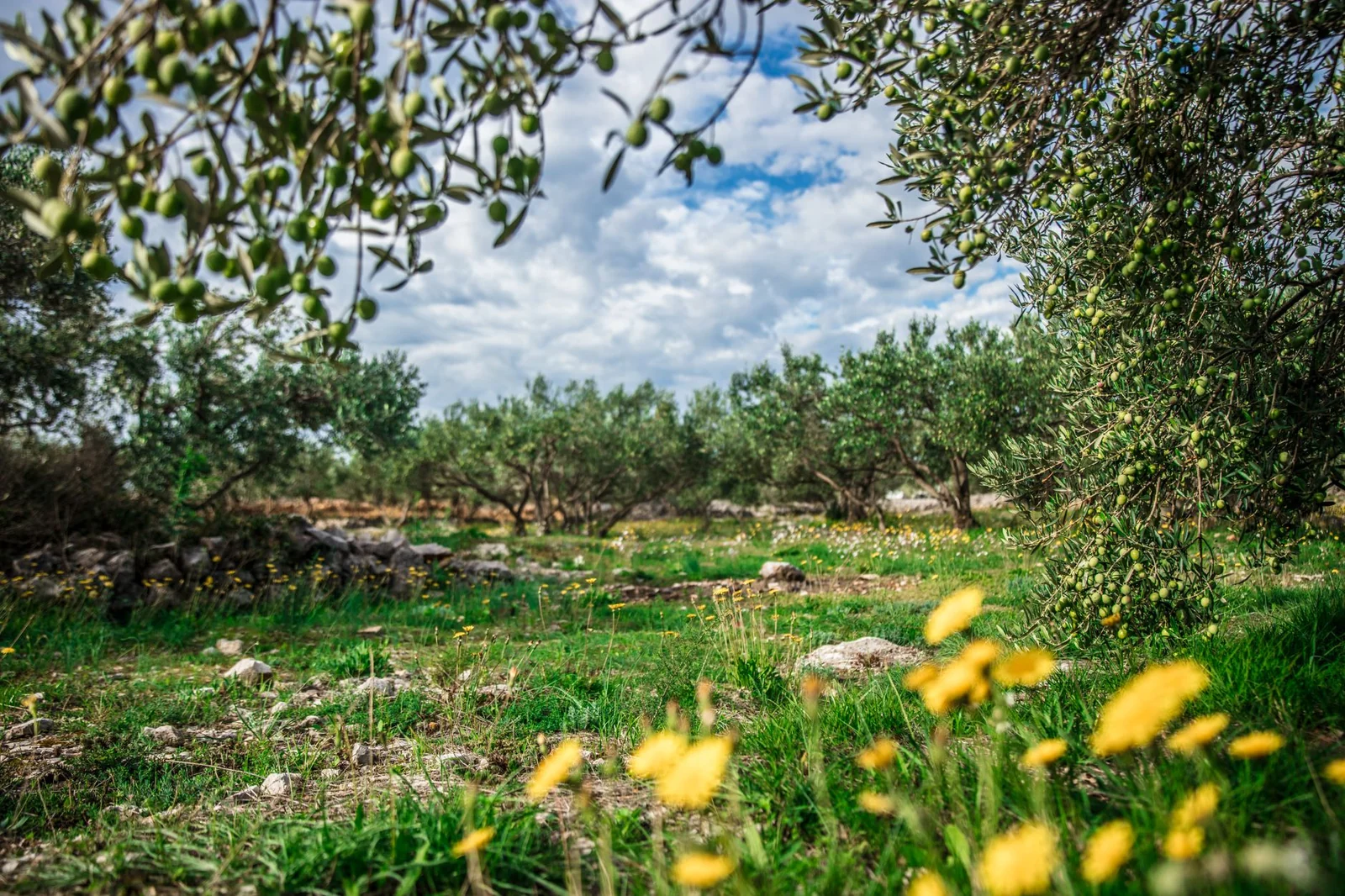
In Türkiye, any sentence that places olive groves next to energy tends to end in the same place: will the trees be cut? That has been the axis of the argument from Law 3573 onwards — we traced the legislative history separately.
An installation completed in Spain this year frames the question from the other side: what if the trees stay?
What was built at Vilches
At Vilches, in the Andalusian province of Jaén, an olive oil bottler has erected solar modules on steel structures above a grove still in production.
| Item | Value |
|---|---|
| Modules | 5,150+ |
| Installed capacity | 3.65 MWp |
| Battery | 3 MWh |
| Module height | 4 m above ground |
| Tree height | ≈ 2 m |
| Tilt | 30° south |
| Row clearance | 1.7 m |
| Adviser | University of Jaén |
No trees were removed. The grove stays in production; the panels sit above it.
Why four metres?
The decisive engineering choice here is not the array's capacity but its height — and the height is set by a machine, not by the trees.
Modern groves in the area are kept at roughly two metres. But the straddle harvester that clamps each trunk and shakes the fruit loose reaches close to 3.5 metres at full stretch. Lifting the module table to four metres leaves the clearance the machine needs to keep working between the rows.
In an agrivoltaic grove, then, the binding constraint is not "how tall does the tree grow" but "how tall does the harvester open". That ties the system directly to hedgerow planting: this geometry cannot be built over a traditional grove with large, spreading canopies.
The research behind it
Vilches is an application; the calculation came first, from the University of Córdoba. A modelling study published in the Journal of Cleaner Production (Marta Varo Martínez and colleagues) tested agrivoltaic geometry over hedgerow olive orchards across 81 combinations: axis heights of 2.5-3.5 m and panel widths of 2-4 m.
The central tension the model found:
- As row spacing widens, radiation reaching the panels rises and electricity output goes up.
- The same move reduces the number of olive hedgerows per hectare, so oil output falls.
- The highest oil yield per hedgerow comes at the widest spacing; the highest oil yield per hectare does not.
Design in an agrivoltaic grove is therefore the geometric answer to a question: how much of each output are we willing to give up?
In the study's headline scenario — hedgerows 10 m apart with 3 m wide, 3 m high trackers — annual output per hectare was:
| Output | Value |
|---|---|
| Olive oil | 789 kg/ha/yr |
| Electricity | 891 MWh/ha/yr |
The researchers conclude that joint production is more efficient than conducting the two activities separately. "Efficient" here refers to land use — total value from a unit of land — not to the grove's own yield increasing.
What the numbers say: which crop is the real crop?
Placing the model's two outputs side by side at current prices changes the picture. The Spanish producer price for extra virgin olive oil is €3.4977/kg (23.08.2026):
| Item | Value |
|---|---|
| Oil revenue (789 kg × €3.4977) | ≈ €2,760/ha/yr |
| Electricity output | 891 MWh/ha/yr |
| Tariff that would match the oil revenue | €3.1/MWh |
That last row is this article's real finding. For the electricity to break even with a year's oil revenue, only €3.10 per megawatt-hour is needed. Actual wholesale prices sit far above that: even at a conservative €40/MWh, electricity revenue reaches €35,640 per hectare — roughly 13 times the oil revenue.
Turkish prices do not change the picture. Extra virgin olive oil traded at TRY 254.33/kg on the Edremit exchange (25.08.2026); at a euro rate of 55.91 that is €4.55/kg, above the Spanish level. Even so, 789 kg yields about €3,590 — still small beside the electricity.
The conclusion that follows is not technical but political: in this geometry the grove becomes the secondary crop in economic terms. For the investor the revenue is in the panels; the olives are a by-product.
That does not make agrivoltaics a bad idea — but it is a critical warning for protection legislation. If more than 90% of revenue comes from electricity, the difference between "an energy investment that protects the grove" and "an energy investment that uses the grove as a pretext" lies in the maintenance and yield commitments written into the contract. Without an inspection regime that guarantees the grove is genuinely kept in production, a four-metre table can easily become a formality.
Why this matters for Türkiye
In Türkiye the grove-versus-energy debate has largely run through the removal of trees. The extent to which mining and energy investment may take place on olive-grove land has been the subject of a legislative sequence running from 3573 to 7554; we also worked through the ten-year arithmetic of clearing a grove.
Agrivoltaics shifts the axis: the question stops being "groves or energy" and becomes "can the same parcel carry both?" The Spanish case shows that it is technically possible.
What the law actually prohibits
There is a common confusion here. Article 20 of Law 3573 prohibits building or operating — within olive-grove areas and within at least 3 kilometres of them, olive oil factories excepted — any facility "leaving chemical waste, raising dust or emitting smoke that would impede the vegetative and generative development of olive groves." A solar panel does not fit that description: it leaves no chemical waste, raises no dust, emits no smoke.
The binding clause is the last sentence of the article: "Olive-growing areas may not be narrowed." A conventional ground-mounted plant built by clearing trees narrows the area; an agrivoltaic array built above the trees, by definition, does not. That is precisely where the line falls.
Courts already draw that line in practice. In Karaburun, İzmir, the environmental approval for a solar plant planned on olive-grove land was suspended by a ruling of the İzmir 7th Administrative Court dated 26 January 2024; the court found no public benefit in siting a plant on land planted with olives since 2007 and covering more than half the project area. Before that ruling, roughly 5,000 olive trees had been cut without authorisation in four separate incidents between September 2023 and January 2024.
That precedent does not count against agrivoltaics; it defines its boundary. What was litigated was a plant taking the place of a grove. If the trees stay, that claim never arises. The public-benefit test does not disappear, though: even with panels overhead, the land must be shown — measurably — to be still doing its agricultural work. That is the real significance of the Vilches yield figures: what clears the legal threshold is data, not good intentions.
Transferring it here, however, requires four things:
1. Orchard structure. The system assumes hedgerow planting and mechanical harvest. Most Turkish groves remain traditional, large-canopied and hand- or pole-harvested. A four-metre table means nothing over those.
2. Capital. A 3.65 MWp array plus a 3 MWh battery is the scale of a cooperative or an integrated business, not an individual grower.
3. Legal status. The standing of permanent steel structures and a grid connection on agricultural land has to be settled alongside olive-grove legislation. Otherwise a practice that protects groves could fall foul of the protection rules.
4. Long-run data. Vilches is a single, new installation. What partial shading does to multi-year yield, alternate bearing and fruit quality has not yet been observed in the field.
Reading it cautiously
The modelling results are strong, but they are simulation. The olive is light-sensitive and shows alternate bearing: heavy one year, light the next. Understanding what partial shade does to that cycle takes several seasons of measurement. How the phenolic profile — the character of the oil — behaves under shade is a separate question again.
The direction is nonetheless clear: a model that does not set energy against olive groves is no longer theoretical; it is standing in a field. Türkiye's irradiance is no lower than Andalusia's. What is missing is not the geometry but the orchard structure and the legal framework.
One rating per visitor; you can change yours at any time. Ratings are real reader votes — no seeded or default scores.
Related
 Article
Oleotourism: a grove's second income
What is olive oil tourism, how does it work elsewhere, and why has it not developed in Türkiye? Oleotourism, from the literature.
Article
Oleotourism: a grove's second income
What is olive oil tourism, how does it work elsewhere, and why has it not developed in Türkiye? Oleotourism, from the literature.
 Article
How much is deducted when you sell olives? Withholding tax, the producer receipt and the social security cut
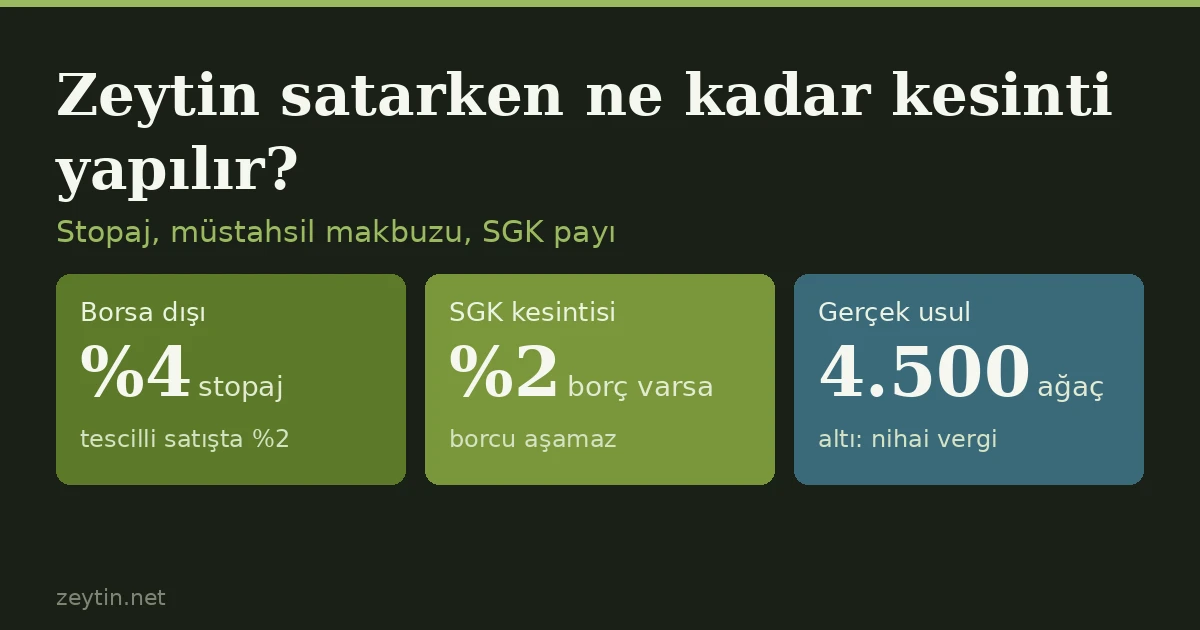
Growers selling olives to a trader or cooperative have 4% of the price withheld as income tax, or 2% if the sale is registered on a commodity exchange; below 4,500 trees this is the final tax. Farmers with premium arrears also face a 2% social security deduction. The producer receipt, exchange fees and a worked example with Akhisar prices.
Article
How much is deducted when you sell olives? Withholding tax, the producer receipt and the social security cut
Growers selling olives to a trader or cooperative have 4% of the price withheld as income tax, or 2% if the sale is registered on a commodity exchange; below 4,500 trees this is the final tax. Farmers with premium arrears also face a 2% social security deduction. The producer receipt, exchange fees and a worked example with Akhisar prices.
 Article
The economics of caliber: how fruit size triples the price
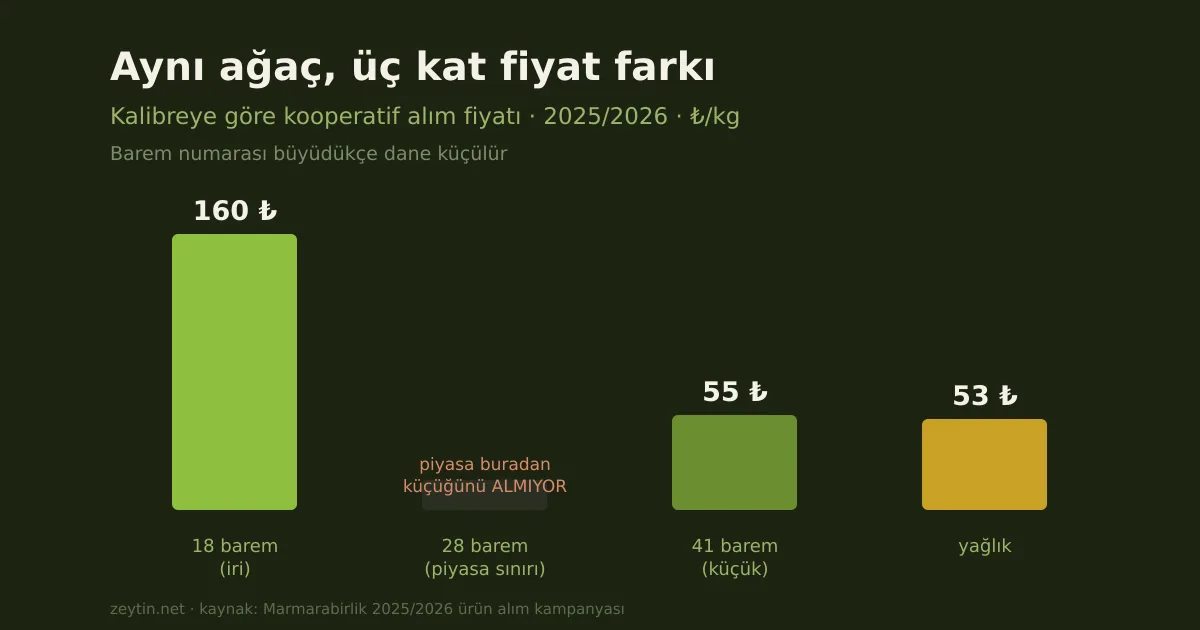
160 TL at caliber 18, 55 TL at caliber 41. Fruit size is price — and the cooperative pays 16% above the exchange average.
Article
The economics of caliber: how fruit size triples the price
160 TL at caliber 18, 55 TL at caliber 41. Fruit size is price — and the cooperative pays 16% above the exchange average.
 Article
What does a kilo of olives cost? The cost sheet of 152 Aegean farms
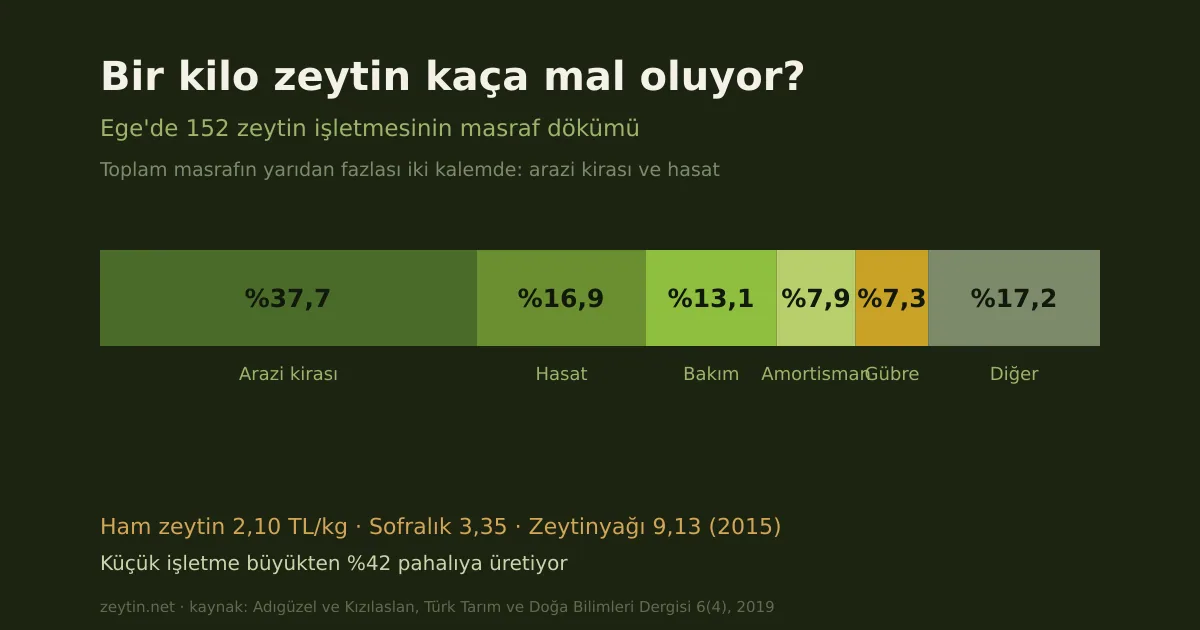
Land rent is 37.70% of cost, harvest 16.90%. In table olives 73% of processing cost is rejected fruit; in oil, 94% is the fruit itself.
Article
What does a kilo of olives cost? The cost sheet of 152 Aegean farms
Land rent is 37.70% of cost, harvest 16.90%. In table olives 73% of processing cost is rejected fruit; in oil, 94% is the fruit itself.