When does picking olives lose money? The per-kilo harvest threshold
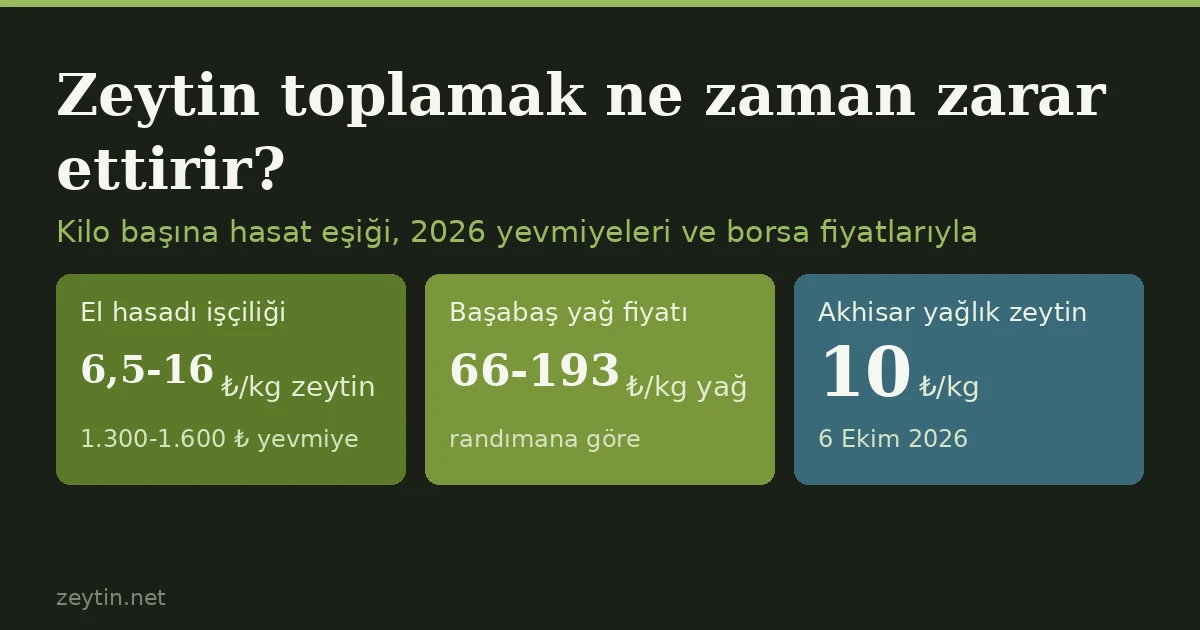
Hand-picking labour now costs 6.5-16 TL per kilo of olives. That band is the threshold for growers who sell the fruit; for those who press, break-even oil is 66-193 TL/kg. Built from 2026 wages, milling fees and exchange registrations, with the cost of leaving fruit on the tree.
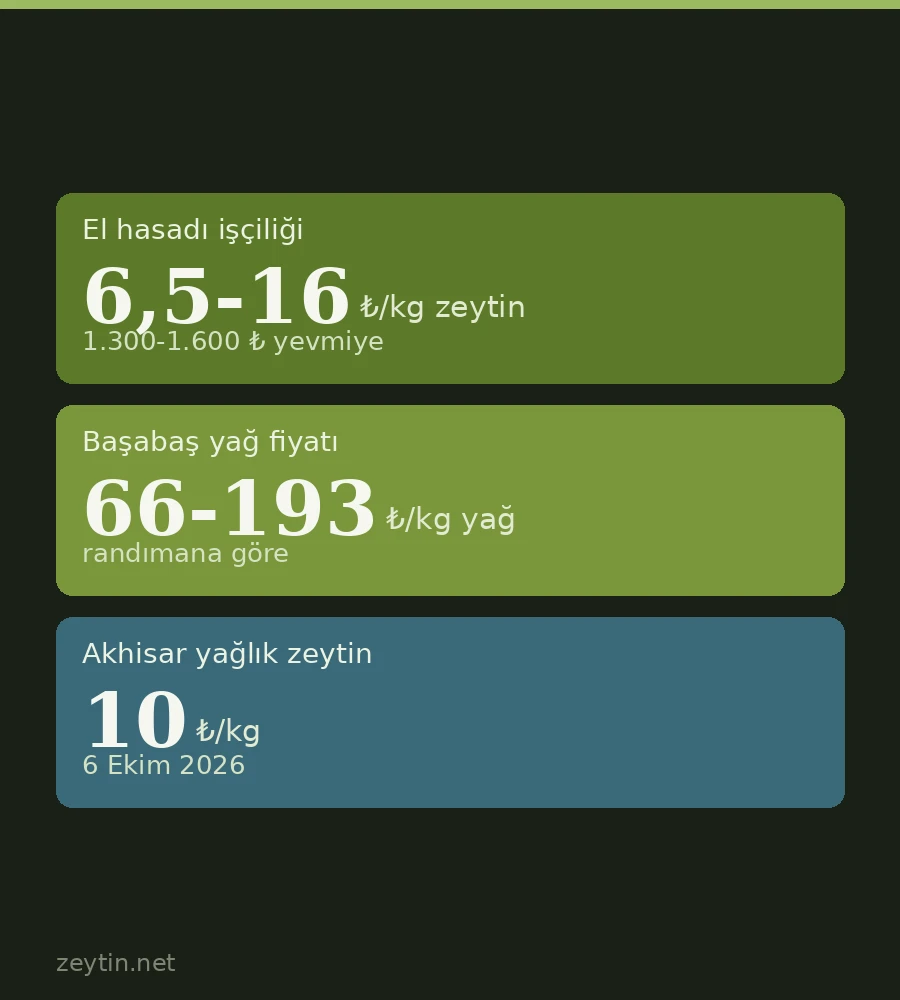
The harvest has started and the same question is being asked in every grove: is it worth picking the olives at this price? This article builds that calculation with numbers: what picking and pressing cost per kilo of olives, below which price picking loses money, and what happens the following year if the fruit stays on the tree.
The year's costs do not enter the harvest decision
Pruning, fertiliser, spraying and land rent were paid before the harvest; they do not come back whether the olives are picked or not. In a cost breakdown of 152 farms in the Aegean, 52.83% of costs were fixed and harvesting alone was 16.90% (<a href="/en/what-does-a-kilo-of-olives-cost-to-produce">what a kilo of olives costs to produce</a>). The decision taken in October looks only at money not yet spent: labour, transport, pressing. If the return covers those three, picking reduces the loss even in a losing year; if it does not, picking adds a loss to a loss.
How much does one worker pick in a day?
A study in 16 groves in İznik, Orhangazi, Gemlik and Görükle in Bursa measured hand picking (Işık and Ünal, Uludağ University Faculty of Agriculture Journal, 2003). A worker's net hand-picking capacity was 16.78 to 28.56 kg per hour, 21.91 kg on average. Idle time such as spreading nets or moving ladders was not counted. With the 08:00-16:00 working day recommended this season by the Bandırma Chamber of Agriculture, that is 134-228 kg a day at best; slopes and a thin crop pull it down. The calculation below uses 100, 150 and 200 kg a day as scenarios.
Daily wages for 2026/27: the Bandırma Chamber of Agriculture (6 October 2026) recommends 1,300 TL for women pickers and 1,600 TL for workers shaking with a comb machine, excluding start-up and transport fees; nets and crates come on top. The Kırkağaç Chamber of Agriculture (2 October 2026) raised the picking wage from 1,200 to 1,500 TL.
| Picked per worker per day | 1,300 TL wage | 1,500 TL | 1,600 TL |
|---|---|---|---|
| 200 kg (good grove) | 6.5 | 7.5 | 8.0 |
| 150 kg | 8.7 | 10.0 | 10.7 |
| 100 kg (slope, thin crop) | 13.0 | 15.0 | 16.0 |
Threshold for those who sell the fruit: when the price falls below labour
For a grower who sells the olives as they are, the calculation is one line: if the purchase price does not exceed the cost of picking and hauling a kilo, picking loses money. Today's prices:
- Marmarabirlik paid 53 TL for oil olives in the 2025/26 season (<a href="/en/marmarabirlik-purchase-prices">purchase prices</a>); the 2026/27 price has not been announced.
- The last oil-olive registration on the Edremit Commodity Exchange was 38 TL on 26 June 2026; there is no new-season registration yet.
- In the first list announced in Akhisar on 6 October, oil olives were 10 TL (<a href="/en/akhisar-table-olive-opening-prices">Akhisar opening prices</a>).
The first two prices are two to three times the most expensive scenario. Akhisar's 10 TL sits inside the band: paying 1,500 TL to a worker who picks 150 kg means 10 TL of labour per kilo, so oil olives sold at that price do not even cover transport. This is where undersized fruit in table-olive country risks staying on the tree.
Threshold for those who press: how low can the oil price go?
Pressing and selling oil adds two items: the milling fee and the oil yield. At a sector meeting at the Çanakkale Chamber of Commerce and Industry (28 September 2026) a milling fee starting at 9 TL per kilo of olives, rising to 12-14 TL depending on oil yield, was discussed for this season. Oil yield ranges from 15% to 25% depending on variety and ripeness (<a href="/en/from-olive-to-oil-the-price-gap">from olive to oil: the price gap</a>).
Break-even oil price = (harvest + milling per kilo of olives) ÷ oil yield.
| Scenario | Harvest + milling (TL/kg olives) | 15% yield | 20% | 25% |
|---|---|---|---|---|
| Good grove: 200 kg/day, 9 TL milling | 16.5 | 110.0 | 82.5 | 66.0 |
| Average: 150 kg/day, 9 TL milling | 19.0 | 126.7 | 95.0 | 76.0 |
| Hard grove: 100 kg/day, 14 TL milling | 29.0 | 193.3 | 145.0 | 116.0 |
Wage 1,500 TL, transport excluded. Exchange registrations: in September 2026 crude olive oil averaged 184.61 TL/kg (volume-weighted, 7 registrations) and extra virgin 258.53 TL/kg (14 registrations). The first extra virgin registrations of October were 200.46 TL in Nazilli (8 October) and 285 TL in Edremit (7 October).
As long as oil stays at today's level, picking still leaves a margin in most scenarios for a grower who turns the fruit into oil. The exception is the worst corner: low yield, a sloping grove, an expensive mill. There the threshold is 193 TL and September's crude oil average is below it.
In worker-days: in the average scenario a worker picks 150 kg of olives, which at 20% yield makes 30 kg of oil. The wage is worth 8.1 kg of crude oil and milling (150 × 9 = 1,350 TL) 7.3 kg; the grower keeps 14.6 kg. In the hard grove, of 15 kg of oil 8.1 kg goes to the wage and 7.6 kg to the mill: minus 0.7 kg. This is the other side of <a href="/en/soke-table-olive-harvest-one-day-ten-kilos">one worker-day costing ten kilos of oil in Söke</a>.
Traditional versus mechanised groves
The variable that moves the threshold most is kilos picked per worker. In the same trial a vibrating harvester picked 147.91 kg per hour on average, about 6.8 times hand picking. Harvest cost per kilo was 0.023 $ by machine and 0.150 $ by hand; 2003 prices do not carry over to today, but the ratio does.
In the table-olive cost study published in September 2026 by Spain's Association of Olive-Growing Municipalities (AEMO), harvesting costs 0.50 € per kilo in a traditional rain-fed grove picked by hand and 0.21 € in an irrigated intensive grove picked by machine. At the ECB rate of 9 October (1 € = 55.1033 TL) that is 27.55 TL against 11.57 TL.
Machines do not fit every grove. According to the Atatürk Central Horticultural Research Institute of the Ministry of Agriculture and Forestry, a trunk shaker works on slopes up to 15% and the umbrella system needs at least 7×7 m spacing (<a href="/en/planting-density-how-many-trees-per-decare">planting density</a>). Sloping, multi-trunk, old groves are left out, and that is where fruit is most likely to stay on the tree (<a href="/en/how-are-olives-harvested-picking-methods">harvest methods</a>).
What happens if the olives stay on the tree?
Not picking sends a bill to the following year:
- Next year's bloom. In a trial on Coratina in Israel by Dag and colleagues (Scientia Horticulturae, 2010), trees whose fruit was removed early bloomed fully the following year; trees whose fruit was removed late or not at all bloomed poorly or not at all. Fruit left on the tree ties an on-year to the next off-year (<a href="/en/alternate-bearing-in-olives">alternate bearing</a>).
- Olive fruit fly. The Ministry's Integrated Pest Management Technical Instruction for olives asks for infested fruit to be removed from the grove every 3-4 days and for ripe varieties to be picked without delay. Without control, losses are 15-30%, up to 80% in outbreak years (<a href="/en/olive-fruit-fly-control">olive fruit fly control</a>).
- Anthracnose. According to the instruction, the pathogen survives for a year in mummified fruit hanging on the branch and becomes a source of infection; in severe years losses reach 50%. One of the measures: do not delay the harvest (<a href="/en/olive-anthracnose">olive anthracnose</a>).
Our earlier calculations in one table
| Article | What this calculation uses |
|---|---|
| What does a kilo of olives cost to produce? | More than half of costs are fixed |
| One worker-day in Söke | Measuring the wage in oil |
| The minimum price debate | Oil olives stood still |
| From olive to oil: the price gap | Oil yield band |
| Two pressures before the harvest | The "olives will stay on the branch" warning |
By the numbers
| Item | Value | Source, date |
|---|---|---|
| Hand picking, net capacity | 16.78-28.56 kg/hour | Işık and Ünal, 2003 |
| Picking wage | 1,300-1,600 TL/day | Bandırma and Kırkağaç chambers of agriculture, October 2026 |
| Labour per kilo of olives | 6.5-16 TL | Calculation |
| Milling fee | 9-14 TL/kg olives | Çanakkale chamber meeting, September 2026 |
| Break-even oil price | 66-193 TL/kg | Calculation |
| Crude olive oil, September average | 184.61 TL/kg | Exchange registrations |
| Oil olives, Akhisar | 10 TL/kg | 6 October 2026 |
| Harvest cost, Spanish table olives (hand / machine) | 0.50 / 0.21 €/kg | AEMO, September 2026 |
In short
- Only labour, transport and milling enter the harvest decision.
- Hand-picking labour today costs 6.5-16 TL per kilo of olives.
- For growers who sell the fruit, that band is the threshold: Akhisar's 10 TL is inside it, Marmarabirlik's 53 TL and Edremit's 38 TL are far above.
- For growers who press, break-even is 66-193 TL per kilo of oil; September's crude oil average falls below it only in the hardest scenario.
- Olives left on the tree reduce next year's bloom and feed the fruit fly and anthracnose.
One rating per visitor; you can change yours at any time. Ratings are real reader votes — no seeded or default scores.
Related
 Article
Frost damage in olive trees: signs, risk factors and what to do after a frost
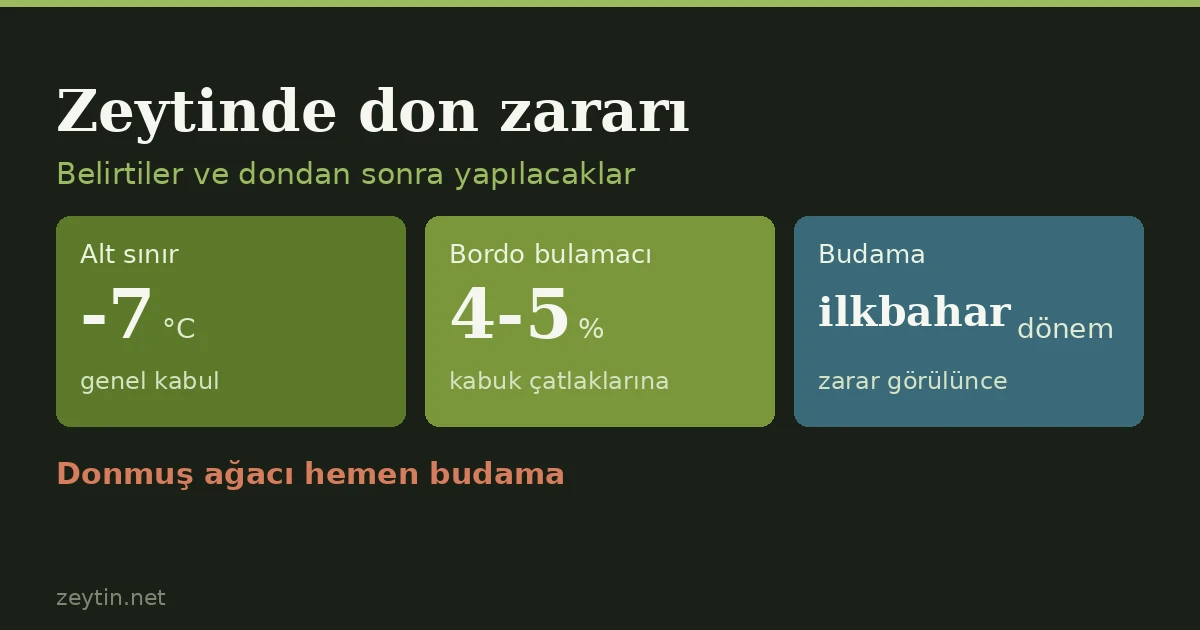
The generally accepted lower limit for olives is around -7 °C, but damage does not depend on the thermometer alone: how long the cold lasts, sudden drops, humidity, tree age and nutrition all matter. Here are the signs of frost damage on leaves, shoots, bark and fruit, ways to reduce the risk and which job to do when after a frost.
 Article
How to plant an olive sapling
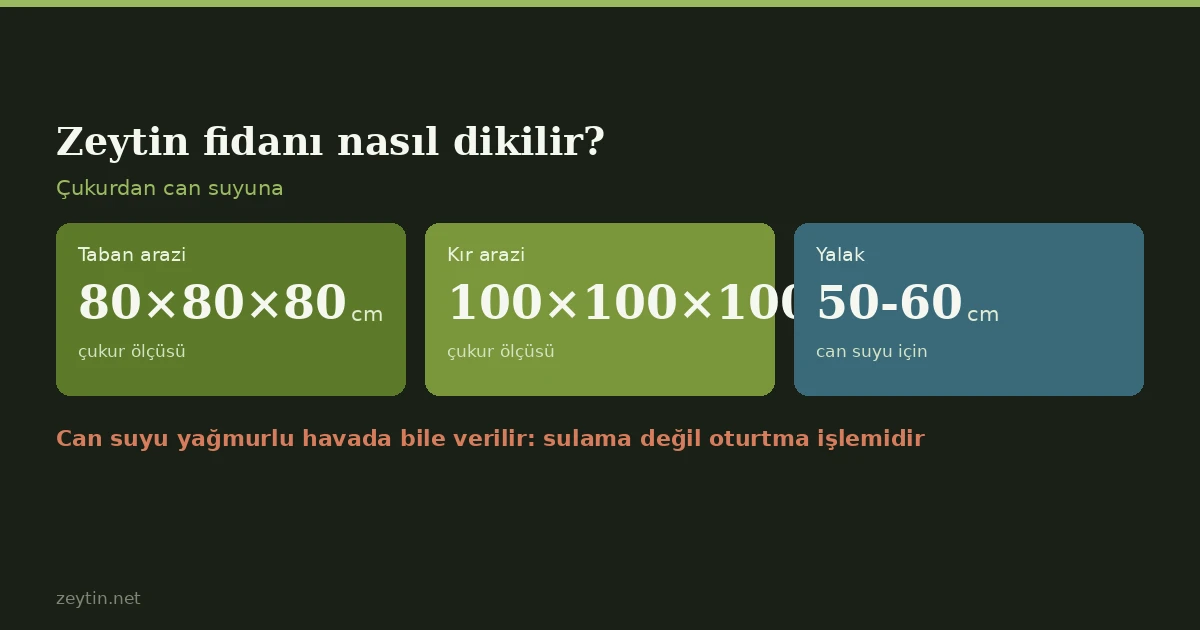
Planting season, hole dimensions, removing a potted sapling, planting depth and the graft union, the basin and settling water — why settling water is given even in rain, first-year care and five common mistakes.
 Article
Irrigating Olives: When, How Much, How
Olive water requirements, critical periods, drip system layout, deficit irrigation and water quality.
 Article
Pollination and pollinator varieties in olive
98% of olive flowers drop. Whether the remaining 1-2% holds depends on having a pollinator in the grove. Gemlik is only partially self-fertile: in a single-variety grove harvest falls to a third.