What is the peroxide value of olive oil? Is a high value harmful?
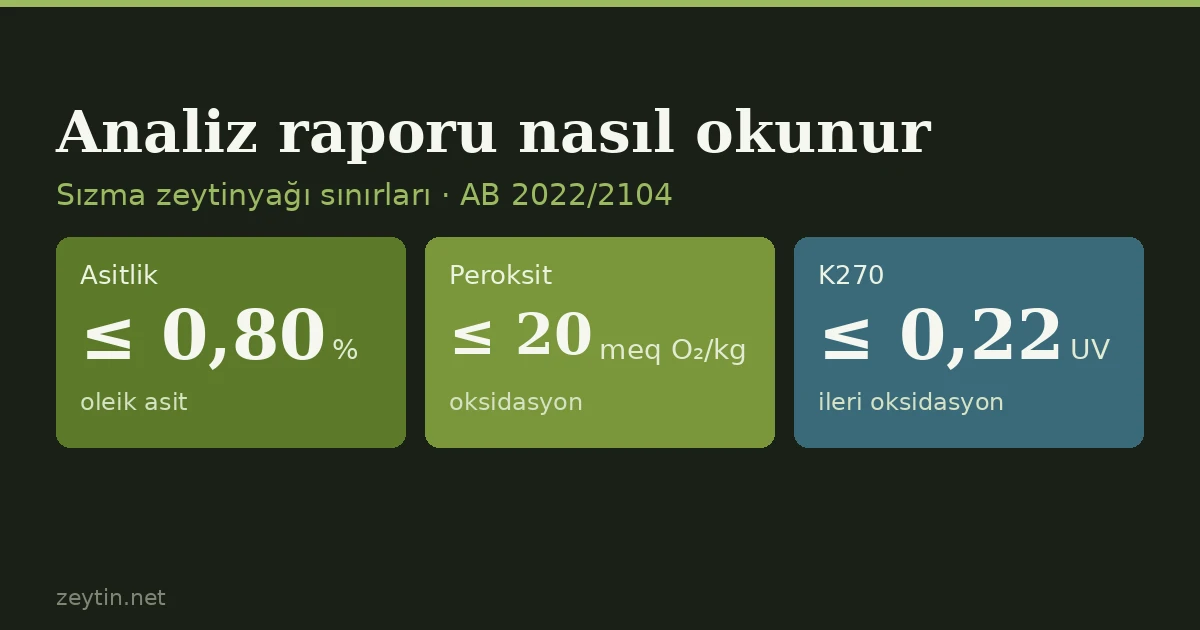
The peroxide value shows that oil has begun to oxidise; the limit for extra virgin is 20 meq/kg. Registered Turkish oils measure 4.5-9.3 on average.
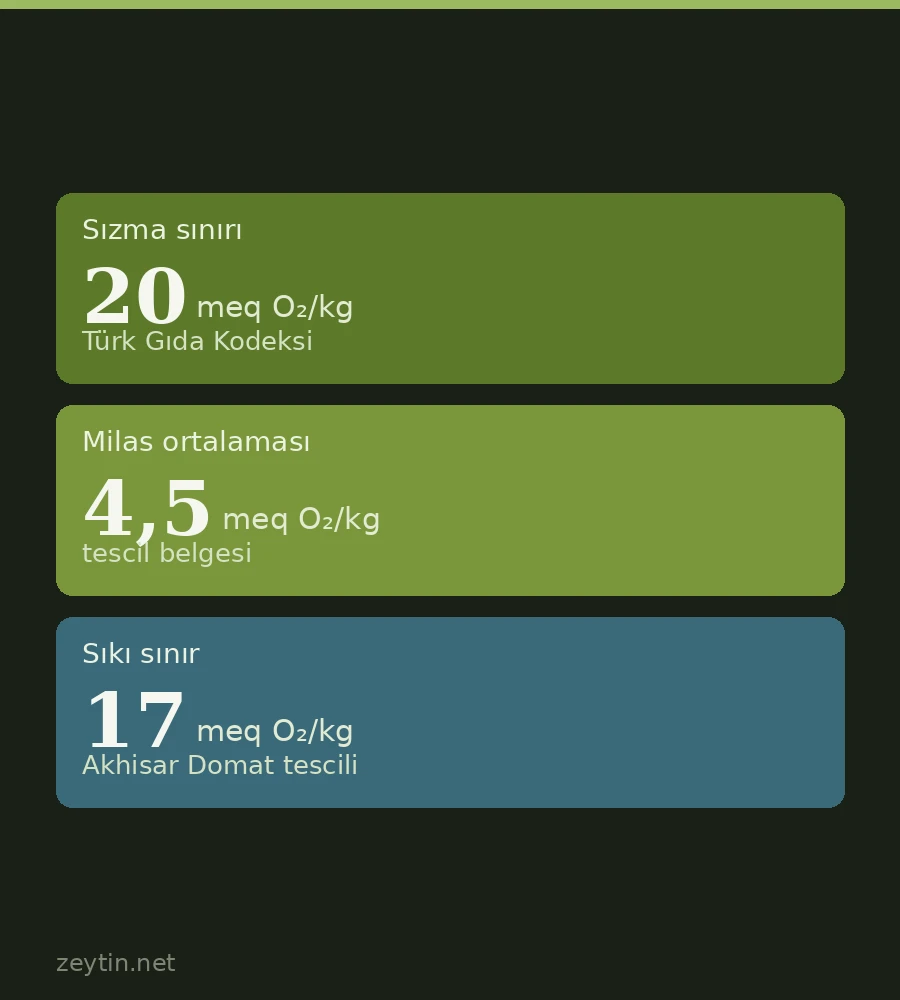
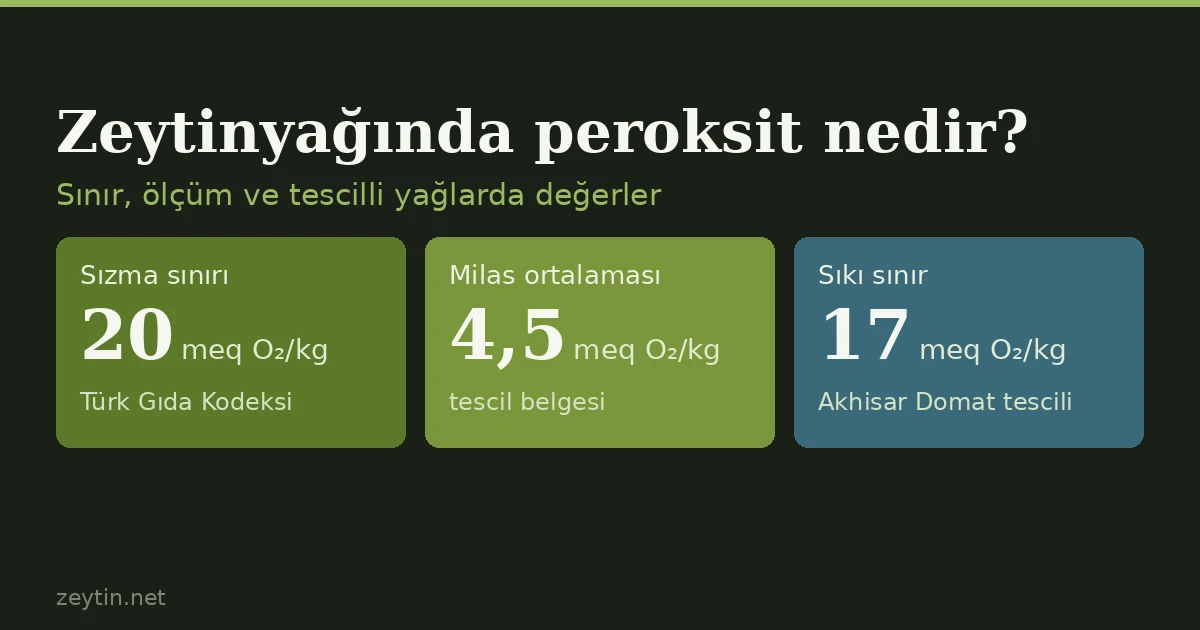
The peroxide value is the number that shows how far olive oil has begun to oxidise. When the fatty acids in the oil react with oxygen in the air, the first products to form are hydroperoxides; the laboratory measures how much of them there is and reports the result as milliequivalents of active oxygen per kilogram of oil (meq O₂/kg). Under the Turkish Food Codex the upper limit for extra virgin and virgin olive oil is 20 meq O₂/kg. The averages measured in the registration documents of Türkiye's geographical-indication oils are far below that, between 4.5 and 9.3.
This article explains how the peroxide value is measured, what a good oil scores, what drives it up and the honest answer to "is a high peroxide value harmful?". To read every line of a lab report together, see how to read an olive oil lab report.
How does it differ from acidity?
Both sit at the top of the report and are often confused, but they answer different questions.
| Free acidity | Peroxide value | |
|---|---|---|
| What it measures | Fatty acids split off from the oil molecules | The first products of oxidation (hydroperoxides) |
| When it forms | Mostly while the olives wait on the tree, on the ground or in sacks | Mostly after pressing, during storage |
| What it tells you | The quality of the fruit and the extraction | How well the oil was protected from air, light and heat |
| Over time | Changes slowly in the bottle | Rises in the bottle |
| Extra virgin limit | 0.8% | 20 meq O₂/kg |
In short, acidity tells the olive's history and peroxide tells the oil's history. An oil with low acidity can still see its peroxide value climb if it is stored badly; one cannot be read in place of the other. Acidity is explained in detail in what does acidity mean in olive oil.
How is it measured in the laboratory?
The standard method is iodometric titration (ISO 3960). A weighed sample of oil is dissolved in a solvent containing acetic acid and potassium iodide is added. The peroxides in the oil oxidise the iodide to iodine, and the amount of iodine released is measured by titration with sodium thiosulfate. The more iodine is released, the more peroxide the oil contains.
That is why the sample itself affects the result. Oil sent for analysis should be:
- in a bottle filled to the brim (an air gap at the top keeps oxidising the oil),
- in dark glass or a tin, kept out of the light,
- kept cool and taken to the laboratory without delay.
A sample taken from a half-empty bottle that stood in the sun measures that bottle's peroxide, not the oil in your store.
What does a good oil score?
The legal limit is 20, but well-made, well-kept oil stays far below it. The registration documents of Türkiye's geographical-indication olive oils show this with measurements:
| Registration | Value in the document | Type |
|---|---|---|
| Milas Olive Oil | average 4.5 | measurement |
| Kilis Olive Oil | 5.62 ± 0.70 | measurement |
| Altınözü Olive Oil | 1.8 – 7.6 | measured range |
| Soma Olive Oil | 3.20 – 8.7 | measured range |
| Tarsus Sarıulak Olive Oil | average 8.23 | measurement |
| Mut Olive Oil | average 8.93 | measurement (2012-2017) |
| Osmaniye Olive Oil | 9.3 ± 5.7 | measurement |
| Hatay Halhalı Olive (oil) | 7.1 – 13.06 | measured range |
| Derik Halhalı Olive Oil | 7.51 – 18.54 | measured range |
| Akhisar Domat Olive Oil | ≤ 17 | registration limit |
| Ayvalık · Aydın Memecik · North Aegean olive oils | ≤ 18 | registration limit |
| Bayramiç · Akhisar Uslu olive oils | ≤ 20 | registration limit |
Two things stand out. First, the measured averages lie between 4.5 and 9.3, so the value expected from a good extra virgin is less than half the limit. The Mut average comes from analyses by the Hatay, İzmir and Ankara food control laboratory directorates between 2012 and 2017. Second, some registrations do not settle for the legal limit and set a stricter one: 17 for Akhisar Domat, 18 for Ayvalık, Aydın Memecik and North Aegean. An oil can count as extra virgin under the Turkish Food Codex and still not carry these names if its peroxide value comes in at 19. All the registrations are listed on olive geographical indications.
What drives the peroxide value up?
Peroxide forms with oxygen, so anything that speeds up oxidation raises it:
- Air. The empty space above a half-used tin, a bottle opened and closed often.
- Light. Clear bottles, shop-window lighting, a kitchen shelf in the sun.
- Heat. Next to the stove, a hot store room, a car boot in summer.
- Metal. Containers that are not stainless; copper and iron speed up oxidation.
- Time. The sum of all of the above; the peroxide value does not fall back on its own in the bottle.
The olive brings its own share: the natural polyphenols and tocopherols in the oil slow oxidation down. The Mut document states that the local oil comes out low in peroxide, that its peroxide value does not rise for a long time, and that it can be stored for two years or more under suitable conditions; this is the document's own description. How to keep the value low at home is covered in how to store olive oil, and shelf life in does olive oil have a use-by date.
Does a low value always mean fresh oil?
No. Hydroperoxides are unstable; over time they break down into secondary products such as aldehydes and ketones. In a very old, spoiled oil the peroxide value can therefore come out lower than expected: the first products are used up and the second ones have taken their place. The K270 value in the report picks up those secondary products, and they are what give the rancid smell. So the peroxide value is never read alone, but together with K232 and K270.
Refined oil is a separate case: since refining removes peroxides, the limit is 5 meq O₂/kg for refined olive oil and 15 for riviera olive oil. A low value there reflects the process, not freshness.
Is a high peroxide value harmful?
The peroxide limit is a quality limit, not a toxicity limit. Oil above 20 may not be sold as extra virgin or virgin because it counts as having begun to deteriorate; but the limit does not mean "oil that scores 21 is poisonous".
The real cost of a high peroxide value is paid in three places:
- Taste and smell. As oxidation advances the oil turns rancid, smelling of stale fat. To a tasting panel this is a defect that on its own disqualifies the extra virgin class (olive oil tasting).
- Valuable compounds. Polyphenols and vitamin E are used up fighting oxidation; the very compounds that make extra virgin what it is decline.
- Class and price. For the seller, a high value means selling the oil in a lower class at a lower price.
The health effect of eating oxidised oils in large amounts over long periods is a subject of scientific research, but there is no health warning attached to a single bottle coming in slightly above the limit. The practical rule is simple: do not use oil that smells rancid for food.
Where does the limit come from?
The limits are set in the annex to the Turkish Food Codex Communiqué on Olive Oil and Pomace Oil, with the same values as the European Union's Regulation 2022/2104: 20 for extra virgin and virgin, 15 for riviera and pomace oil, and 5 meq O₂/kg for refined olive oil and refined pomace oil. The limits for every class and the structure of the communiqué are in what is the Turkish olive oil and pomace oil communiqué.
One rating per visitor; you can change yours at any time. Ratings are real reader votes — no seeded or default scores.
Related
 Article
Which olive oil is the best quality?
The three measures that decide olive oil quality: grade, acidity and harvest year, plus how to read a label.
 Article
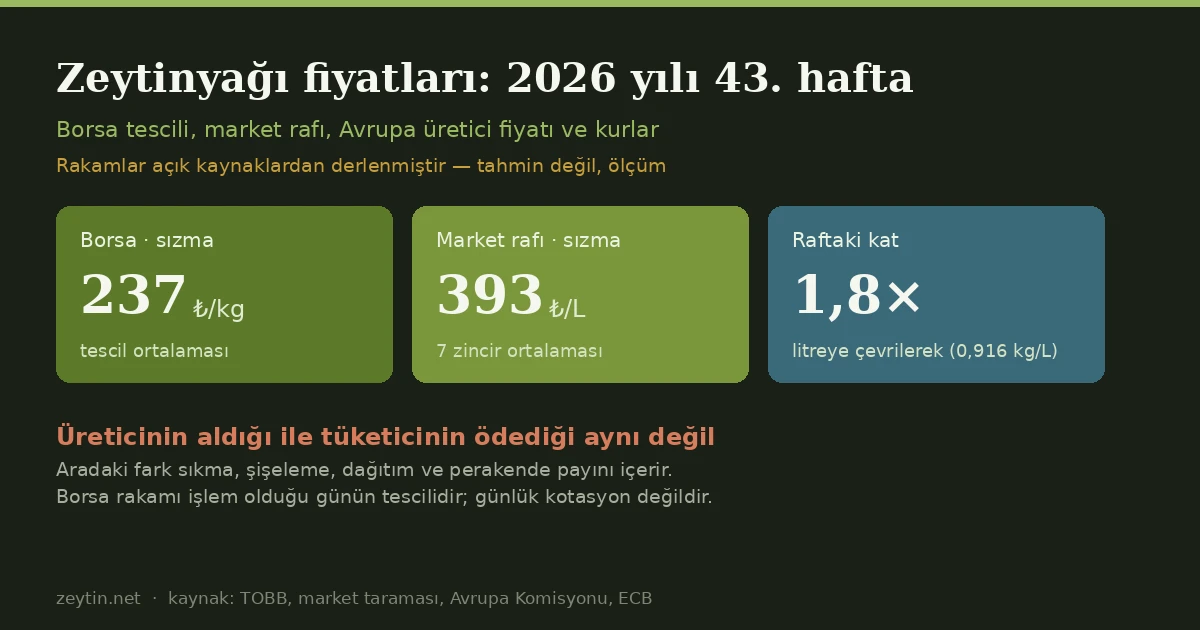
Olive Oil Prices: Week 43 of 2026
Week 43 of 2026: Turkish exchange prices, European producer prices and exchange rates side by side.
 Article
How to read an olive oil lab report: acidity, peroxide, K232, K270 and ΔK
The rows of figures on an olive oil lab report look cryptic at first. What do free acidity, peroxide value, K232, K270, ΔK, ethyl esters and sensory analysis measure, what are the limits for extra virgin and virgin grades, and how do you interpret a report using a worked example?
 Article
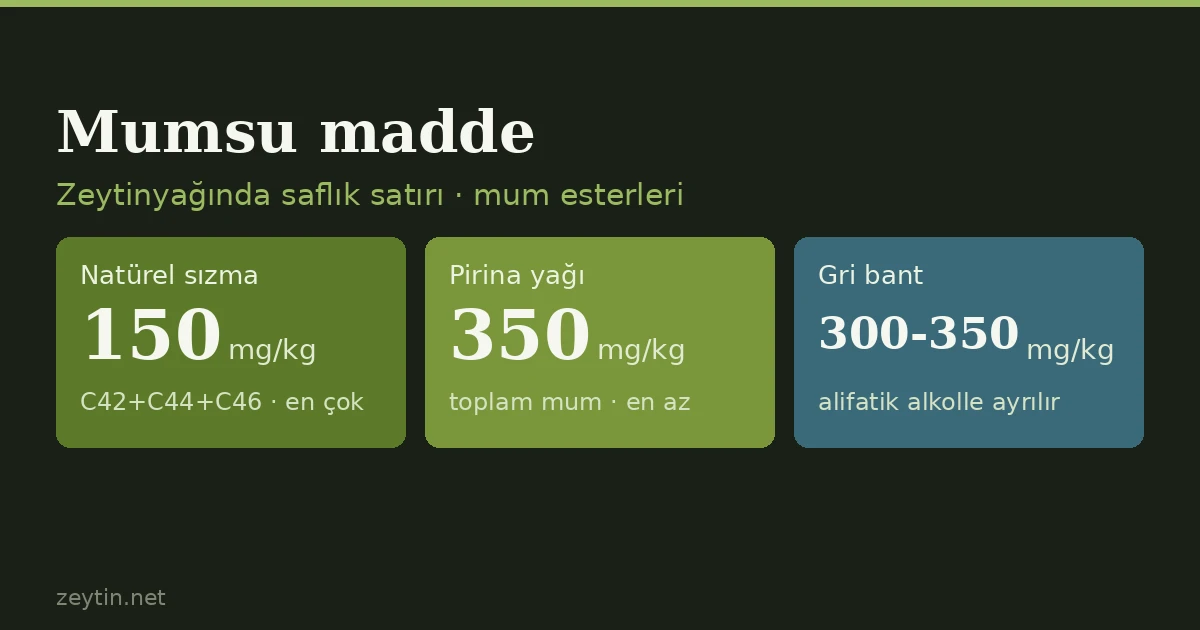
What are waxes (wax esters) in olive oil, and what do they catch?
If a label states the acidity, the wax content has to be printed too. Wax comes from the protective layer on the olive skin; little of it passes into mechanically pressed oil, while solvent extraction from pomace pulls out many times as much. That makes it a purity indicator rather than a quality one: it tells you by what route the oil was obtained. In the International Olive Council standard, extra virgin oil must stay below 150 mg/kg for C42+C44+C46, while the pomace grades must exceed 350 mg/kg in total. In the grey band between 300 and 350 the decision is taken with aliphatic alcohols and erythrodiol plus uvaol.