What is squalene in olive oil? How many grams per kilogram, is it lost in storage, and why is there no EU-approved health claim?
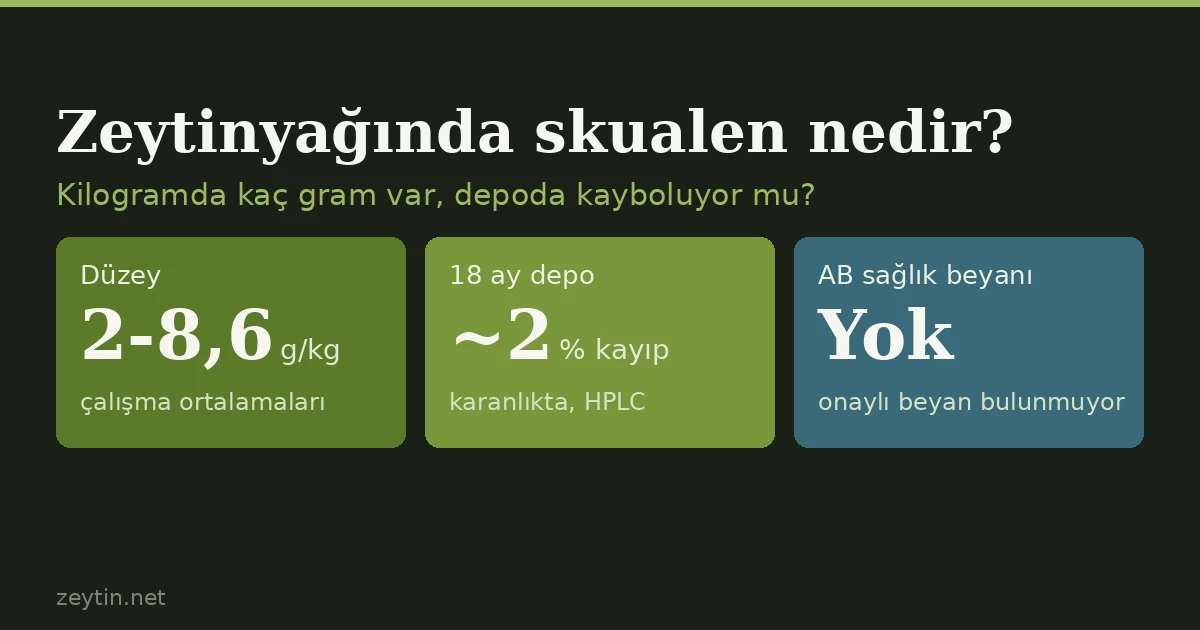
By study averages, squalene runs from about 2 to 8.6 grams per kilogram of olive oil, is lost very little in storage and falls as olives ripen. The article reads a 2021 Greek olive oil study and a mouse experiment, and explains why the EU has approved no health claim for squalene and where the evidence stands.
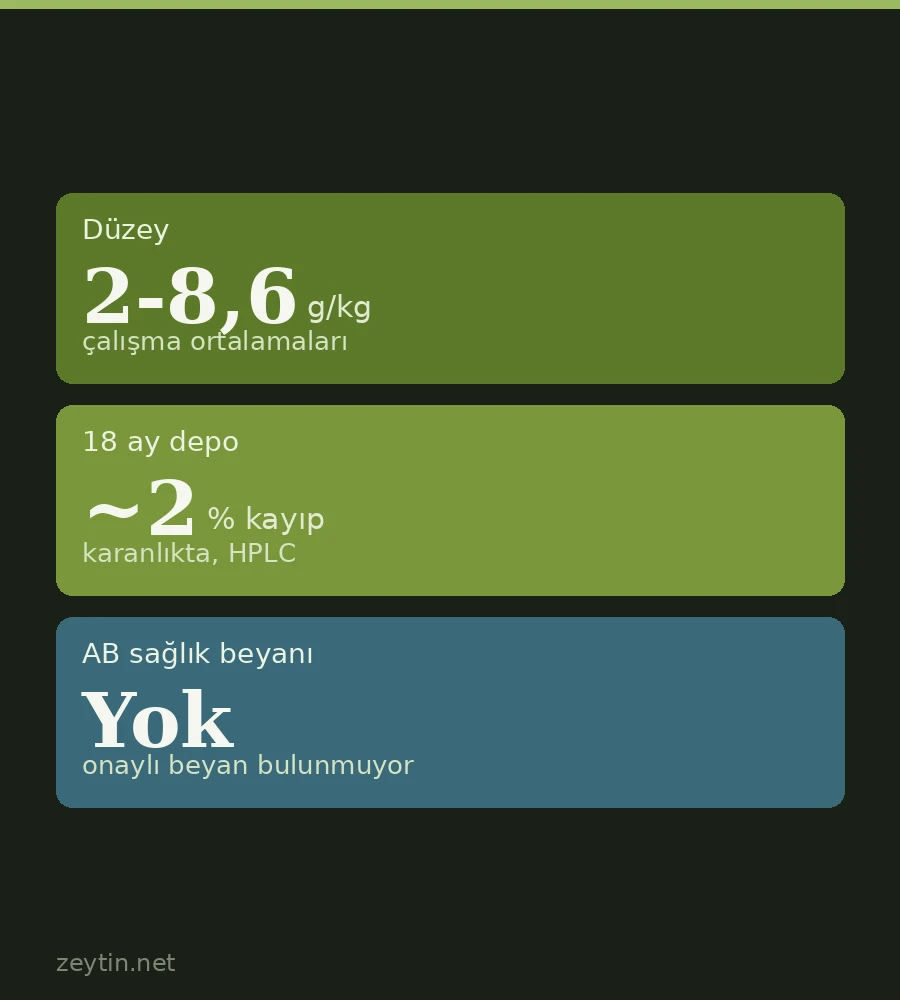
Short answer: Squalene is one of the minor components of virgin olive oil. According to study averages it runs from about 2 to 8.6 grams per kilogram of oil, and about 4-5 grams in many measurements. It is lost very little in storage, and the amount in the oil falls as the olives ripen. Its health effect is not a settled claim: the European Union has not approved a health claim for squalene. This article reads a Greek olive oil study published in Molecules in 2021 (Mastralexi and Tsimidou) and a mouse experiment published in PLoS ONE in 2014 (Gabás-Rivera and colleagues).
What is squalene?
Squalene is a hydrocarbon with the formula C30H50 and the major constituent of the minor-compound fraction of virgin olive oil, as Mastralexi and Tsimidou put it. Its main historical source was the liver oil of certain deep-sea sharks, where the content can reach 80 percent; for ecological reasons plant sources are now preferred. Compared with other plant oils, virgin olive oil comes out ahead for this compound.
Do not confuse squalene with the oil's other well-known "healthy" components: polyphenols (see our oleocanthal and polyphenols article) and vitamin E (alpha-tocopherol) are different molecules. For the general fatty acid and vitamin table see our nutritional profile article.
How much is there per kilogram of oil?
The figure varies widely with the measuring method, cultivar, region and year. Here are the studies gathered in the introduction of the article, and its own measurements:
| Source and sample | Squalene |
|---|---|
| Review (to 2014): commercial oils, Mavrolia and Koroneiki | 2,000-5,858 |
| North-East Aegean islands, 2017/18, 452 samples (Martakos et al.) | 635-6,344; mean 2,195 |
| Greece, 2018/19: Koroneiki, 59 samples (Mikrou et al.) | mean 8,576 |
| Greece, 2018/19: Kolovi, 9 samples (Mikrou et al.) | mean 5,440 |
| Chalkidiki oils, 2016/17, 15 samples (HPLC, this study) | 2,762-5,967; mean 4,228 |
| Koroneiki oils, 2016/17, 23 samples (GC, this study) | mean 4,134 |
So even for one cultivar two studies can differ twofold: the authors write that their Koroneiki mean (4,134) is about half of the value of Mikrou and colleagues (8,576) and about twice what Martakos and colleagues reported from the island of Lesvos. In the authors' own assessment one reason is that each study uses its own measuring protocol and no single validated official method exists for squalene, which is why they ask the International Olive Council to recommend a dedicated method. The difference between the two cultivars is not settled either: the Chalkidiki and Koroneiki means came out of the same magnitude, and there is not enough data to prove a cultivar effect.
The introduction of a mouse study also writes that in extra virgin olive oil squalene can reach "up to 0.7 percent (7 g/kg)", in line with the upper values in the table.
Does squalene fall as olives ripen?
The Chalkidiki authors picked olives every 1-2 weeks from mid-September to 14 November, made cold-extracted oil in the laboratory, and repeated this over four harvest years (2017/18 to 2020/21). In all four years, squalene fell with maturity. The longest series is 2017/18: by HPLC, olives with a maturity index of 0.9 on 15 September gave 4,640 mg/kg, while on 16 November, at an index of 3.7, 3,144 mg/kg was measured. The authors also report that the best squalene accumulation was at a maturity index of about 2, the same stage that had given the best result for oleic acid, vitamin E and polyphenols. We explain the maturity index in our harvest timing article. The introduction notes that the effect of maturity is not the same in every study in the literature.
Is it lost in storage?
Fifteen oils were stored for 18 months in brown bottles without headspace, in the dark, at room temperature (a September-February average of 17 °C and a March-August average of 26 °C). By HPLC the mean squalene went from 4,228 to 4,157 mg/kg, which the authors give as about 2 percent loss. The change over time is reported as not statistically significant (p values 0.973 and 0.395). In the same oils alpha-tocopherol fell about 26 percent. In the authors' reading, squalene is a stable molecule but does not protect vitamin E from oxidation. Another study reports that squalene stays stable in virgin olive oil heated at 180 °C for 36 hours; we pass that on only as stated in the introduction of that study. For storage see our how to store olive oil article.
What is known about health?
The authors introduce squalene as a modifier of biological responses linked to oxygen, the immune system and steroid synthesis, and write that antiaging, anti-inflammatory and cholesterol-lowering activities are mentioned for it. These are claims listed in the introduction on the basis of the literature; the article itself does not measure them.
There are two nutrition figures. In Mediterranean countries such as Greece, where annual olive oil consumption exceeds 12 kilograms per person, daily squalene intake may be 200-400 mg. Absorption is about 60-80 percent, and intake in Northern Europe and the United States is about ten times lower. This is a comparison of how different consumption is, not cause and effect.
On the level of evidence: the experiment by Gabás-Rivera and colleagues is an animal study. In three mouse models, 1 gram of squalene per kilogram of body weight was given for 11 weeks; HDL cholesterol and paraoxonase 1 rose and oxidative stress fell. The paper presents no human clinical trial, and the authors themselves accept that the effect of dose is unclear. That dose cannot be compared with what a person gets from oil. By our calculation, 20 grams of oil at 2,000-5,900 mg/kg means roughly 40-118 mg of squalene, far from the mouse dose.
On the official side the position is clear: Mastralexi and Tsimidou write that EU authorities have so far issued no health claim for squalene. The EU register holds one application rejected for "insufficient scientific documentation" (an antioxidant and UV skin-protection claim). For olive oil, approved claims are used only for oleic acid, vitamin E and polyphenols. The detail of the polyphenol claim is in our polyphenols article.
Limits of these sources
- Most measurements come from Greece; this article has no measurements for Turkish cultivars.
- The Chalkidiki data are a small sample (15 mills) and three groves at laboratory scale.
- The storage experiment used dark, headspace-free bottles; it says nothing about open, lit or half-full bottles.
- The mouse experiment cannot be carried over to people.
Summary
- Squalene is among the leading minor components of olive oil; study means run from about 2 to 8.6 grams per kilogram.
- Even for one cultivar the figure can differ twofold between years and studies; the measuring method is not standardised.
- It falls as olives ripen; in one study the best accumulation was at a maturity index of about 2.
- In the dark at room temperature over 18 months the loss was small; vitamin E fell about 26 percent.
- For a health effect there is only animal and observational evidence; there is no EU-approved claim.
One rating per visitor; you can change yours at any time. Ratings are real reader votes — no seeded or default scores.
Related
 Article
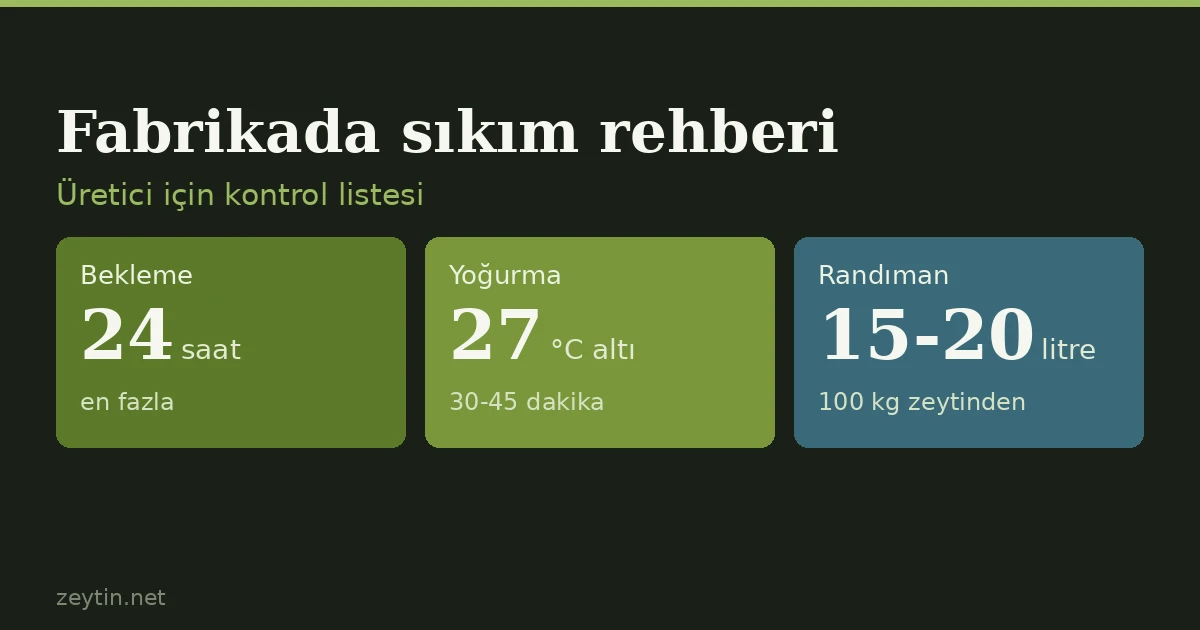
What to check when having your olives pressed at a mill: a grower's checklist
The same olives can give a very different oil when pressed at a different mill under different conditions. From what to do before bringing olives in to two-phase versus three-phase systems, kneading temperature, yield, milling fees and the questions to ask when collecting the oil, here is what a grower having olives pressed needs to know.
 Article
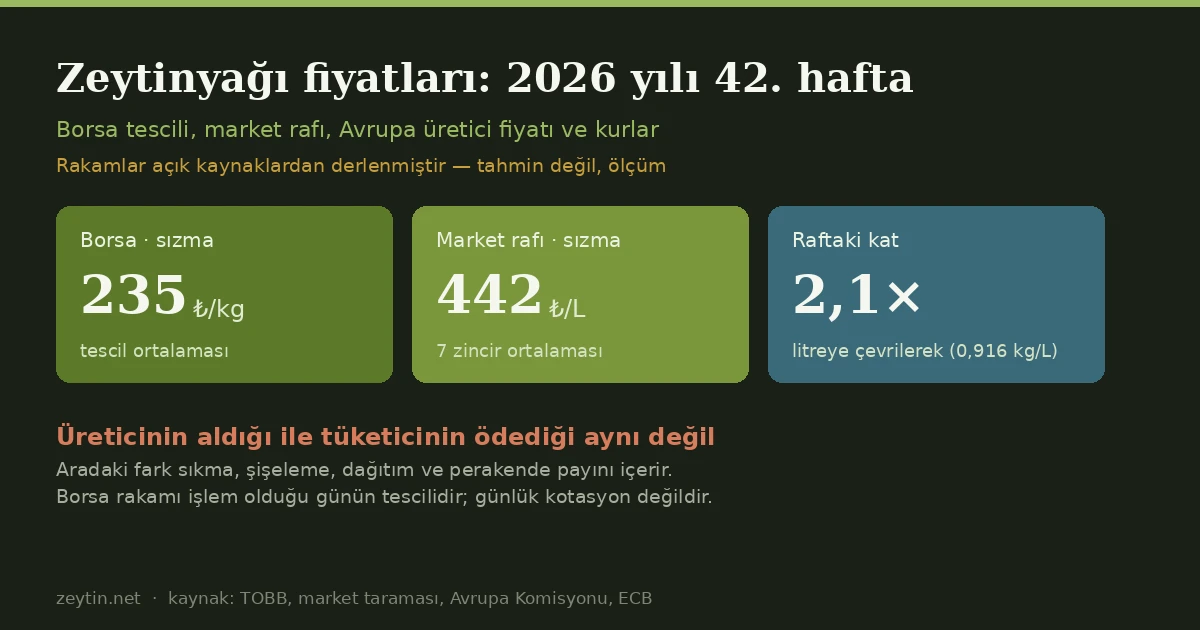
Olive Oil Prices: Week 42 of 2026
Week 42 of 2026: Turkish exchange prices, European producer prices and exchange rates side by side.
 Article
How soon must harvested olives be pressed? What waiting writes into the oil
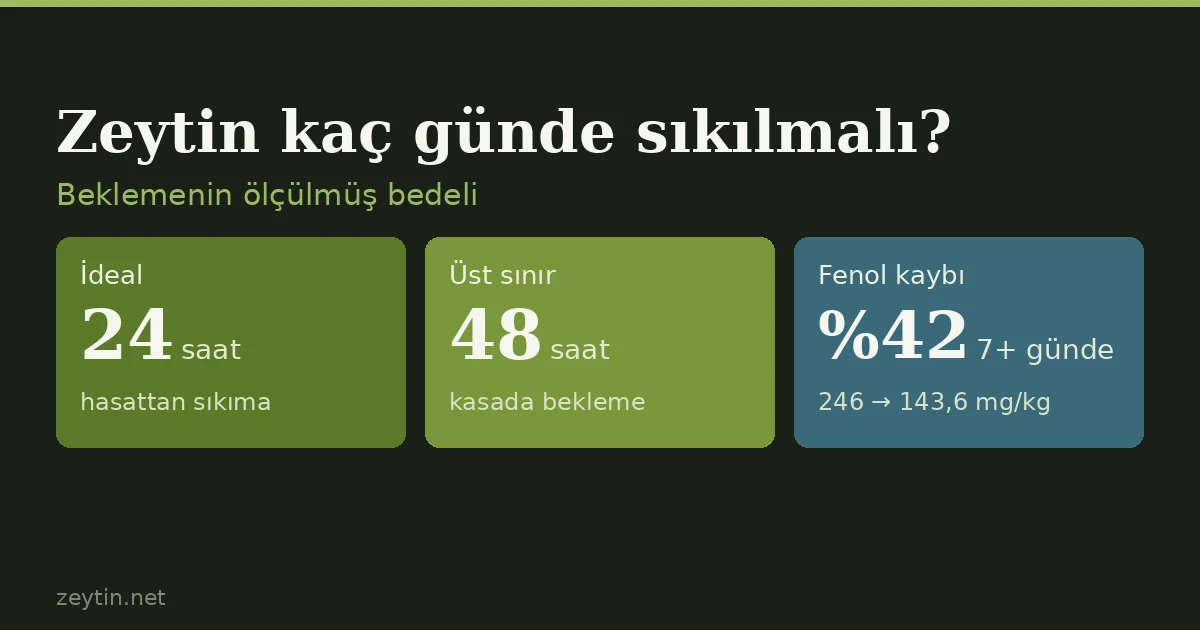
The right answer is 24 hours, with 48 as the outer limit. Measurements on 228 batches across seven mills show that olives left waiting lose 42% of their polyphenols, more than half of their green aroma and a third of their oxidative stability — even while staying inside the legal acidity limit. In an 'on' year, with mill queues lengthening, this is the grower's most critical call.
 Article
Altınözü Olive Oil: one oil from four cultivars
Registered in 2019. Halhalı, Saurani, Sarı Haşebi and Karamani are processed together. Alpha-tocopherol spans a wide 51.6-387.4 mg/kg.