What happens if it rains during the olive harvest? Wait, or pick?
Rain does not destroy the oil; it distorts the yield figure, because fruit oil content is measured on a fresh-weight basis. The real damage shows up as emulsion at the mill, as the "musty-humid-earthy" sensory defect, and as olive knot bacteria entering harvest wounds in wet weather.
October brings two things at once: the harvest and the autumn rains. If the fruit on the tree has been rained on, the grower faces a single decision — pick today, or wait for it to dry. The answer is usually "wait," but the reason is widely misunderstood. Rain does not destroy the oil; it distorts the yield figure. The real bill is written in three other places: in the paste at the mill, in the sensory defect list, and in the tree itself.
Yield falls, oil does not disappear
After rain the fruit takes up water. Because olive oil content is measured on a fresh-weight basis, the percentage per kilogram drops even when the amount of oil in the fruit has not changed at all. Seeing the arithmetic settles the confusion:
| Item | Before rain | After rain |
|---|---|---|
| Olives on the scale | 100 kg | 106 kg |
| Oil inside | 20 kg | 20 kg |
| Yield (fresh weight) | 20.0% | 18.9% |
These figures are an illustration of the mechanism, not a measurement. How much water the fruit takes up depends on the cultivar, ripeness and the intensity of the rain.
More kilograms on the scale, the same oil in the tin. "The yield dropped" is a correct sentence; "the oil is gone" is not. Why yield is not an absolute measure of quality is discussed in our article on early harvest and the arithmetic of yield.
There is a wallet side to this too. If you pay the mill a fee per kilogram, you are paying for the weight of the water as well; if you pay as a share of the oil, the difference disappears. The two fee structures are compared in our mill checklist for growers.
The problem of wet paste: emulsion
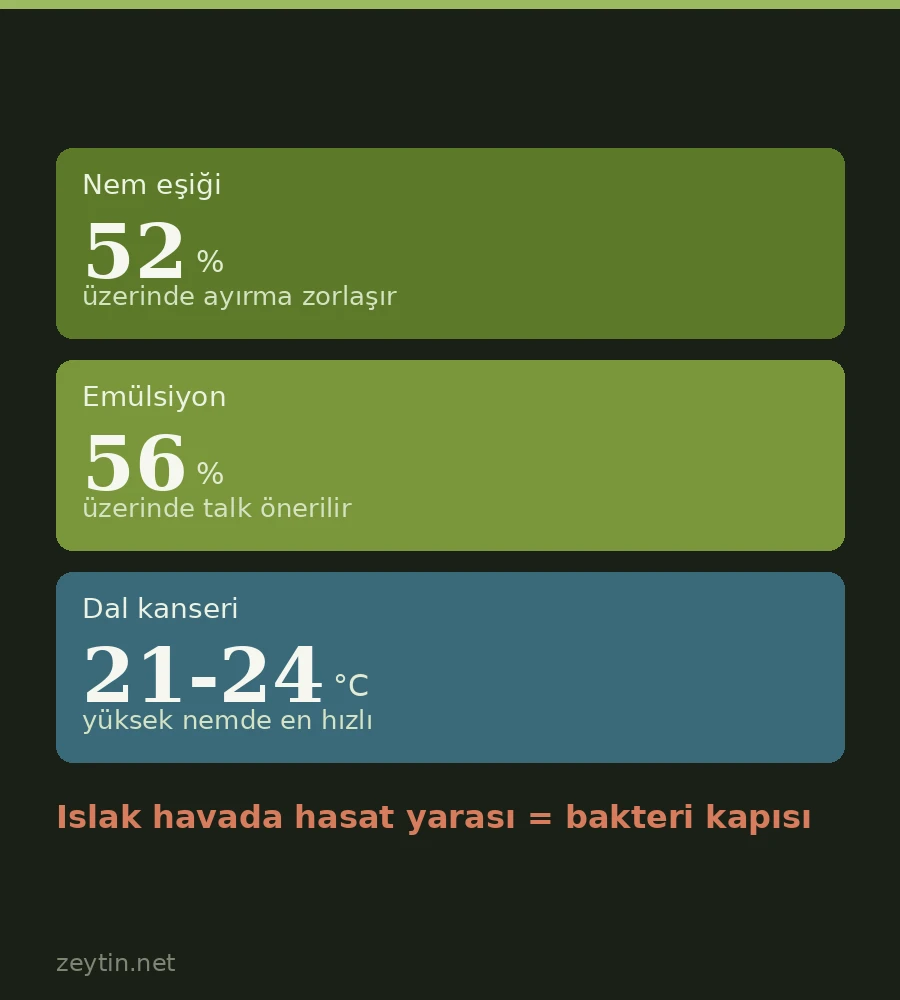
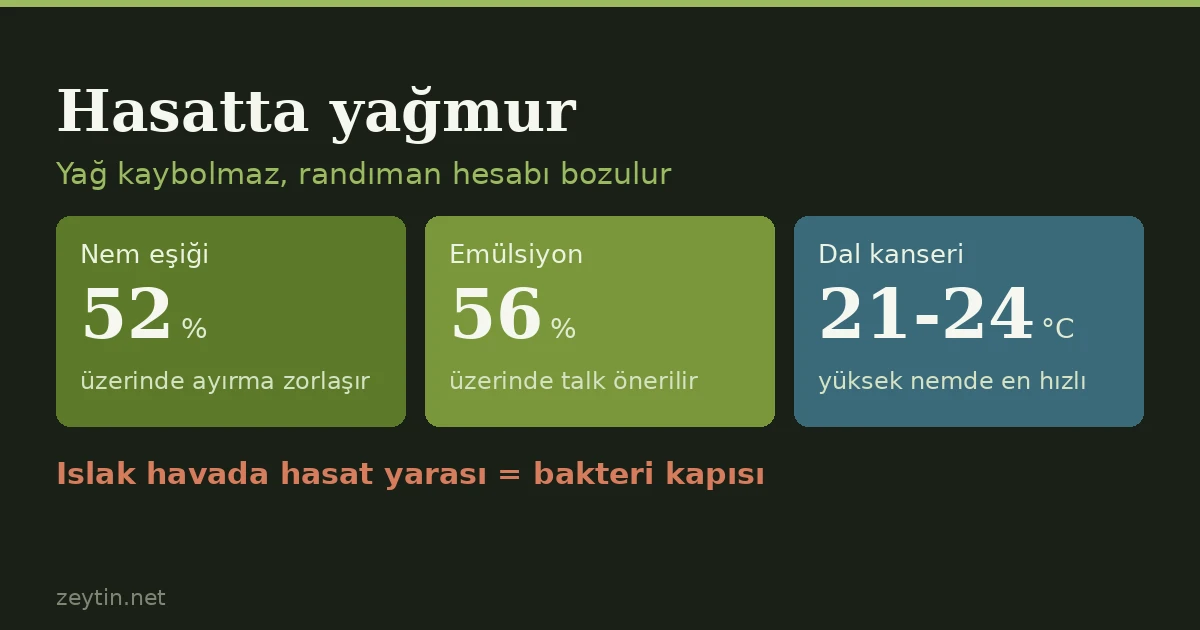
The second effect appears on the processing line. In olive oil extraction, fruit moisture is treated as one of the main factors governing how easily oil separates from the paste, and separation becomes more difficult once moisture rises above 52%. Above 56% moisture, water–oil emulsions form that malaxation does not readily break, which is why the addition of talc — a natural processing aid — is recommended for high-moisture fruit.
An emulsion that will not break has one consequence: part of the oil leaves the decanter not as oil but together with the pomace and the mill wastewater. Breaking that emulsion is precisely the job of the malaxer; wet paste asks it to do work it cannot do.
Mud is a named sensory defect
Olives picked after rain carry soil and mud. In sensory analysis this corresponds to a defect with a name. The International Olive Council's sensory standard (COI/T.20/Doc. No 15) defines the musty-humid-earthy defect as the characteristic flavour of oils obtained from fruit in which large numbers of fungi and yeasts have developed because it was stored in humid conditions for several days, or of oil obtained from olives collected with earth or mud on them that were not washed.
The same standard defines the muddy sediment defect as coming from olives piled or stored in conditions that led to advanced anaerobic fermentation, or from oil left in contact with the sediment that settles at the bottom of tanks. An oil in which a panel detects a defect cannot remain in the extra virgin category, even when its chemical values are within limits. The full defect list is in our article on olive oil tasting: defects and positive attributes.
One operational rule follows: washing cannot be skipped. If the mill cuts the washing stage short on a muddy batch, the shortcut goes straight into the defect.
Picking off the ground: the most expensive option after rain
Rain makes fallen fruit twice as problematic. On wet soil, fermentation in the fruit accelerates, mud sticks to the drupe and does not fully come off in washing. Leaving fruit that fell on a rainy day on the ground "because it will be collected anyway" can pull an entire batch down.
The same logic applies to transport: wet olives heat up faster in sacks. The difference between perforated crates and sacks is set out with figures in crates or sacks. The waiting margin also narrows for a wet batch: the intervals given in how soon must harvested olives be pressed shorten, because surface water creates an environment for mould and yeast.
The bill written to the tree: wounds opened in wet weather
This is the least discussed damage. Pseudomonas savastanoi, the bacterium behind olive knot, survives inside the knots on the tree and is excreted as an infectious bacterial ooze when it rains, then carried to healthy trees by rain splash. It enters the tree through any kind of wound: pruning cuts, hail, frost and harvest bruising. Its optimal conditions are 21–24 °C combined with very high humidity — that is, a wet October day. In the literature, harvesting by beating the trees with sticks is identified as an important epidemiological factor for disease incidence, and wounding combined with rainy, humid weather increases disease severity.
So beating the trees in wet weather puts two ledgers into debt at once: this year's oil through bruising, and future years through olive knot. The disease is covered in olive knot, and the cost of each harvest method to tree and oil in how olives are harvested.
The picture is the same for fungal disease: anthracnose advances with autumn rain and mild temperatures, with mummified fruit left on the tree acting as the inoculum source. Walking the grove after rain can also mean carrying the disease on boots and tools.
Then there is the soil. Driving a tractor and trailer over wet ground causes compaction. Because the olive's feeder roots are largely in the upper layer, passes made through mud in the rush of harvest leave a bill that is paid over years.
For table olives the bill is harsher
Everything above concerns oil olives. For table olives the cost of rain is heavier, because in oil production a defect is diluted into the oil, whereas in table olives it stays on the individual drupe. Fruit picked wet and muddy bruises and wounds more easily, and in brine those points come back as staining and softening. On top of that, each table olive is seen individually, so defective fruit means a sorting burden. Where quality is lost in table olives is covered in detail in quality problems in table olives.
Hail is a separate event. In a hail-struck grove the wounds opened on the fruit both let bacteria in and cut the waiting margin to almost nothing; the crop has to be processed as quickly as possible and largely loses its chance of making the table-olive grade.
Decision table
| Situation | Action |
|---|---|
| It is still raining | Do not harvest: wounding and spread risk are at their peak |
| Rain stopped, branches and fruit wet | Wait until the surface water has dried |
| Soil is muddy | Keep vehicles and trailers out to avoid compaction |
| Fruit has fallen to the ground | Collect separately; do not add to the main batch |
| Batch is going to the mill | Make sure washing is done properly |
| Harvest postponed | Ripeness is advancing: reassess your target |
⚠ There is no standard answer to "how many days should I wait." In practice two or three dry days are reported as sufficient, but that rests on field habit rather than measurement; temperature, wind and the aspect of the grove change it considerably.
Waiting has its own cost. The longer the fruit stays on the tree, the further the ripeness index advances, the lower the polyphenols and the softer the oil. If you are targeting an early harvest, a long run of rain shifts that target. That side of the decision is covered in when to harvest olives: the ripeness index.
In short
Rain is not an event that cancels the harvest; it is an event that changes its order. Wet olives do not contain less oil — they inflate the scale, create emulsion in the paste, bring a sensory defect along with the mud, and every wound opened in wet weather lets bacteria into the tree. Waiting for surface water to dry, separating fallen fruit, refusing to skip washing and keeping machinery out of the mud: together, these four reduce the cost of rain almost to zero.
One rating per visitor; you can change yours at any time. Ratings are real reader votes — no seeded or default scores.
Related
 Article
Caring for an olive tree in a pot: container, soil, watering, light and winter
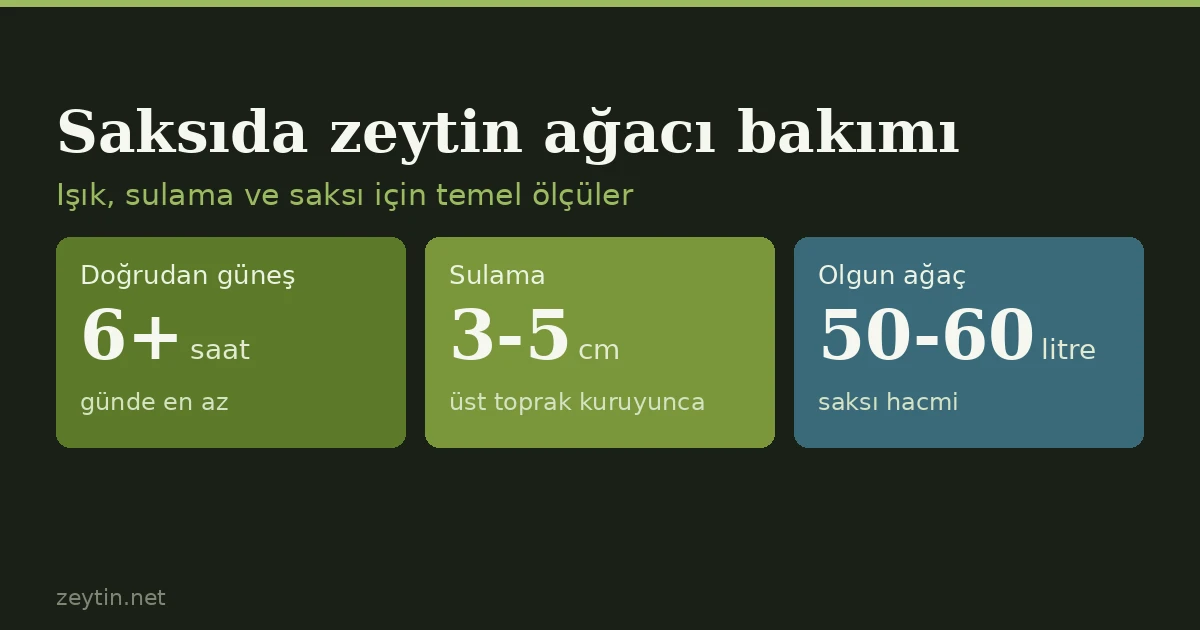
Olive trees can live in pots, but they do not forgive two things: too much water and too little light. A wide pot with drainage holes, a free-draining mix, watering once the top layer dries and at least six hours of direct sun are the basic rules. Expecting fruit indoors is usually pointless without a cool winter.
Article
Caring for an olive tree in a pot: container, soil, watering, light and winter
Olive trees can live in pots, but they do not forgive two things: too much water and too little light. A wide pot with drainage holes, a free-draining mix, watering once the top layer dries and at least six hours of direct sun are the basic rules. Expecting fruit indoors is usually pointless without a cool winter.
 Article
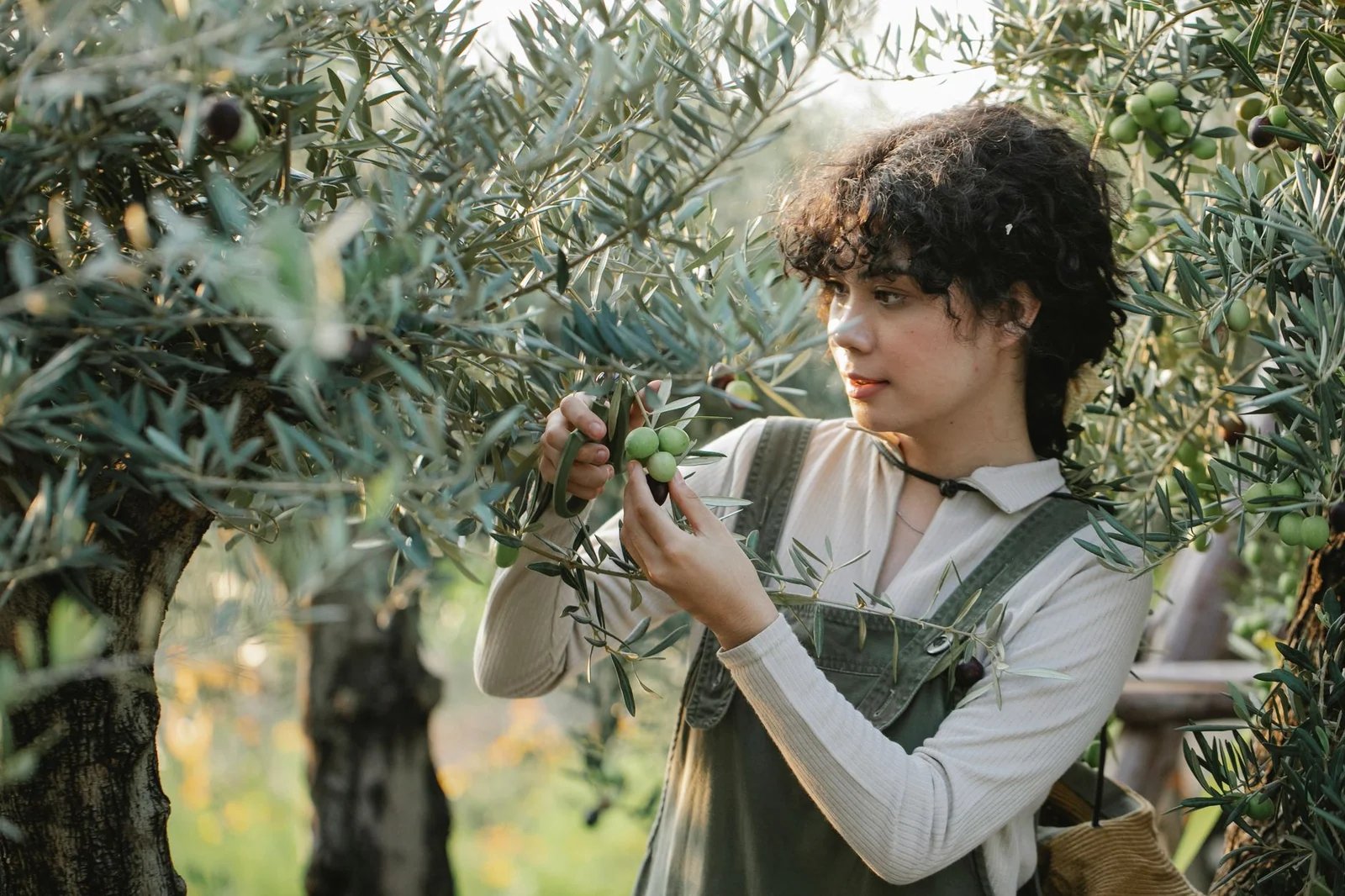
How are olives harvested? What five picking methods cost the tree and the oil
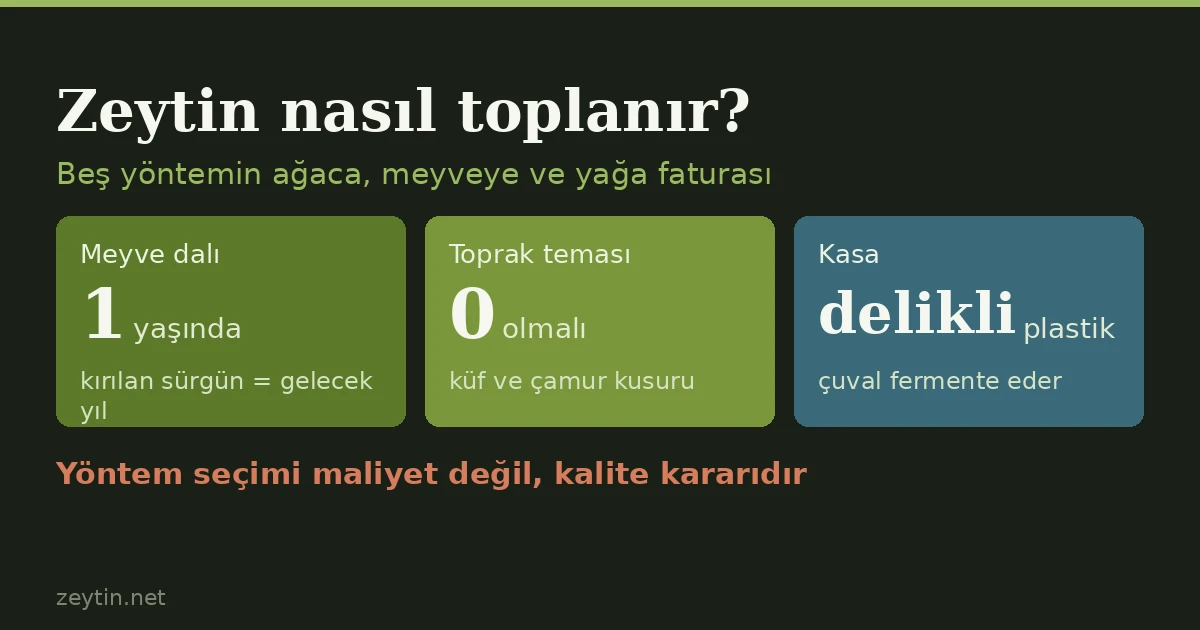
Hand picking, poles, combs, trunk shakers and straddle harvesters each charge a different bill — to the fruit, to the tree and to the acidity of the oil. Which method suits which grove, and what goes wrong on harvest day.
Article
How are olives harvested? What five picking methods cost the tree and the oil
Hand picking, poles, combs, trunk shakers and straddle harvesters each charge a different bill — to the fruit, to the tree and to the acidity of the oil. Which method suits which grove, and what goes wrong on harvest day.
 Article
Where does an olive sapling come from? From cutting to laboratory
Most table olive varieties will not root, and those that do are clones of one another — defenceless against disease. Tissue culture reports up to 85% success in vitro, but zeatin is expensive.
Article
Where does an olive sapling come from? From cutting to laboratory
Most table olive varieties will not root, and those that do are clones of one another — defenceless against disease. Tissue culture reports up to 85% success in vitro, but zeatin is expensive.
 Article
Building a high-density olive grove: five requirements
High-density planting is not a choice of variety but a five-component system — miss one and it performs worse than a traditional grove. Spacing, yields, the overlooked oil-content trade-off, and who it does not suit.
Article
Building a high-density olive grove: five requirements
High-density planting is not a choice of variety but a five-component system — miss one and it performs worse than a traditional grove. Spacing, yields, the overlooked oil-content trade-off, and who it does not suit.