Tunisia sold 381,000 tonnes of olive oil in ten months: 85.5% in bulk, half of it to Spain and Italy
According to the National Observatory of Agriculture (ONAGRI), Tunisia exported 381,200 tonnes of olive oil in the first ten months of the 2025/26 season — volumes up 50.8% and receipts up 41.2% year on year. But 85.5% of it left the country in bulk, and more than half went to Spain and Italy. Packaged oil averaged 16.7 dinars per kilo against 11.8 for bulk. Production is set to fall 40% next season, which changes the bulk market Turkish exporters face.
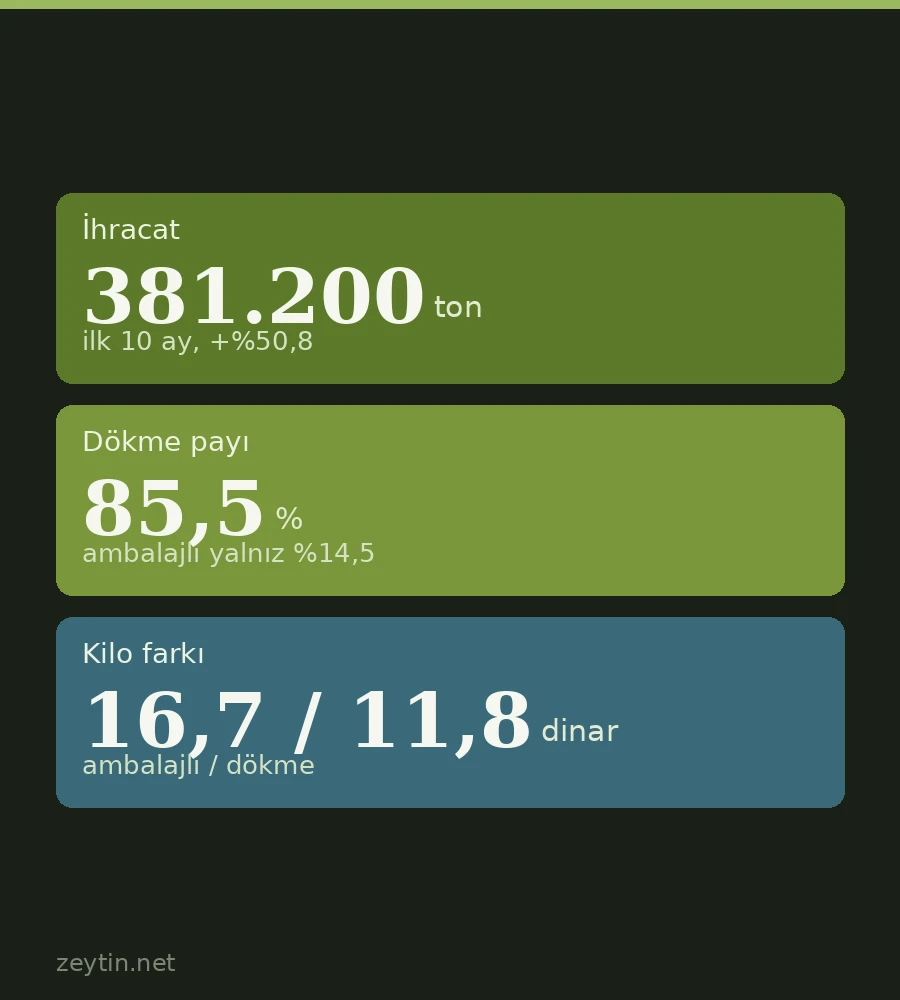
Tunisia's olive oil exports reached 381,200 tonnes in the first ten months of the 2025/26 season. According to figures published by the National Observatory of Agriculture (ONAGRI) for the period from November 2025 to the end of August 2026, that volume was worth 4,780.4 million dinars, roughly €1.42 billion. Against the same period a year earlier, volumes rose 50.8% and receipts 41.2%.
One comparison shows the scale: this ten-month tonnage already exceeds the 365,000 tonnes Tunisia exported across the whole of the 2019/20 season. The reason is no mystery — 2025/26 was the largest harvest in the country's history, at roughly 500,000 tonnes.
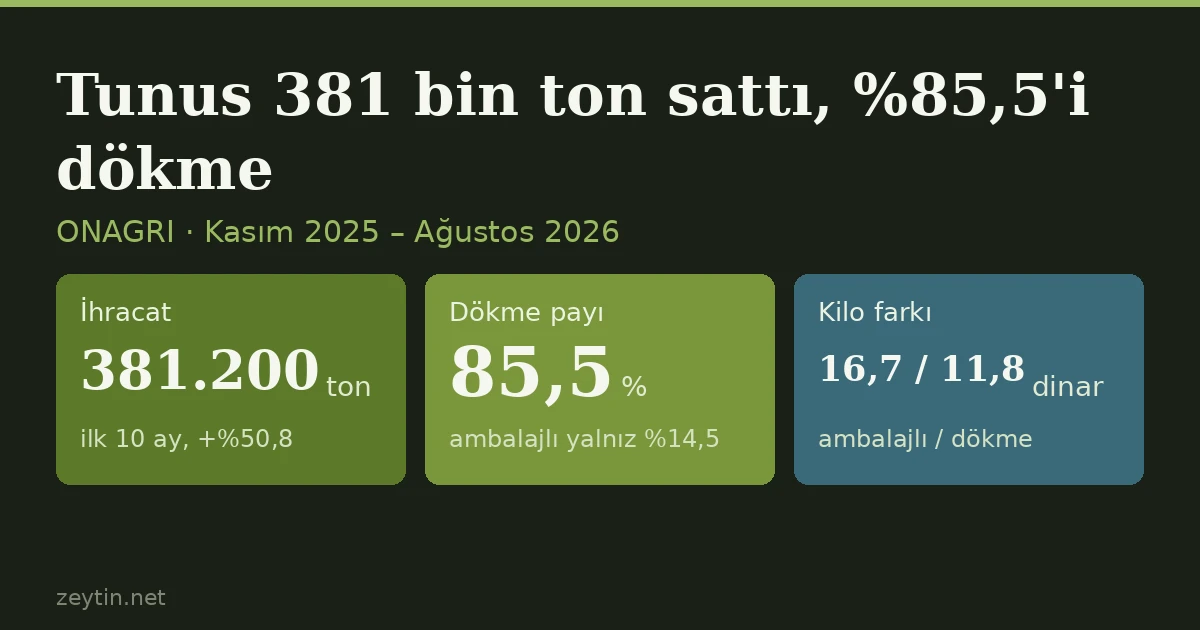
The figures
| 2025/26 · first 10 months | Value | Year on year |
|---|---|---|
| Export volume | 381,200 t | +50.8% |
| Export receipts | 4,780.4 m dinars | +41.2% |
| Bulk share | 85.5% | — |
| Packaged | 55,400 t · 14.5% | +48.7% |
| Organic | 53,000 t | — |
Bulk is the real story
The volume broke a record; the composition did not. 85.5% of exports left in bulk and only 14.5% as packaged product. On the revenue side the ratio shifts slightly: bulk oil accounts for 80.7% of receipts and packaged for 19.3%. Packaged oil, in other words, earns more than its share of volume.
The per-kilo value explains why. On ONAGRI's figures, packaged oil averaged an export value of 16.7 dinars per kilo against 11.8 dinars for bulk — a gap of 41%. That gap has nothing to do with the quality of the oil and everything to do with the container it leaves in.
The growth rate of the packaged segment is the one encouraging line in the data: it rose to 55,400 tonnes, up 48.7% in a year. But its share of the total barely moved, because bulk grew at almost exactly the same pace. Tunisia is not shifting the mix; it is scaling both halves of it.
One common misreading is worth correcting: the oil leaving in bulk is not poor oil. On ONAGRI's breakdown for the same period, 83.5% of exported volume was extra virgin. Tunisia is selling its top category by the drum. What is being given away is not the quality but the label for it — and the price that label carries.
The pace also eased over the season. In ONAGRI's nine-month data (November 2025 to July 2026) the volume stood at 368,000 tonnes and the increase at 55.3%; by the ten-month mark the increase had come down to 50.8%, meaning August ran below the season's own average. The same institution put the average price for July 2026 at 13.16 dinars per kilo, ranging from 8.22 to 17.00 dinars depending on category.
Where the oil goes
On ONAGRI's breakdown for the same period, Tunisian oil reaches more than 82 countries, but the concentration sits in one place: the European Union takes 56.6% of the total, with Spain at 31.9% and Italy at 19.8%. Those two countries alone absorb more than half of all exports.
That also explains why the bulk share refuses to fall. Spain and Italy are not buying Tunisian oil for their own shelves; they are buying it for their blending and bottling lines, and the brand the consumer eventually sees is born there. We have written separately about Italy turning from a production giant into a trading hub — Tunisian bulk oil is part of that hub's raw material.
The rest of the ranking: North America 24.4% (United States 19.3%, Canada 5.1%), Asia 11.5% (Saudi Arabia 4.9%, Jordan 3%), Africa 3.7% (Egypt 3.1%).
Organic oil is not a more balanced picture, only a differently ordered one: 53,000 tonnes worth 699.7 million dinars, at an average of 13.20 dinars per kilo. The market order there is Italy 39%, Spain 26%, the United States 23%, France 8%. Certified organic oil, too, mostly ends up in the country that does the packaging — and only 6.3% of organic exports leave Tunisia already packaged, a bulk share even higher than the overall average.
Next season reverses
This record closes a bracket rather than opening one. Najeh Saïdi Hamed, president of Tunisia's National Chamber of Olive Producers, has put 300,000 tonnes on the table for 2026/27 — a 40% fall from 500,000. The reason given is the biennial bearing cycle: a high-yield year is followed by a low one.
Receipts may not fall by the same proportion. In August 2026 the average export price was 7.1% higher than in August 2025, so a smaller crop can still be sold into a firmer market. But the tonnage available to sell is shrinking.
Meanwhile Tunisia keeps planting. The olive area was 2.06 million hectares in 2024/25, rose to 2.10 million in 2025/26, and is expected to reach 2.15 million hectares in 2026/27. The coming drop therefore comes from the trees' load in a given year, not from the orchard shrinking.
What it means for Turkey
The comparison is uncomfortable. Turkish olive oil exports last season came to 17,721 tonnes; Tunisia sold more than twenty times that in ten months.
We have written before that the two countries sit in opposite phases of the bearing cycle, and that is exactly what is now playing out. As Tunisia drops toward 300,000 tonnes in 2026/27, the figures being discussed in Turkey for this season are 500,000 to 600,000 tonnes. The volume needed to fill the space Tunisia vacates in the bulk market does exist in Turkey.
But the Tunisian picture is also a warning. Selling a record tonnage at a record bulk share means settling for 11.8 dinars a kilo, while the same country selling the same oil in a bottle collects 16.7. The side that ships in drums is not the side that sets the price — Spain's November decision on whether to withdraw oil from the market is another illustration of the same rule.
Where that ceiling is set shows up in our own price data: in the week of 27 September, the weekly extra virgin producer price was €3.45/kg in Spain, €3.42/kg in Jaén and €4.75/kg in Italy. Tunisian bulk oil flows straight into the pool where those prices form. The seller who packages stands outside that pool and sets a price of its own — and the Tunisian case shows that owning a record harvest is not by itself enough to get out of the pool.
Turkey's problem today is volume. If volume is solved, the next question is composition — and Tunisia has not managed to answer that question even in a record season.
One rating per visitor; you can change yours at any time. Ratings are real reader votes — no seeded or default scores.
Related
 Article
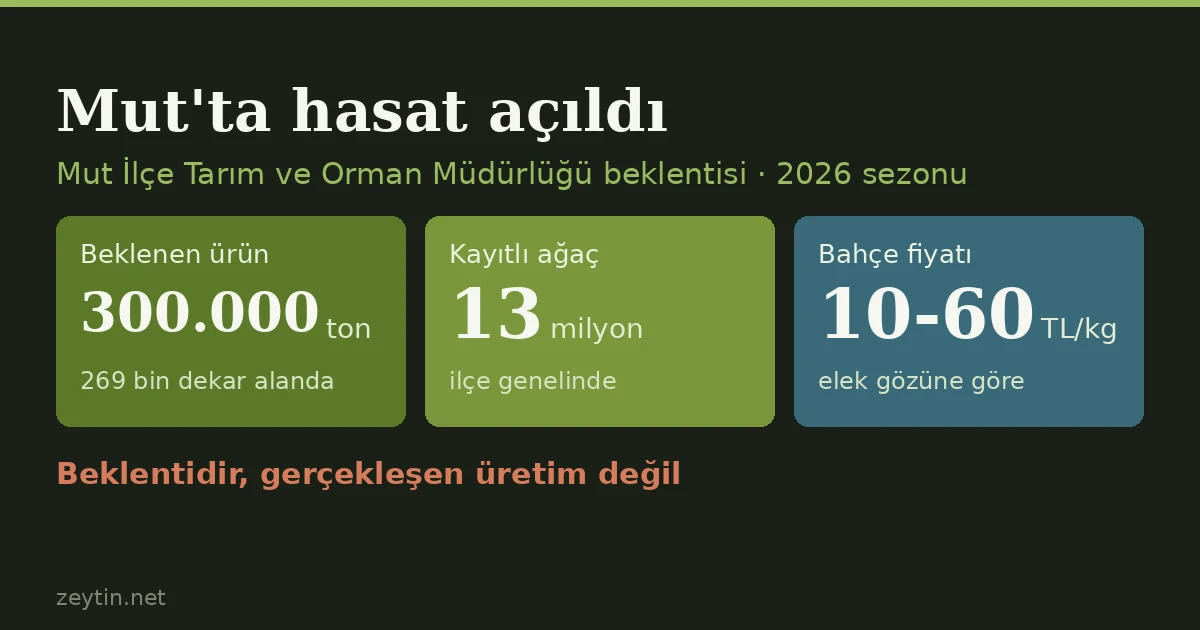
Harvest opens in Mut: 300,000 tonnes expected, orchard prices start at 10 lira
Mut's district agriculture directorate reports 300,000 tonnes expected from 269,000 decares, with orchard prices ranging from 10 to 60 lira by sieve size. Yield is high but growers are unhappy with prices. Set against our own Mersin figures the tonnage leaves an unresolved measurement gap, and we report it as such.
Article
Harvest opens in Mut: 300,000 tonnes expected, orchard prices start at 10 lira
Mut's district agriculture directorate reports 300,000 tonnes expected from 269,000 decares, with orchard prices ranging from 10 to 60 lira by sieve size. Yield is high but growers are unhappy with prices. Set against our own Mersin figures the tonnage leaves an unresolved measurement gap, and we report it as such.
 Article
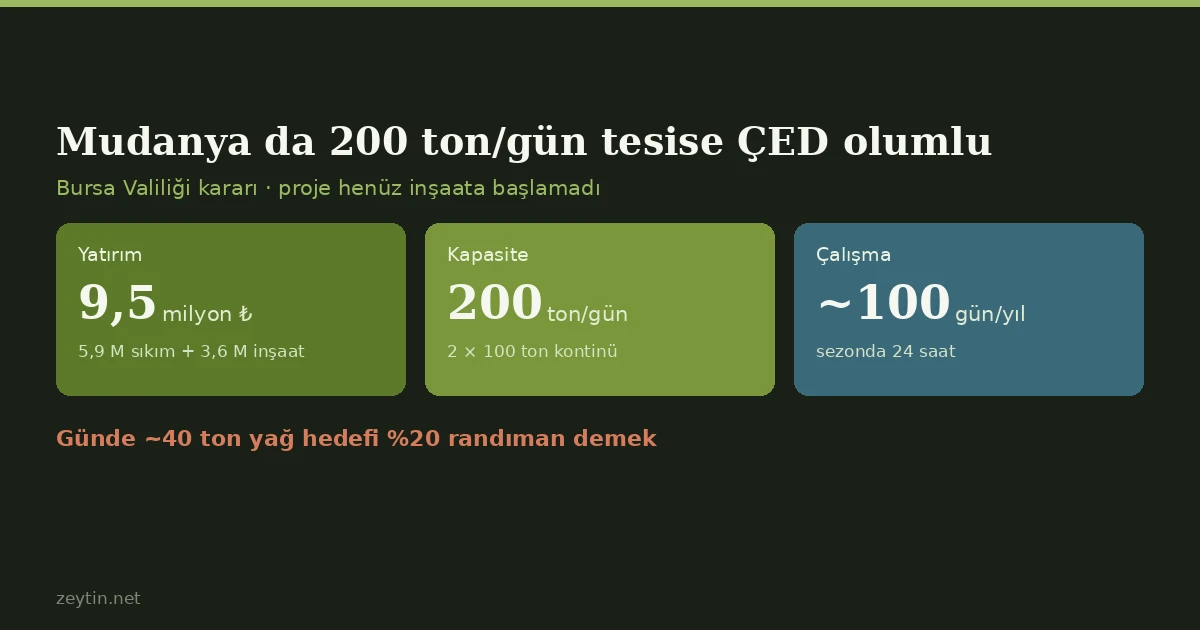
EIA approval for a 200 t/day olive oil plant in Mudanya
A 9.5 million lira olive oil plant planned in Mudanya, Bursa, has received a positive environmental impact decision: 200 tonnes of olives a day, around 100 operating days a season.
Article
EIA approval for a 200 t/day olive oil plant in Mudanya
A 9.5 million lira olive oil plant planned in Mudanya, Bursa, has received a positive environmental impact decision: 200 tonnes of olives a day, around 100 operating days a season.
 Article
Marmarabirlik opens crop declarations on 21 September: no declaration, no purchase
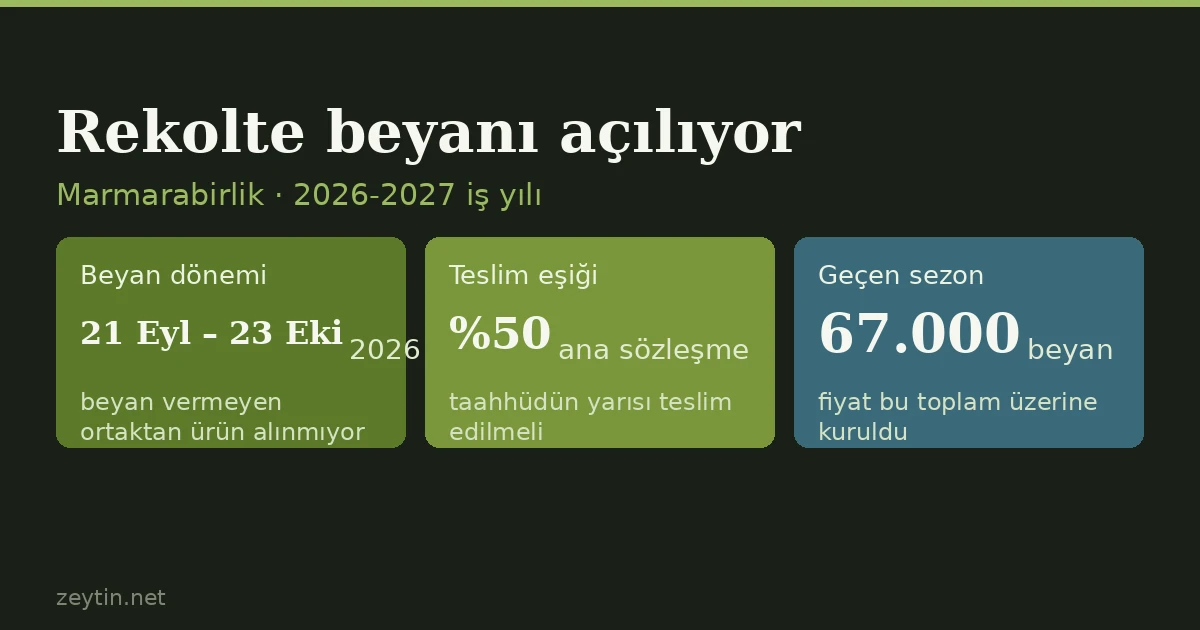
Crop declarations for the 2026-27 business year open on 21 September and close on 23 October at cooperatives affiliated with Marmarabirlik, Türkiye's largest table olive cooperative union. Members who do not file cannot sell to the cooperative, and the declared figure is a binding commitment covering oil olives too. In Orhangazi some 300 members are close to expulsion under the union's fifty-percent delivery rule.
Article
Marmarabirlik opens crop declarations on 21 September: no declaration, no purchase
Crop declarations for the 2026-27 business year open on 21 September and close on 23 October at cooperatives affiliated with Marmarabirlik, Türkiye's largest table olive cooperative union. Members who do not file cannot sell to the cooperative, and the declared figure is a binding commitment covering oil olives too. In Orhangazi some 300 members are close to expulsion under the union's fifty-percent delivery rule.
 Article
Spain decides in November: will part of a 1.6 million tonne crop be withdrawn from the market?
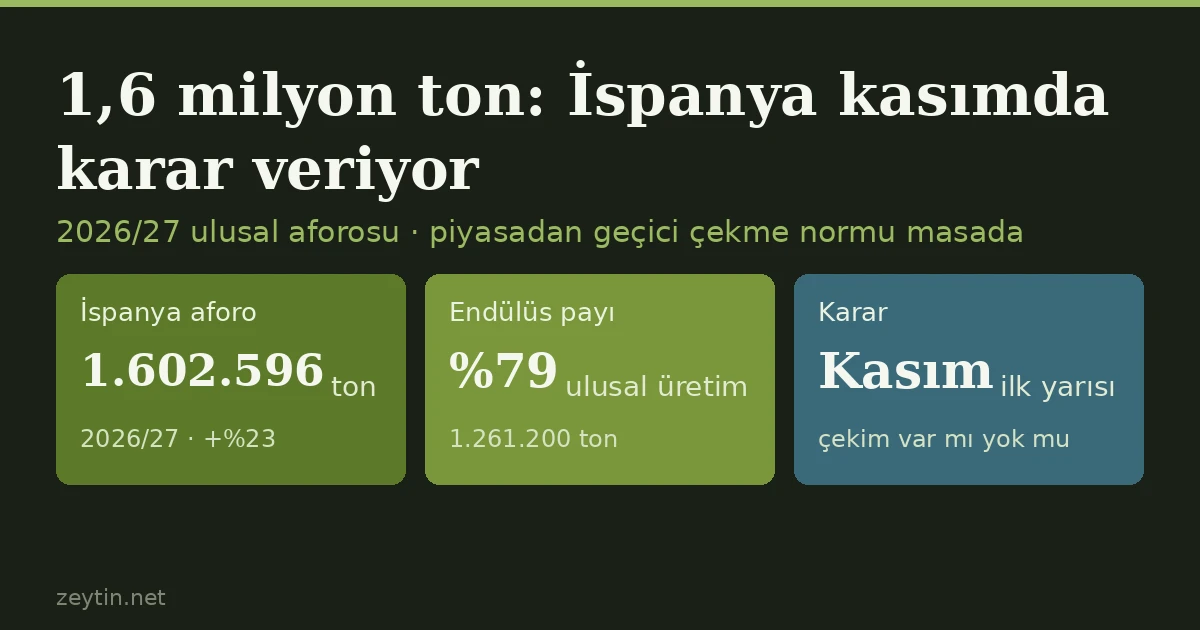
Spain's first national aforo for 2026/27 was presented in Jaén on 1 October: 1,602,596 tonnes of olive oil, 23% above last harvest. With carry-over stock, total availability approaches two million tonnes, and the Ministry of Agriculture will decide in the first half of November whether to activate a temporary withdrawal mechanism that has never been used. The ceiling on the world price Turkish exporters will face is being set here.
Article
Spain decides in November: will part of a 1.6 million tonne crop be withdrawn from the market?
Spain's first national aforo for 2026/27 was presented in Jaén on 1 October: 1,602,596 tonnes of olive oil, 23% above last harvest. With carry-over stock, total availability approaches two million tonnes, and the Ministry of Agriculture will decide in the first half of November whether to activate a temporary withdrawal mechanism that has never been used. The ceiling on the world price Turkish exporters will face is being set here.