Spain activates mandatory olive oil withdrawal for the first time: 12% of output, about 188,000 tonnes held until September 2027
Spain's agriculture ministry published its decision in the BOE on 6 November: from November, mills must keep 12% of declared output in storage until 30 September 2027. The ministry estimates about 188,000 tonnes will be withdrawn; October early-harvest oils are exempt and mills receive no compensation.
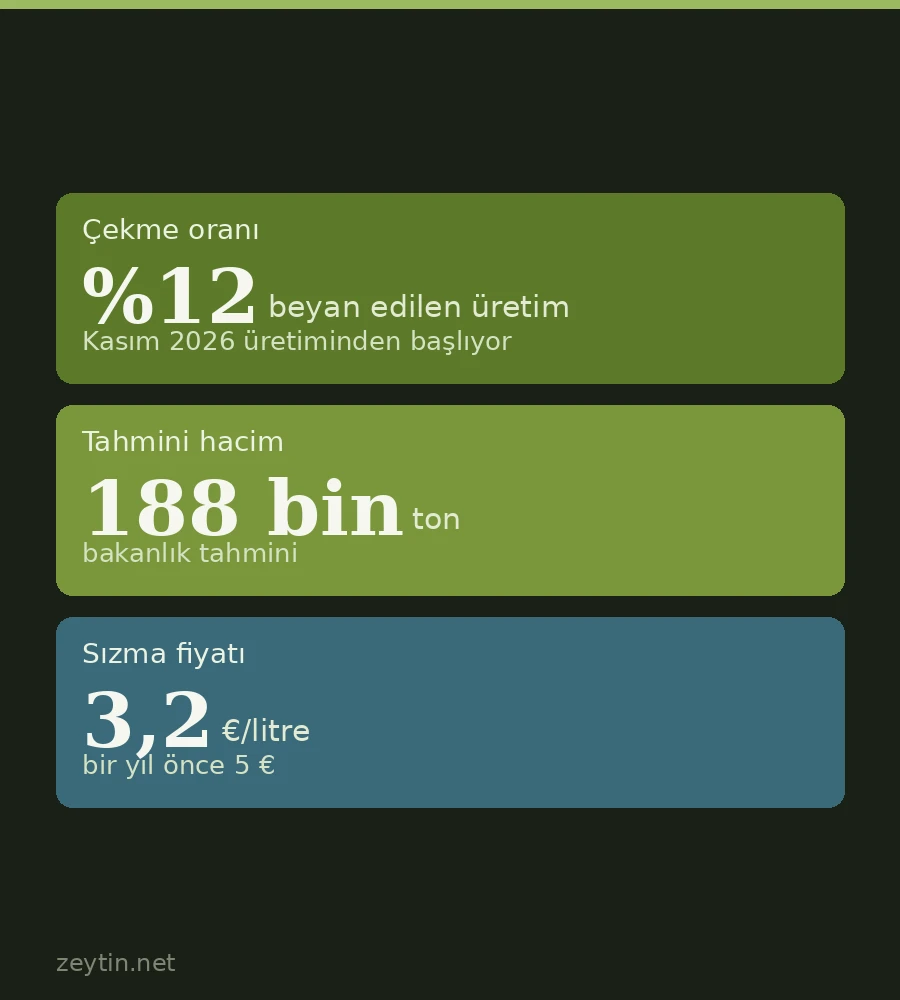
Spain is applying mandatory withdrawal to olive oil for the first time. The Ministry of Agriculture, Fisheries and Food published its decision in the BOE, the Spanish official gazette, on Friday, 6 November 2026: for the 2026/27 season every mill must keep 12 per cent of the oil it declares in storage instead of selling it. This is the decision that the framework order published at the end of October was waiting for. We wrote then that the percentage would be set by 15 November at the latest; it came nine days early.
What the decision says
The ministry's Directorate-General for Agricultural Production and Markets confirmed that the trigger for the mechanism has been met. The condition was that opening stocks plus estimated production must reach 120 per cent of the average of the same sum over the previous six seasons. For this season the arithmetic is as follows: 357,040 tonnes of carry-over stock plus a production estimate of 1,602,596 tonnes gives 1,959,636 tonnes. The production estimate is roughly 23 per cent above last season's, and opening stocks are also about 23 per cent higher.
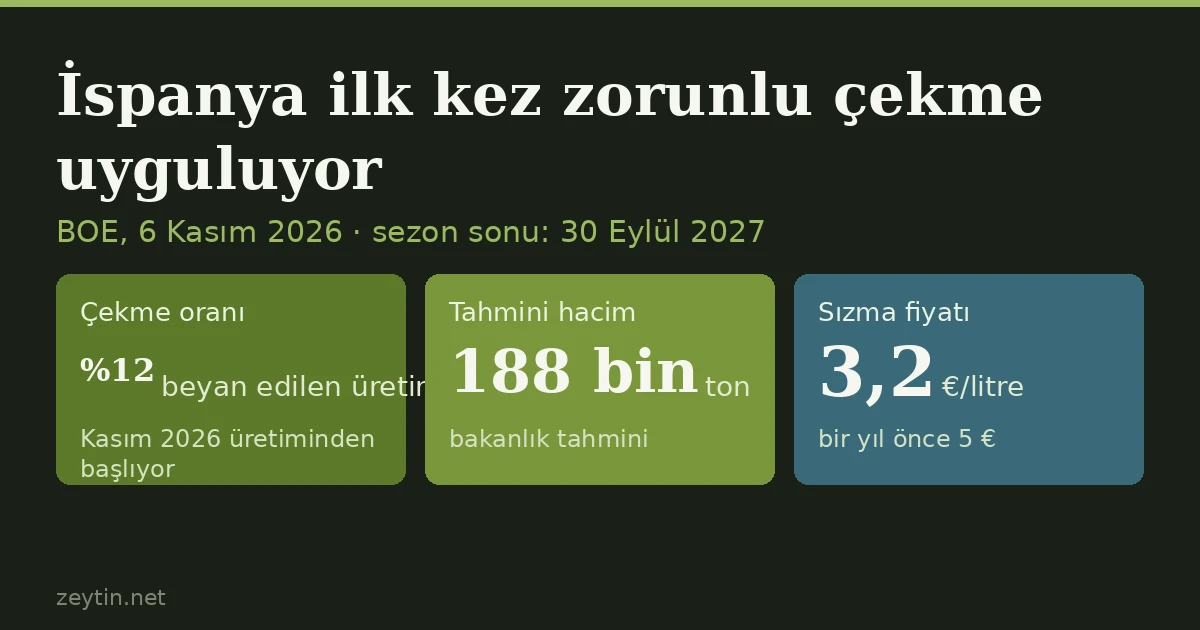
The rules of application are these:
- The percentage applies from the production declared in November 2026; from that date each mill must hold back 12 per cent of its cumulative declared output.
- The oil stays in storage until 30 September 2027, the end of the season. A mill may use its own tanks or rented ones, and must be able to prove the volume and the facility at any time.
- The mill chooses which category of oil it sets aside.
- Early-harvest oils produced in October are exempt; the ministry notes that their value depends on early picking and quick sale.
- On current data the ministry estimates that about 188,000 tonnes will be withdrawn. The resolution can be amended after 31 December 2026, depending on how production develops.
A quick check shows the numbers hang together: 12 per cent of 1.6 million tonnes is about 192,000 tonnes, and the exemption for October early-harvest oil pulls the ministry's figure slightly below that. This reconciliation is ours; the ministry did not break the figure down.
Why prices are at this point
The withdrawal mechanism was designed to stop a supply surplus from collapsing prices. In 2025/26 there was no surplus, so it stayed on the shelf. This season the picture changed.
According to Poolred, the system that tracks producer prices, prices fell 6 per cent over the past month. The Infaoliva observatory puts the average price of extra virgin oil at €3.2 per litre and virgin oil at €2.8 per litre; a year ago extra virgin was paid at €5. That is a drop of roughly 36 per cent in a year (our arithmetic). According to the Spanish press, farmers could not even cover their costs at these prices. Producer organisations had asked for the mechanism to be activated as early as possible this season.
Who objects
Reactions split in two. Producer organisations back the decision as a way to protect prices. The packaging industry argues that it breaks the market balance and has announced that it will again go to the Audiencia Nacional against the rules; a case against last season's order is already pending. The competition authority CNMC had also warned that the measure carries risks for competition, could make the product more expensive and could reduce variety and quality.
How it differs from the old private storage aid
This is not a repeat of the private storage aid authorised by the European Commission. In its last use, in 2019, €26.9 million was paid in Spain through four tenders to store close to 200,000 tonnes of oil. Today's mechanism is national, compulsory and uncompensated: the mill that holds the oil carries the storage cost. The legal basis is Article 167a of the EU common market regulation and Spain's 2021 royal decree. The mechanism has been on the books since then but was never used.
What it means for Turkish producers
The effect is not known; the Spanish press itself calls it "an unknown". On paper, keeping about 188,000 tonnes in storage until the end of the season reduces the supply leaving Spain and could ease the pressure on prices. On the other hand, the same oil returns to the market at the end of the season, and mills choose for themselves which category to hold, so the impact could end up limited. It is too early to tell.
What matters to Turkish producers is how the market that sets the floor for world prices will react. The decision follows the record Spanish crop estimate and the expectation of a November decision; what is new is that the uncertainty is gone. The Poolred and Infaoliva figures due in the coming weeks will show whether the decision holds up producer prices.
What comes next
The decision is a beginning, not an end. November is the first month of application; once mills have reported that month's production, the oil set aside is supposed to be checked in storage. Under the framework order, the autonomous regions carry out the inspections, and a mill that does not comply can be sanctioned under a 2022 law. The ministry has kept the right to change the percentage after 31 December: if the production estimate moves up or down, the 12 per cent can move with it. The second thing the sector will watch is the legal route; the packaging industry's announcement that it will sue suggests that the measure could remain contested even in mid-season. Prices can be followed in the series on the site's market page.
One rating per visitor; you can change yours at any time. Ratings are real reader votes — no seeded or default scores.
Related
 Article
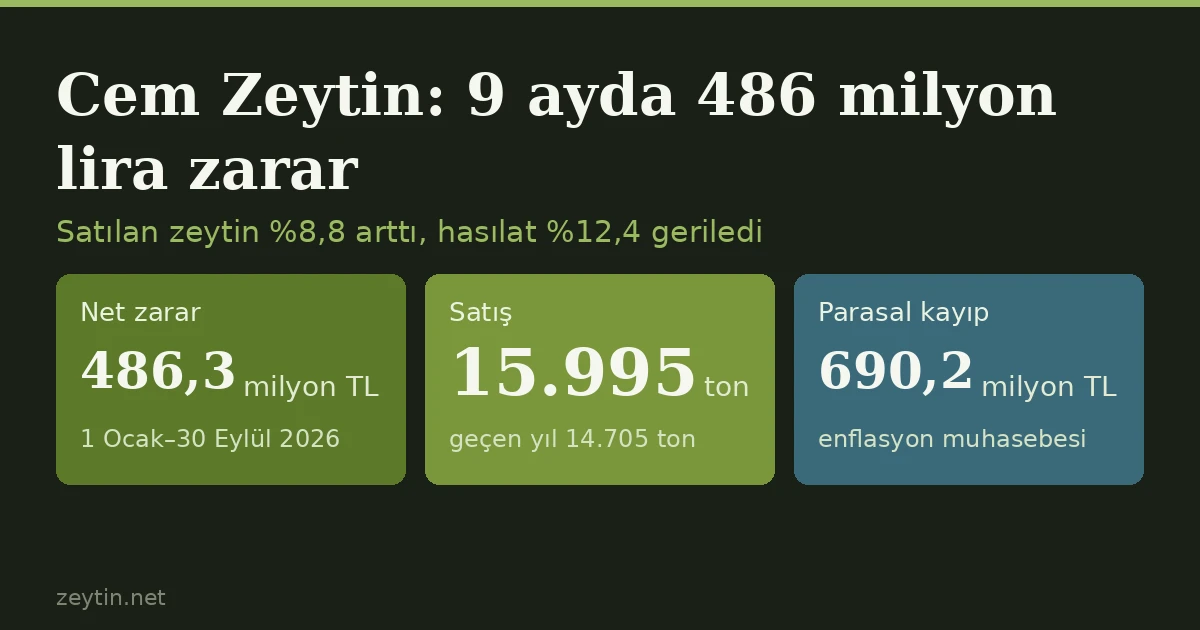
Cem Zeytin loses 486 million lira in nine months: it sold 9% more olives but earned 19% less per kilo
Table olive processor Cem Zeytin, listed in Istanbul, reported a nine-month net loss of 486.3 million lira in its filing to KAP. Sales rose from 14,705 to 15,995 tonnes while revenue fell 12.4%. The loss came not from operations but from a 690 million lira inflation-accounting monetary loss and a swing in tax.
 Article
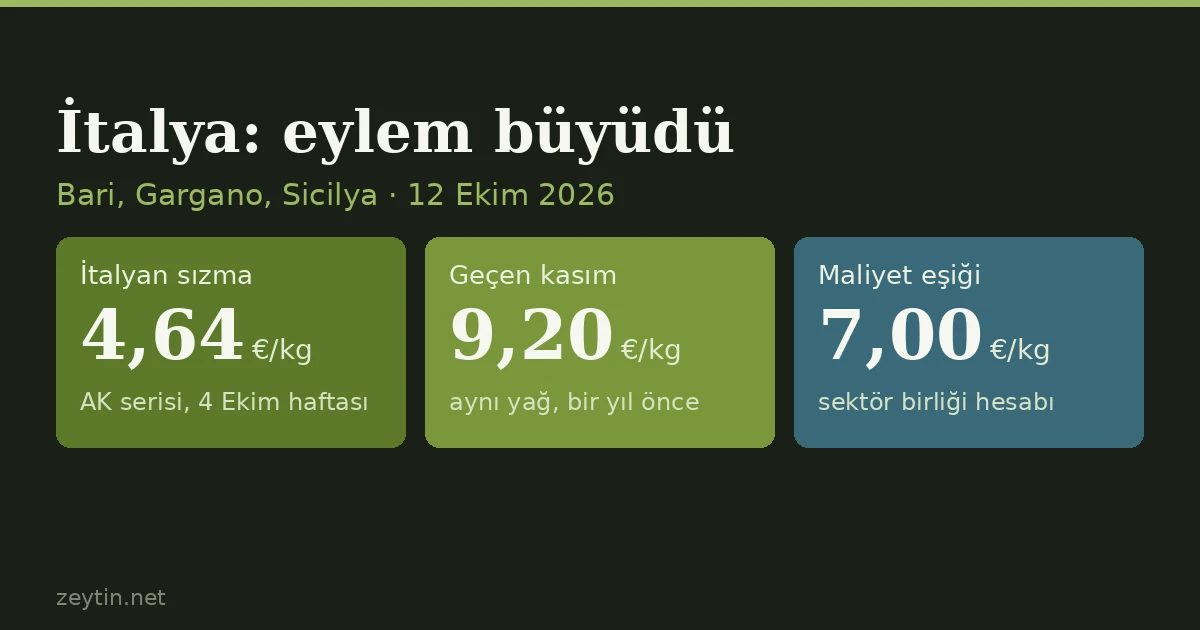
Italy's protest widens: thousands of growers in Bari, mills idle in Sicily, still no crisis status
The deadline given in Puglia expired without crisis status being granted: on 12 October thousands of growers gathered in front of the Bari prefecture, hundreds of tractors blocked roads on the Gargano, and harvesting and milling have been suspended since 5 October across nine municipalities in Sicily. Two of the four demands concern anti-fraud controls and an electronic transport document for olives. In the European Commission series, Italian extra virgin stood at 4.64 €/kg in the week of 4 October; the figure quoted in the field is 4 euros, against 9.20 € last November. The next threshold is 15 October.
 Article
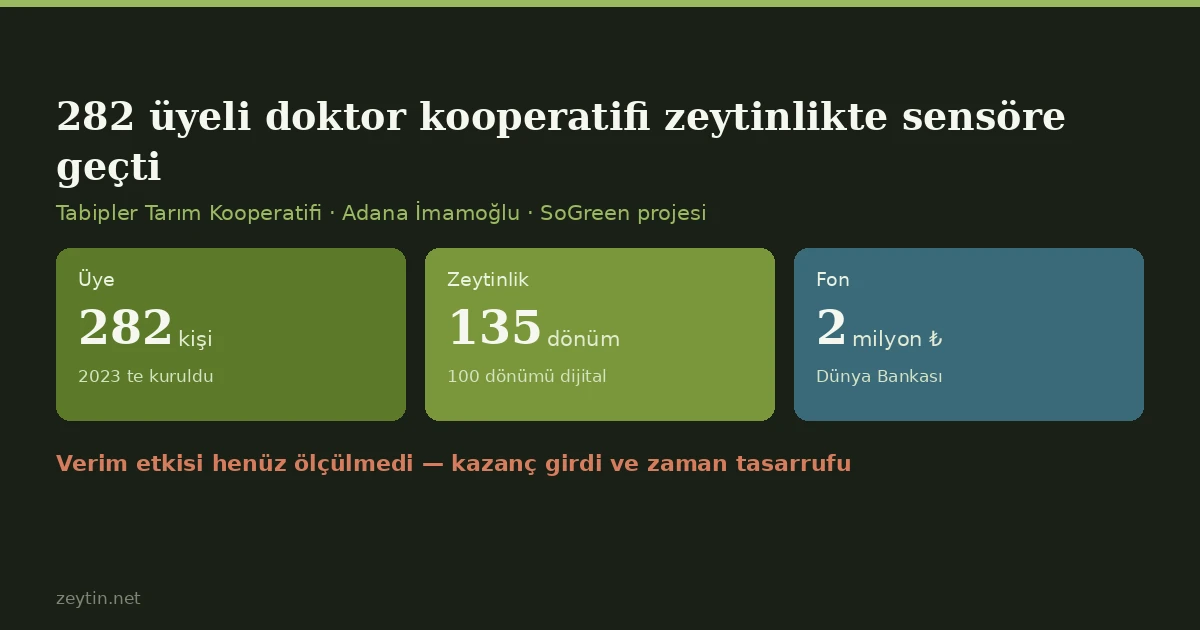
A 282-member doctors' cooperative puts sensors in the olive grove
A cooperative founded by doctors in Adana is monitoring water and fertiliser with buried sensors across 100 of its 135 dönüm of bearing olive grove, funded with 2 million lira.
 Article
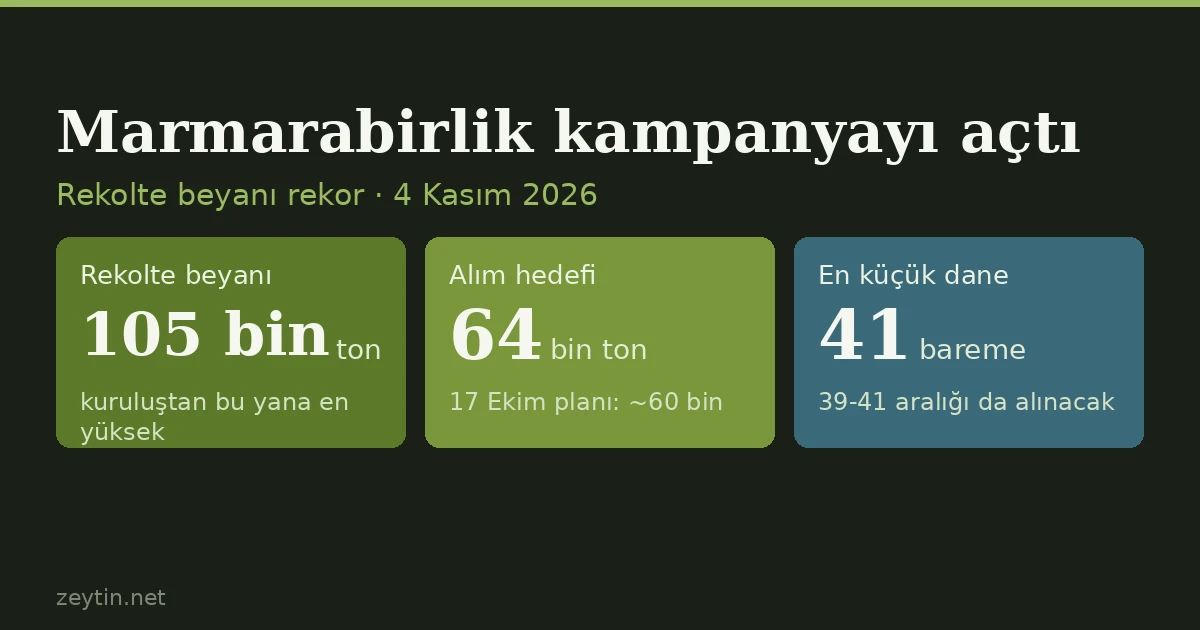
Marmarabirlik opens its purchase campaign: record 105,000-tonne declaration, 64,000-tonne target, olives bought down to size 41
Marmarabirlik opened its purchase campaign on 4 November 2026: members declared a record 105,000 tonnes and the buying target is 64,000 tonnes. Small olives will be bought down to size 41, and Erdek members hit by hail get a loan deferral and a price-difference payment.