EIA process ended for the Selçuk Çamlık olive oil plant meant to grow from 20 to 160 tonnes a day: the reason is an incomplete permit, not a negative decision
The İzmir Governorate's Provincial Directorate of Environment, Urbanisation and Climate Change ended the ÇED process for a project to raise the daily pressing capacity of an olive oil plant in Çamlık, Selçuk, from 20 to 160 tonnes, in a letter dated 7 November 2026. Reason: the permit at the Provincial Directorate of Agriculture and Forestry could not be completed.
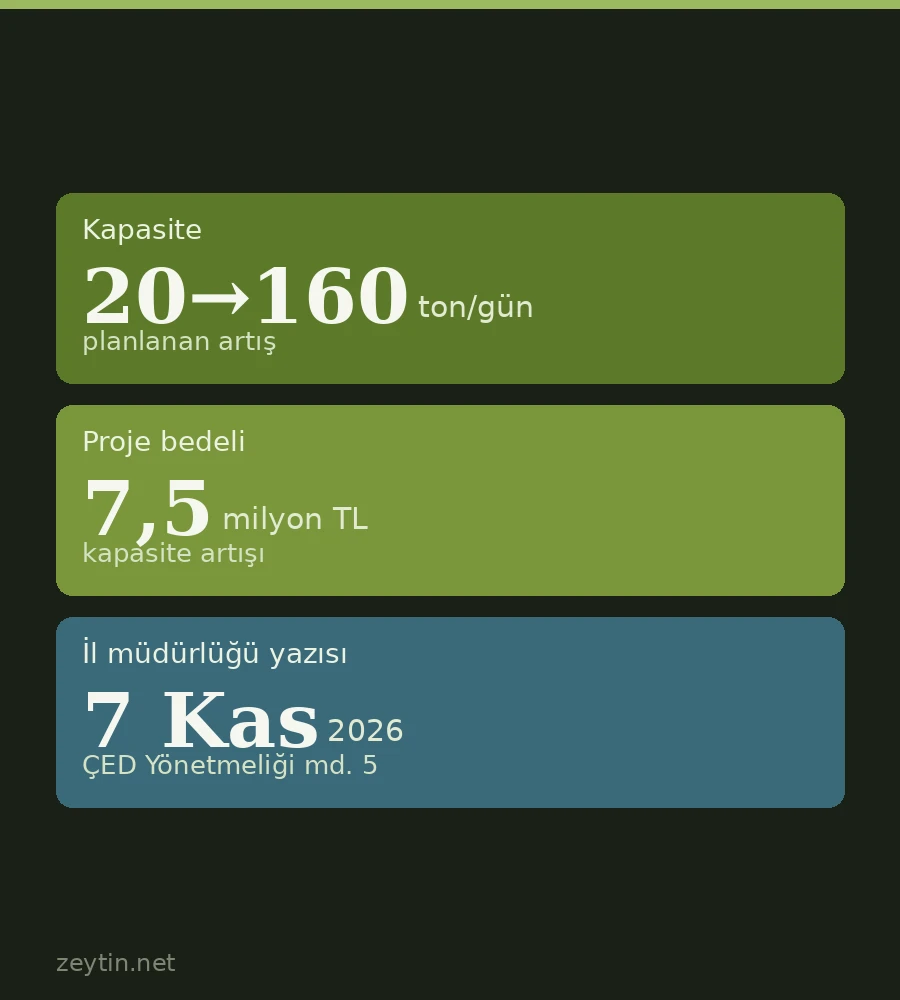
The environmental impact assessment (ÇED) process for a project to raise the daily pressing capacity of an olive oil plant in Çamlık neighbourhood, Selçuk district, İzmir, from 20 to 160 tonnes has been terminated. According to a letter dated 7 November 2026 from the İzmir Governorate's Provincial Directorate of Environment, Urbanisation and Climate Change, the consultancy that prepared the project file applied on 23 October 2026 asking for the ÇED process to be ended because the permit process at the Provincial Directorate of Agriculture and Forestry could not be completed. The report appeared around 11 November 2026.
The word "cancelled" in the headline can mislead: this is not a negative decision issued because of the project's environmental effects.
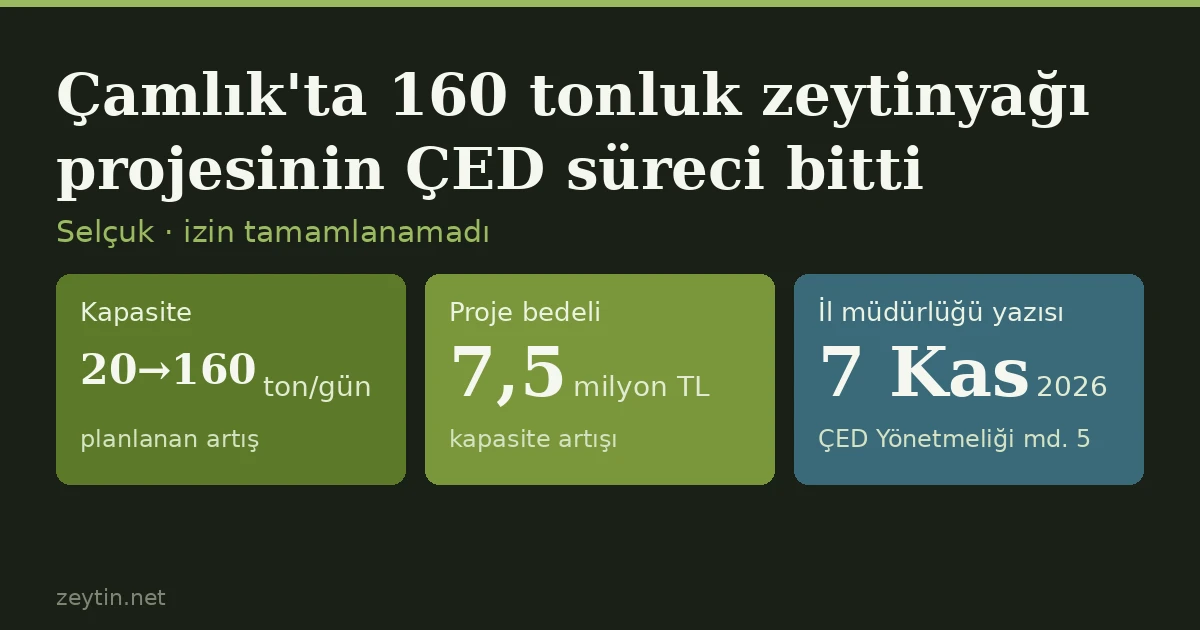
What does the official letter say?
| Item | Detail |
|---|---|
| Location | Selçuk, Çamlık neighbourhood, Kazıntıyeri locality, block 109 parcel 17 |
| Project | Olive oil plant capacity increase, cost 7.5 million lira |
| Current capacity | 20 tonnes/day, two-phase pressing system |
| Planned addition | New continuous line of 140 tonnes/day; total 160 tonnes/day |
| Application date | 23 October 2026 (request to terminate) |
| Provincial directorate letter | 7 November 2026 |
| Stated reason | Permit at the Provincial Directorate of Agriculture and Forestry could not be completed |
| Basis | Article 5 of the ÇED Regulation |
On a site inspection the provincial directorate noted that work on the capacity increase had not begun, cancelled/returned the file and ended the process. The letter was signed on the Governor's behalf by Provincial Director Aytaç Yalçınkaya.
The official letter does not say what type of permit remained incomplete, nor whether the relevant authority issued a refusal. So the question "why was the permit not obtained?" is not answered in this document.
What did the project envisage?
The project description file the report cites was submitted in September 2024. According to it:
- A new continuous line of 140 tonnes/day would be added to the existing 20 tonnes/day system; no new building, the existing production building would be used.
- In a 100-day season, 16,000 tonnes of olives would be processed, yielding 3,632 tonnes of olive oil and 14,400 tonnes of wet pomace.
- Daily pomace would be 144 tonnes.
In a two-phase system most of the vegetation water stays inside the pomace, so a separate wastewater stream shrinks, while storing and hauling wet pomace becomes more important. We covered this in Olive mill waste water and pomace.
Inconsistencies the report found in the file
The report also reviewed the project file and argues it contains several inconsistencies. These are the newspaper's reading, not an administrative decision or a court finding. Some examples from the report:
- The seasonal pomace amount of the existing 20 tonnes/day plant appears as 14,400 tonnes in the non-technical summary and monitoring form, but as 1,800 tonnes in the file's own calculation for the existing capacity.
- The monitoring table says household solid waste will be collected by Datça Municipality; the plant is in Selçuk.
- The main text gives eight employees, the monitoring form six.
- Although it says no new construction will take place, the monitoring table has excavation and construction-site lines.
The report also questions the consistency of the pomace storage volume and the haulage plan; we do not repeat the detail of those calculations here.
What the report does not say
- Which authority's step the permit process stalled on.
- Whether the investor will apply again.
- Whether the existing 20 tonnes/day plant continues to operate.
What to watch
The report does not say whether the investor will complete the permits and reapply. If a new application comes, how the inconsistencies above are answered in the file will be decisive.
One rating per visitor; you can change yours at any time. Ratings are real reader votes — no seeded or default scores.
Related
 Article
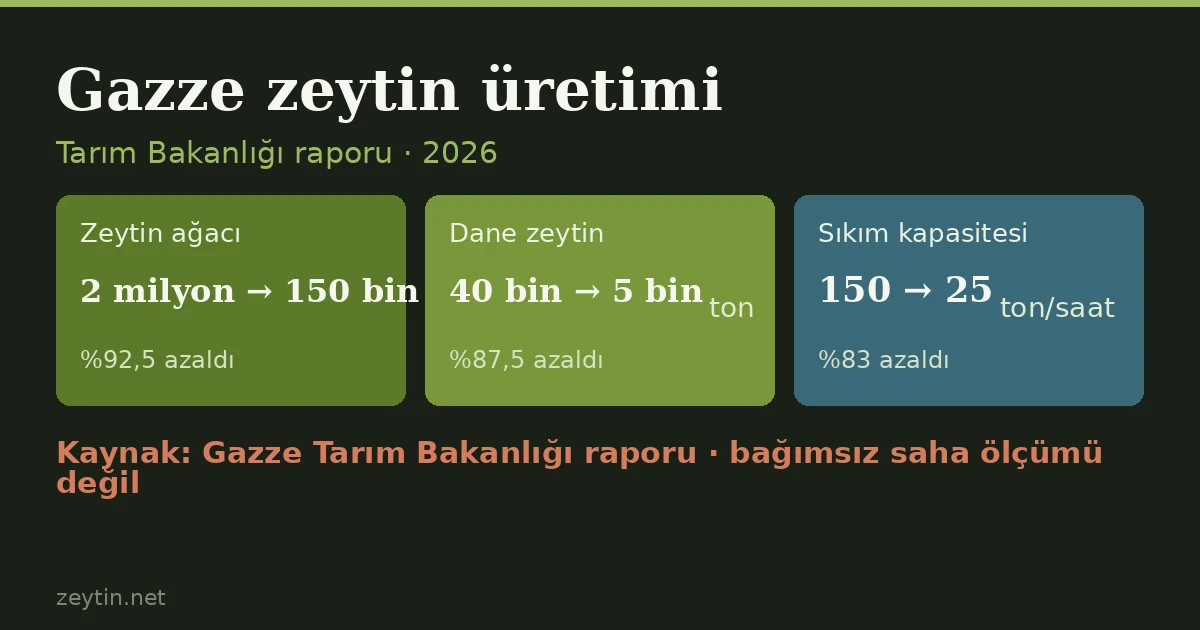
Gaza's olive report: 150,000 trees left of two million, production down 87.5%
According to a report from Gaza's Ministry of Agriculture, olive groves have shrunk from 50,000 dunums to 5,000 and the olive crop from 40,000 tonnes to 5,000. The loss is not confined to the grove: milling capacity has fallen from 150 tonnes an hour to 25, and the number of growers from 20,000 to 1,000.
 Article
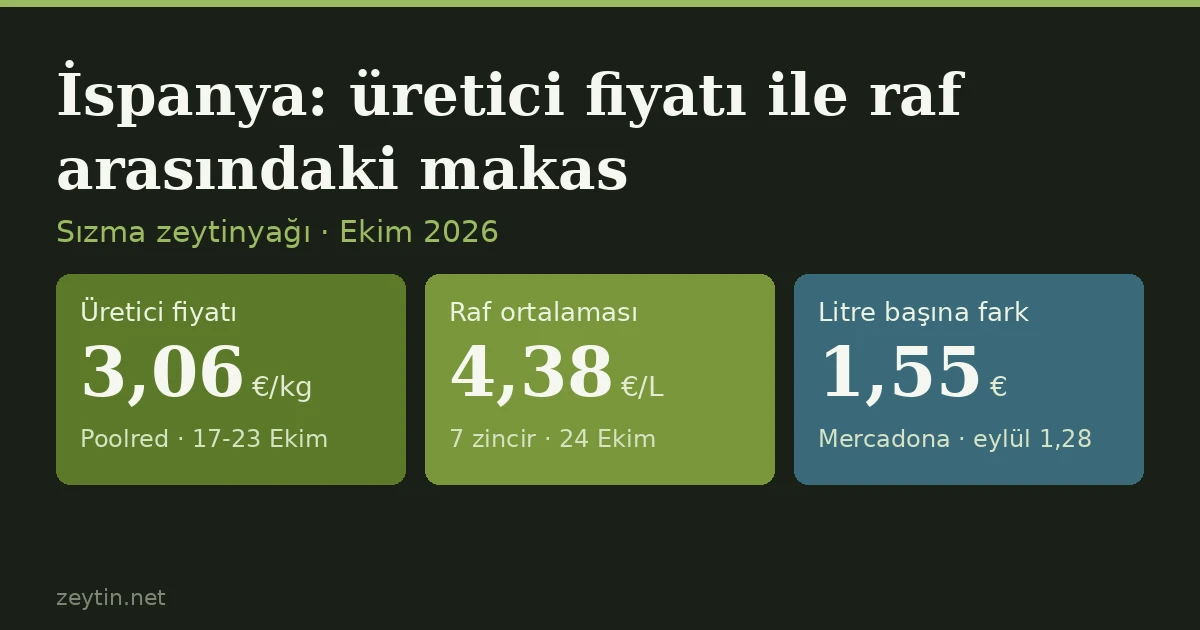
Spain's olive oil producer price falls to €3.06 while shelf prices drop at half the pace
Poolred data show the Spanish producer price of extra virgin olive oil at €3.06/kg in 17-23 October, about 12% below early September. Seven chains' own-label bottles fell 6.7% on average to €4.38 per litre. At Mercadona the per-litre gap widened from €1.28 to €1.55.
 Article
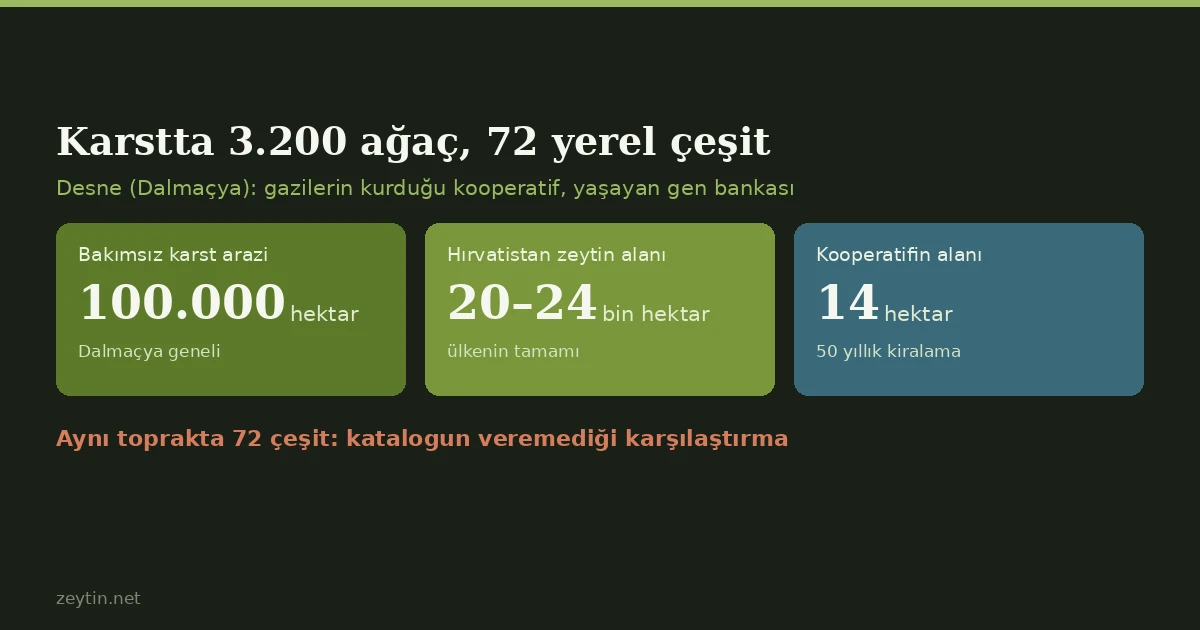
3,200 trees and 72 varieties on 14 hectares of stone: the cooperative turning Dalmatian karst into groves
Some 100,000 hectares of karst lie neglected in Dalmatia while all of Croatia has 20,000–24,000 hectares under olives. In Desne a veterans' cooperative has grown 3,200 trees of 72 native varieties on 14 hectares of rock — a grove that doubles as a natural laboratory for climate resilience.
 Article
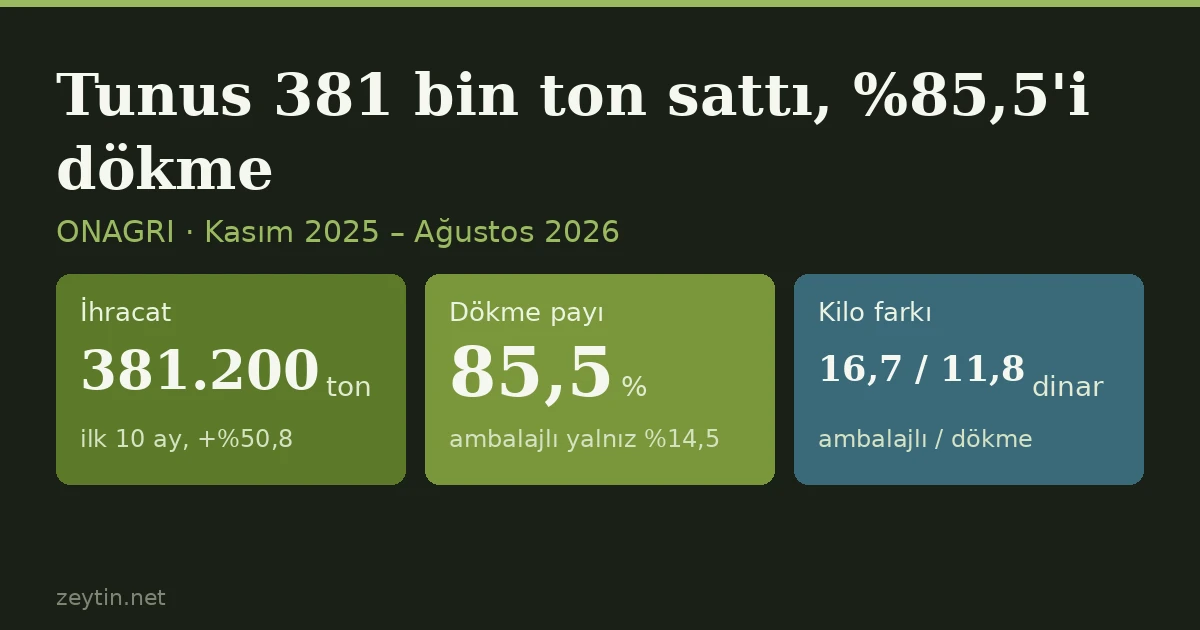
Tunisia sold 381,000 tonnes of olive oil in ten months: 85.5% in bulk, half of it to Spain and Italy
According to the National Observatory of Agriculture (ONAGRI), Tunisia exported 381,200 tonnes of olive oil in the first ten months of the 2025/26 season — volumes up 50.8% and receipts up 41.2% year on year. But 85.5% of it left the country in bulk, and more than half went to Spain and Italy. Packaged oil averaged 16.7 dinars per kilo against 11.8 for bulk. Production is set to fall 40% next season, which changes the bulk market Turkish exporters face.