Osmaniye Olive Oil: a registration with sensory thresholds above six
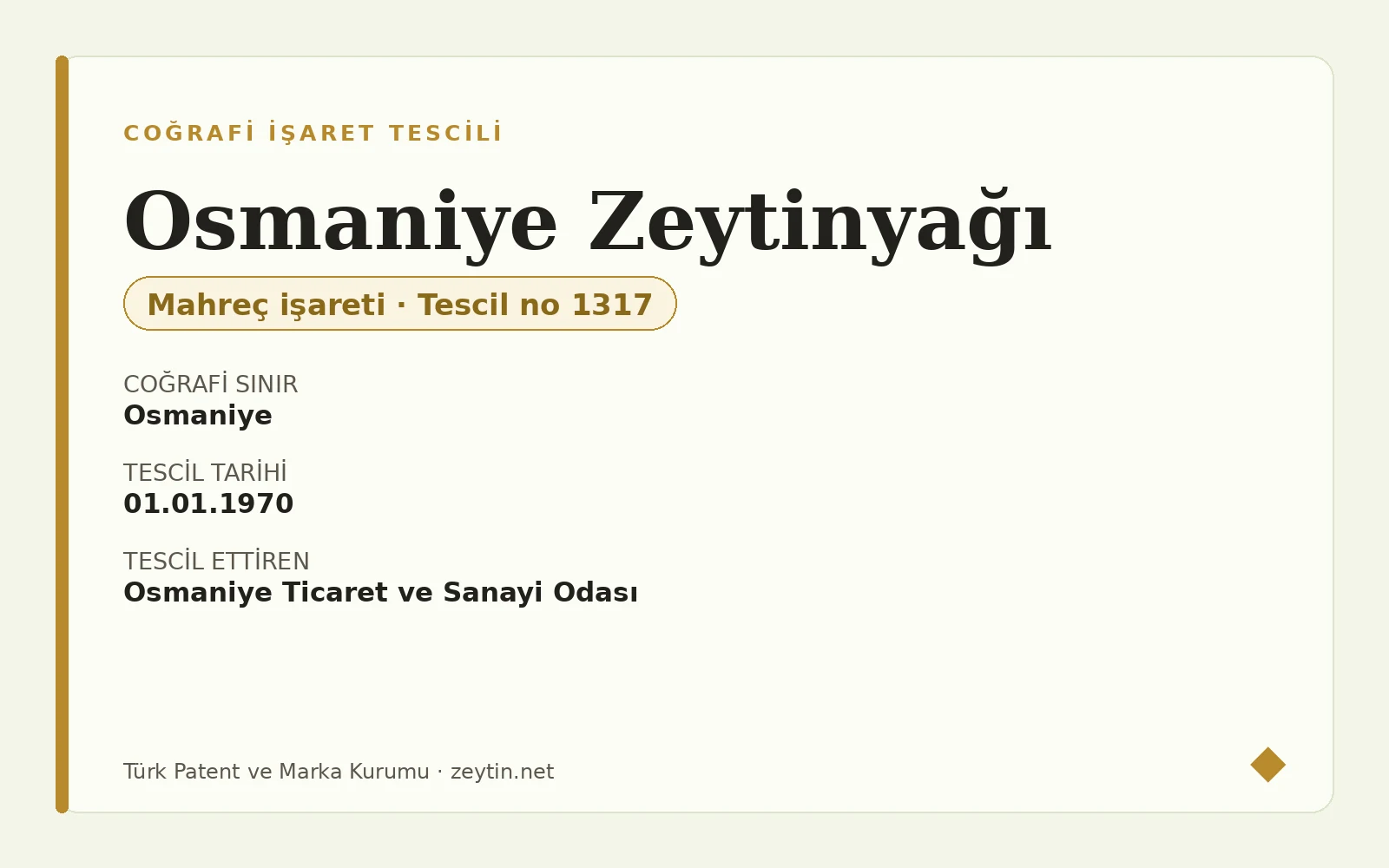
Registered in 2022. Fruitiness ≥6.4, bitterness ≥6.0, pungency ≥6.1 — unusually high thresholds. Milling within 48 hours of harvest is required.
In sensory analysis of olive oil, fruitiness, bitterness and pungency are scored from 0 to 10. Most registrations are content with median > 0. Osmaniye Olive Oil requires all three above six.
The record
| Registration no | 1317 |
| Protection from | 15.11.2021 |
| Type | Geographical indication |
| Registered by | Osmaniye Chamber of Commerce and Industry |
| Area | The province of Osmaniye |
| Cultivars | Gemlik and Ayvalık |
Sensory thresholds
| Attribute | Median |
|---|---|
| Fruitiness | ≥ 6.4 |
| Bitterness | ≥ 6.0 |
| Pungency | ≥ 6.1 |
| Green perception | ≥ 6.0 |
| Floral | ≥ 6.1 |
And defects must be at zero: fusty/muddy sediment 0 · musty/humid/earthy 0 · winey/vinegary/acid-sour 0 · wet wood 0 · rancid 0.
Meeting these is not easy. Fruitiness of 6.4 means early harvest and fast processing.
The 48-hour rule
The certificate makes it a condition: milling within 48 hours of harvest.
Olives begin to ferment once picked; fruit left waiting raises acidity and generates sensory defects. Meeting the thresholds above depends on this provision.
Measured values
| Criterion | Value |
|---|---|
| Free acidity | 0.5 ± 0.3% |
| Peroxide | 9.3 ± 5.7 meq/kg |
| E232 | 1.75 ± 0.65 |
| E270 | 0.161 ± 0.05 |
| Total phenols (GAE) | 530.2 ± 130 |
| Oleic acid | 74.37 ± 4.62% |
| Palmitic acid | 15.70 ± 1.62% |
| Linoleic acid | 3.68 ± 0.27% |
Total phenols of 530 mg/kg is high — the chemical counterpart of bitterness and pungency scoring above six. Oleic acid at 74% also works towards stability.
We described what these compounds do in oleocanthal and polyphenols.
In short
Osmaniye Olive Oil builds its distinctiveness less on chemistry than on sensory thresholds — and is one of the rarer certificates that writes into the document how those thresholds are to be met: the 48-hour rule.
The criteria the document binds
The registration does not only protect a name; it defines the product numerically:
| Criterion | Value in the document |
|---|---|
| Harvest-to-pressing window | max 48 saat |
Limiting the time from harvest to pressing binds the operation rather than the outcome: free fatty acidity rises while the fruit waits.
Inspection. The inspection body convenes with at least 3 kişi. Members: Osmaniye Ticaret ve Sanayi Odası, Osmaniye İl Tarım ve Orman Müdürlüğü. Results are reported under Industrial Property Law no. 6769 and submitted to the Turkish Patent and Trademark Office.
Its place in Osmaniye's olive production
| Item | Value |
|---|---|
| Fruit production | 99,238 t |
| — for oil | 94,775 t |
| — for the table | 4,464 t |
| Olive oil production | 14,809 t |
| Trees | 4,672 thousand |
| Yield per tree | 21.2 kg |
96% of the province's fruit goes to oil. An oil-based registration matches how the province actually produces.
Osmaniye's olive sector in figures
The registration covers a province, not a district. The province's place in olive growing appears in a compilation by the Osmaniye Investment Support Office drawing on provincial agriculture directorate and TÜİK data:
| Indicator (2019) | Value |
|---|---|
| Table olive production | 10,000 t |
| Oil olive production | 19,997 t |
| Planted area | 149,640 decares |
| Share of Türkiye's output | 1.97% |
| Growth since 2008 | 43% |
Two ratios make the table readable.
First: two-thirds of production goes to oil. 19,997 tonnes against 10,000 for the table — Osmaniye is an oil province. A registration built on olive oil matches the province's actual direction.
Second: 43% growth. Osmaniye accounts for only 1.97% of Türkiye's output, yet raised production by 43% in eleven years. Planted area is expanding fast in the Eastern Mediterranean, and the registration can be read as the institutional step in that expansion.
Processing capacity
Facilities across the province, from the same source:
| Facility type | Number |
|---|---|
| Olive oil | 14 |
| Brined olives | 7 |
| Both | 4 |
Facilities pressing oil (14 + 4 = 18) clearly outnumber those brining (7 + 4 = 11) — consistent with the production mix.
The leading districts by planted area are Bahçe, Düziçi, Hasanbeyli, Kadirli and Merkez. Taking the registration at province level follows from production not being concentrated in one district: an output spread across five districts could not be protected under a single district's name.
⚠ The figures are for 2019; the province's output may have changed since.
Further sources
- Osmaniye Investment Support Office (Eastern Mediterranean Development Agency), Olive and Olive Oil sector page; data from the Osmaniye Provincial Directorate of Agriculture and Forestry and TÜİK (2019).
One rating per visitor; you can change yours at any time. Ratings are real reader votes — no seeded or default scores.
Related
 Article
Altınözü Olive Oil: one oil from four cultivars
Registered in 2019. Halhalı, Saurani, Sarı Haşebi and Karamani are processed together. Alpha-tocopherol spans a wide 51.6-387.4 mg/kg.
 Article
Geyikli Olive Oil: a registration that names its pollinators
Registered in 2020. From the Ayvalık cultivar; the certificate also records Gemlik and Hanım Parmağı as pollinators in the groves. Limits are set on 16 aroma compounds.
 Article
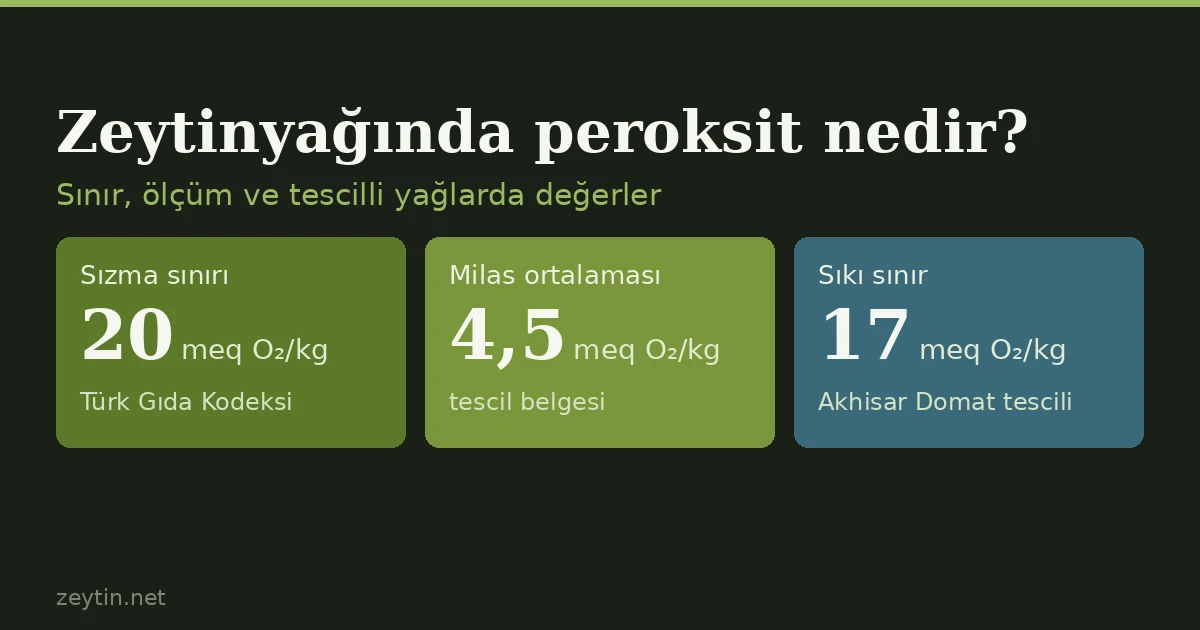
What is the peroxide value of olive oil? Is a high value harmful?
The peroxide value shows that oil has begun to oxidise; the limit for extra virgin is 20 meq/kg. Registered Turkish oils measure 4.5-9.3 on average.
 Article
How to store freshly pressed olive oil: settling, sediment and the right container
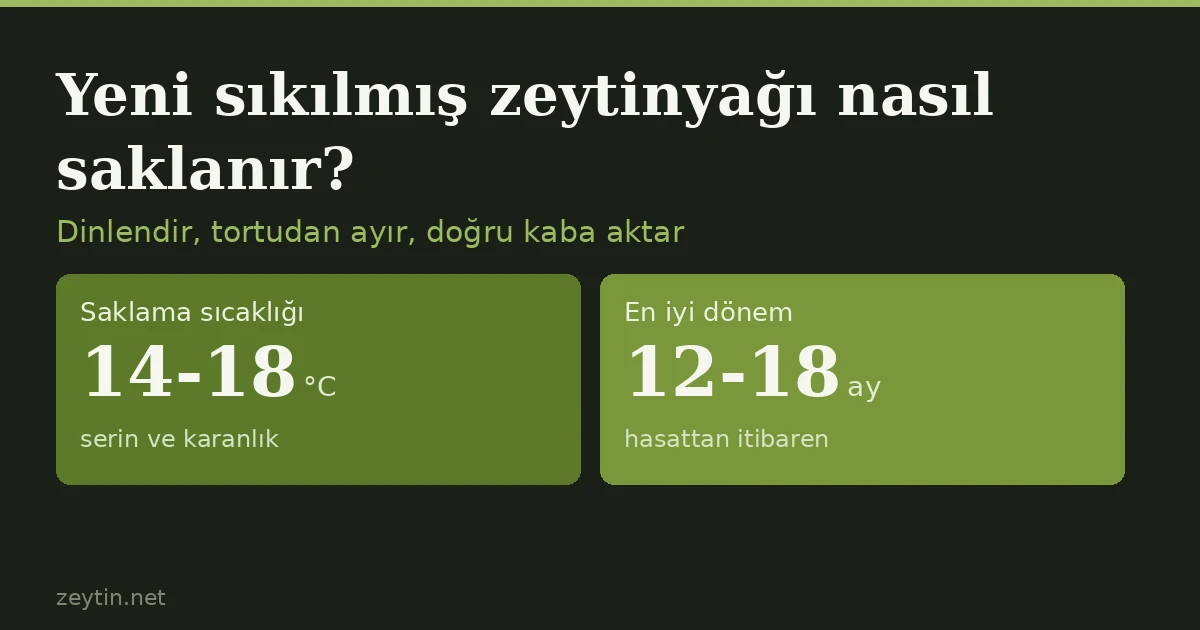
Oil fresh from the mill is cloudy and contains water and fruit particles. It is left to settle for a few weeks somewhere cool and dark in a container filled to the top, then the clear oil is separated from the sediment and moved into tins or dark glass. Oil left sitting on its sediment for months spoils.