Irrigating Olives: When, How Much, How
Olive water requirements, critical periods, drip system layout, deficit irrigation and water quality.
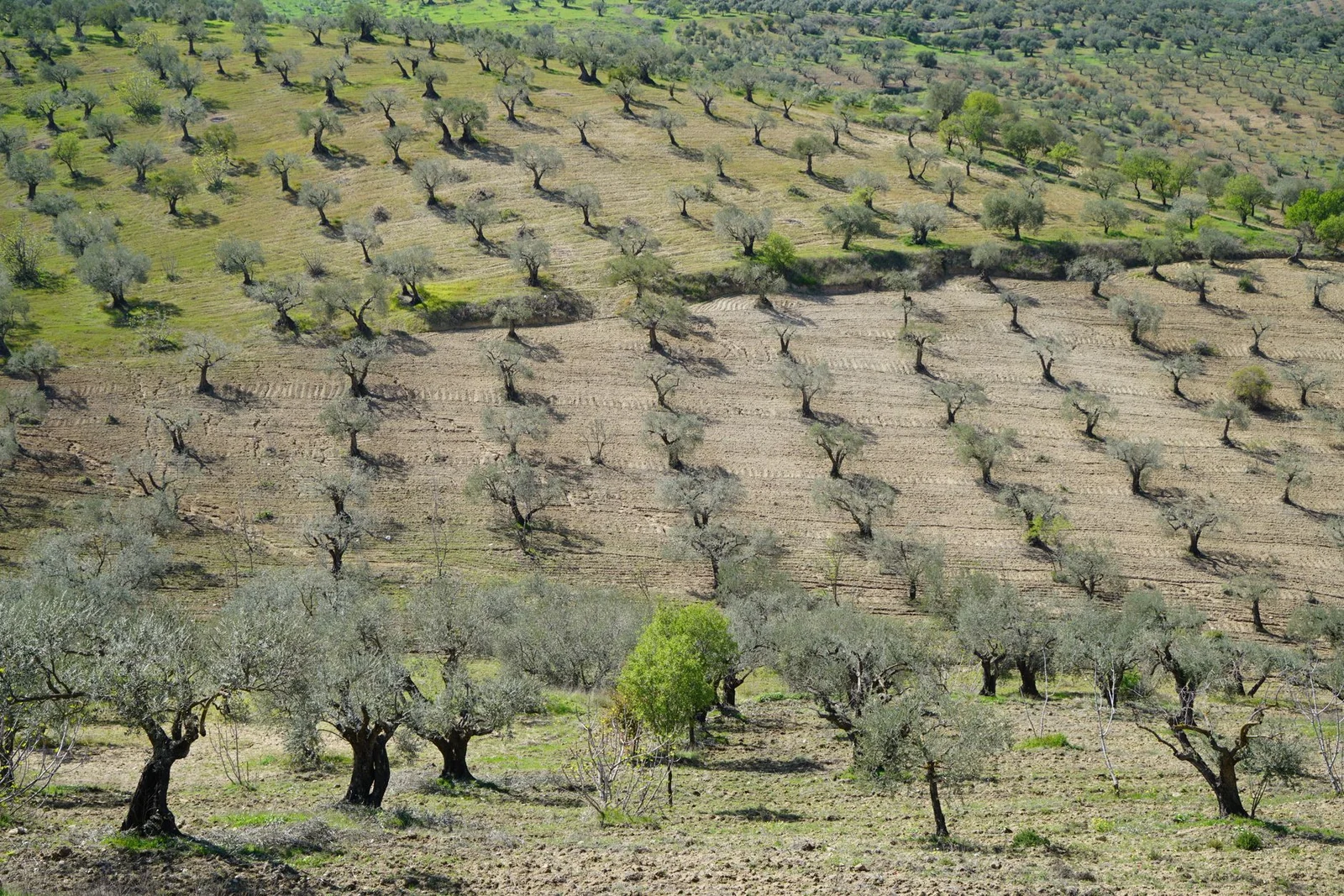
The olive is a drought-tolerant tree. That sentence is true and misleading in equal measure: surviving and cropping are not the same thing. A tree short of water does not die — it makes smaller leaves, shorter shoots, drops fruit, and fails to set next season's flower buds. The bill for drought is not paid that year; it is spread across two.
How much water does an olive need?
A rainfed grove holds together on 400–500 mm of annual rainfall. But the gap between "holding together" and "economic yield" is wide: irrigated groves can yield two to three times what rainfed ones do.
Water demand depends on three things:
- Climate. Temperature and wind set evaporation. The same cultivar does not want the same water on the İzmir coast as in Şanlıurfa.
- Soil. Sandy soil holds little water and wants frequent, small applications. Clay holds water but drains and aerates poorly; less frequent, larger applications suit it better.
- Planting density and canopy volume. Twenty trees per decare and a hundred trees per decare do not use the same water. High-density plantings need markedly more water per unit area.
Critical periods: when the water arrives matters more than how much
The olive is not equally sensitive all year. Four periods decide the season:
1. Before flowering (April–May). Flower bud development is governed by water status now. Stress here directly reduces the number of flowers that season.
2. Fruit set and early growth (May–June). The four to six weeks after fertilisation are when fruit cells divide. A water deficit here permanently reduces fruit number; water applied later does not make it up.
3. Pit hardening (July). This is the period in which the olive is most tolerant of drought. Deliberate deficit irrigation (below) is normally placed here.
4. Oil accumulation (August–October). The period in which oil forms in the fruit. Water stress now lowers oil content — but excess water dilutes polyphenols and delays harvest.
⚠ Heavy irrigation close to harvest swells the fruit, proportionally lowers oil content and leaves the fruit prone to bruising. Irrigation is reduced or stopped two to three weeks before picking.
Why drip became the standard
Flood irrigation still exists in olive groves, but it is retreating for three reasons:
- Water efficiency. Drip delivers water directly to the root zone; evaporation and deep percolation losses are low.
- Weeds. Flood irrigation wets the entire surface and germinates weed seed. Drip wets only the tree row.
- Fertilisation. The drip line is also the fertiliser line (fertigation): nutrients go where the water goes.
Typical layout. One or two lateral lines along the row, two to four emitters per tree, emitter flow of 2–4 L/hour. A single line suffices on young trees; a second is added as the canopy grows. Placing emitters hard against the trunk keeps the root collar permanently wet and invites collar rot — emitters are shifted out toward the canopy drip line.
Deficit irrigation: withholding water on purpose
A widespread approach in olives is to give the tree deliberately less than its full requirement during a defined window (regulated deficit irrigation). The logic: the olive passes through pit hardening with comparatively little cost from water stress. Cutting water in that window reduces total consumption substantially while the yield penalty stays much smaller.
In practice:
- The deficit goes only into pit hardening — never into flowering or fruit set.
- A deficit is not "no water"; roughly half the requirement is still supplied.
- A deficit imposed without measuring soil moisture is not a deficit, it is neglect.
How do you know when to irrigate?
Calendar irrigation is the most common method and the weakest. Three better options:
Soil moisture measurement. A tensiometer or moisture sensor placed in the root zone. Cheap, direct and instructive: after a couple of seasons you know how your grove behaves.
Water budgeting. Reference evapotranspiration (ET₀) from meteorological data, multiplied by a crop coefficient, minus rainfall. Works on calculation, needs no sensors.
The tree itself. Slight leaf curling at midday is the first sign. But by the time it shows, stress has already begun: this is late confirmation, not early warning.
Water quality
The olive is considered comparatively salt-tolerant, but not without limit. Yield falls as the electrical conductivity of irrigation water rises, and under drip irrigation salt accumulates specifically at the edge of the wetted zone. Where saline water is used, winter rainfall leaches that salt away; where rainfall is insufficient, deliberate leaching irrigations are applied periodically.
Lime and iron deposits also block emitters. Filter maintenance and an end-of-season acid flush are the most mundane jobs in the system and the most frequently skipped — and they decide how long it lasts.
Young trees and mature trees are not the same
A newly planted tree has a small root volume and cannot reach moisture deeper in the profile. Young trees are therefore watered little and often. A mature tree draws from a large volume through deep roots and makes better use of less frequent, larger applications.
The first two years after planting are when irrigation matters most. Saving water here produces a tree that grows on with a root system it never fully recovers.
Irrigation in high-density orchards
Super-high-density (SHD) systems do not work without irrigation. Tree numbers per unit area are high, canopy volume is constrained and root volume is small; the system demands regular, measured water. Here irrigation is not a supplement but a load-bearing part of the design — an interruption is a yield loss.
Common mistakes
1. Irrigating by the calendar. Same day, same duration every week. The soil and the weather change; the schedule does not.
2. Many short irrigations instead of fewer long ones. This wets the surface, never draws roots downward, and produces a shallow root system.
3. Emitters against the trunk. The root collar stays permanently wet.
4. Irrigating right up to harvest. Oil content and fruit robustness both fall.
5. Neglecting the filter. A blocked emitter is invisible; trees weaken one by one and the cause is hunted elsewhere.
Summary
Irrigating olives is less a question of "how much" than of "when." Water given at flowering and fruit set converts directly into crop; water withheld at pit hardening is largely profit; water given close to harvest is usually a cost. Irrigating without measuring is like broadcasting fertiliser into the wind: the expense is certain, the return is not.
One rating per visitor; you can change yours at any time. Ratings are real reader votes — no seeded or default scores.
Related
 Article
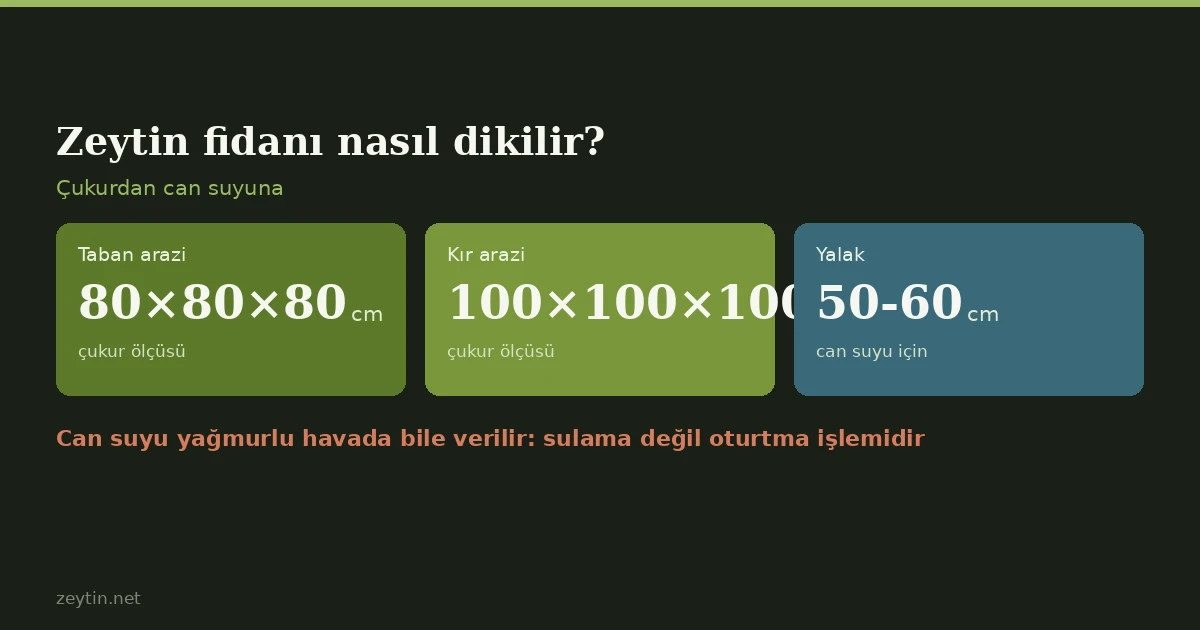
How to plant an olive sapling
Planting season, hole dimensions, removing a potted sapling, planting depth and the graft union, the basin and settling water — why settling water is given even in rain, first-year care and five common mistakes.
Article
How to plant an olive sapling
Planting season, hole dimensions, removing a potted sapling, planting depth and the graft union, the basin and settling water — why settling water is given even in rain, first-year care and five common mistakes.
 Article
How to Grow an Olive Tree
Soil, climate, watering, pruning and patience. A basic care guide for anyone planting an olive tree.
Article
How to Grow an Olive Tree
Soil, climate, watering, pruning and patience. A basic care guide for anyone planting an olive tree.
 Article
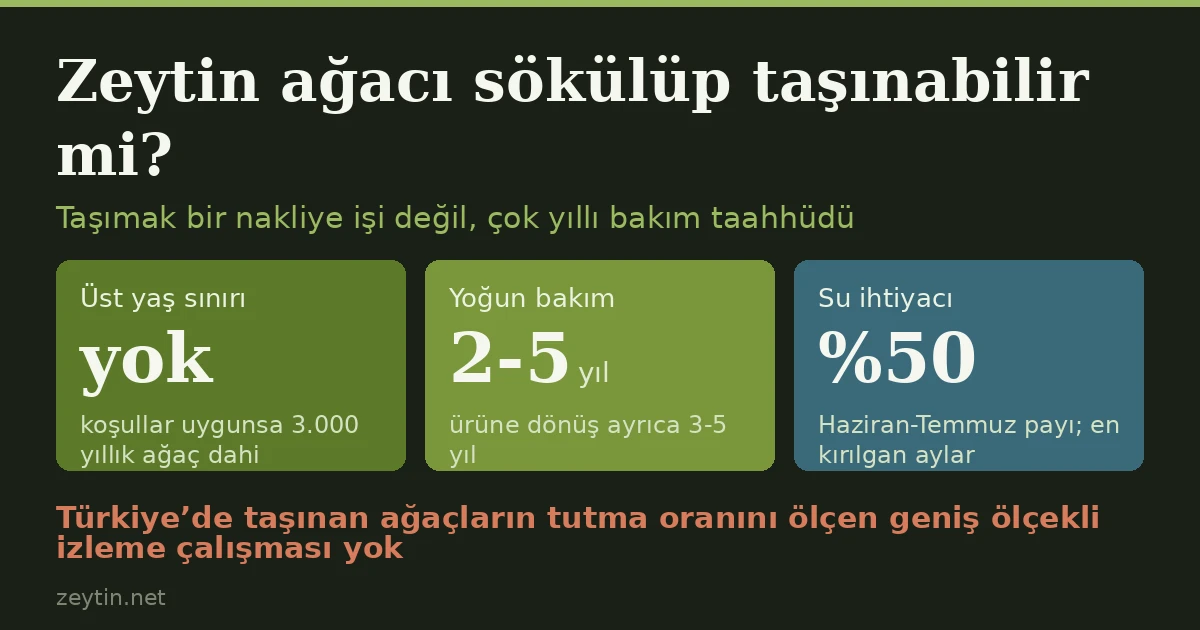
Can an olive tree be uprooted and moved?
The technical answer is yes: olives can be moved at any age, with no upper limit. But "can be moved" and "is the same tree afterwards" are different questions. Winter timing, root-to-canopy balance, two to five years of care and three to five years without fruit are the real cost — and no large-scale Turkish study measures survival rates.
Article
Can an olive tree be uprooted and moved?
The technical answer is yes: olives can be moved at any age, with no upper limit. But "can be moved" and "is the same tree afterwards" are different questions. Winter timing, root-to-canopy balance, two to five years of care and three to five years without fruit are the real cost — and no large-scale Turkish study measures survival rates.
 Article
How many kilos of olives does one tree yield?
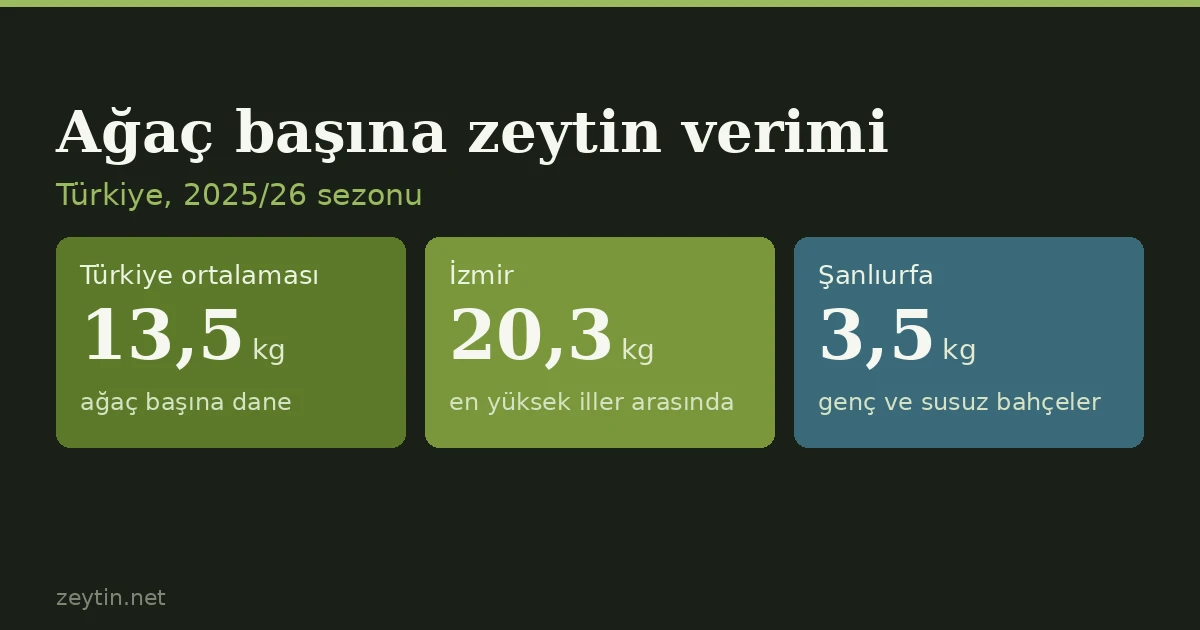
Türkiye averaged 13.5 kilos per tree in the 2025/26 season. But the average describes nobody's grove: 20.3 kilos in İzmir, 3.5 kilos in Şanlıurfa. The same grove does not repeat its own number either — across six major provinces, per-tree yield went from 22.6 kilos one season to 8 kilos the next. Here is what the figure actually depends on, and how to place your own tree against it.
Article
How many kilos of olives does one tree yield?
Türkiye averaged 13.5 kilos per tree in the 2025/26 season. But the average describes nobody's grove: 20.3 kilos in İzmir, 3.5 kilos in Şanlıurfa. The same grove does not repeat its own number either — across six major provinces, per-tree yield went from 22.6 kilos one season to 8 kilos the next. Here is what the figure actually depends on, and how to place your own tree against it.