Harvest opens in Mut: 300,000 tonnes expected, orchard prices start at 10 lira
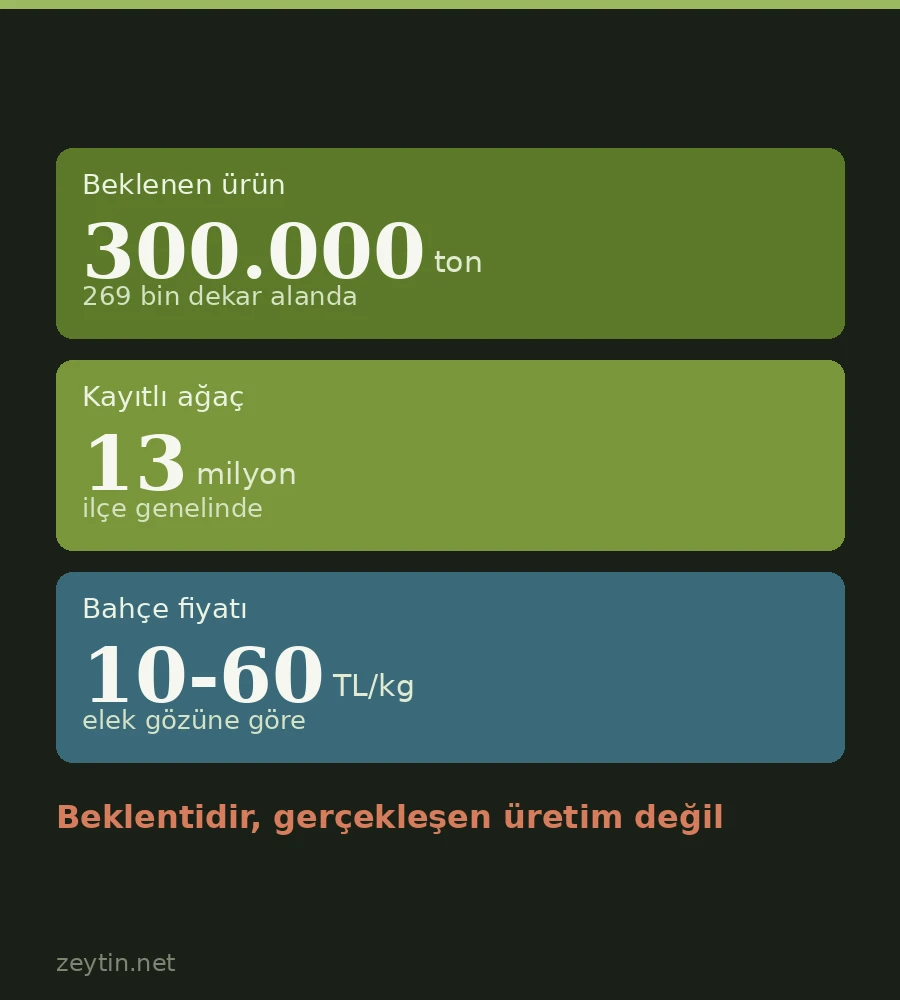
Mut's district agriculture directorate reports 300,000 tonnes expected from 269,000 decares, with orchard prices ranging from 10 to 60 lira by sieve size. Yield is high but growers are unhappy with prices. Set against our own Mersin figures the tonnage leaves an unresolved measurement gap, and we report it as such.
Turkey's table-olive harvest has opened in what is, by a wide margin, the country's largest single-district olive area. The first picking has been done in Mut, a district of Mersin province, and orchard-gate prices came in between 10 and 60 lira per kilo depending on sieve size.
The expectation
According to information relayed from officials at the Mut District Directorate of Agriculture and Forestry, the district holds 13 million registered olive trees across 269,000 decares (26,900 hectares), and this year's yield is high: 300,000 tonnes of fruit is expected.
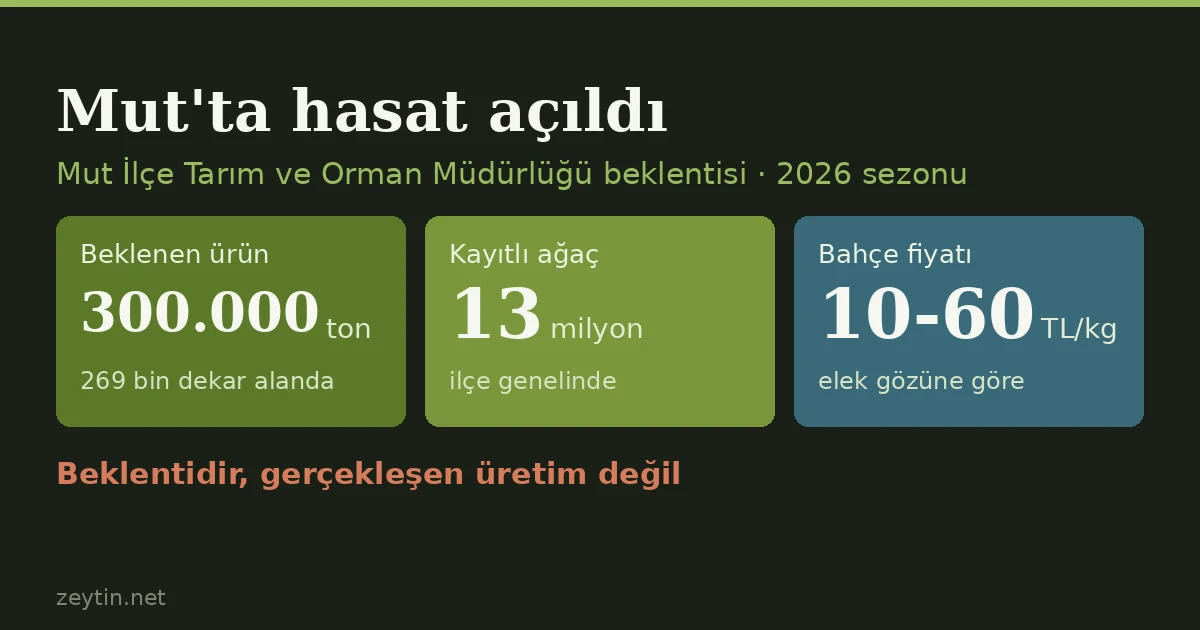
| Mut · 2026 season | Value |
|---|---|
| Area | 269,000 decares |
| Registered trees | 13,000,000 |
| Expected crop | 300,000 t |
| Orchard price | 10 – 60 TL/kg |
A sixfold price range is not as strange as it looks. In table olives the price is set by sieve size — the calibre of the individual fruit. The fewer olives it takes to make a kilo, the higher the price. So 10 lira and 60 lira are not two ends of one market but the prices of two different markets: small fruit largely goes to oil or to paste, while large calibres go directly into shelf-ready table products.
What growers say
Hasan Tepe, who both grows and sells, confirmed that the yield is high but said prices are low compared with last year, adding: "What we wanted was different — our farmers were expecting better, and it did not happen." Another grower, İbrahim Arı, said the season had opened in Mut, that prices run from 10 lira up to 60 lira according to sieve size, and that the yield is high.
That pairing — plenty of fruit, weak prices — looks like the defining shape of this season. In the same week Andalusia published a crop forecast up 23.9%, and growers there were unhappy about prices too. Supply growth pushing prices down is expected behaviour. The problem is that costs do not fall at the same speed, so a bigger harvest does not reach the grower's pocket in the same proportion. Labour, fuel and packaging are priced in this year's lira, not last year's.
We checked the figure against our own data, and it does not close
This needs stating plainly. The Mersin data on this site comes from UZZK's official assessment report for the 2025-26 season, and it is at province level, not district:
| Mersin province · 2025-26 (UZZK) | Value |
|---|---|
| Total fruit | 224,537 t |
| Bearing trees | 11,539,000 |
| Non-bearing trees | 2,575,000 |
| Yield per tree | 19.5 kg |
Put the two side by side and this is what comes out: the district of Mut alone reports 13 million trees, while the whole of Mersin province holds 14.1 million including non-bearing stock. The district would therefore account for almost the entire province, as though the olive groves of Silifke and Tarsus were not there. The same tension appears in tonnage: the district expects 300,000 tonnes, while the province's total last season was 224,537.
⚠ This is not a gotcha, it is a difference in measurement base, and we cannot resolve it. The phrase "registered trees" may refer to declarations in the Farmer Registration System, whereas what UZZK counts in its pre-harvest assessment is bearing trees. The two counts are not measuring the same thing. Because the source does not state which definition applies, we pass the figure on without correcting it.
One cross-check does hold up. Divide 300,000 tonnes by 13 million trees and you get 23 kg per tree. The national average UZZK gave for 2024-25 was 21 kg, and Mersin's 2025-26 average was 19.5 kg. So the implied per-tree yield is entirely plausible for an on-year. The inconsistency is not in the yield assumption; it is in the scope of the tree count.
Why Mut is worth watching
Mut is the largest centre where Turkish olive growing moves outside the Aegean. The district's olive oil carries a geographical indication, and we have separately examined its processing structure in a field study. It is also no accident that the national harvest calendar opens in Mut: in the hot inland Mediterranean, ripening completes earlier than in the Aegean. That makes the Mut price the first reference point of the season, and buyers elsewhere watch it for exactly that reason.
⚠ The orchard-gate price is not the shelf price. The 10–60 lira band is what leaves the grower's hands; brining, processing, packaging and distribution are added on top.
⚠ The 300,000 tonnes here is an expectation, not realised production. Harvest closes in November and December, and the national figure only becomes firm when the UZZK report is published.
One rating per visitor; you can change yours at any time. Ratings are real reader votes — no seeded or default scores.
Related
 Article
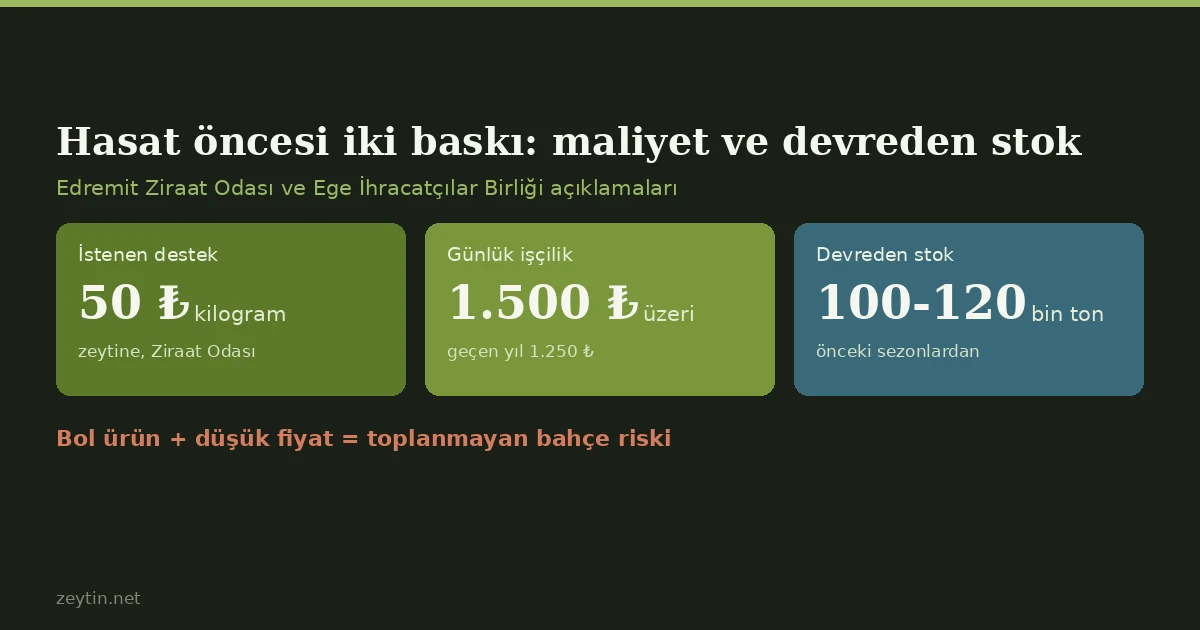
Two pressures before the harvest: costs and 100,000 tonnes carried over
The chamber of agriculture wants 50 lira per kilo; daily labour has passed 1,500 lira. Exporters report 100,000-120,000 tonnes carried over from previous seasons.
Article
Two pressures before the harvest: costs and 100,000 tonnes carried over
The chamber of agriculture wants 50 lira per kilo; daily labour has passed 1,500 lira. Exporters report 100,000-120,000 tonnes carried over from previous seasons.
 Article
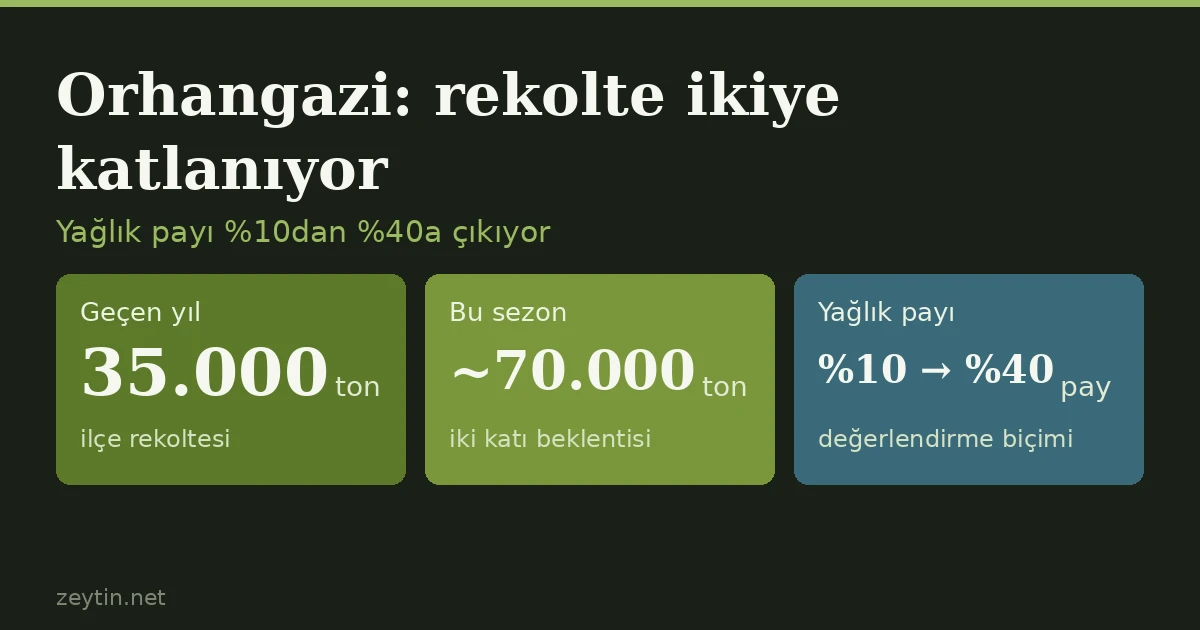
Orhangazi's crop is doubling: the oil olive share climbs from 10% to 40%
According to figures from the Orhangazi District Directorate of Agriculture and Forestry, last season's crop of roughly 35,000 tonnes could double this year. But in Türkiye's table olive heartland the real shift is in the split: the share pressed for oil is expected to rise from 10% to 40%. Mills are already in maintenance, and the grower's income now depends on fruit size.
Article
Orhangazi's crop is doubling: the oil olive share climbs from 10% to 40%
According to figures from the Orhangazi District Directorate of Agriculture and Forestry, last season's crop of roughly 35,000 tonnes could double this year. But in Türkiye's table olive heartland the real shift is in the split: the share pressed for oil is expected to rise from 10% to 40%. Mills are already in maintenance, and the grower's income now depends on fruit size.
 Article
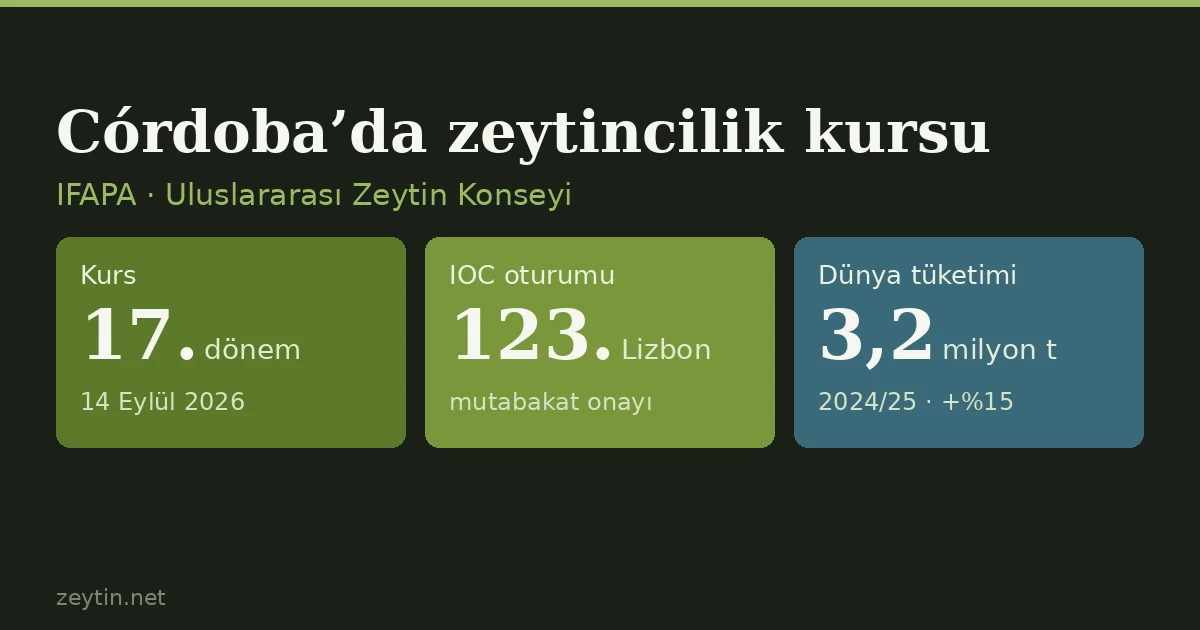
17th Advanced Course in Olive Growing opens in Córdoba as the IOC and IFAPA move towards genetic resources cooperation
Andalusia's Institute of Agricultural and Fisheries Research and Training (IFAPA) opened its 17th Advanced Specialisation Course in Olive Growing in Córdoba on 14 September, with the International Olive Council giving the opening lecture. The Council has approved signing a memorandum of understanding with IFAPA, which hosts one of the world's key olive germplasm collections.
Article
17th Advanced Course in Olive Growing opens in Córdoba as the IOC and IFAPA move towards genetic resources cooperation
Andalusia's Institute of Agricultural and Fisheries Research and Training (IFAPA) opened its 17th Advanced Specialisation Course in Olive Growing in Córdoba on 14 September, with the International Olive Council giving the opening lecture. The Council has approved signing a memorandum of understanding with IFAPA, which hosts one of the world's key olive germplasm collections.
 Article
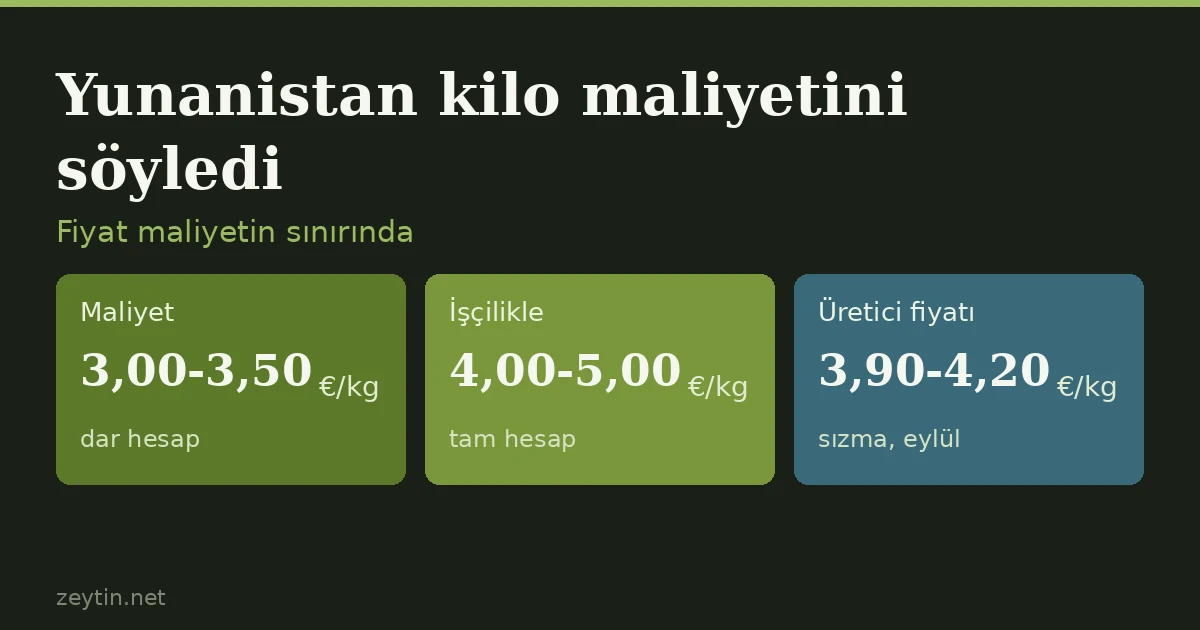
Greece finally puts a number on its cost: €3-3.5 a kilo, up to €5 with labour
For the first time Greece has put a per-kilo figure on its olive oil production cost: €3.00-3.50, rising to €4.00-5.00 once labour is fully counted. The producer price stands at €3.90-4.20, at or below that cost. Spain's €1.70-2.00 for the same item shows where the competitive gap actually sits. Greek output for 2026/27 is estimated at 280,000-330,000 tonnes.
Article
Greece finally puts a number on its cost: €3-3.5 a kilo, up to €5 with labour
For the first time Greece has put a per-kilo figure on its olive oil production cost: €3.00-3.50, rising to €4.00-5.00 once labour is fully counted. The producer price stands at €3.90-4.20, at or below that cost. Spain's €1.70-2.00 for the same item shows where the competitive gap actually sits. Greek output for 2026/27 is estimated at 280,000-330,000 tonnes.