Milas Olive Oil Soap: a registered second life for oil unfit for the table
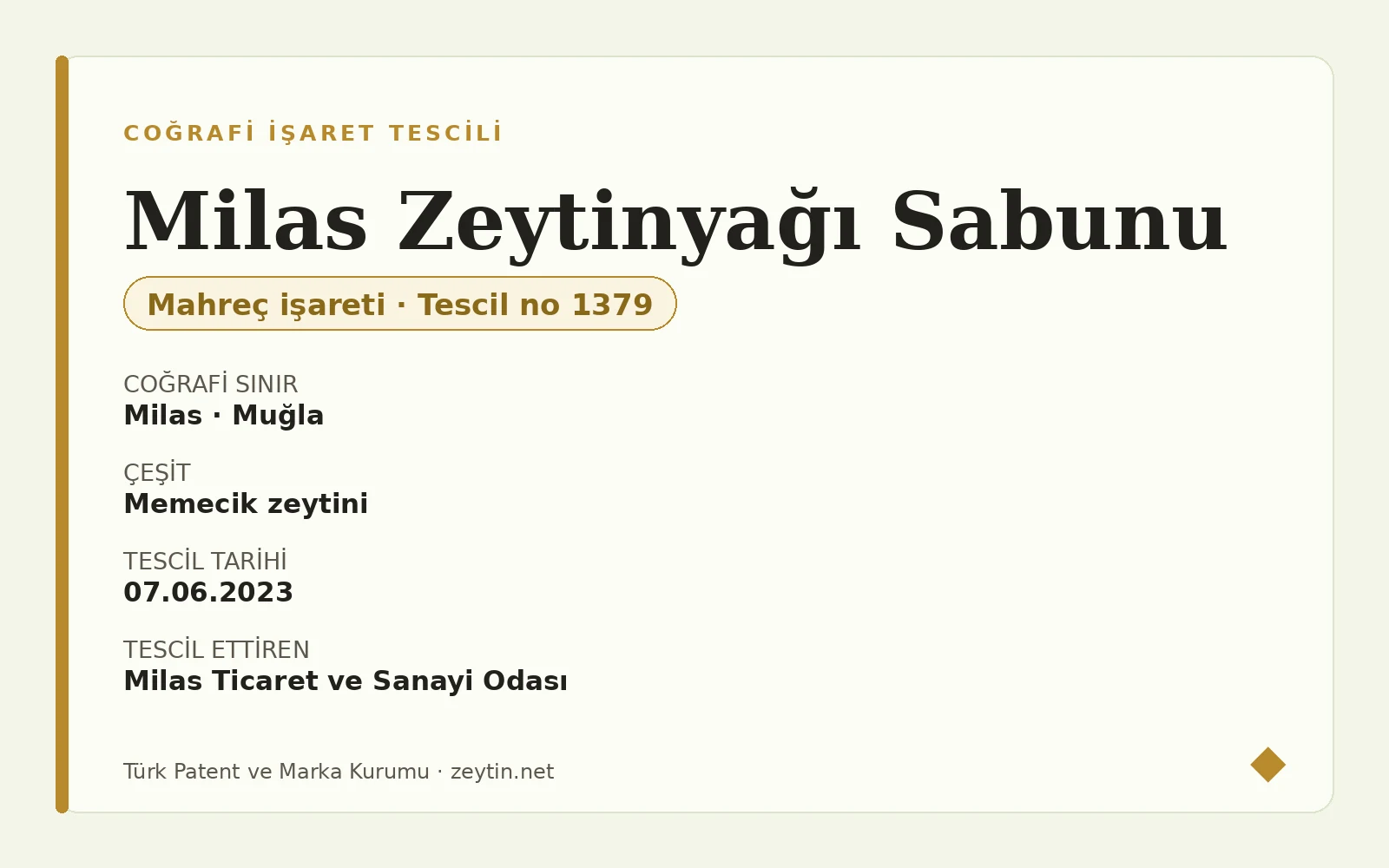
Registered in 2023. The document ties the soap to oil unfit for cooking: Memecik oil of acidity 6 or more and the sludge left at the bottom of oil jars.
Olive oil soap is usually praised for being made from good oil. The registration document for Milas Olive Oil Soap says the opposite: the raw material is oil that cannot go to the table. According to the document, the soap is boiled from Milas olive oils with an acidity of 6 or higher, and from the sediment that settles at the bottom of oil containers, known locally as "olive oil mud". Low-acidity oil that has become contaminated ("murdar" in local speech) may also be used. In a sense, the registration gives a centuries-old job description to the part of the oil that would otherwise be thrown away.
Reference details
| Registration no. | 1379 |
| Registration date | 07.06.2023 |
| Application | C2022/000254 · 12.08.2022 |
| Type | Geographical indication (mahreç işareti) |
| Registered by | Milas Chamber of Commerce and Industry |
| Geographical area | Milas district, Muğla province |
| Product group | Soap / Other products |
A geographical indication of this type normally requires at least one stage of production to take place in the defined area. This document is stricter: because the product is tied to the place by human skill and reputation, all operations must be carried out within Milas.
The raw material rule
Both methods share one condition: the oil must be olive oil or olive oil mud obtained from Memecik olives in the Milas area. The document counts it as distinctive that olive oil is the only fat used and that no chemical other than caustic soda (sodium hydroxide) goes in. Polishing and colouring are not allowed.
The acidity threshold puts this in context. Olive oil acidity may be at most 0.8 percent for extra virgin and 2 percent for virgin. A value of 6 or more is far above that; such oil could reach the table only after refining. The soap cauldron is a local and much older alternative to the refinery.
Two production methods
| Method | Scale in the document | Process |
|---|---|---|
| Hot | 60 kg of oil and/or mud, 15 kg of caustic soda, 150 litres of water in total | In 200-litre drums over an olive or pine wood fire; once boiling, the soap water is drawn off, then boiling continues for another 5-6 hours |
| Cold | 750 ml of oil, 840 g of caustic soda, 200 ml of water | Caustic soda and oil are stirred with a wooden stick; the mixture heats up by itself and saponification is complete when it thickens |
According to the document, the hot method is still the common one in Milas villages, while demand for the cold method is growing because the volatile compounds in the oil are not driven off by heat. In the hot method the caustic soda is a quarter of the oil by weight: 15 kilos to 60.
Caustic soda is dangerous. The document itself notes that the fumes from the cold mixture are toxic and must not be inhaled. The quantities above are therefore the procedure the registration defines, not a home recipe.
Moulds, drying and the stamp
The thickened soap is poured onto a flat surface with 5 cm edges or into 8 × 5 × 5 cm moulds. It starts to set within three days at most and is cut into pieces of about 8 × 5 cm. The pieces are left where they are to dry, and the maker's or the company's stamp is struck onto them with a mallet. Lifting them takes another 5-6 days; drying fully can take 2-3 months in winter.
The document's test for readiness is practical: the bar should be hard enough not to give when pressed with a finger, and its surface should not be powdery. It may be sold by weight at markets; cardboard, tin, paper or cloth packaging are all allowed.
What the inspection checks
The inspection body has three representatives: the Milas Chamber of Commerce and Industry, the Milas Olive and Olive Oil Agricultural Sales Cooperative No. 153, and the Milas Chamber of Agriculture. Inspection takes place once a year, and at any time after a complaint. Laboratory analysis can be ordered from an accredited laboratory, at the chamber's expense.
| Criterion | Condition in the document |
|---|---|
| Hardness | Does not give when pressed with a finger |
| Colour | Bone white when dry; white to pale yellow when freshly poured |
| Smell | A light olive oil smell; no strong smell of the sludge |
| Lather | Checked by washing hands in tap water at 18-22 °C: should lather easily, without irritation or unusual dryness |
| Oil/caustic balance | Judged from lather and softness, again by washing hands |
All the criteria are sensory. The document sets no chemical limit for the soap, such as free alkali content; the inspector's hands take the place of a measuring instrument.
The historical record in the document
The document bases the soap's link to the place on three records. According to the 1889 Aydın Province yearbook (salname), the Milas district had 11 oil mills and 1 soap works at the end of the 19th century, producing 30,000-40,000 okka of soap a year. A 1954 source says most Milas soap was shipped to Mersin and İzmir. In the 1990s, branded Milas soaps were sold to provinces that produce no olive oil, such as Kahramanmaraş, Kayseri and Malatya. The wider history of the tradition, alongside Aleppo, Castile and Marseille soaps, is in the history of olive oil soap; how to recognise the real thing on the shelf is in our olive oil soap guide.
The document's sentence on skin
The document states that because olive oil "binds sodium in optimum proportion", the soap irritates the skin less, and that the product is known for its softness. This is the applicant's own description; the document cites no study measuring it. Soap is also not the same as oil applied to the skin: soap is rinsed off and does not stay on.
In short
Milas Olive Oil Soap is a geographical indication built on the same Memecik oil as the separately registered Milas Olive Oil, but it puts to use the part that cannot go to the table. What the document teaches is that it defines quality not by the oil's acidity but by the method: a wood fire, caustic soda only, an uncoloured and unpolished bar, and months of drying.
One rating per visitor; you can change yours at any time. Ratings are real reader votes — no seeded or default scores.
Related
 Article
How Cold-Pressed Olive Oil Is Made
From tree to bottle: washing, crushing, malaxation and separation. Why the temperature must stay below 27°C.
 Article
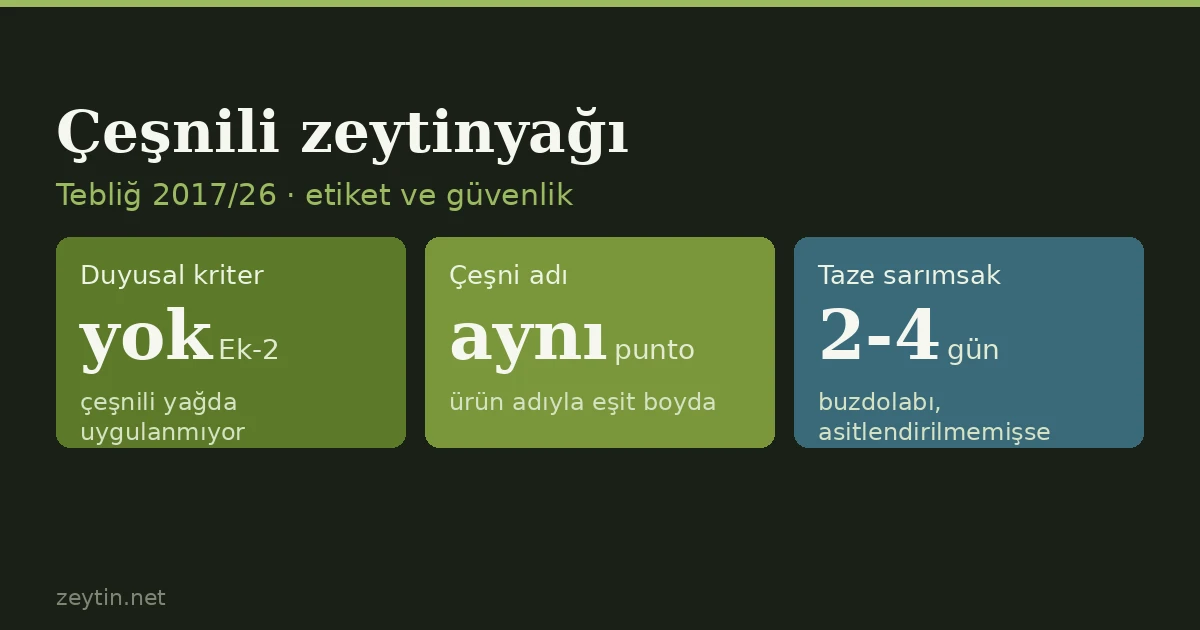
What is flavoured olive oil, and what should you look for on the label?
Flavoured olive oil is not a separate grade but an existing grade with spices, plants, fruit or vegetables added. The Turkish Food Codex requires the flavour name to be printed as large as the product name; yet the same communiqué does not apply sensory criteria to flavoured oils, meaning defects are not officially measured. Production methods, the botulism risk with fresh garlic, shelf life, and what to ask when buying.
 Article
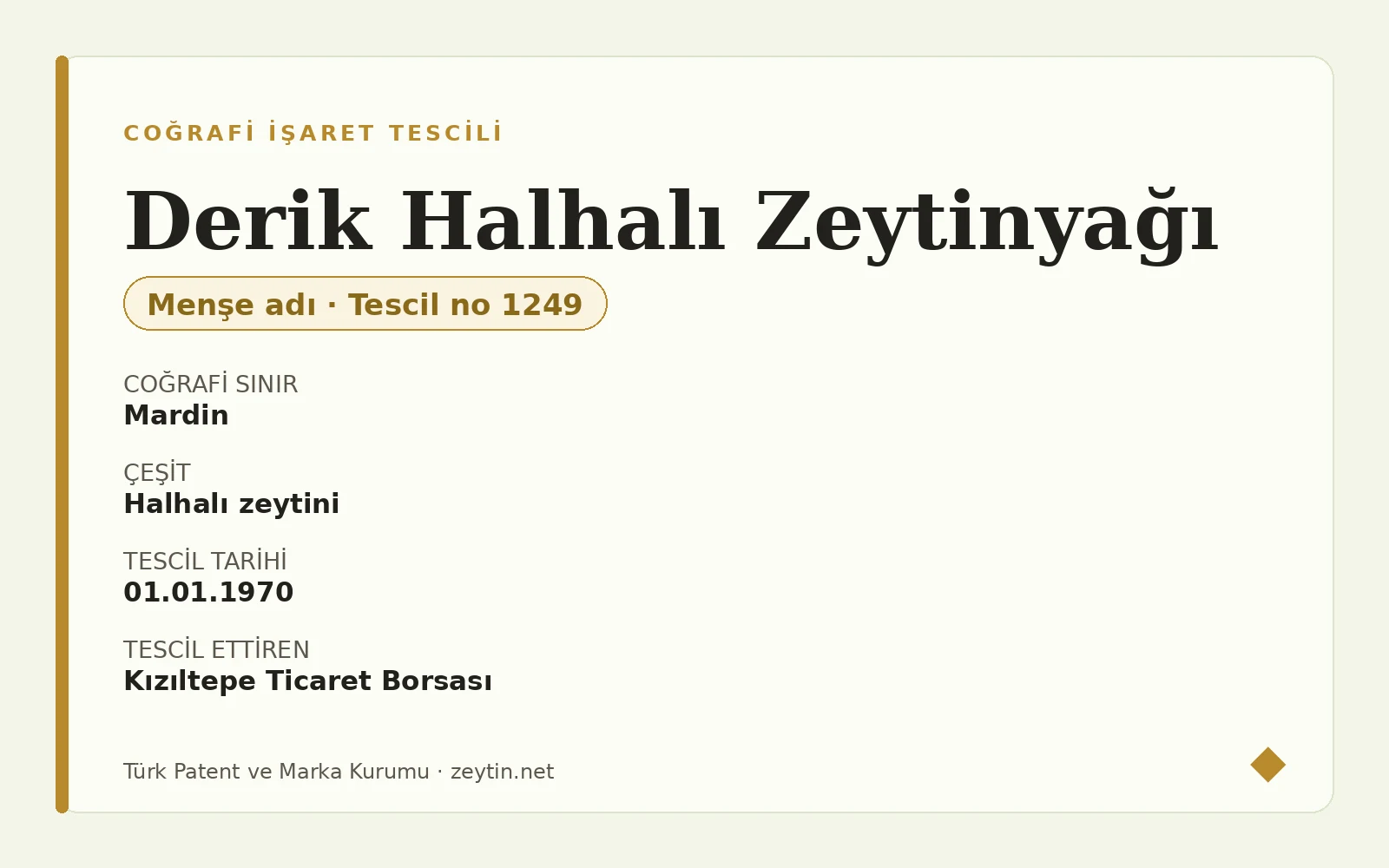
Derik Halhalı Olive Oil: a burn reminiscent of red pepper
Registered in 2022. Low acidity (0.29-0.60%) and high phenols; the certificate describes the pungency directly — a lasting burn spreading over tongue and lips.
 Article
Mut Olive Oil: a landscape that needs no pesticide
The certificate's real claim rests on altitude and humidity: 10-40% relative humidity keeps out both the olive fly and peacock spot. That is why organic production is straightforward here.