Marmarabirlik purchase prices: what the grower actually receives in Marmara
The 2025/2026 season: 160 ₺ for calibre 18, 55 ₺ for calibre 41, 53 ₺ for oil fruit. Size alone changes the price 2.9×, and the union buys down to calibre 41 where the market stops at 28.
In Marmara the price of table olives is set in practice not by an exchange but by a cooperative union: Marmarabirlik. Because no registered exchange price is published in the region, the most concrete indicator of what the grower actually receives is the purchase price this union announces each season.
2025/2026 purchase prices
The Marmara Olive Agricultural Sales Cooperatives Union announced its final prices for the 2025/2026 campaign as follows:
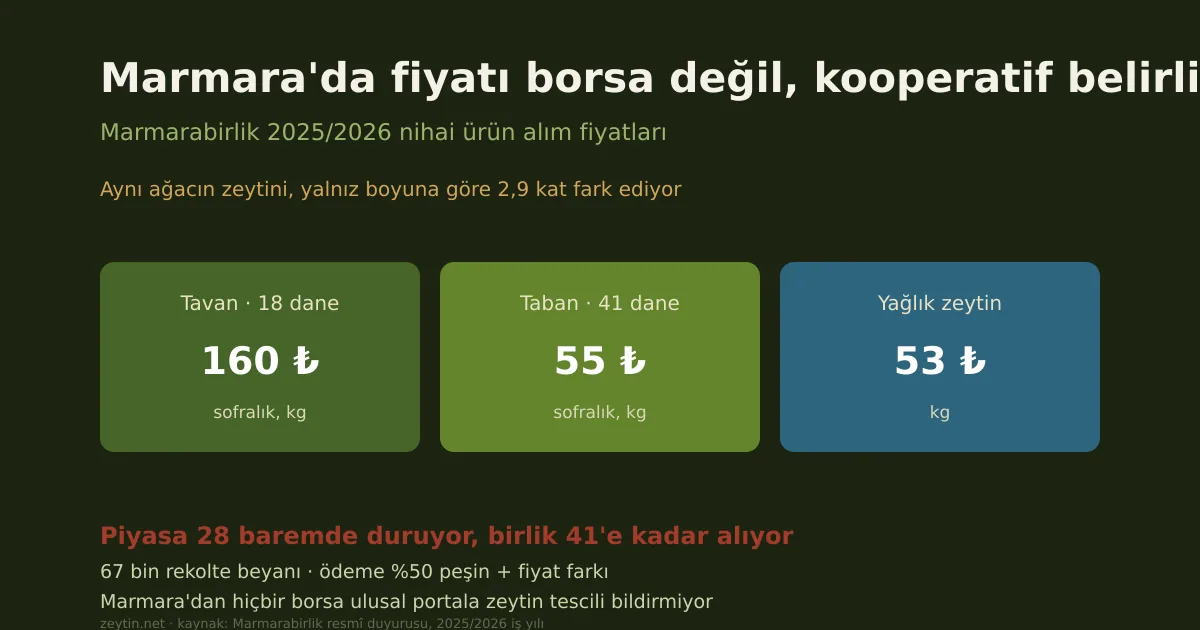
| Product | Calibre (fruits/kg) | Price |
|---|---|---|
| Table olives — ceiling | 18 | 160 ₺ |
| Table olives — floor | 41 | 55 ₺ |
| Olives for oil | — | 53 ₺ |
Prices are per kilogram. The calibre figure is the number of fruits in one kilo; the lower the number, the larger the olive and the higher the price.
The union received 67,000 crop declarations this season and set its prices on that basis.
What the numbers say: size changes price almost threefold
There is a 2.9× gap between the two ends of the table: 160 lira for 18-calibre, 55 lira for 41-calibre. Olives from the same tree, picked the same day, are priced this differently on size alone.
The reason is that the table market runs on calibre: large fruit is worth more to the consumer and suits value-added products such as stuffing and premium packaging. Small fruit goes to paste and to oil.
For how calibre drives price in detail: The economics of calibre — how fruit size changes the price
The gap between oil and table
On the same list, olives for oil fetch 53 lira. So there is almost no difference between the smallest table calibre (41, at 55 ₺) and oil fruit — while large table fruit is worth three times as much.
That alone explains why Marmara growers lean toward the table: more than 80% of the region's crop is processed as black table olives, most of it Gemlik.
Buying down to calibre 41
One detail in the chairman's statement shows the cooperative's role in the market: while the open market buys nothing above calibre 28, Marmarabirlik buys down to calibre 41.
In other words, the cooperative takes small fruit the free market will not. For the grower that means a return on produce that would otherwise be unsellable; for the union it means acting as a price floor.
Payment schedule
| Payment cycle | 15-day periods |
| Paid up front | 50% |
| Remainder | To be set once purchasing ends |
| First payment | 7 November 2025 (for deliveries up to 31 October) |
Splitting payment in two is standard cooperative practice: the union pays a price differential as it sells the crop and sees the revenue. In the same season the union went on to announce second and third instalments.
This means the announced figure is not the final income: the grower's total can end up higher once the differentials are paid at the end of the season.
Why is there no exchange price?
Olive prices in Türkiye are published on the national commodity exchange portal, but no exchange in Marmara reports olive registrations — all four exchanges publishing there are in the Aegean and the southeast.
The region's closest record is the Gemlik Commodity Exchange's monthly bulletins for 2019–2022, and that publication has stopped too. You can see that history here: Marmara olive price history (2019–2022)
So today the only regular, official answer to the price question in Marmara is Marmarabirlik's seasonal announcement.
In short
- 2025/2026 season: table olives 160 ₺ (calibre 18) to 55 ₺ (calibre 41); oil fruit 53 ₺.
- Size alone changes the price 2.9×.
- The cooperative buys down to calibre 41; the market stops at 28.
- Payment is 50% up front plus a differential; the announced figure is not the final income.
Source: Marmarabirlik official announcement, 2025/2026 purchasing campaign. Prices are set anew each season; check the union's own site for the current announcement.
One rating per visitor; you can change yours at any time. Ratings are real reader votes — no seeded or default scores.
Related
 Article
Early harvest: expensive or valuable? The arithmetic of yield
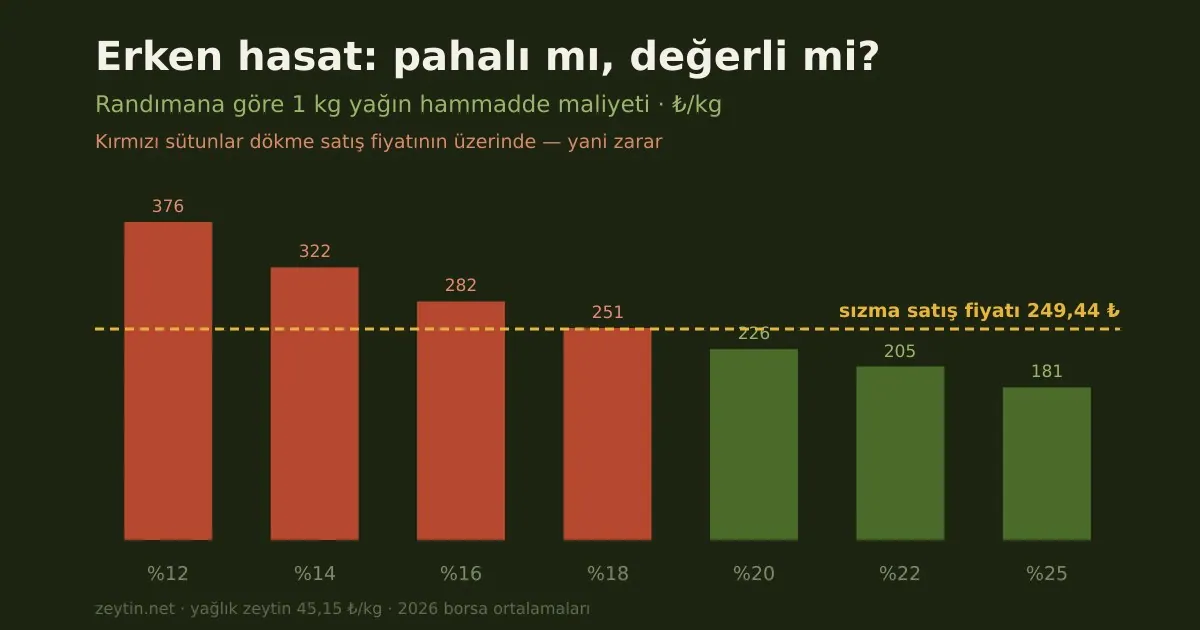
Below 18% yield the raw material costs more than the bulk price. Early-harvest oil needs a 43% premium to break even.
Article
Early harvest: expensive or valuable? The arithmetic of yield
Below 18% yield the raw material costs more than the bulk price. Early-harvest oil needs a 43% premium to break even.
 Article
The real price of olive oil: the inflation-adjusted calculation
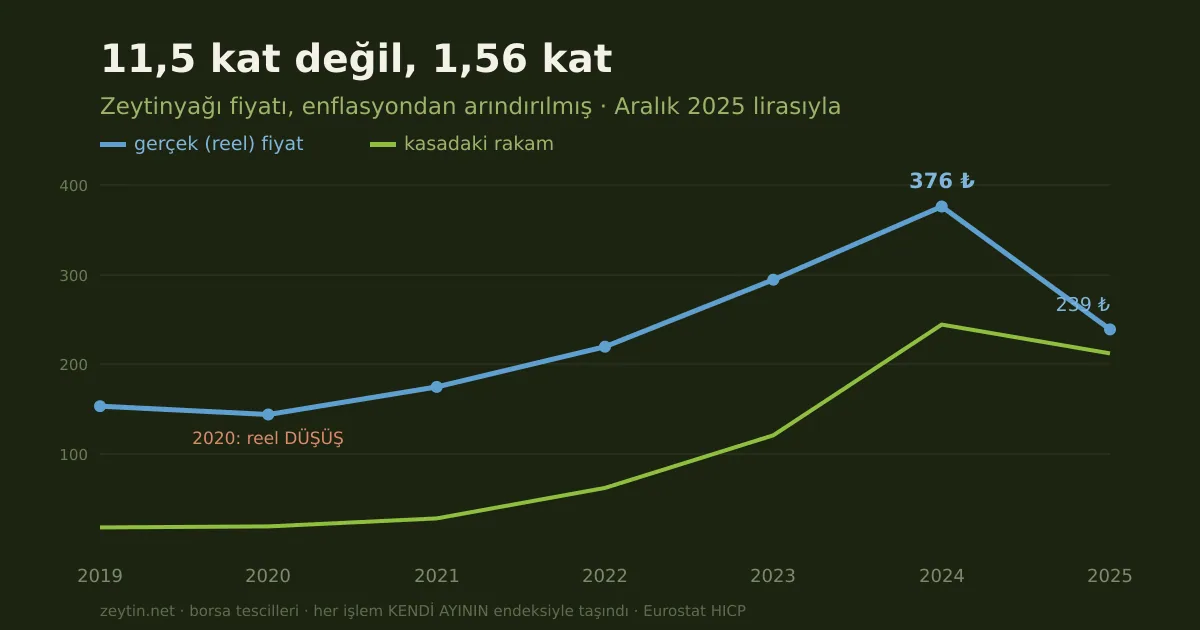
The lira price rose 11.5-fold, inflation 7.6-fold. The real increase is 1.56-fold — and it matches the euro-based calculation.
Article
The real price of olive oil: the inflation-adjusted calculation
The lira price rose 11.5-fold, inflation 7.6-fold. The real increase is 1.56-fold — and it matches the euro-based calculation.
 Article
Fourth in the world with 25 registrations — but what are they doing?
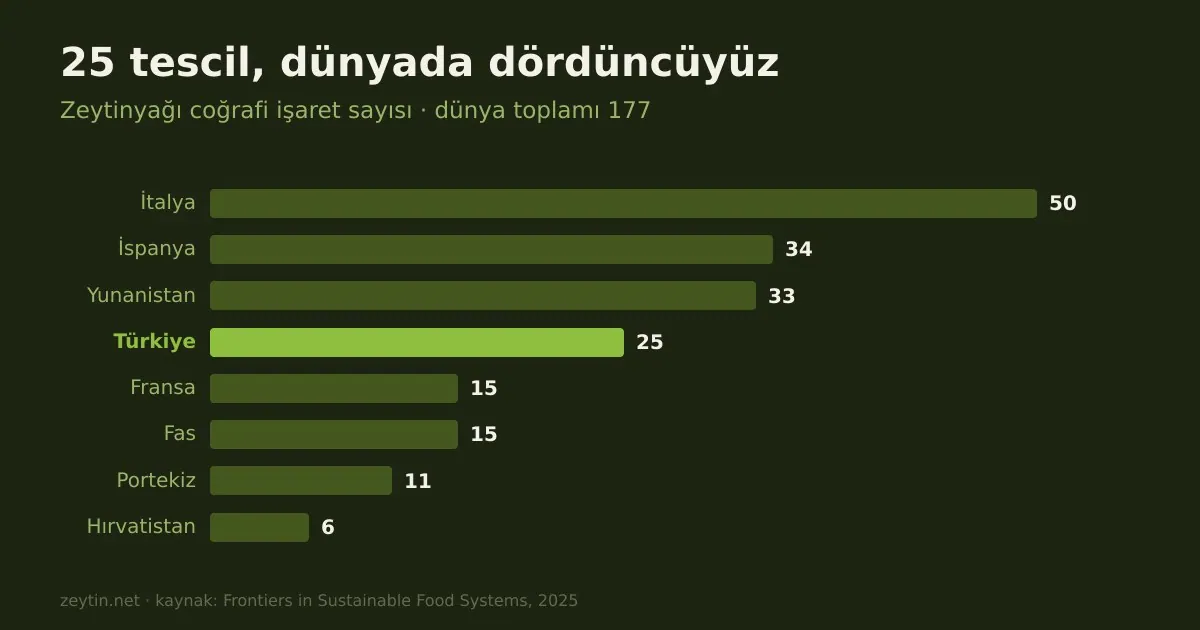
Türkiye is fourth in the world with 25 olive oil GIs. Yet exports fetch $3.17/kg — the product is still priced as a commodity.
Article
Fourth in the world with 25 registrations — but what are they doing?
Türkiye is fourth in the world with 25 olive oil GIs. Yet exports fetch $3.17/kg — the product is still priced as a commodity.
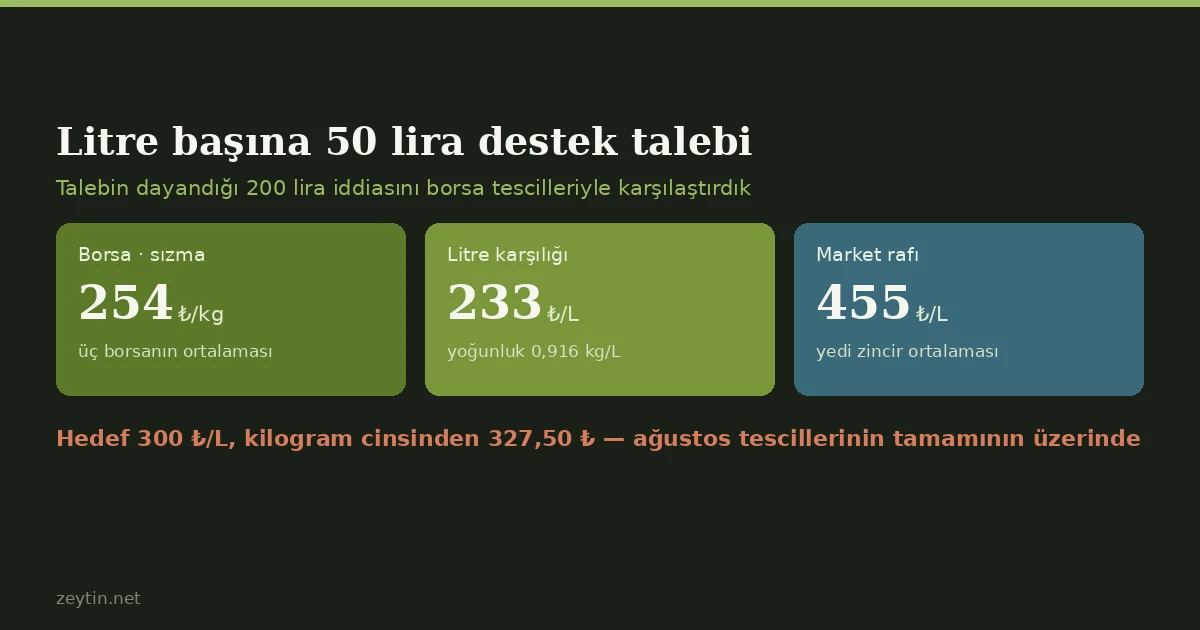 Article
A demand for 50 lira per litre: what the numbers say
The Edremit Chamber of Commerce has called for at least 50 lira per litre in support for olive oil producers. We check the price claim behind that demand against registered exchange trades.
Article
A demand for 50 lira per litre: what the numbers say
The Edremit Chamber of Commerce has called for at least 50 lira per litre in support for olive oil producers. We check the price claim behind that demand against registered exchange trades.