Lichen and moss on olive trees: harmful, or just a symptom?
The grey-green crusts and cushions of green on an olive trunk are not a disease: lichen is epiphytic, never enters living tissue and takes no water or nutrients from the tree. The real risk is the scale insects sheltering beneath it. Turkey's official olive IPM manual does not list lichen or moss as pests at all; the answer is not scraping but pruning the canopy open and restoring tree vigour.
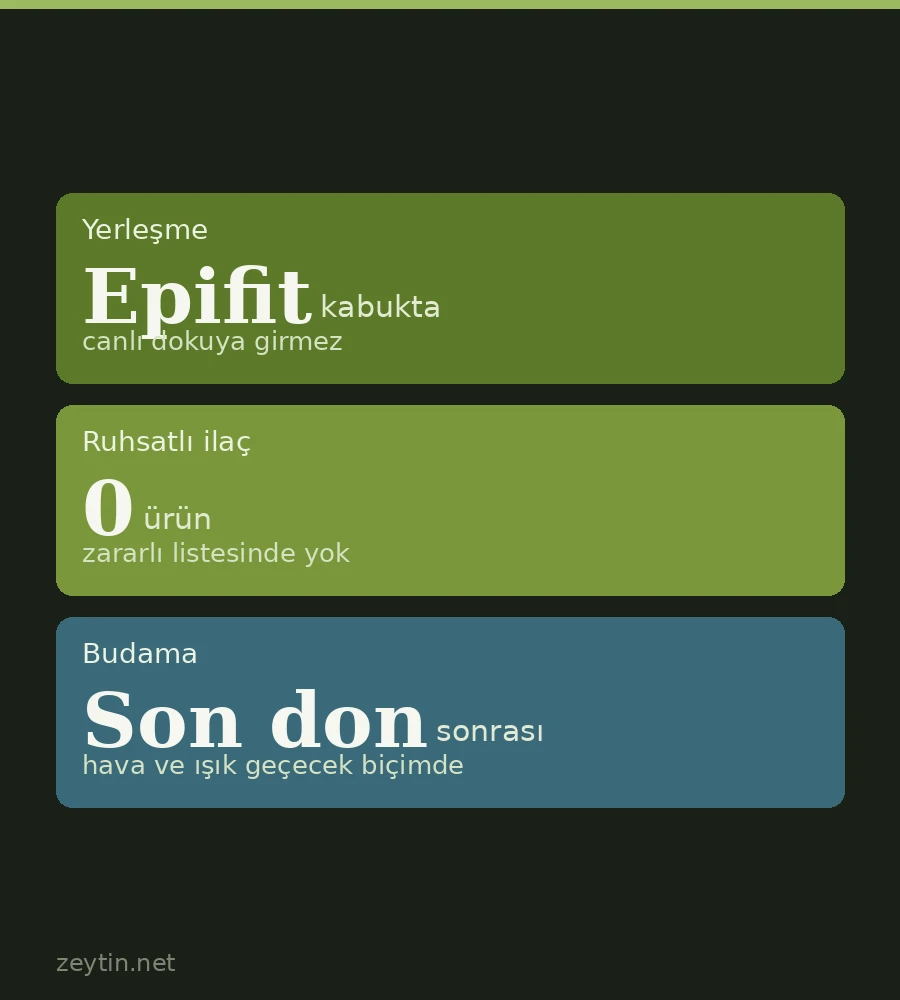
As harvest winds down and the pruning season approaches, growers look at the trunks and scaffold branches of their trees and see grey-green crusts, pale leafy flakes lifting away from the bark, and cushions of green. The same question comes back every year: is this killing the tree, and should it be scraped off? The short answer is that lichen and moss are not a disease of the olive tree. They are an indicator of the condition the tree is in. But they are not entirely innocent either, because of what shelters underneath them.
What lichen is, and what moss is
Lichen is not a single organism but a partnership: a fungus living together with a green alga or a blue-green bacterium. The fungus provides the structure and the grip on the surface; the alga photosynthesises and produces the sugar. On olive trunks the commonest forms are grey-green patches pressed flat against the bark and pale, leaf-like flakes whose edges lift away from it. Moss, by contrast, is a true plant, non-vascular, growing as a cushion on damp and shaded surfaces.
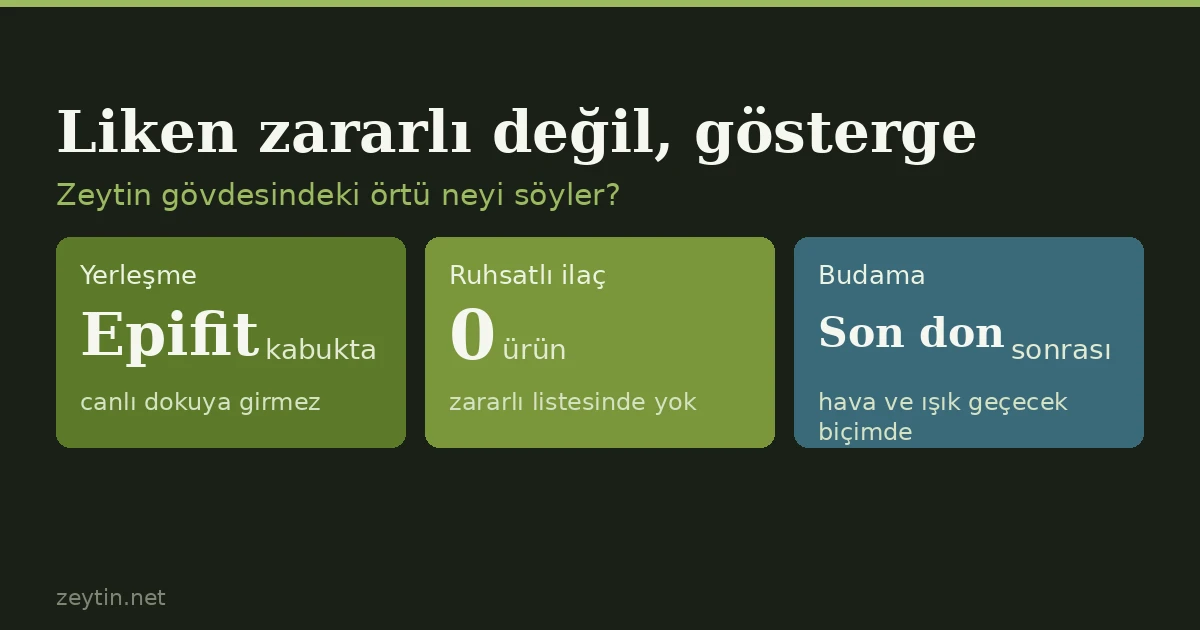
What they share is how they sit on a tree. Both are epiphytic: they use the surface they stand on purely as support. They take their water and nutrients from the air, from rainwater and from the dust that settles on the bark. The structures that anchor a lichen to bark are not roots, and they do not enter living conductive tissue. Extension sources from the universities of Alabama and Maryland state this plainly: lichen is not parasitic, it does not penetrate the bark, and it draws neither water nor nutrients from the tree.
What it does to the tree, and what it does not
Start with what it does not do. It does not feed on the tree, does not kill branches, does not cause leaf drop, and does not directly reduce yield. If an olive tree whose trunk is covered in lichen from top to bottom is cropping less than its neighbour, lichen is not the reason.
What it does is indirect. A classic Oregon State University extension bulletin written for Pacific Northwest fruit orchards draws the distinction in a single sentence: none of these growths are parasitic, but they may harbour injurious insects of various kinds. A thickened layer of lichen and moss covers over the fissures in the bark and keeps what is underneath damp and shaded, which is exactly the environment in which scale insects settle, lay eggs, and stay out of reach of their natural enemies. The same bulletin adds that where an orchard is sprayed regularly for diseases, no special spray for moss control is needed.
That indirect link matters in Turkish conditions too. The Ministry of Agriculture and Forestry's Olive Integrated Pest Management manual notes that the olive scale builds up in orchards that are dusty, where parasitoid activity is low, and in humid coastal districts and irrigated groves. For black scale the same manual states that the pest becomes a problem in orchards where routine cultural operations are not carried out. A tree heavy with lichen and moss fits that description precisely: a dense canopy, little light, no air movement, and care that has been allowed to slip.
Why that tree in particular?
Lichen needs light, moisture and time. On a vigorously growing tree the bark is constantly renewed, and a thick lichen layer cannot stay in place long enough to establish. The common finding across extension sources is that heavy lichen cover is mostly seen on trees already weakened for other reasons, with a thinned canopy. As the canopy thins, more light reaches the trunk and the inner branches, and the lichen finds more room. The arrow of causation runs the other way: lichen does not weaken the tree; weakness makes room for lichen.
In olives the usual causes of that weakness are well known: pruning that has not been done for years or has been done wrongly, planting that is too dense, poor drainage, nutrient deficiency, branches that never recovered after frost damage, a young tree planted too deep. And the place where lichen is heaviest is usually the dampest, shadiest corner of the grove, which is also the riskiest corner for peacock spot. If a tree has not borne fruit for years, the thing to investigate is not the crust on the trunk but the shade and moisture that feed it.
There is a piece of good news in lichen as well. Because lichens are sensitive to air pollutants such as sulphur dioxide, they are used as biological indicators of air quality, and they are among the first organisms to disappear where the air is dirty. A grove whose trunks carry plenty of lichen is at least standing in clean air.
Three things mistaken for lichen
What a grower calls lichen is sometimes not lichen at all, and confusing them leads to the wrong response.
- Sooty mould. A black, soot-like film. Unlike lichen this is a symptom of a pest: saprophytic fungi grow on the honeydew secreted by black scale, and as the manual puts it, the result blocks photosynthesis and weakens the tree. If what you see is black, look for scale, not lichen.
- Olive knot galls. Hard, rough swellings on branches and trunk. Olive knot is a bacterial disease that enters through pruning wounds; scraping will not remove it.
- Bark simply ageing. On an old olive the bark naturally cracks, hollows and changes colour. That is not a covering; it is the age of the tree.
What to do
The answer lies in pruning, not in spraying.
1. Open the canopy. Listing the cultural measures against black scale, the technical manual says exactly this: cut out dead and dying branches, prune so that the interior of the tree receives air and light, and fertilise according to proper practice. It also gives the timing: after the last frost, varying by region and by year. There is no need to reach for the saw the moment harvest ends. The peacock spot section repeats the same principle, that pruning should be done so as to provide air circulation and let light through. See olive pruning for the detail.
2. Restore vigour. The logic of the manual is clear: black scale survives less well on strong trees, so weakened trees need to be built back up. Fertilisation based on soil analysis, sound irrigation and care after harvest also push lichen back over time, because they close the canopy again.
3. Stop scraping the bark. A wire brush and a knife will take the covering off for a while, but they wound living bark, and that wound is a doorway for the olive knot bacterium. The shared advice of extension sources is not to treat the lichen but to find the underlying cause of the tree's weakness. There is in fact no plant protection product registered against lichen: the Ministry's olive technical manual does not list lichen or moss among pests at all.
4. Keep the winter copper spray on its own calendar. Copper applications made after harvest and after pruning for peacock spot and olive knot are also effective against these growths, and Bordeaux mixture was precisely what older extension bulletins recommended against moss and lichen. But it should be done as part of the disease calendar, not as a "lichen treatment", and the only authority on dose and timing is the label on the product in your hand, together with the spray calendar and intervention thresholds.
In short
Lichen and moss do not make an olive tree ill; they show that it is standing in shade and damp and has lost vigour. The risk is not the growths themselves but the scale insects sheltering beneath them. The right response is not scraping, and not hunting for a lichen spray, but pruning so the canopy takes light and air, and rebuilding the tree with soil-analysis-based fertilisation and sound irrigation. Where the covering is thick, the question is not how to clean it off, but why this tree is so weak.
One rating per visitor; you can change yours at any time. Ratings are real reader votes — no seeded or default scores.
Related
 Article
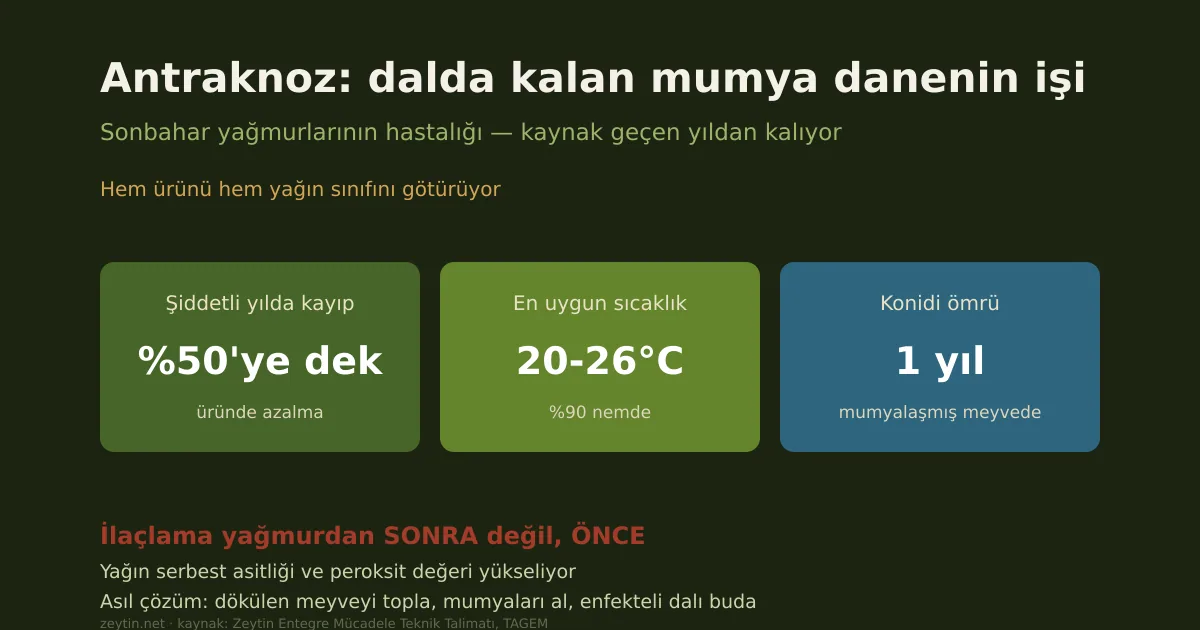
Olive anthracnose: the disease of the mummified fruit left on the branch
Up to 50% crop loss in bad years. The source is last year's mummified fruit still on the branch, and the spray goes on before the autumn rains, not after.
 Article
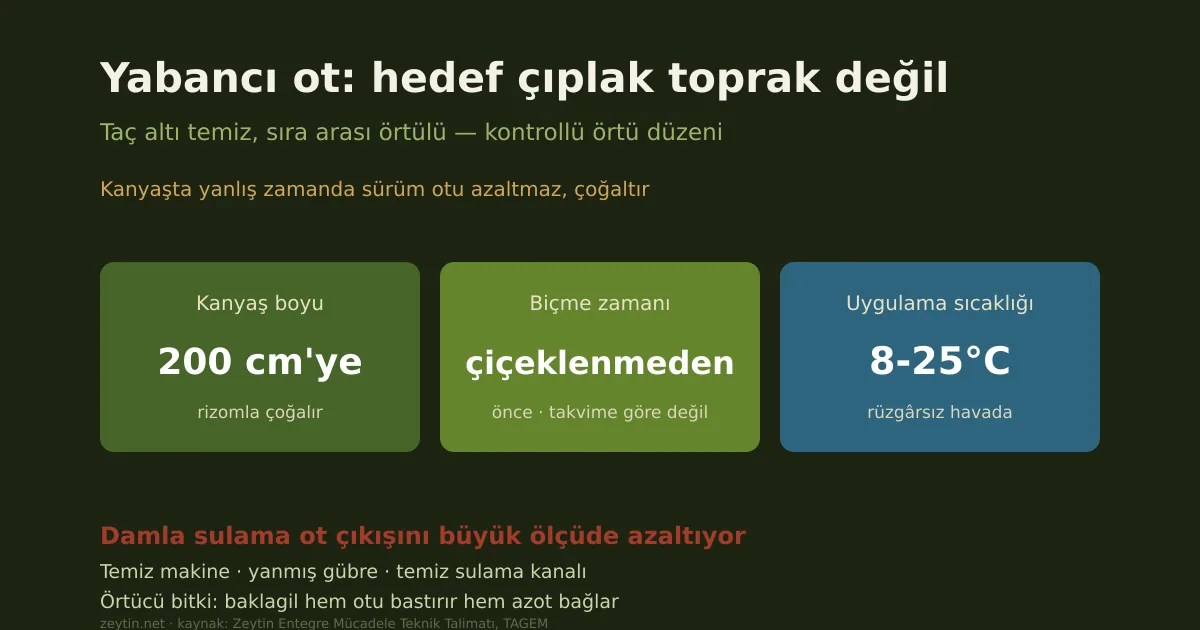
Weeds in the olive grove: bare soil is not the goal
Johnson grass, Bermuda grass and fat hen. With perennials, ill-timed tillage spreads them while mowing stops the seed. Clean under the canopy, covered between rows.
 Article
The olive moth: three generations, three kinds of damage
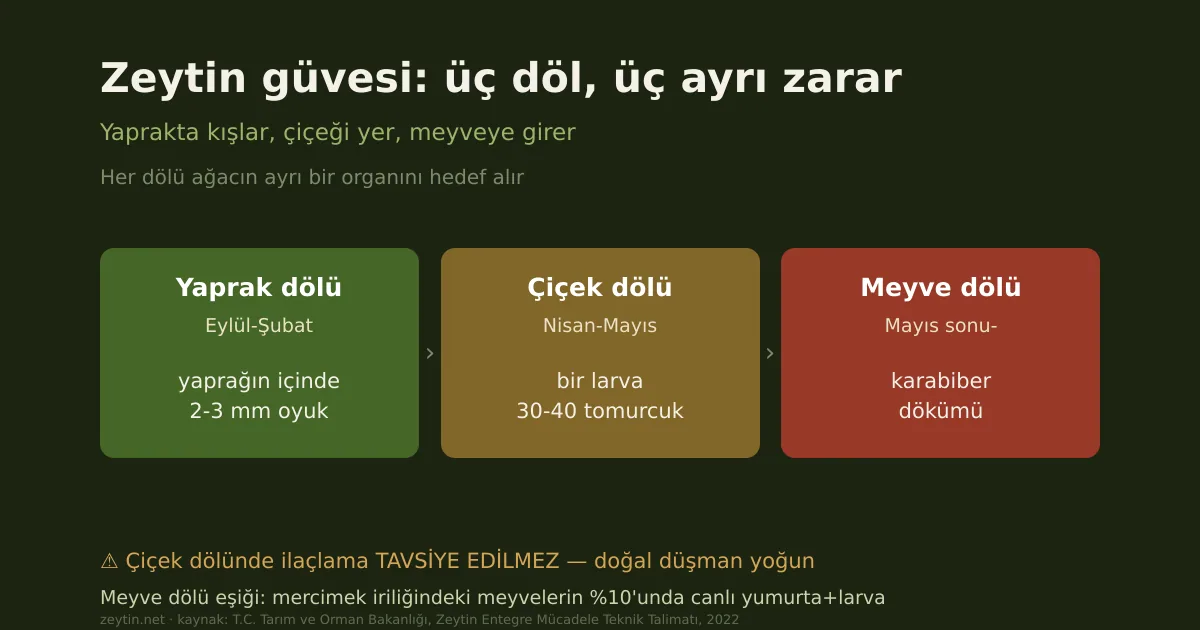
The olive pest with three generations: it winters in the leaf, eats the flowers, enters the fruit. One larva can take 30-40 buds.
 Article
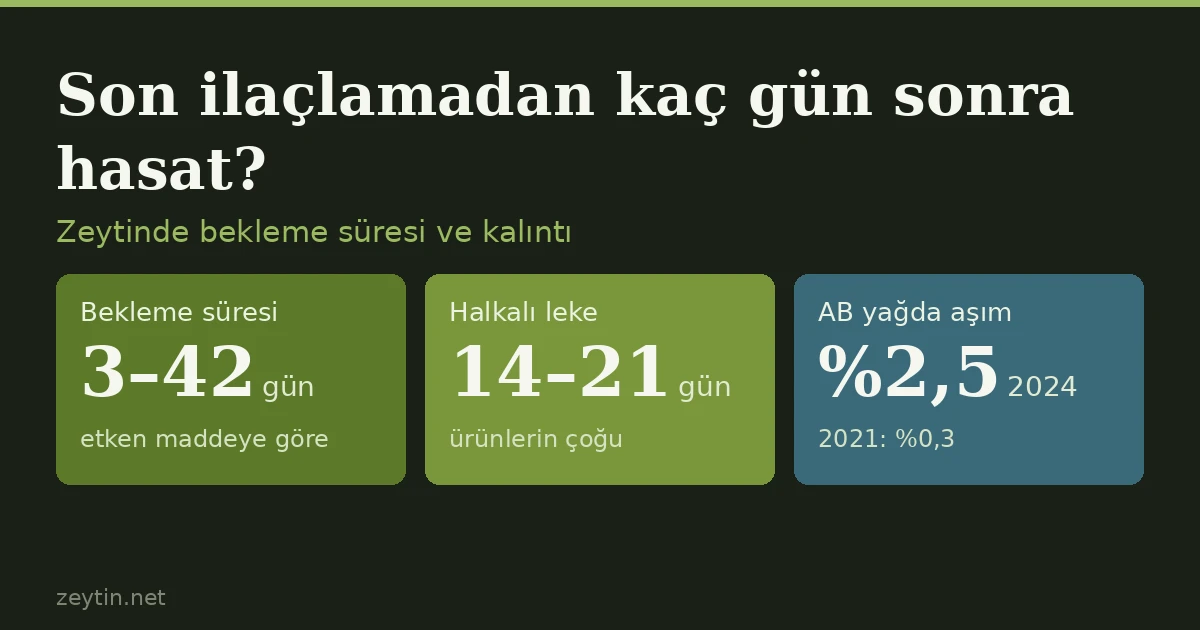
How many days after the last spray can olives be harvested? Pre-harvest interval and residues
The interval between the last spray and harvest in olives ranges from 3 to 42 days depending on the active substance; most peacock spot products carry 14–21 days. Fat-soluble residues concentrate in the oil at pressing; EU exceedances in virgin olive oil rose to 2.5% in 2024. 2026/27 is Turkey's first harvest with spraying and harvest recorded plot by plot under B-Reçete.