Early harvest: expensive or valuable? The arithmetic of yield
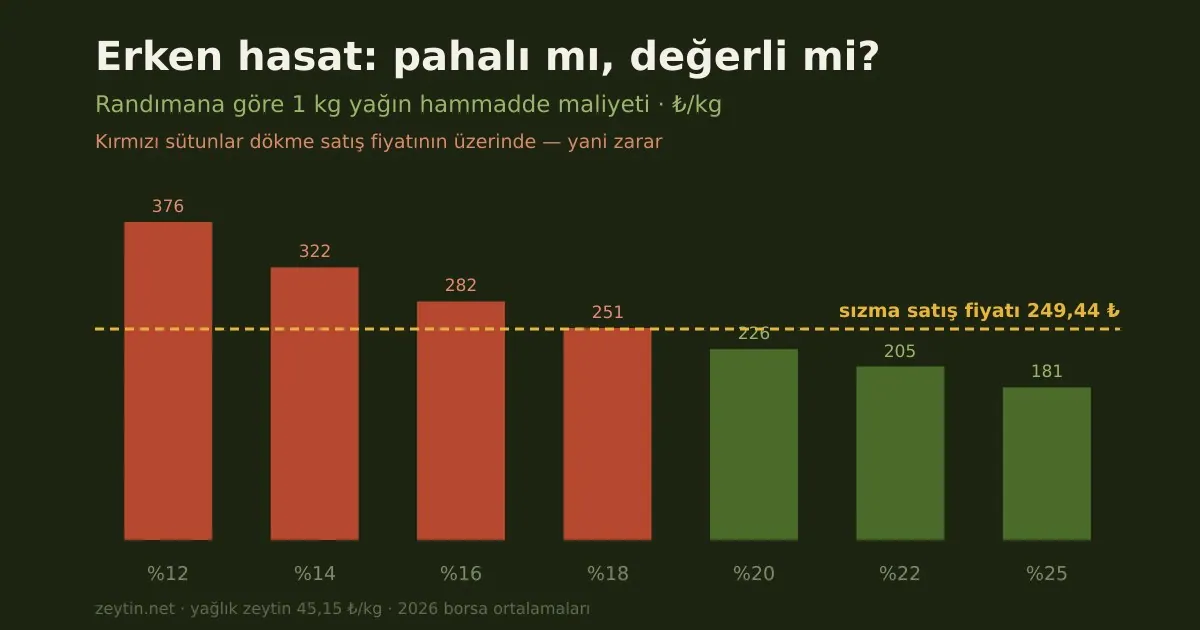
Below 18% yield the raw material costs more than the bulk price. Early-harvest oil needs a 43% premium to break even.
Early harvest is the most talked-about idea in olive oil right now. Bottles carry the words, the price can be double the ordinary, and tasters praise the bitterness and the peppery catch at the back of the throat.
None of that praise is misplaced. But the coin has an arithmetic side that gets far less attention: early harvest means less oil from the same tree. How much less, and how much would the oil have to sell for to make up the difference?
This article does that calculation. The result shows clearly who early harvesting makes sense for, and who simply loses money on it.
What early harvest means
As olives ripen on the tree, two things happen: oil content rises and polyphenol content falls.
Oil pressed from green, not yet darkened fruit is more bitter, more peppery, and higher in antioxidants. It leans green in colour and smells of grass and green almond. That is early harvest, sometimes called green harvest.
When the fruit reaches full ripeness and turns black, oil content peaks; the oil is softer, less bitter and lower in polyphenols.
There is a trade-off between the two ends, and its cost can be measured.
The yield difference
The share of the fruit's weight that becomes oil is the yield. The typical range is 15-25%; early harvest generally sits in the 12-16% band and full ripeness in the 20-25% band.
That sounds like a small difference. It is not.
| Yield | Olives per kg of oil | Raw material TL/kg | Raw material TL/litre | Share of the oil price |
|---|---|---|---|---|
| 12% | 8.33 kg | 376.25 | 344.65 | 151% |
| 14% | 7.14 kg | 322.50 | 295.41 | 129% |
| 16% | 6.25 kg | 282.19 | 258.48 | 113% |
| 18% | 5.56 kg | 250.83 | 229.76 | 101% |
| 20% | 5.00 kg | 225.75 | 206.79 | 90% |
| 22% | 4.55 kg | 205.23 | 187.99 | 82% |
| 25% | 4.00 kg | 180.60 | 165.43 | 72% |
Olive price is the 2026 volume-weighted average (45.15 TL/kg); extra virgin olive oil is 249.44 TL/kg. Litre figures use a density of 0.916 kg/L. To try your own numbers, use our yield calculator.
The critical threshold: 18%
The last column tells the whole story. At a yield of 18%, the raw material cost of a kilogram of oil equals what that oil sells for on the exchange.
In other words: selling oil in bulk when the yield falls below 18% is a loss. Before milling, storage or transport enter the picture, the fruit alone costs more than the sale price.
The typical early-harvest band is 12-16%. All of it sits below the threshold.
Concretely: a producer working at 14% spends 7.14 kilograms of olives on one kilogram of oil, costing 322.50 lira. Selling that oil at the exchange price of 249.44 lira means losing about 73 lira per kilogram.
What early-harvest oil has to sell for
The answer is a simple proportion.
Oil made at 20% yield costs 225.75 lira in raw material and sells for 249.44. The 23.69 lira strip between them covers milling and profit.
To keep that same strip at 14% yield, the selling price would have to be 356.34 lira — 43% above today's price.
Put differently: early-harvest oil is not economic for a producer unless it sells for at least 40% more than late-harvest oil. That is the premium needed just to cover the yield loss; the other costs of early harvesting — harder picking, a shorter window, more careful processing — are not even counted yet.
So who is early harvest for?
The table does not make early harvest a mistake. What it shows is that early harvest is incompatible with the bulk market.
For a producer selling in bulk: early harvest is a loss under almost any conditions. The bulk market does not price by yield; extra virgin olive oil has a single price on the exchange, and that price does not ask when the fruit was picked.
For a producer selling bottled and branded: early harvest makes sense, and may be essential. Consumers will pay a premium for high-polyphenol green-harvest oil, and that premium can run well beyond 40%. This is exactly where the boutique olive oil market was built.
For a producer doing both: this is the most common solution. Part of the grove is picked early for the branded product, the rest at full ripeness for bulk sale. The premium is captured and the volume is kept.
The decision turns not on which oil you make, but on who you sell it to.
The tree's own arithmetic
So far we have only looked at one year's figures. In olives, one year is an incomplete calculation.
Olive trees show alternate bearing: a heavy year is followed by a light one, because ripening fruit consumes the tree's energy and weakens the following year's flower buds.
Early harvest eases that load. Fruit does not stay on the tree to full ripeness, so the tree tires less and the next year's yield is better protected. How much this matters varies with variety and management, but the direction is not in dispute.
So early harvest can give back part of this year's yield loss in next year's crop. Seen through a two-year window, the 43% premium required comes down somewhat. We do not have the data to size that offset, so we put no number on it — but it should not be left out of the calculation either.
The number behind the quality: polyphenols
The premium on early harvest is not arbitrary; it rests on a measurable difference.
Polyphenols — oleuropein, hydroxytyrosol, tyrosol — are responsible for the bitterness and the peppery catch. They are also natural preservatives: an oil high in polyphenols keeps longer than one that is not.
The European Food Safety Authority has recognised a health claim for the contribution of olive oil polyphenols to protecting blood lipids from oxidative damage, for oils containing at least 250 mg of polyphenols per kilogram. That threshold matters: ordinary extra virgin on the shelf often falls below it, while early-harvest oils generally sit above.
That is what the premium buys — bitterness is not a fault, it is the taste of a measurable difference in content.
Summary
- Early harvest yields 12-16%, full ripeness 20-25%.
- Below 18% yield, raw material cost exceeds the bulk selling price.
- Oil made at 14% and sold at the exchange price loses around 73 lira per kilogram.
- Keeping the same margin requires a 43% premium on early-harvest oil.
- So early harvest is a loss for bulk sellers and the right choice for branded sellers.
- Tiring the tree less may return part of the loss in the following year's crop.
Run your own numbers with the yield calculator · Current prices: market page
Related reading: The olive harvest: when and how · How cold-pressed olive oil is made · From olive to oil: the price gap · Oleocanthal and polyphenols
One rating per visitor; you can change yours at any time. Ratings are real reader votes — no seeded or default scores.
Related
 Article
How war destroys an olive grove: denial of access does more than the bomb
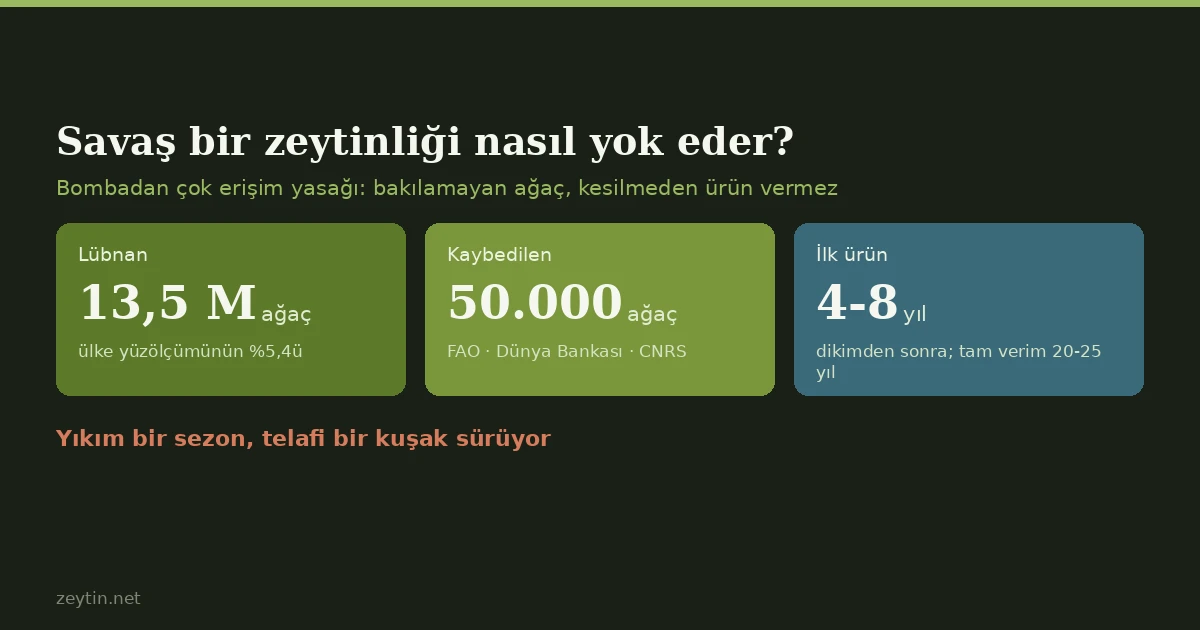
An olive grove is not an annual field: first fruit takes 4-8 years, full yield 20-25. War's damage is therefore generational, not seasonal. We read the picture in Lebanon and Palestine through the tree's own biology.
Article
How war destroys an olive grove: denial of access does more than the bomb
An olive grove is not an annual field: first fruit takes 4-8 years, full yield 20-25. War's damage is therefore generational, not seasonal. We read the picture in Lebanon and Palestine through the tree's own biology.
 Article
Twenty trees per decare, or 250? The density debate
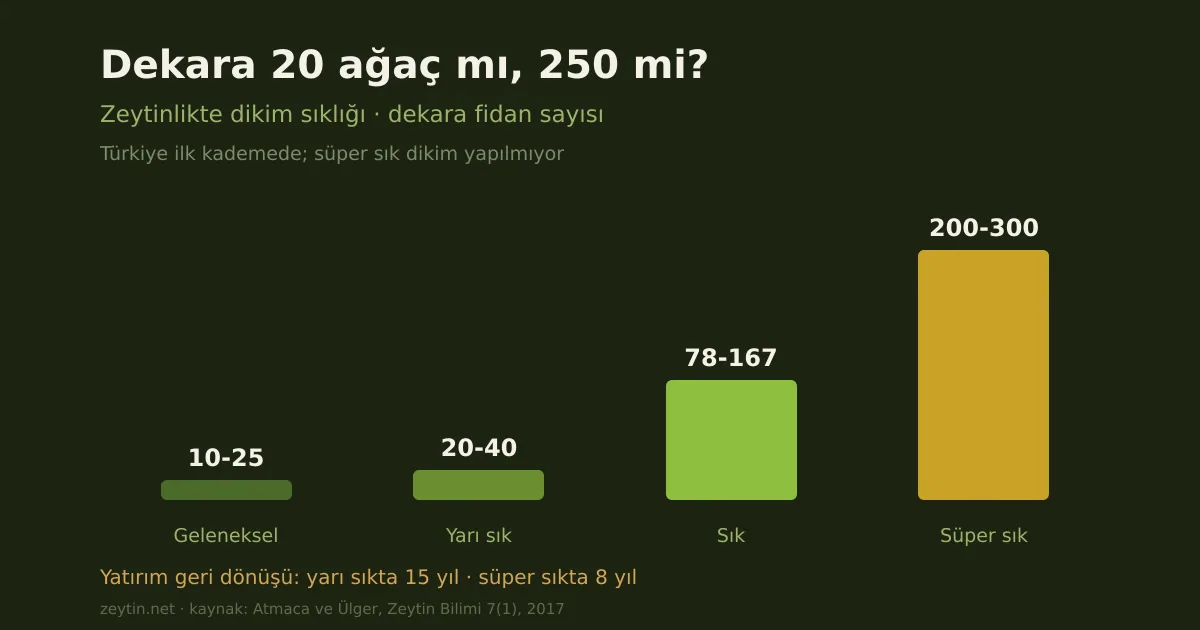
15-25 trees per decare in Türkiye, 200-300 in super-intensive systems. Payback falls from 15 years to 8 — but the densest is not the most profitable.
Article
Twenty trees per decare, or 250? The density debate
15-25 trees per decare in Türkiye, 200-300 in super-intensive systems. Payback falls from 15 years to 8 — but the densest is not the most profitable.
 Article
Vegetation water and pomace: olive oil's waste problem
Processing 1.5–2 million tonnes of olives yields 1 million tonnes of vegetation water and 1 million tonnes of pomace. Waste, or resource?
Article
Vegetation water and pomace: olive oil's waste problem
Processing 1.5–2 million tonnes of olives yields 1 million tonnes of vegetation water and 1 million tonnes of pomace. Waste, or resource?
 Article
The table olive sector: 461 registered, 8,000 unregistered
Turkey has become the world's leading table olive producer, with a record $255.3m in 2024-25 across 117 countries. Yet only one enterprise in twenty is registered.
Article
The table olive sector: 461 registered, 8,000 unregistered
Turkey has become the world's leading table olive producer, with a record $255.3m in 2024-25 across 117 countries. Yet only one enterprise in twenty is registered.