How to recognise a good table olive — and what to check when buying
Is the colour mottled, the brine clear, the calibre stated? Concrete checks for buying table olives, whether Gemlik is an oil or table variety, and how to store them at home.
Deciding in the olive aisle is hard: the jars look alike, prices differ fivefold, and most of what the label says tells you nothing about quality. This piece works through concrete checks — where to look, what to feel, what to ask.
How do you recognise a good olive?
Appearance. The fruit should look firm and alive; a high share of crushed, shrivelled or split-skinned fruit means the batch was handled badly. Excessive, artificial gloss points the other way: oil may have been applied for shine.
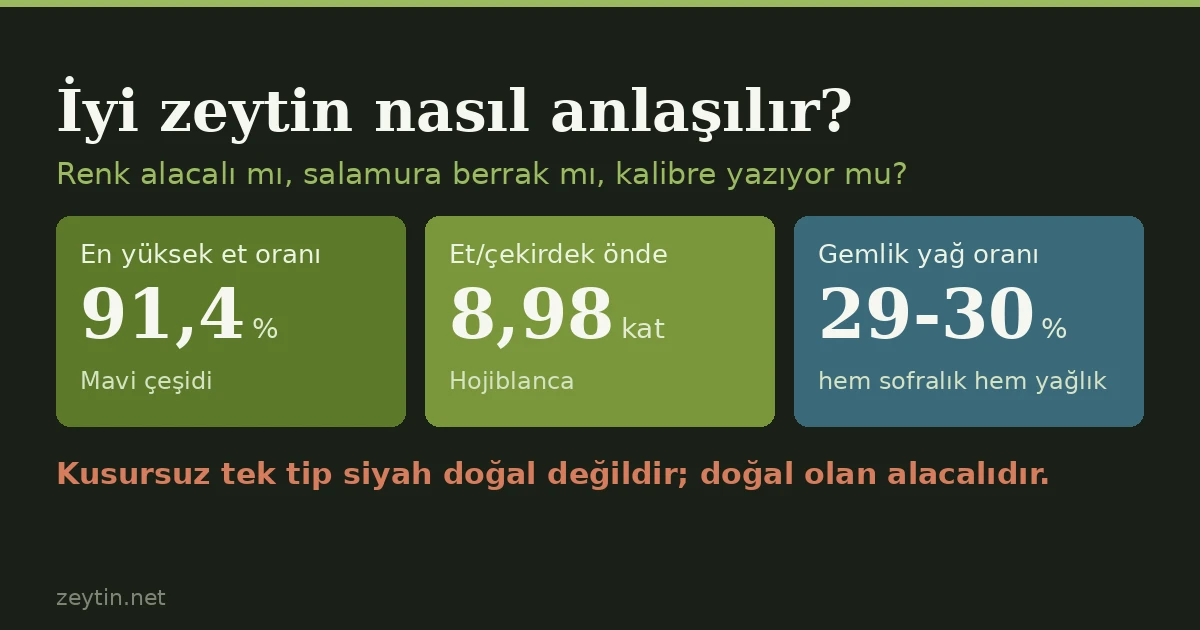
Colour spread. Natural product is mottled. Fruit ripened on the tree differs in tone from one to the next — brown, purple and black together. Every fruit in the jar being the same flawless black is not natural; it is the signature of artificial blackening.
Texture. The flesh should be soft but firm enough not to fall apart. If it crushes and weeps under a finger, it has been over-processed. The pit should separate easily; if it does not, the fruit may have been picked before ripeness.
Taste. Neither over-salted nor bland. A mild bitterness natural to olives and a fruity aftertaste should remain. A chemical burn at the back of the throat, a metallic smell or any sharpness beyond salt means put it back.
The brine. It should be clear. Cloudiness, heavy sediment or floating matter is a poor sign. If the liquid is a distinctly different darkness from the fruit, colour may be leaching out.
What to check when buying
Is the calibre stated? Table olives are graded by count per kilogram. A range such as "201-230" tells you the size — a lower count means larger fruit. A product without a calibre has not been priced by size.
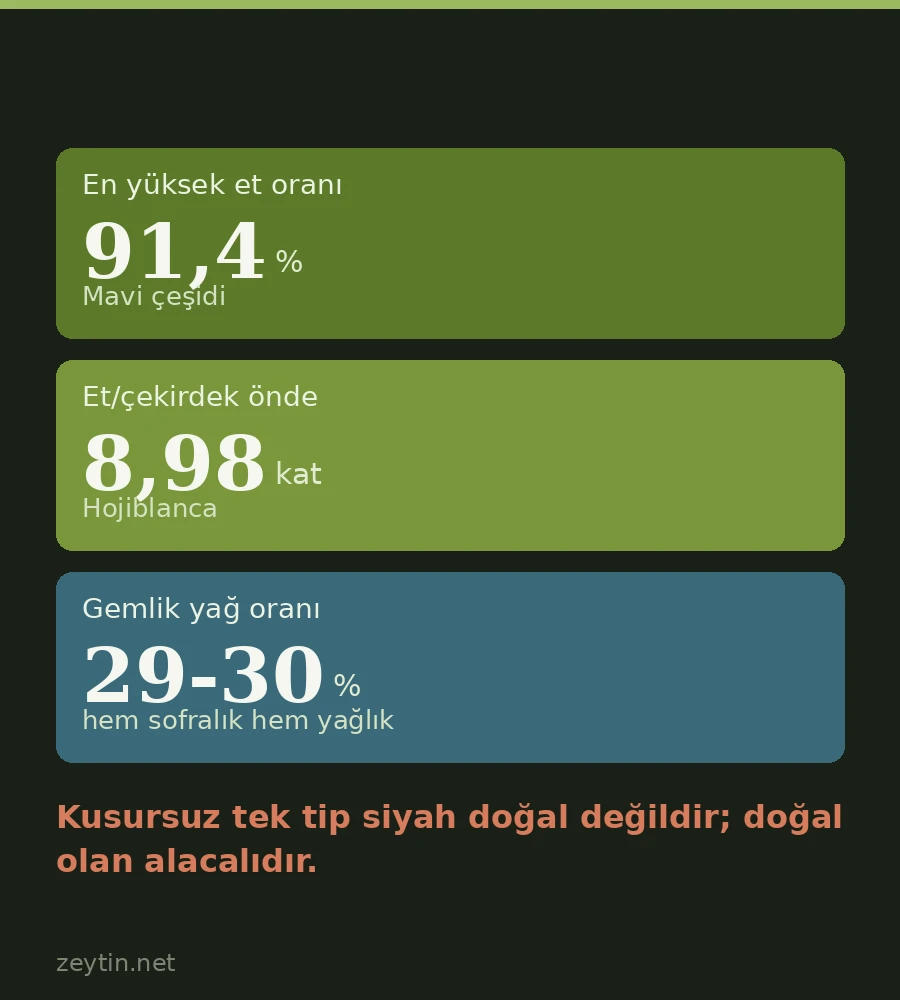
Which variety? A variety name on the label is a good sign. In our records the highest flesh ratios belong to Mavi at 91.4%, Hojiblanca at 90% and Kalamata at 89.4%; on flesh-to-pit, Hojiblanca leads at 8.98. A higher flesh ratio means more edible fruit per kilogram.
Is the processing style stated? "Blackened olives" is not a defect but the name of a production style, and it must be declared. If it is absent and the fruit is flawlessly black, there is a question to ask.
Packaging and records. Producer name, batch number and ministry approval should be legible. With loose olives of unknown origin, none of that chain can be verified.
Price. Product priced strikingly below its peers raises one question: how was the process shortened? Our retail survey runs from 112 to 1,294 lira per kilogram for green table olives and 110 to 905 for black. That width is not brand alone; it includes differences in how the fruit was made.
Is Gemlik an oil or a table olive?
Both. Gemlik is Türkiye's most widespread table variety, yet our records put its oil content at 29-30%, high on the oil ranking. Flesh-to-pit is 6.14 and chilling requirement about 600 hours.
That dual use gives the grower flexibility: when prices favour table olives the fruit goes to brine, when they favour oil it goes to the mill. For the buyer the consequence is that a "Gemlik" label alone says nothing about table quality; calibre and processing style do.
Green or black?
They are not separate varieties but the same fruit at different ripeness. Green is picked early, black late. Green is firmer with more evident bitterness; black softens and rounds out. Preference is a matter of taste — but remember that natural black is mottled, and a flawless uniform black invites suspicion.
Storing at home
Keep an opened jar refrigerated with the fruit below the brine. Any that rise above the surface meet air and mould. If the brine runs low, top it up with salted water that has been boiled and cooled. A finger of olive oil poured on top is a simple, natural way to cut off air contact.
One rating per visitor; you can change yours at any time. Ratings are real reader votes — no seeded or default scores.
Related
 Article
Olive wood: why spoons and not beams?
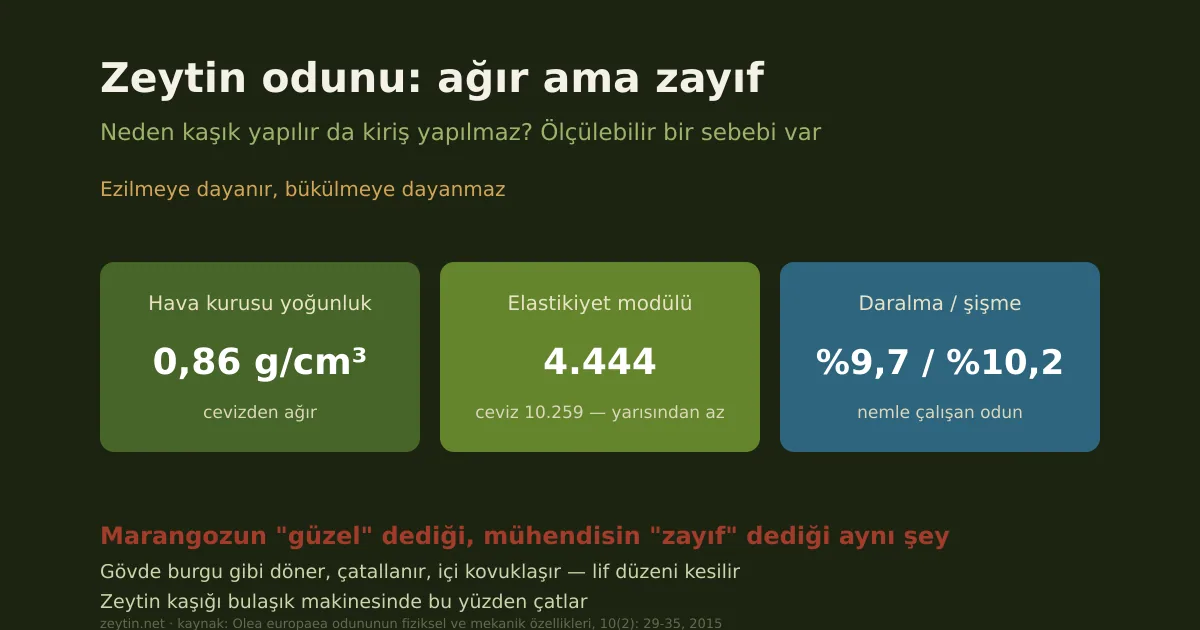
At 0.86 g/cm³ air-dried it is denser than walnut, yet its modulus of elasticity of 4,444 N/mm² is less than half walnut's. It resists crushing but not bending.
Article
Olive wood: why spoons and not beams?
At 0.86 g/cm³ air-dried it is denser than walnut, yet its modulus of elasticity of 4,444 N/mm² is less than half walnut's. It resists crushing but not bending.
 Article
Where is quality lost in table olives?
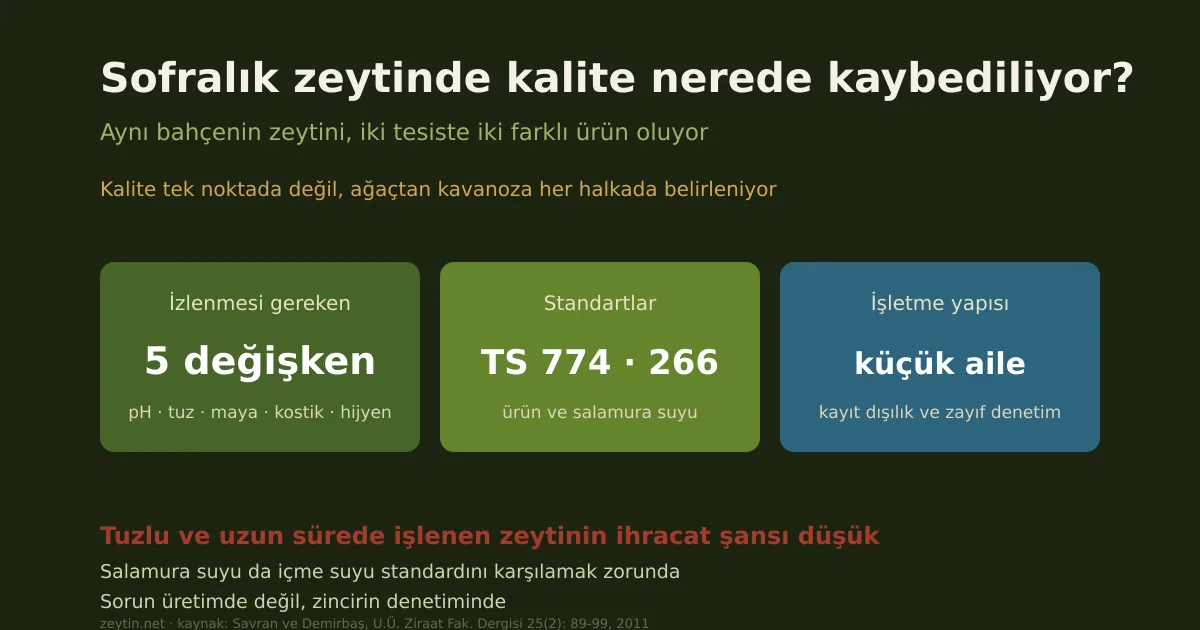
Variety choice, harvest technique, fermentation control, sterilisation and the pre-packing check are each a separate point of loss. The structural problem is scale and inspection.
Article
Where is quality lost in table olives?
Variety choice, harvest technique, fermentation control, sterilisation and the pre-packing check are each a separate point of loss. The structural problem is scale and inspection.
 Article
İzmir Sofralık olive
İzmir Sofralık is a recorded variety of the Aegean. Described in the source.
Article
İzmir Sofralık olive
İzmir Sofralık is a recorded variety of the Aegean. Described in the source.
 Article
Arbequina olive: Spain's oil variety
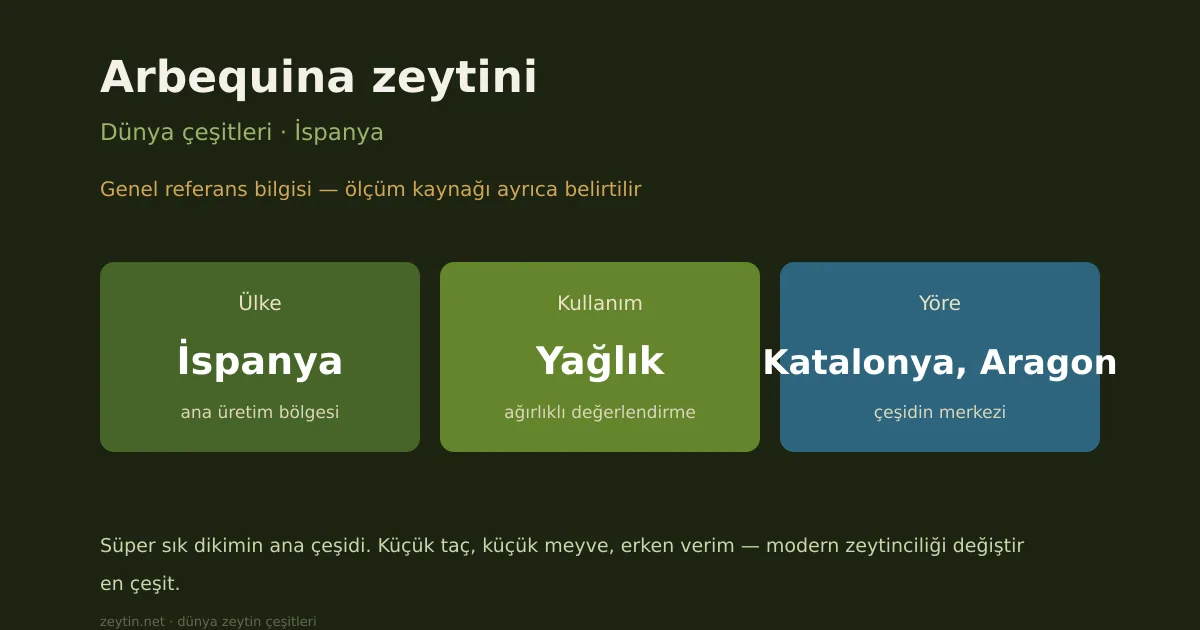
The mainstay of super-high-density planting. Small canopy, small fruit, early bearing — the variety that changed modern olive growing.
Article
Arbequina olive: Spain's oil variety
The mainstay of super-high-density planting. Small canopy, small fruit, early bearing — the variety that changed modern olive growing.