How do you become a member of an olive cooperative?
Joining an agricultural sales cooperative is one of the most asked questions of the harvest season. The conditions are written into the bylaws: you must be a grower, you must not trade in the same products, and you cannot belong to another cooperative in the same region. The real obligation, though, is the crop declaration — because that document is a delivery commitment.
When harvest begins, the same question returns to every grower's agenda: should I join a cooperative, and what changes if I do? It peaks in exactly this season, because the crop declaration period opens with the harvest and a grower who is not a member cannot walk through that door.
This article sets out the written conditions for membership of an agricultural sales cooperative in the olive sector, the documents required, and the obligation that membership brings. What follows comes from the cooperatives' own bylaws — the text, not an interpretation of it.
Cooperative, union, company: which is which
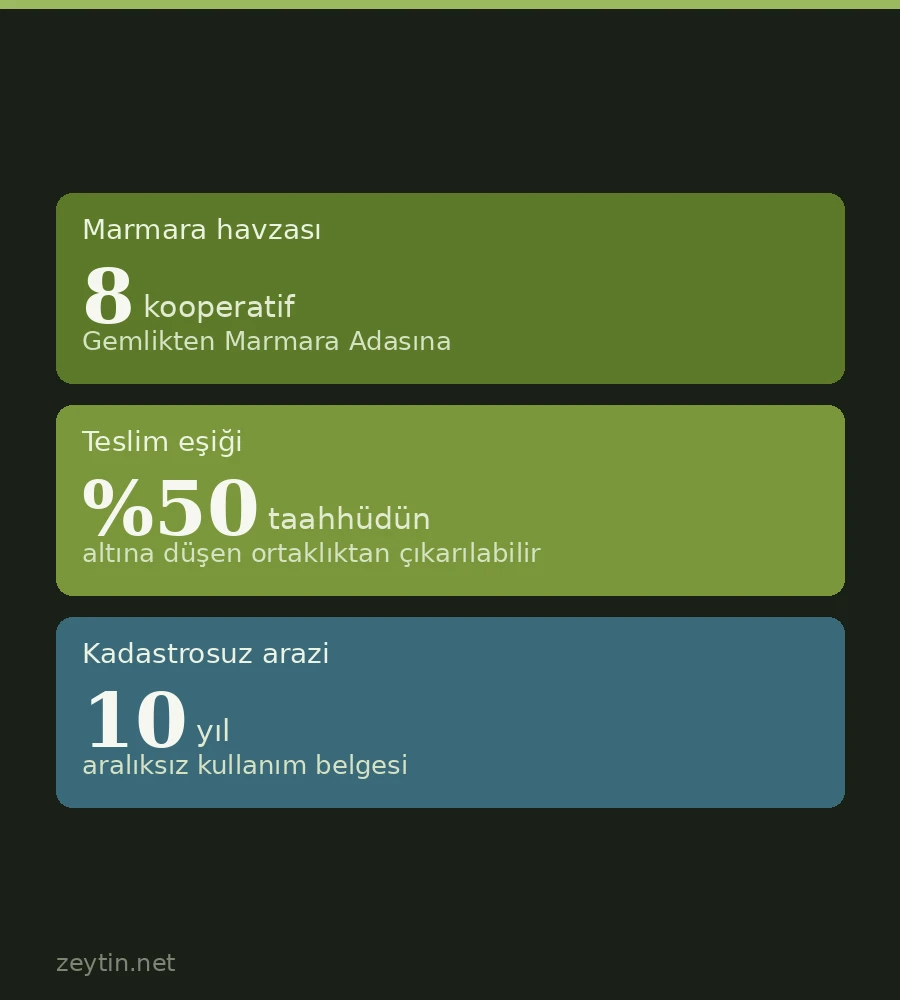
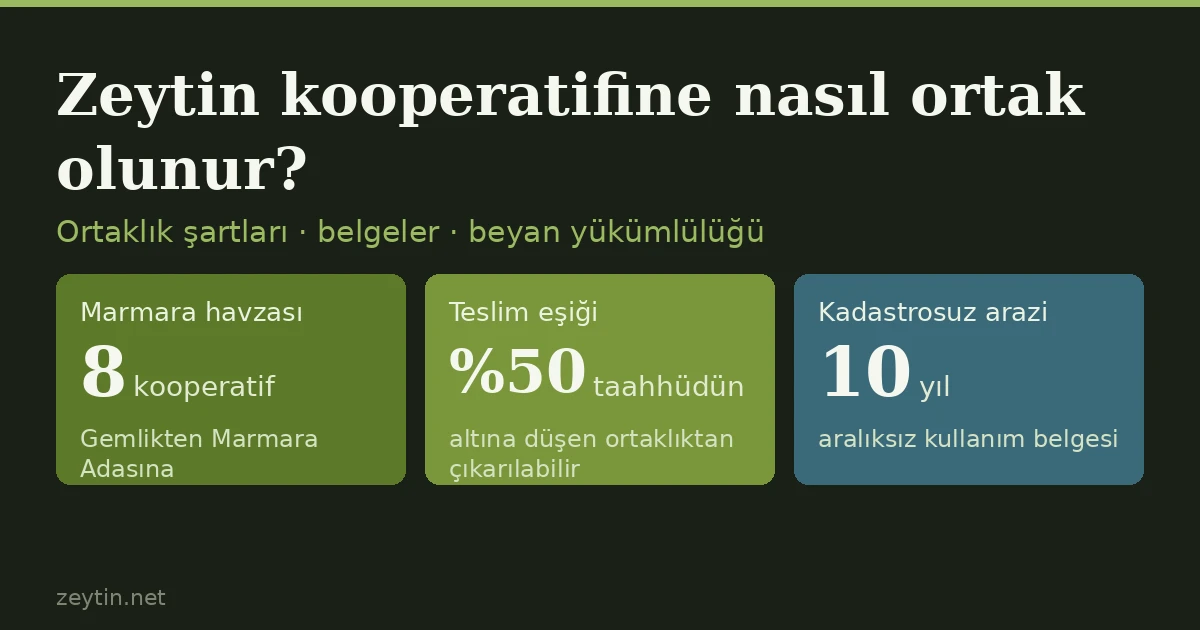
The structure a Turkish olive grower meets has three layers. At the base is the cooperative: the local body the grower joins and delivers fruit to. Cooperatives together form a union, which handles processing, branding and marketing. In the Marmara basin that structure consists of eight cooperatives — Gemlik, Mudanya, Erdek, Orhangazi, İznik, Edincik, Mürefte and Marmara Adası. In the Aegean, olive and olive oil cooperatives are organised under their own union.
The grower does not join the union. The grower joins the cooperative in their own district, and delivers the crop there.
Who can join?
The conditions are listed in the bylaws. To become a member, a grower must:
- have legal capacity to exercise civil rights;
- not trade or act as a commission agent in the products the cooperative deals in, whether on their own behalf or another's; not be a director or officer of a company working in those products; not buy produce on behalf of such a company; and not lend money or goods at interest;
- be a producer of one of the products within the cooperative's remit, inside the cooperative's working area;
- not be a member of another agricultural sales cooperative established for the same purpose within the union's working area;
- not be a family member whose production income is held jointly with an existing member — although joint and shared ownership does not prevent separate memberships.
The practical meaning of the second condition is this: trading and membership cannot run together. A cooperative is the institution of the grower who sells produce; someone who buys and sells the same product is considered contrary to its purpose.
The documents required
Applicants prove they are not trading with documents from the tax office, the Social Security Institution, trade registry offices, or a chamber of commerce, industry or tradesmen.
Producer status is established with a document from the local chamber of agriculture or the provincial or district directorate of agriculture, showing that the applicant is a producer and stating an estimated production volume. Alongside this, a document establishing the relationship to the land is needed:
- a title deed, or
- a lease certified by a notary or the village council of elders, or
- a document from the provincial treasury or finance office showing the land has been allocated to the applicant.
There is a separate route for those farming land that has never been through cadastral survey: a village certificate and tax record, together with evidence that the land has been used continuously and without dispute for at least ten years.
The board examines the application on these documents and may request more. Membership is not automatic; it is subject to acceptance.
The real obligation: the crop declaration
This is the most widely misread part of membership. A crop declaration is not merely a form stating expected output. With the same document the grower commits to how much will be delivered to the cooperative.
That commitment has consequences. Members who fail to file a declaration for five consecutive business years, or who fail to deliver at least fifty per cent of what they undertook to deliver, face expulsion from membership. The right to attend the general assembly is tied to a similar condition: having filed a declaration and delivered at least half of the commitment.
This season's declarations are still coming in: in Orhangazi, growers' crop declarations passed 4,200 tonnes in the first ten days.
What membership gives
1. A market with a known buyer. The cooperative buys its members' fruit at the purchase price it announces. In a period when open-market prices move daily, that is a floor — and that floor is exactly what sits at the centre of the argument around this season's opening prices.
2. Staged payments and price adjustments. Cooperatives usually pay in instalments rather than all at once, and a price difference payment may follow after the season closes. The total return on the crop is known at the end of the season, not at delivery.
3. Grading by size and quality. Purchases are made by fruit size, which is a direct advantage for a grower whose grove produces large fruit.
⚠ Staged payment carries a cost. A grower's need for cash peaks during harvest: labour, fuel and transport all fall due in the same weeks. When cooperative payments are spread across months, the pressure to sell part of the crop to a merchant who pays immediately grows. This is why harvest financing has become one of the sector's central arguments.
Is it the right choice for everyone?
Membership is as much a commitment as a safeguard. The obligation to deliver what was declared can tie a grower's hands when open-market prices rise. When prices fall, that same obligation means a buyer is guaranteed.
The decision depends on grove size, on whether the fruit is destined for the table or the mill, and on the grower's cash flow. It cannot be made soundly without calculating what a kilo of olives costs to produce: if the announced price sits above that cost, membership is a safeguard; if below, it is only a tie.
Applications are made at the local cooperative's own office. Once documents are complete the decision rests with the board, and because the declaration period advances with the harvest, the application needs to be made at the start of the season.
One rating per visitor; you can change yours at any time. Ratings are real reader votes — no seeded or default scores.
Related
 Article
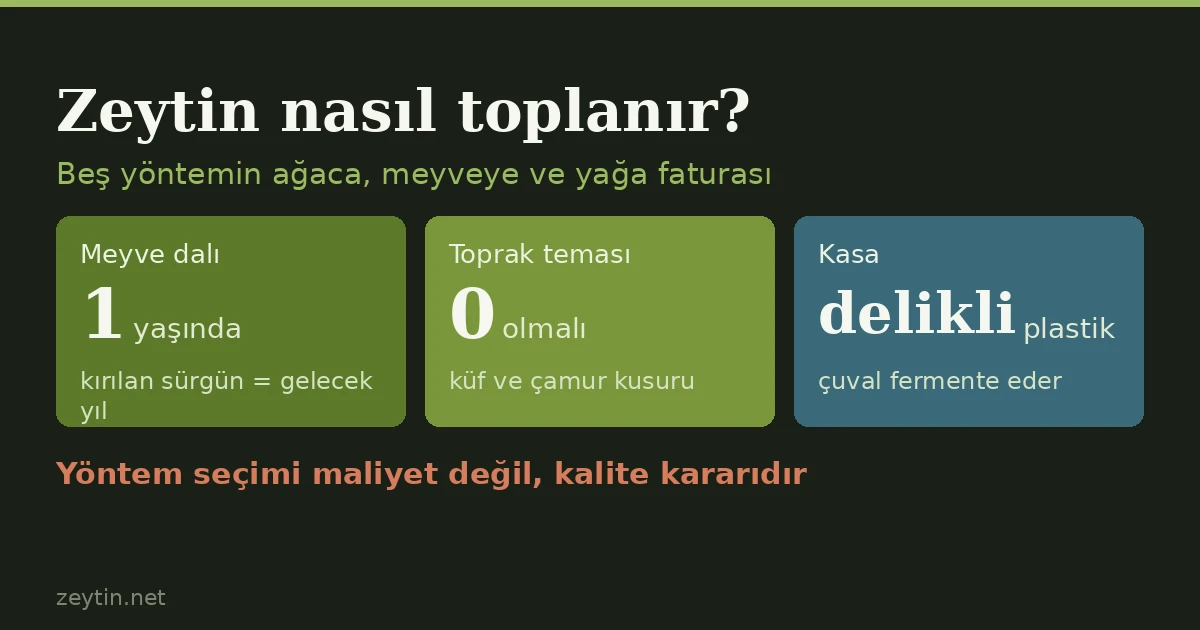
How are olives harvested? What five picking methods cost the tree and the oil
Hand picking, poles, combs, trunk shakers and straddle harvesters each charge a different bill — to the fruit, to the tree and to the acidity of the oil. Which method suits which grove, and what goes wrong on harvest day.
Article
How are olives harvested? What five picking methods cost the tree and the oil
Hand picking, poles, combs, trunk shakers and straddle harvesters each charge a different bill — to the fruit, to the tree and to the acidity of the oil. Which method suits which grove, and what goes wrong on harvest day.
 Article
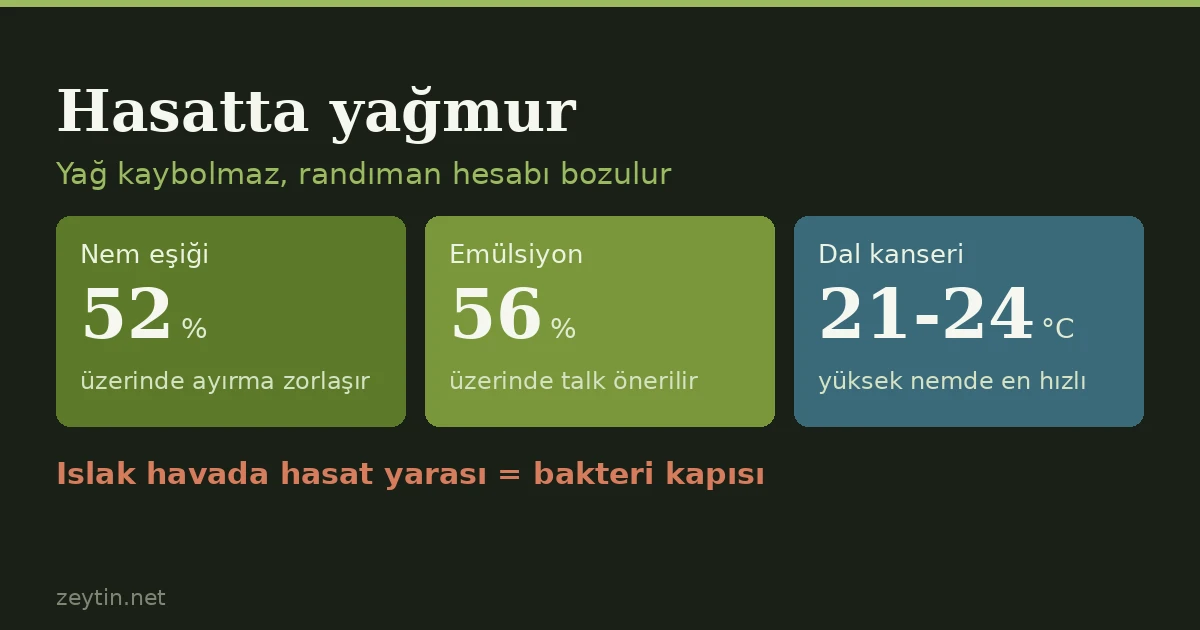
What happens if it rains during the olive harvest? Wait, or pick?
Rain does not destroy the oil; it distorts the yield figure, because fruit oil content is measured on a fresh-weight basis. The real damage shows up as emulsion at the mill, as the "musty-humid-earthy" sensory defect, and as olive knot bacteria entering harvest wounds in wet weather.
Article
What happens if it rains during the olive harvest? Wait, or pick?
Rain does not destroy the oil; it distorts the yield figure, because fruit oil content is measured on a fresh-weight basis. The real damage shows up as emulsion at the mill, as the "musty-humid-earthy" sensory defect, and as olive knot bacteria entering harvest wounds in wet weather.
 Article
Should I switch to organic? A decision guide for olive groves
A four-year trial found no yield difference and put organic 11% ahead economically. But where does the real cost of switching lie, who does it suit, and how do you fight the fly without chemicals?
Article
Should I switch to organic? A decision guide for olive groves
A four-year trial found no yield difference and put organic 11% ahead economically. But where does the real cost of switching lie, who does it suit, and how do you fight the fly without chemicals?
 Article
Should harvested olives be carried in crates or in sacks?
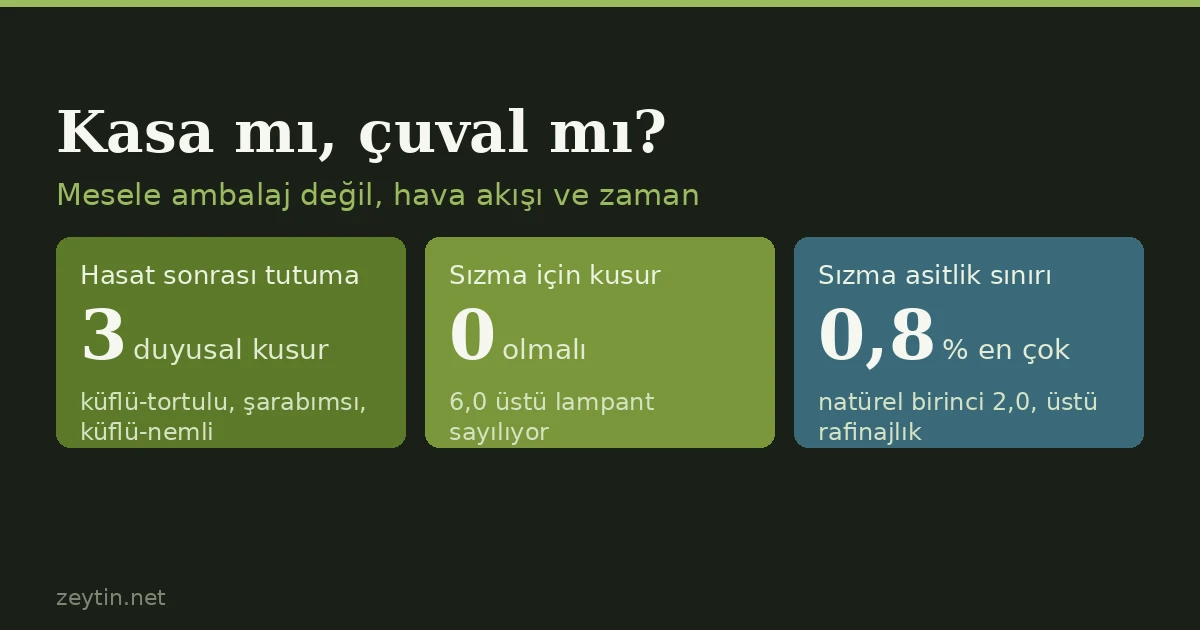
The cheapest decision of the harvest season is also one of the decisions that sets the grade of the oil. Three separate defects in the International Olive Council's vocabulary are defined directly by how the fruit was held after picking — and all three describe what a sack does.
Article
Should harvested olives be carried in crates or in sacks?
The cheapest decision of the harvest season is also one of the decisions that sets the grade of the oil. Three separate defects in the International Olive Council's vocabulary are defined directly by how the fruit was held after picking — and all three describe what a sack does.