Felling an olive grove: the arithmetic of a ten-year decision
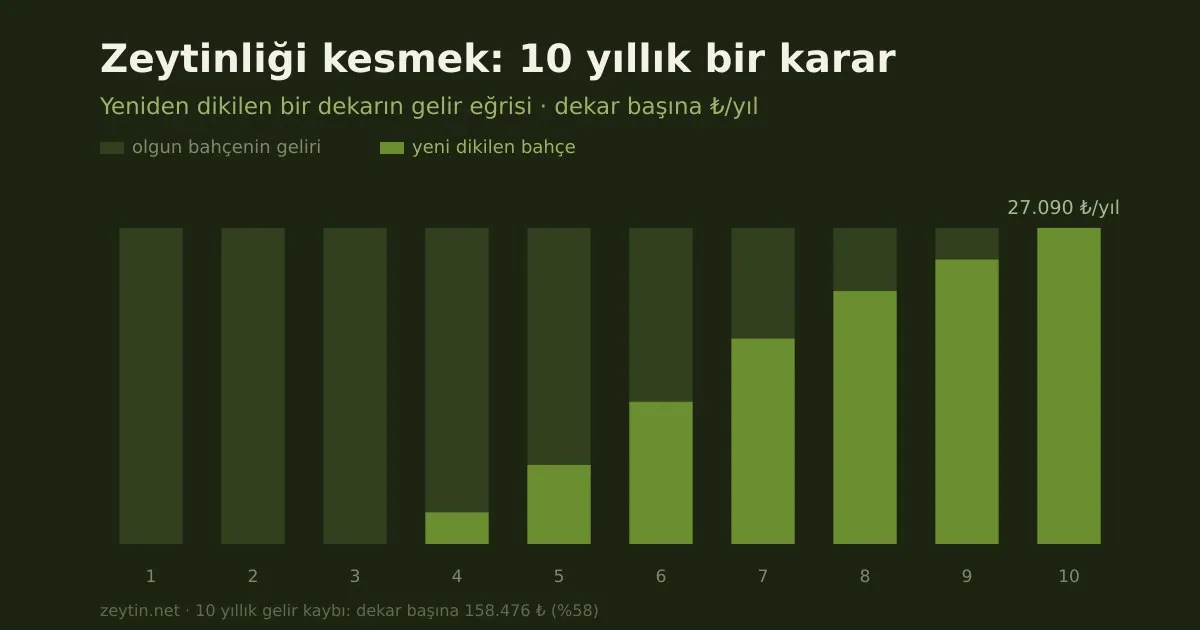
The ten-year cost of clearing a grove for another crop: establishment, years to bearing and forgone income, per decare.
Opening olive groves to mining, energy projects or development is one of Türkiye's longest-running arguments. It usually runs on two fronts: the jobs and income an investment brings on one side, the environment and heritage on the other.
This article takes neither side. It calculates one figure that usually gets skipped: how long does it take to replace a felled olive grove, and how much income is lost in the meantime?
Because the olive tree has a particular property. A wheat field comes back in a year. An olive grove does not.
The assumptions, stated openly
A calculation like this is only meaningful if its assumptions are visible. Ours are:
| Variable | Value | Note |
|---|---|---|
| Trees per decare | 20 | Traditional spacing; up to 40 in intensive planting |
| Yield per tree | 30 kg | At full bearing, averaged across irrigated and rain-fed |
| Olive price | 45.15 TL/kg | 2026 exchange registration average |
| First crop | year 4 | From planting |
| Full bearing | year 10 | 8-12 years depending on variety and care |
⚠ The assumption of 20 trees per decare is confirmed by the literature: traditional unirrigated planting is recommended at 15-25 trees per decare (Atmaca and Ülger, 2017). Under dense planting the figure passes 200 and the whole calculation changes — see Twenty trees per decare, or 250?
These are averages; irrigation, variety, soil and management move every one of them substantially. The aim is not a precise figure but an order of magnitude. A decare is 1,000 m², roughly a quarter of an acre.
On these assumptions a decare at full bearing grosses 20 trees × 30 kg × 45.15 TL = 27,090 lira a year.
The cost of starting again
When a grove is cleared, even if saplings are planted in its place, that land will not produce its old income for ten years. Bearing comes in gradually.
| Year | Share of full bearing | Income (TL) | Loss (TL) |
|---|---|---|---|
| 1-3 | 0% | 0 | 81,270 |
| 4 | 10% | 2,709 | 24,381 |
| 5 | 25% | 6,772 | 20,318 |
| 6 | 45% | 12,190 | 14,900 |
| 7 | 65% | 17,608 | 9,482 |
| 8 | 80% | 21,672 | 5,418 |
| 9 | 90% | 24,381 | 2,709 |
| 10 | 100% | 27,090 | 0 |
| Total | — | 112,424 | 158,476 |
A mature grove would have earned 270,900 lira over the same ten years. The newly planted one earns 112,424.
The difference is 158,476 lira per decare — 58% of a decade's income.
That is the income loss alone. Clearing, saplings, planting, irrigation infrastructure and ten years of management come on top.
For scale: on a 10-decare grove the loss is roughly 1.6 million lira. On a hundred decares, 16 million.
Why does it take so long?
The olive tree's slowness is not a defect; it is a survival strategy.
The tree spends its early years building a root system. In a Mediterranean climate the only way through a dry summer is to go deep, and every year spent above ground is a year of risk. So the olive does not hurry.
In return it gains an extraordinary lifespan. A well-kept olive tree bears for centuries; Anatolia has trees held to be over a thousand years old. The olive is a slow-starting but very long-running investment.
The two have to be weighed together. Ten years of delay may look small beside two hundred years of production. But the person who lives through those ten years is the one who plants the tree; not the one who sees the two hundred.
Does a felled tree come back?
Partly. One of the olive's remarkable properties is that it can resprout from the root.
An olive whose trunk is cut, or killed back by frost, will send up new shoots from the base if the root is intact. Select one and grow it on, and the tree is re-established — faster than starting from a sapling, because the root system is already there.
But this depends on the root staying where it is. In a grove cleared for mining or construction the roots go too, and recovery starts from a sapling.
The distinction matters: a cut tree and an uprooted tree are not the same thing. The two are sometimes conflated in the debate.
Is transplanting a solution?
That olive trees can be moved is an argument often heard. It is true: mature olives can be lifted and replanted, and the practice is common in ornamental landscaping.
Three qualifications are needed.
Survival is not 100%. A share of transplanted trees fails; the rate varies with the tree's age, the season and the care taken.
Yield does not return for years. Even a tree that takes needs several years to recover from the shock and return to its old yield. Transplanting does not eliminate the income loss, it shortens it.
It is expensive. Lifting, transport, replanting and aftercare are a serious cost per tree, justifiable mainly where the tree has monumental value or the law requires it.
Transplanting is a mitigation. It does not mean there is no loss.
What is not in the calculation
The figure here is for oil-olive income only. What a grove is actually worth is broader:
- Table olive sales — income per decare can be higher than for oil.
- Milling and bottling your own oil — several times the bulk price.
- Wood, prunings, pomace — small but continuous.
- Soil retention and erosion control — a real service with no market price.
- Landscape and tourism value — in some areas the grove itself is an attraction.
None of these is counted. So 158,476 lira is the lower bound of the loss.
Summary
- At full bearing a decare of olives grosses 27,090 lira a year at today's prices.
- Replacing a cleared decare with saplings costs 158,476 lira in lost income over ten years — 58% of a decade's earnings.
- Olives start bearing in year 4 and reach full yield around year 10.
- A tree whose root survives can resprout; an uprooted tree cannot.
- Transplanting reduces the loss; it does not remove it.
- Table olive income, bottling, erosion control and landscape value are excluded — the real loss is larger.
Related reading: How to grow an olive tree · The olive sector · Yield calculator
One rating per visitor; you can change yours at any time. Ratings are real reader votes — no seeded or default scores.
Related
 Article
The nameless olives of southeast Anatolia: Mardin, Şırnak and the pollinator problem
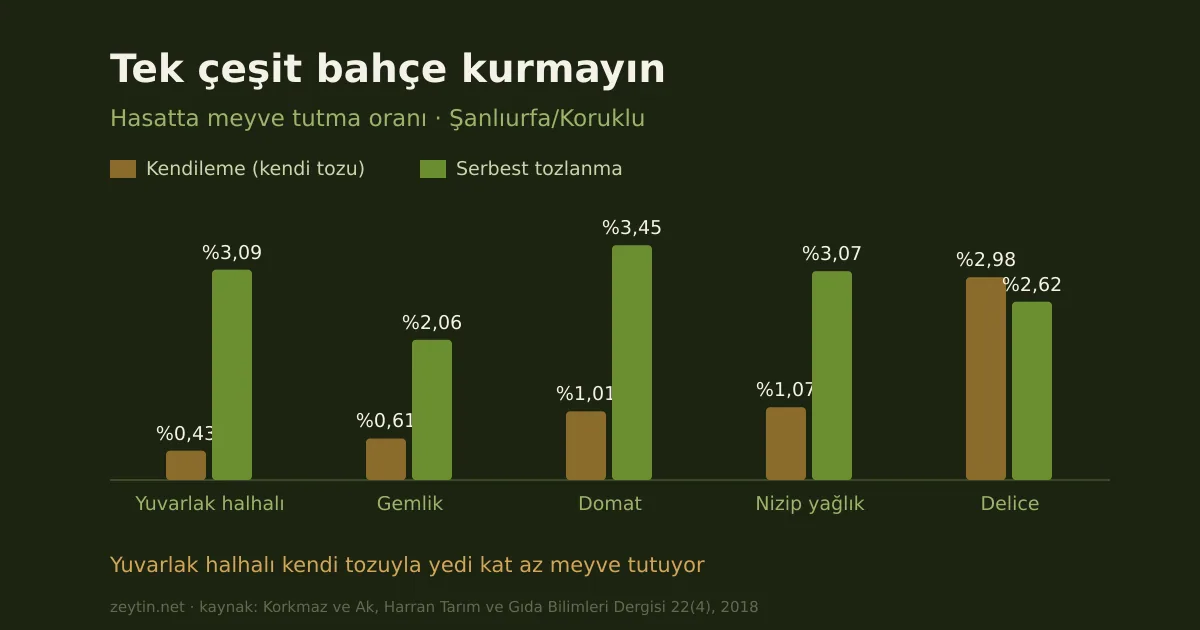
Kumçatı and Derik genotypes beat Ayvalık and Gemlik on flesh ratio. Yuvarlak halhalı sets only 0.43% of its flowers with its own pollen.
Article
The nameless olives of southeast Anatolia: Mardin, Şırnak and the pollinator problem
Kumçatı and Derik genotypes beat Ayvalık and Gemlik on flesh ratio. Yuvarlak halhalı sets only 0.43% of its flowers with its own pollen.
 Article
Two thirds of our exports are table olives: the $260 million picture
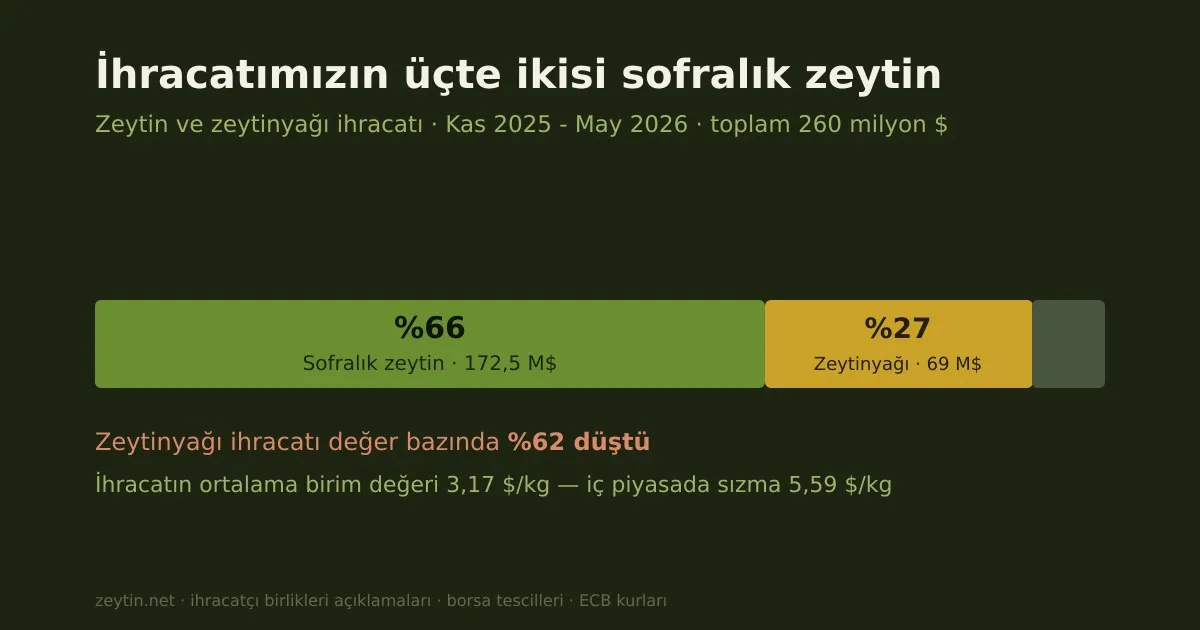
In 2025-26, 66% of exports were table olives and 27% oil. Average unit value $3.17/kg — the added value sits inside the packaging.
Article
Two thirds of our exports are table olives: the $260 million picture
In 2025-26, 66% of exports were table olives and 27% oil. Average unit value $3.17/kg — the added value sits inside the packaging.
 Article
The table olive sector: 461 registered, 8,000 unregistered
Turkey has become the world's leading table olive producer, with a record $255.3m in 2024-25 across 117 countries. Yet only one enterprise in twenty is registered.
Article
The table olive sector: 461 registered, 8,000 unregistered
Turkey has become the world's leading table olive producer, with a record $255.3m in 2024-25 across 117 countries. Yet only one enterprise in twenty is registered.
 Article
How to read olive oil exchange prices
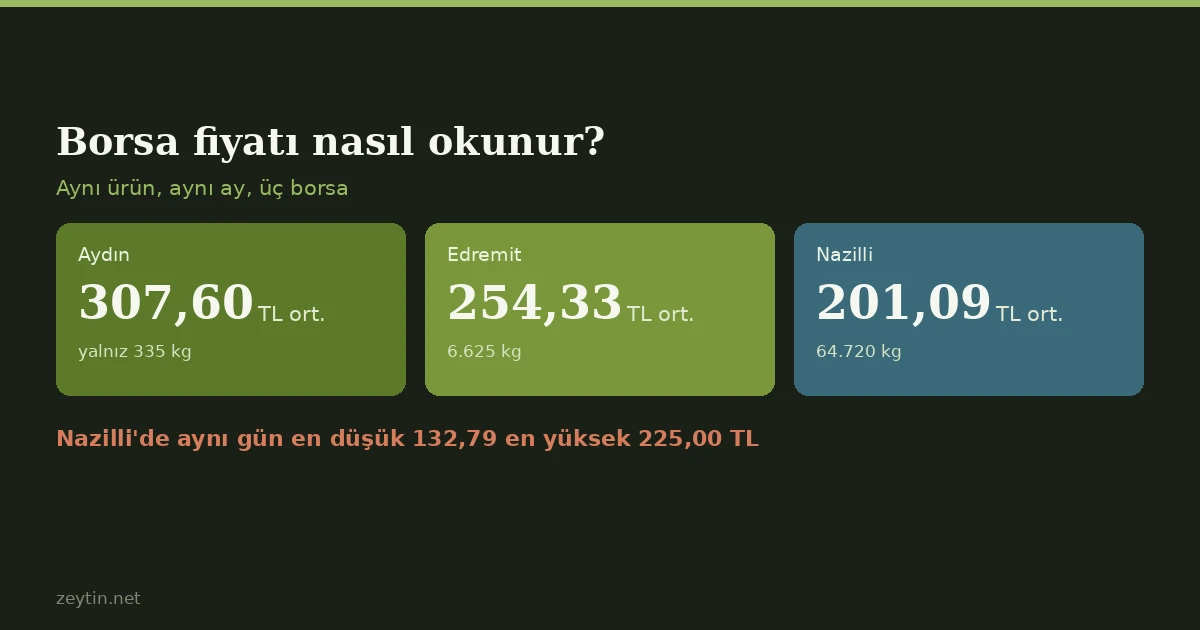
Three exchanges, three averages for the same product: 201, 254 and 308 lira. In Nazilli, trades from 132.79 to 225.00 in a single day. What an exchange price measures, and why date and volume matter more than the average.
Article
How to read olive oil exchange prices
Three exchanges, three averages for the same product: 201, 254 and 308 lira. In Nazilli, trades from 132.79 to 225.00 in a single day. What an exchange price measures, and why date and volume matter more than the average.