Does olive oil make you lose weight? What the meta-analyses and PREDIMED say
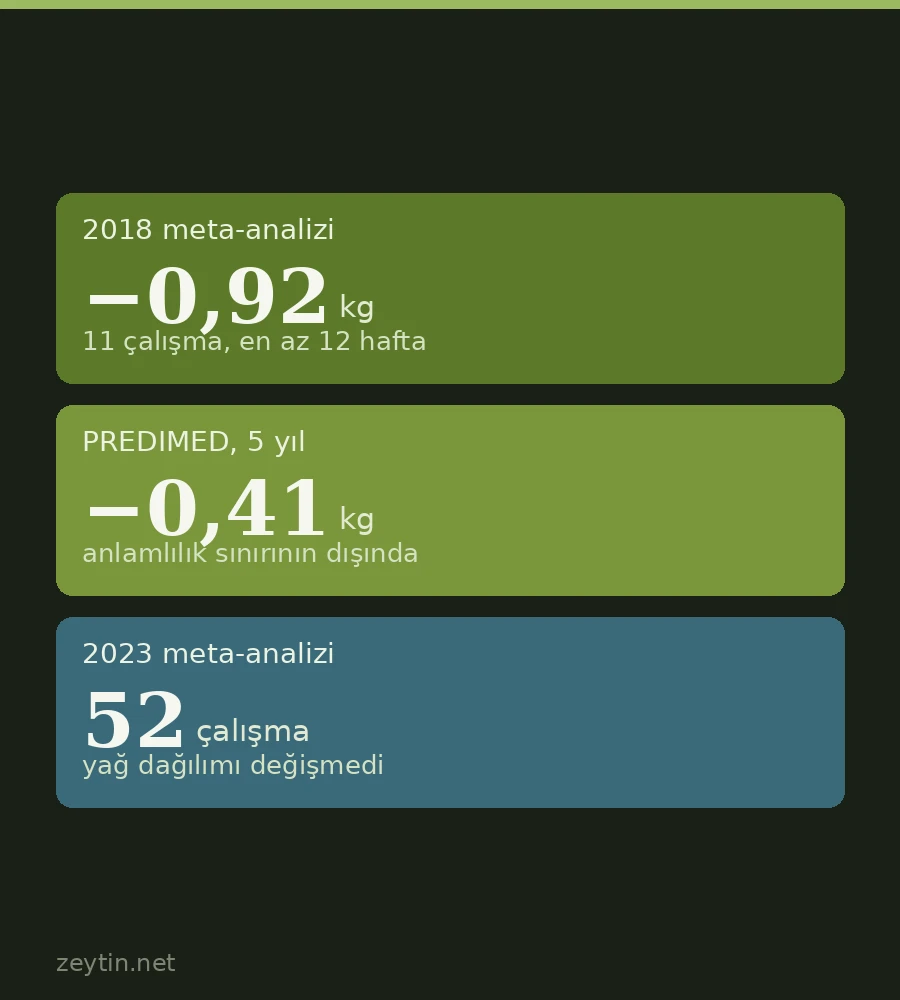
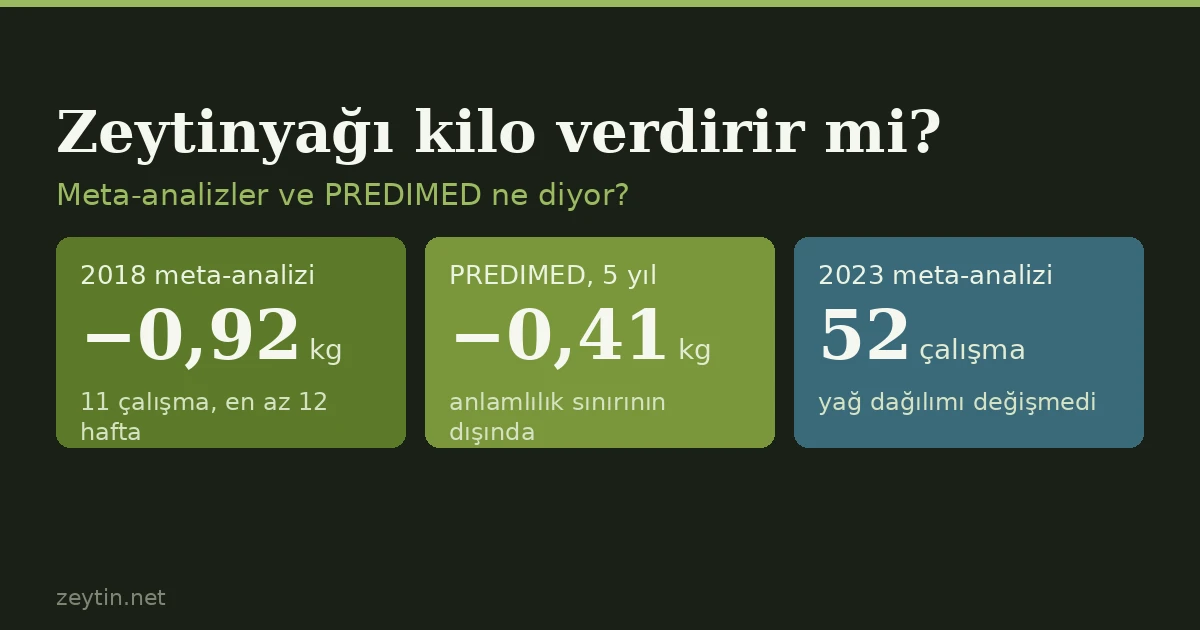
Olive oil does not make you gain weight, but it does not make you lose it on its own either: a 0.92 kg difference in a 2018 meta-analysis, no change in body fat distribution across 52 trials in 2023, and −0.41 kg over 5 years in PREDIMED (not significant). Capsules showed no benefit.
Olive oil is pure fat, and a tablespoon carries about 120 calories; yet observations that obesity rates are lower where olive oil is eaten freely around the Mediterranean have been debated for a long time. The question is whether olive oil on its own makes people lose weight, or whether it is merely an option that does not add weight when it replaces another fat. The summaries of randomised studies point to "does not cause weight gain and may help the waistline slightly in some settings" rather than "makes you lose weight".
Short answer
Even when calories are not restricted, olive oil does not raise body weight noticeably, and some meta-analyses have measured a difference of under one kilogram compared with a control diet. That difference is not enough to say that drinking olive oil slims you down. Results vary from study to study, and the largest and most recent review found no meaningful change in body fat distribution.
| Study | Design | Main finding |
|---|---|---|
| Zamora et al., 2018 | Meta-analysis of 11 randomised trials (at least 12 weeks) | −0.92 kg weight, −0.60 cm waist |
| Santos et al., 2023 | Meta-analysis of 52 randomised trials | Body fat distribution unchanged |
| PREDIMED (5 years) | 7,447 people, Mediterranean diet with olive oil | −0.41 kg (borderline, not significant) |
The 2018 meta-analysis: a small but measured difference
A review published in 2018 by Spanish researchers found only 11 of 490 studies, in a search running to December 2016, that met its criteria: an intervention of at least 12 weeks, in adults with no previous cardiovascular event. A diet enriched with olive oil lowered body weight by an average of 0.92 kg compared with a control diet (confidence interval −1.16 to −0.67) and waist circumference by 0.60 cm (−1.17 to −0.04). The difference in body mass index was reported as 0.90 units.
The authors also drew a distinction: the difference appeared when the olive oil was taken in liquid form, that is, in meals or salads, and not in studies where capsules were given. That makes it harder to tell whether the effect comes from the oil itself or from the food that goes with it. The authors' conclusion is cautious: a diet enriched with olive oil can be an important weight control strategy in people with no previous cardiovascular event; the word "can" is chosen deliberately.
The 2023 meta-analysis: no change in fat distribution
A review published in 2023 by a Brazilian team is far broader: 52 articles comparing olive oil with other oils in adults. Its conclusion is that olive oil consumption does not change the distribution of body fat. Two details stand out. First, studies giving olive oil as capsules showed a hint of slightly higher fat mass and waist circumference (the 0.28 kg difference in fat mass is not statistically significant, while the waist circumference difference was reported as significant). Second, lean mass tended to fall as the dose and duration increased.
The authors state the limits of these findings openly: differences in populations and interventions may have left confounding factors the analysis could not resolve. The 2018 and 2023 reviews differ in scope and criteria; reading one as refuting the other would be wrong, but nothing here supports the sentence "it makes you lose weight" either.
PREDIMED: an unrestricted-calorie Mediterranean diet
The study that most directly looks at the effect on weight of adding plenty of olive oil to meals is PREDIMED in Spain. 7,447 people at high cardiovascular risk (men aged 55-80, women aged 60-80) were split into three groups: a Mediterranean diet supplemented with extra virgin olive oil (2,543 people), a Mediterranean diet supplemented with nuts (2,454 people), and a control group advised to cut fat (2,450 people). Calorie restriction was not advised and physical activity was not promoted.
Over a median follow-up of about 4.8 years, weight fell slightly and waist circumference rose slightly in all three groups. Compared with the control group, the olive oil group's difference was −0.41 kg for weight (confidence interval −0.83 to 0.01; p=0.056) and −0.47 cm for waist circumference (−1.11 to 0.18; p=0.154): both fall short of statistical significance. In the nut group the waist difference was −0.92 cm and significant. The researchers' conclusion was that an unrestricted-calorie Mediterranean diet rich in vegetable fat made no significant difference to body weight and showed some evidence of less gain in central adiposity, which supports advice not to restrict healthy fats for weight maintenance.
One note is needed: the first report was published in 2016, but a protocol deviation was later identified in which some participants had not been randomised as intended; the authors withdrew the earlier report and redid the analysis with methods that do not depend on it. The figures given here come from the reanalysis.
Why are the figures so small?
The summaries do not give a reason; there are two possible explanations, and neither is a confirmed result of this data. First, olive oil in these studies may often be replacing something else, such as butter, margarine or refined vegetable oils. Second, a fatty meal may prolong the feeling of fullness, so that calories from the rest of the meal fall on their own. That offset may be incomplete and varies from person to person. A small difference in the average therefore does not mean one person at their own table will get the same result.
Why does the calorie arithmetic not match the measured difference?
A simple calculation shows (our calculation): three tablespoons of olive oil a day come to about 360 calories; with the widely used rule of roughly 7,700 calories per kilogram of fat, and if nothing else changed, that is 2,520 calories a week, about a third of a kilogram. Yet neither PREDIMED nor the meta-analyses saw an increase like that. The mismatch suggests that participants cut calories from the rest of their food on their own, or that the oil was replacing another fat, but this data cannot prove it. So the same result may not await you at your own table: oil added by the spoon, when it is not measured, easily becomes extra calories.
What it means in practice
- Olive oil still adds calories. Three tablespoons poured into food by eye is about 360 calories; for the spoon and gram arithmetic, see how many calories in olive oil.
- Its benefit shows when it replaces the fat already in use, a logic set out in how much olive oil a day. When added on top, the rest of the energy balance decides.
- There is no favourable evidence for capsules or "fat-burning" products; in the capsule studies there is even a signal in the opposite direction.
What cannot be said
The sentence "you will slim down by drinking a spoonful of olive oil every morning on an empty stomach" has no basis in any of these studies. We cover what drinking it on an empty stomach does in a separate article. Olive oil is not a tool for weight control but a fat that must be counted in the energy balance; for someone who wants to lose weight, the overall diet and physical activity are what decide.
One rating per visitor; you can change yours at any time. Ratings are real reader votes — no seeded or default scores.
Related
 Article
How many olives should you eat a day? Portions, salt and common questions
Calories, fat and salt in olives: what is a sensible daily amount? Based on nutrition data, without unauthorised health claims.
 Article
What are the benefits of olive oil?
Authorised claims, topics still under research and unproven claims kept apart — including the EFSA claim and PREDIMED.
 Article
What Is the Mediterranean Diet?
Not a weight-loss plan but a pattern of eating. The basics of the Mediterranean way of eating, recognised by UNESCO, and where olive oil sits within it.
 Article
Is olive oil good for earwax? Can you put it in your ear?
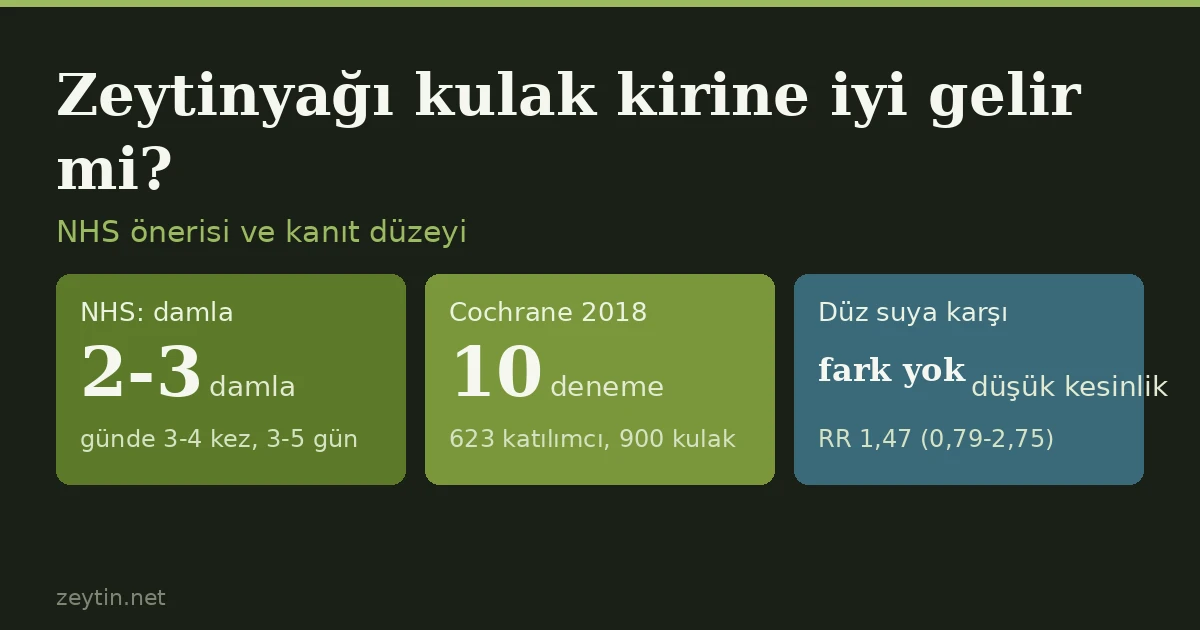
The NHS suggests 2-3 drops of olive oil, 3-4 times a day for 3-5 days, to soften earwax; a Cochrane review could not show drops beat plain water. The evidence, guidelines, the eardrum warning, cotton buds and ear candles.