Does olive oil lower blood pressure?
In most trials olive oil's effect on blood pressure is around 1-3 mmHg and it does not appear in every study; the strongest results come from the Mediterranean diet as a whole. EFSA rejected a blood pressure claim. The figures from PREDIMED to the meta-analyses, plus the salt in table olives.
Short answer: some studies suggest olive oil can lower blood pressure slightly, but in most trials the effect is in the order of 1-3 mmHg, it does not show up in every study, and the strongest results come from trials where olive oil was part of a whole Mediterranean-style diet rather than taken on its own. The European Food Safety Authority (EFSA) rejected the claim that "olive polyphenols contribute to the maintenance of normal blood pressure" for lack of evidence. Olive oil is no substitute for blood pressure medication, and table olives, because of their salt, are a separate matter altogether.
Below we go through what each study actually found, with the numbers.
The figures
| Study | Who, for how long | Result |
|---|---|---|
| PREDIMED, Toledo et al. 2013 | 7,447 high-risk adults, 4 years | No difference in systolic pressure; diastolic 1.53 mmHg lower than control |
| PREDIMED sub-study, Doménech et al. 2014 | 235 people, 1 year, 24-hour monitoring | Systolic -2.3 mmHg; +1.7 in the control group |
| Ferrara et al. 2000 | 23 hypertensive patients, 6 months per diet | Drug dose cut by 48% on olive oil, 4% on sunflower oil |
| Moreno-Luna et al. 2012 | 24 young women, 2 months per oil | Systolic -7.9, diastolic -6.7 mmHg on polyphenol-rich oil |
| Khaw et al. 2018 | 91 healthy adults, 4 weeks, 50 g a day | No difference between olive oil, butter and coconut oil |
| Schwingshackl et al. 2019 (meta-analysis) | 13 trials, 611 people | Virgin oils about 3 mmHg lower systolic than refined; no difference in diastolic |
| McNabb et al. 2024 (meta-analysis) | 17 trials | No significant effect on systolic or diastolic pressure |
The largest trial: PREDIMED
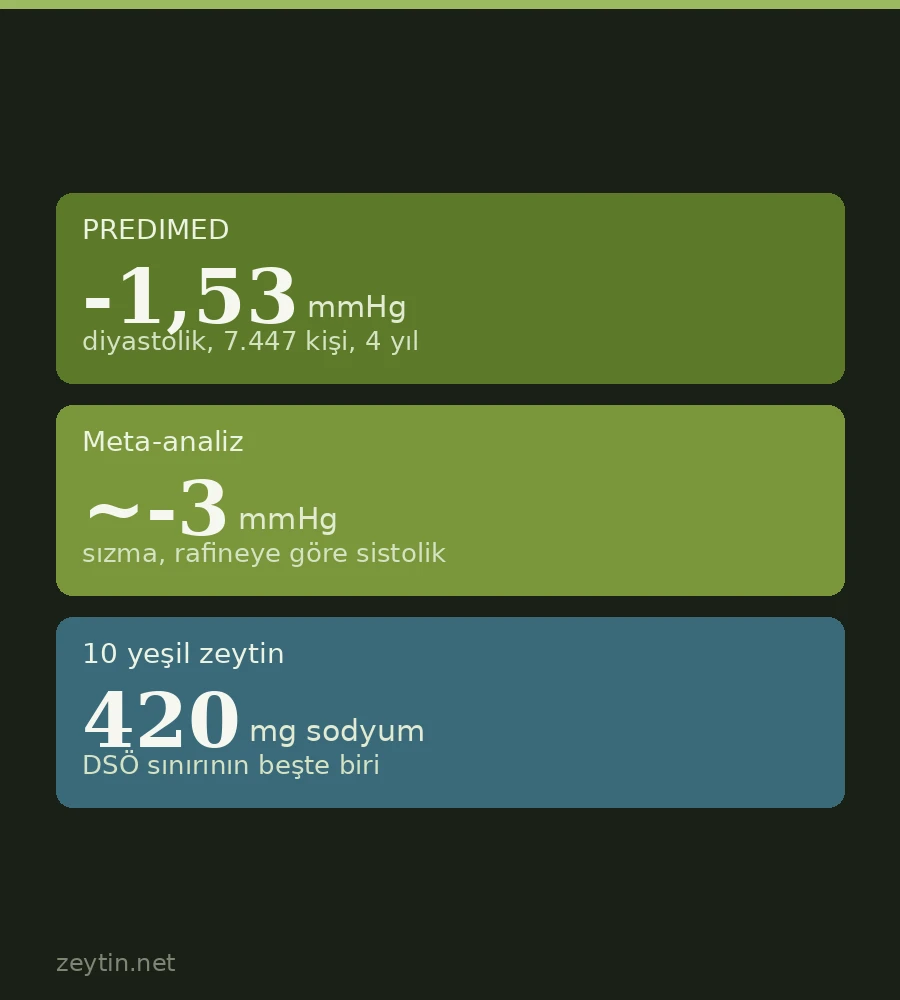
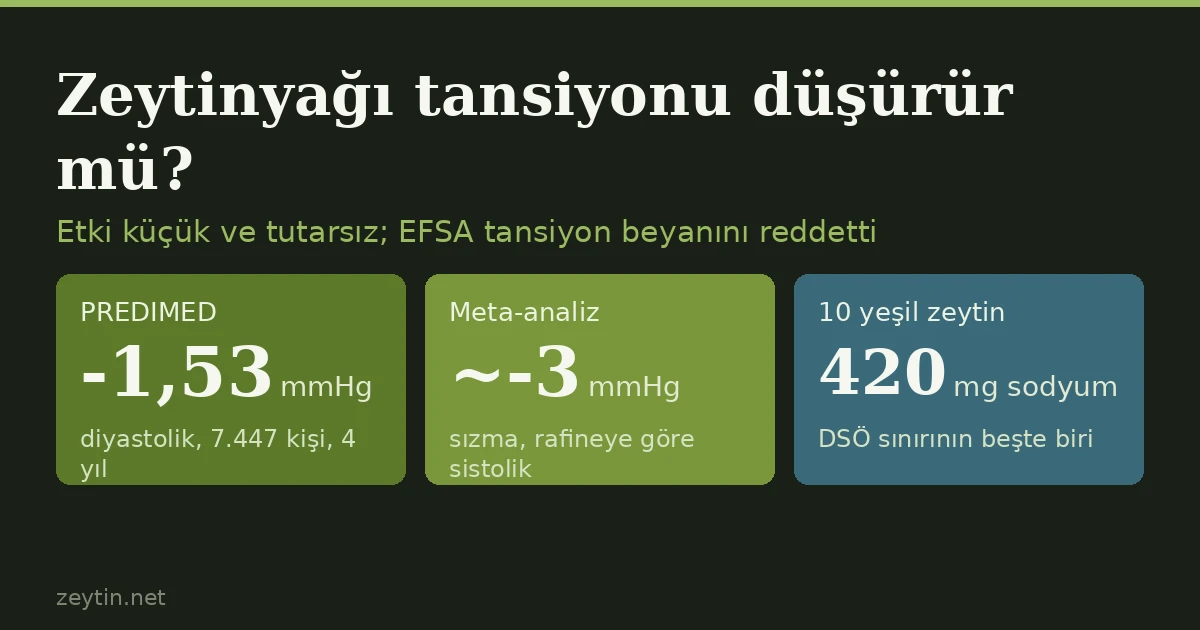
PREDIMED, run in Spain, is the largest randomised trial involving olive oil. 7,447 people at high cardiovascular risk were assigned to one of three diets: a Mediterranean diet supplemented with extra virgin olive oil, a Mediterranean diet supplemented with nuts, or a low-fat control diet. According to the blood pressure analysis published in BMC Medicine in 2013, annual office measurements over four years showed no difference in systolic pressure between the groups. Diastolic pressure was 1.53 mmHg lower in the olive oil group than in the control group, and 0.65 mmHg lower in the nut group. Blood pressure improved over time in all three groups, including the control.
In a sub-group of 235 participants, most of them already hypertensive, blood pressure was measured over 24 hours with ambulatory monitors for a year. According to the 2014 paper in the journal Hypertension, mean systolic pressure fell by 2.3 mmHg in the olive oil group and 2.6 mmHg in the nut group, while it rose by 1.7 mmHg in the control group.
The catch with both results is that participants were not simply given olive oil; their whole diet changed. The design does not allow the share of the effect due to olive oil itself to be separated out. For the broader framework, see our article on what the Mediterranean diet is.
Two small but widely quoted studies
The study by Ferrara and colleagues, published in the Archives of Internal Medicine in 2000, is the one cited most often. Twenty-three hypertensive patients already on medication followed, in a double-blind crossover design, a diet based on either extra virgin olive oil or sunflower oil for six months each. At the end of the olive oil period resting blood pressure was lower and the patients' daily drug dose had been cut by 48 per cent, against 4 per cent during the sunflower oil period. Eight patients on the olive oil diet were able to come off medication altogether. The result is striking, but it comes from a sample of 23 and the dose reductions were decided under medical supervision.
In the study by Moreno-Luna and colleagues, published in the American Journal of Hypertension in 2012, 24 young women with high-normal blood pressure or stage 1 hypertension spent two months each on an olive oil providing about 30 mg of polyphenols a day and on an olive oil with the polyphenols removed. Only during the polyphenol-rich period did blood pressure fall from baseline: by 7.9 mmHg systolic and 6.7 mmHg diastolic. We explain what polyphenols are in oleocanthal and polyphenols.
This study supports the idea that any effect may come from the polyphenols rather than from the fat itself. But the sample was small, all participants were women, and the comparison was made against each woman's baseline, not directly between the two oils.
What the meta-analyses say
Analyses that pool the scattered results of individual trials draw a more cautious picture:
- Schwingshackl and colleagues (2019) combined 13 trials covering 611 people. Virgin olive oils, whether high or low in phenols, kept systolic pressure about 3 mmHg lower than refined olive oil; there was no difference in diastolic pressure. The authors rated the certainty of the evidence as "low to moderate".
- In the analysis by Zamora-Zamora and colleagues (2018), diastolic pressure fell on average by 0.73 mmHg; in trials using 10-50 ml of extra virgin olive oil a day the reduction rose to 1.44 mmHg. There was no significant fall in systolic pressure, and polyphenols given in capsule form showed no effect.
- The 17-trial analysis by McNabb and colleagues (2024) found no significant effect on either systolic or diastolic pressure.
Studies that found nothing
In a trial published in BMJ Open in 2018 by Khaw and colleagues in the United Kingdom, 91 healthy adults ate 50 grams a day of extra virgin olive oil, coconut oil or butter for four weeks. There was no significant difference in systolic or diastolic pressure between the three groups. In the European EUROLIVE trial, 25 ml of olive oil a day lowered systolic pressure by 3 per cent in 160 healthy men, but only in participants from non-Mediterranean countries.
That makes sense: for someone with normal blood pressure who already eats plenty of olive oil, one more spoonful may make no measurable difference.
Why EFSA said no
The only health claim authorised for olive oil in the European Union concerns blood lipids, not blood pressure: olive oils containing at least 5 mg of hydroxytyrosol and its derivatives per 20 grams may state that "olive oil polyphenols contribute to the protection of blood lipids from oxidative stress". The details are in our article on the benefits of olive oil.
In the same 2011 opinion EFSA also examined a blood pressure claim, and concluded that a cause-and-effect relationship had not been established between consuming olive polyphenols and maintaining normal blood pressure. Its reason was that the dossier contained no human studies from which conclusions could be drawn. Some of the trials above were published later, but the claim has not been re-approved. A bottle labelled "lowers blood pressure" is therefore not using wording from the EU's list of authorised claims.
Olives are another story: salt
Olive oil contains almost no sodium; the US Department of Agriculture's food database lists 2 mg per 100 grams. Table olives are the opposite. The same database gives 1,556 mg of sodium per 100 grams of canned green olives; one olive weighs about 2.7 grams, which means about 42 mg of sodium each. Ten green olives therefore provide around 420 mg of sodium, roughly one fifth of the 2,000 mg a day the World Health Organization recommends as the upper limit for adults.
For someone with high blood pressure, the salt in the olives on the breakfast table can easily cancel out the few millimetres one might hope to gain from olive oil. Ways to reduce it are in how to reduce the salt in olives, and the differences between types in which olive is healthiest.
So what should you do?
- Do not use olive oil instead of blood pressure medication; only your doctor can change the dose. The dose reductions in the Ferrara study were made under medical supervision too.
- If there is a benefit to be had, the route is substitution, not addition: olive oil in place of butter, margarine or other solid fats. A tablespoon of olive oil is about 120 calories; for amounts, see how much olive oil a day.
- The studies with positive results used extra virgin or high-polyphenol oils; refining removes most of these compounds.
- For the wider picture on the heart, see olive oil and heart health. For the findings on olive leaf extract and blood pressure, along with the warning about drug interactions, see olive leaf tea.
Summary
Olive oil is not a blood pressure drug. As part of a Mediterranean-style diet it may contribute to an improvement of a few millimetres of mercury; on its own, over short periods and in healthy people, that effect often fails to appear. No blood pressure claim is authorised in Europe. For anyone with high blood pressure, the salt in the olives and the rest of the food on the table matters more than the olive oil.
t; This article is general information; for diagnosis and treatment, consult your doctor.
One rating per visitor; you can change yours at any time. Ratings are real reader votes — no seeded or default scores.
Related
 Article
Can you put olive oil on your skin? What the evidence says
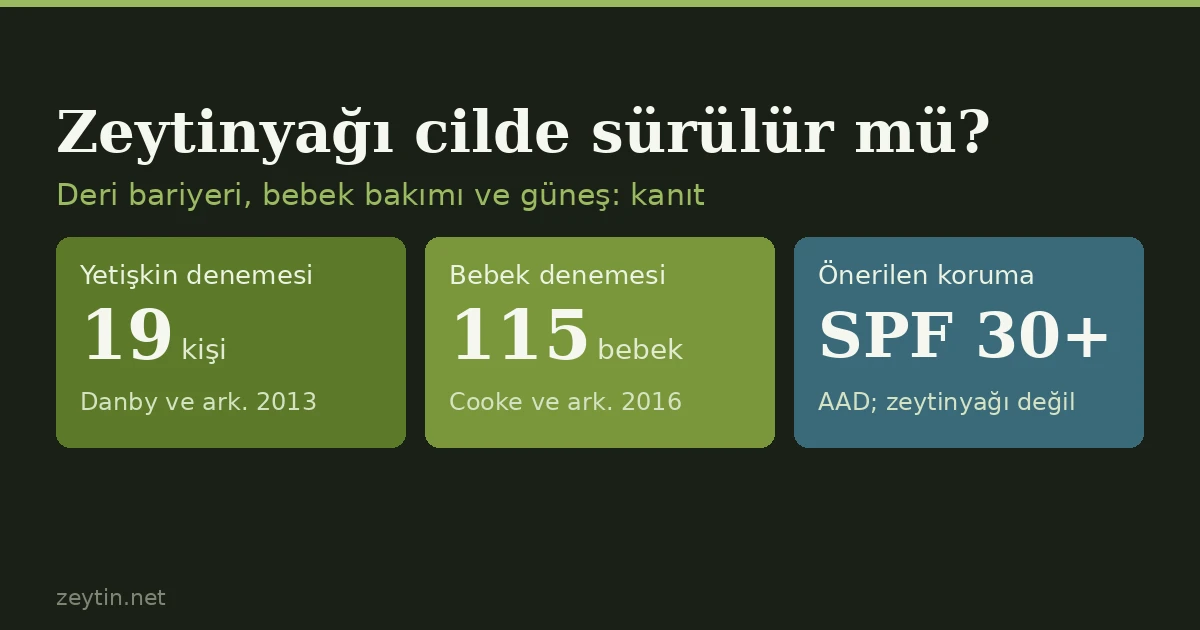
You can, but studies suggest regular use may weaken the skin barrier; it is not advised for eczema or babies and gives no sun protection.
 Article
What Are the Benefits of Olives? What Do They Actually Provide?
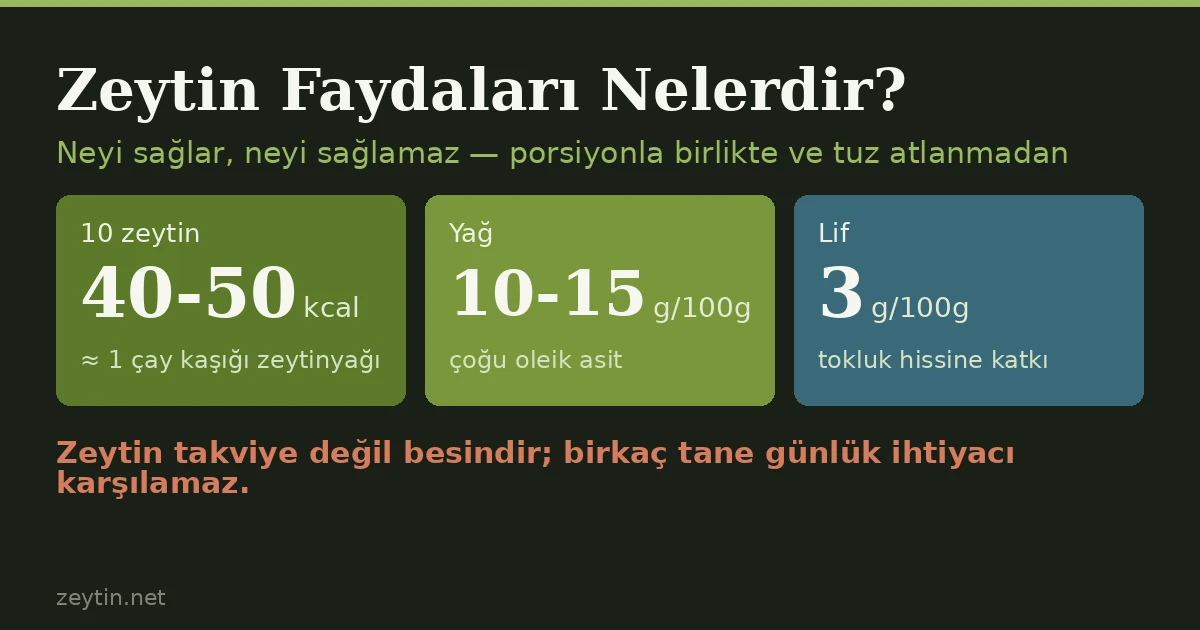
What olives do and do not provide. Fat, fibre, vitamin E, iron and polyphenols — without overstatement, with portions, and without skipping salt.
 Article
Can you put olive oil on your hair? What the evidence says on dandruff, hair loss and lice
It can go on the hair shaft: it coats the surface and partly passes into the fibre. The only regrowth evidence is a mouse study with pure oleuropein. Oleic acid can irritate a dandruff-prone scalp, and olive oil did not kill lice in the lab.
 Article
Olive pollen allergy: the quiet cause of May to July
Olive pollen fills the air across western Türkiye from May to July. Bursa recorded 791 grains/m³ in one day over an 87-day season; 67.8% of pollen-sensitised patients in İzmir react to it.