Do olives grow in cold regions?
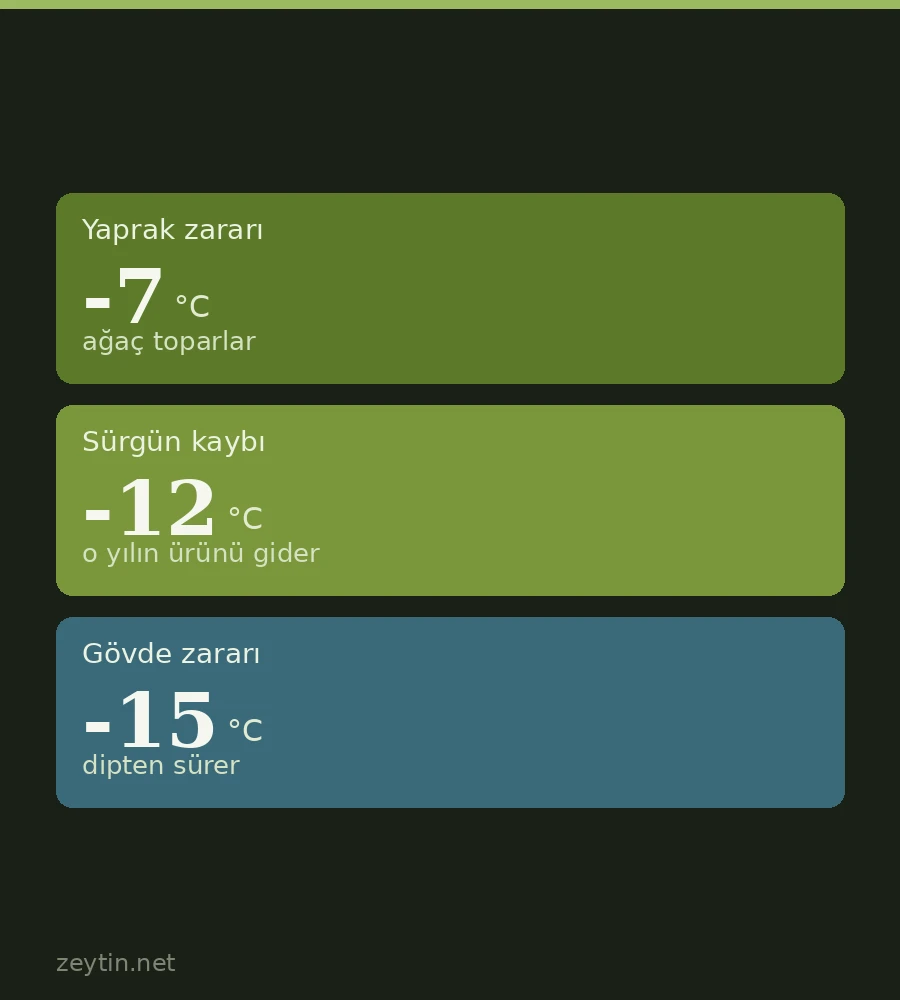
Olives survive -7 °C, lose shoots at -12 °C and the trunk below -15 °C. Yet Artvin delivers Turkey's highest yield per tree: microclimate beats the map.
Short answer: yes, within limits. The tree tolerates cold up to a point, but a commercial grove needs a reliable crop every year, and those are two different thresholds. In Turkey, provinces whose winter averages stay below zero for long periods have no commercial groves.
How much cold can an olive tree take?
A single number would mislead, because damage depends on three things at once: how cold it gets, how long it lasts, and what stage the tree is in.
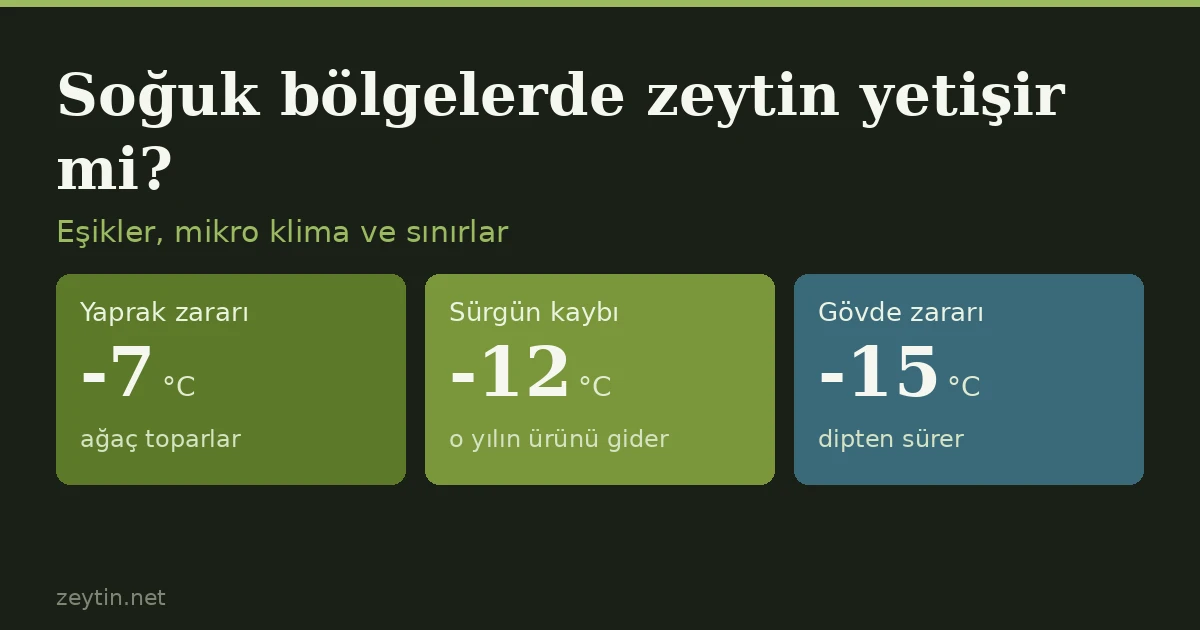
| Temperature | Expected effect |
|---|---|
| -5 to -7 °C | Leaf burn begins; the tree usually recovers |
| -10 to -12 °C | Thin branches and one-year shoots die back; that season's crop is lost |
| Below -15 °C | Trunk and main branches are damaged; the tree regrows from the base |
These thresholds apply to a dormant tree. In spring, once sap is rising and buds are swelling, far less cold does the same damage. A frost in April can be more destructive than the coldest night in January.
Duration matters too. Two hours at -8 °C and two days at the same temperature are not equivalent; the second drives cold deep into the tissue.
Where does the line run in Turkey?
In practice Central and Eastern Anatolia cross these thresholds every year. Erzurum, Kars, Ardahan, Ağrı, Van, Sivas and Yozgat have no commercial groves. A single tree can be protected through one winter, but a grove needs a guarantee annually.
The only Central Anatolian province in the statistics is Eskişehir: 211 tonnes from 46,000 trees. Ankara is listed but reports zero. Those two lines show a region at the margin, where Eskişehir manages a crop in sheltered pockets.
Microclimate changes everything
Reading a map and concluding "not here" can mislead. The best example is Artvin, in Turkey's north-eastern corner in the wettest part of the Black Sea region, which nonetheless delivers the highest yield per tree in the country at 30.8 kilograms.
The reason is that the groves are not on the coast but in the Çoruh Valley: inland, sheltered by mountains and at low elevation. Together these create a pocket with mild winters and dry summers.
The same logic works at garden scale:
- Cold air pools in hollows. The upper part of a slope runs several degrees warmer than the valley floor.
- The foot of a south-facing wall radiates heat through the night and lowers frost risk.
- A corner sheltered from wind blunts the drying effect of freezing wind.
These differences reach three or four degrees, and for an olive three degrees is the difference between a crop and none.
How much does variety choice matter?
Cold tolerance varies between cultivars by a few degrees. That sounds small but is decisive at the margin: at -10 °C one variety loses only leaves while another loses its shoots.
For measured figures and how each variety compares: cold-hardy olive varieties
One caveat: variety choice widens the limit by a few degrees, it does not change the climate. Where winters drop regularly to -15 °C no cultivar makes a commercial grove viable.
If you are planting in a cold region
- Find the lowest temperature of the past decade. If it went below -12 °C the tree will eventually be cut to the base.
- Wrap young trees for the first three or four winters. Hardiness increases with age; the critical period is the start.
- Do not apply nitrogen in autumn. Late growth has no time to harden, enters winter soft and is lost to the first frost.
- Reduce irrigation in autumn. A tree still taking water keeps growing and enters dormancy late.
- Set expectations. At the margin a tree bears in some years and not others. Do not plan on regular oil production.
What happens where winters are never cold?
There is a limit in the other direction too. To form flower buds an olive needs a winter period below roughly 7-10 °C. Without that chill the tree grows and stays green but does not flower or fruit.
In a tropical climate an olive survives as an ornamental and bears nothing. The tree tolerates neither hard cold nor the absence of cold; it grows in the narrow band between. That is why the Mediterranean basin is the olive basin.
Related pages
- Production by region: Where do olives grow in Turkey?
- Provinces with no production: Which provinces in Turkey grow no olives?
- The humidity margin: Do olive trees grow on the Black Sea coast?
Production figures come from the Turkish Statistical Institute's provincial crop statistics for the 2025-2026 season.
One rating per visitor; you can change yours at any time. Ratings are real reader votes — no seeded or default scores.
Related
 Article
Building a high-density olive grove: five requirements
High-density planting is not a choice of variety but a five-component system — miss one and it performs worse than a traditional grove. Spacing, yields, the overlooked oil-content trade-off, and who it does not suit.
 Article
Fertilising Olives: From Soil Analysis to an Annual Programme
How to read a soil test, which nutrients olives need and when, fertigation and organic matter management.
 Article
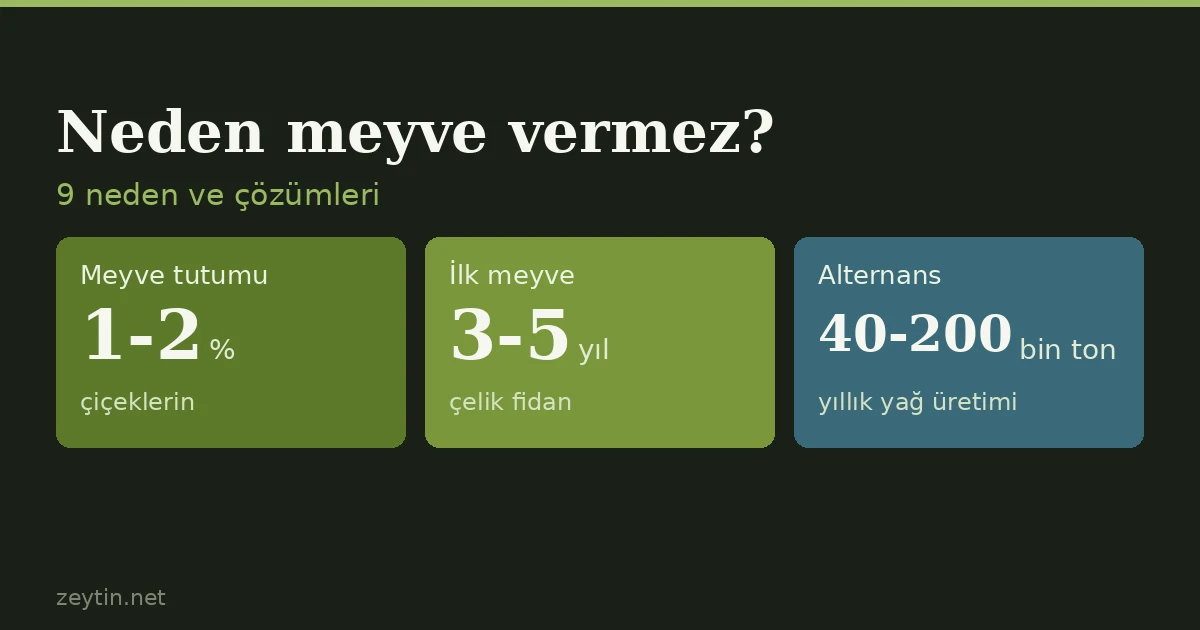
Why is my olive tree not bearing fruit? 9 causes and what to do
Behind an olive tree that flowers but sets no fruit, fills one year and stays empty the next, or has never cropped at all, there is usually more than one cause. From the tree's age and lack of grafting to missing pollinators, insufficient chilling, drought and the wrong fertiliser or pruning, here is how to diagnose by symptom and what to do.
 Article
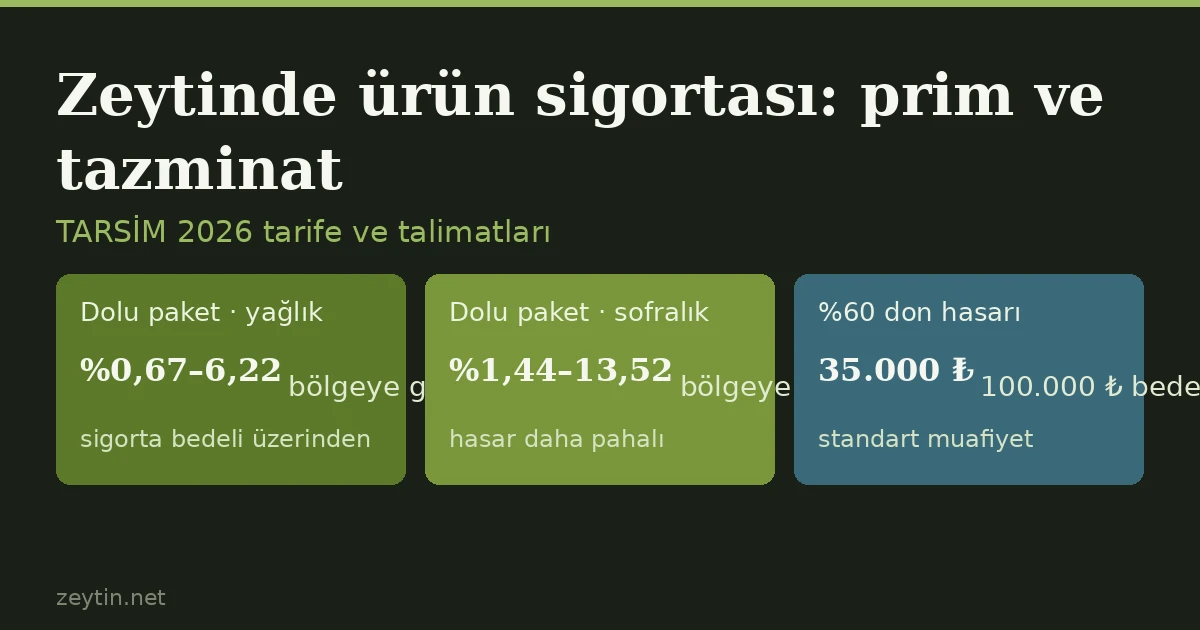
What does crop insurance cover for olives, and what does it cost?
Olives can be insured twice: for the crop and for the tree. Under TARSİM's 2026 tariff the hail package runs from 0.67% to 6.22% for oil olives and 1.44% to 13.52% for table olives, while frost cover sits on its own tariff and is optional. What a claim pays is set by the deductible and coinsurance: 60% frost damage on the standard option pays 35% of the sum insured.