Ceyhan Olive Oil: harvest defined as “no green fruit left on the tree”
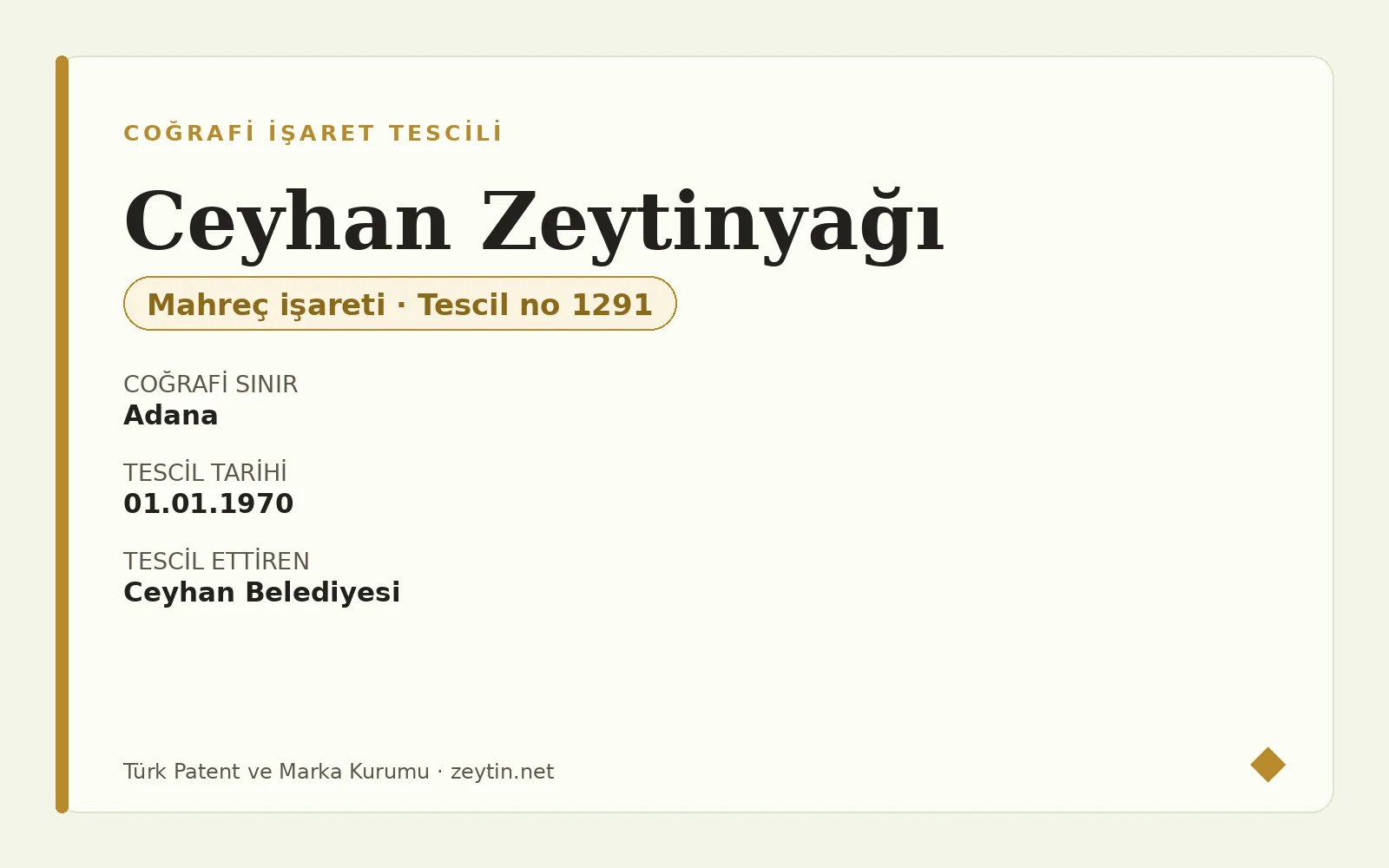
Registered in 2022. The certificate defines harvest not by calendar but by the state of the tree: when no green fruit remains and oil content peaks.
Most certificates give harvest timing in months. Ceyhan Olive Oil's leaves the criterion to the tree itself.
The record
| Registration no | 1291 |
| Registration date | 19.12.2022 |
| Application | C2021/000286 · 16.07.2021 |
| Type | Geographical indication |
| Registered by | Ceyhan Municipality |
| Area | The Ceyhan district of Adana |
That the registrant is a municipality is notable — most olive registrations are held by chambers of commerce, commodity exchanges or district governorships.
The harvest criterion
According to the certificate, olives destined for oil are harvested in the months when no green fruit remains on the tree and the oil content of the fruit has reached its maximum.
This is a definition tied to ripeness rather than the calendar — a sounder criterion, since the climate varies from year to year. The certificate acknowledges as much by saying “depending on climatic conditions”.
Oil content rises as the olive approaches black maturity, peaking at full ripeness. We covered that curve in the life cycle of an olive tree.
Cold pressing
Once milled to paste, the oil is extracted below 27 °C by appropriate technique — extra virgin olive oil under the Turkish Food Codex.
The same threshold appears in the Ödemiş Çekişte Olive Oil certificate; 27 °C is the internationally accepted limit for cold pressing.
The eastern Mediterranean
Ceyhan is one of Adana's olive production centres. Osmaniye Olive Oil (1317) and the Hatay registrations lie in the same belt — the eastern Mediterranean forms its own line on Türkiye's olive map.
The criteria the document binds
The registration does not only protect a name; it defines the product numerically:
| Criterion | Value in the document |
|---|---|
| Free acidity (as oleic acid) | max %0.8 |
| Processing temperature | max 27 °C |
The free acidity limit of 0.8% is the codex ceiling for extra virgin olive oil. Here the registration restates the codex; what distinguishes the product is the other criteria below. Capping processing at 27 °C is what cold extraction means in practice: above that threshold yield rises but aroma compounds and phenolics are lost.
Inspection. The inspection body convenes with at least 3 kişi, at least once a year. Results are reported under Industrial Property Law no. 6769 and submitted to the Turkish Patent and Trademark Office.
The production steps in the document
The registration describes production step by step. The document's own sequence:
1. Üretim Metodu — Ceyhan Zeytinyağı üretim aşamaları aşağıda verilmiştir.
2. Zeytinlerin Hasadı — Ceyhan Zeytinyağının üretiminde kullanılacak zeytinler coğrafi sınırdaki hasat dönemi içerisinde zeytin meyvelerine hasar vermeyecek şekilde makine ve/veya el ile özenle zeytin ağaçlarından toplanır.
3. Zeytinlerin Muhafazası — Hasat edilen zeytinler gıda ile temasa uygun olan temiz, tercihen plastik kasalarda hava alacak şekilde taşınır.
4. Zeytinlerin Temizlenmesi ve Yıkanması — Zeytinlerin hasat edilmesi sırasında bulunabilecek dal parçaları, toz, toprak, yaprak vb.
5. Zeytinlerin Kırılması ve Ezilmesi — Ezme işlemini kolaylaştırmak için zeytinler parçalarına ayrılması ile yağ veriminin artırılması sağlanır.
6. Zeytin Hamurundan Yağın Ekstraksiyonu — Ekstraksiyon işlemleri; presleme (geleneksel yöntem), santrifüjleme (modern yöntem), seçici filtrasyon (perkolasyon/sinolea yöntemi) gibi yöntemlerden biri ya da birkaçı kullanılarak gerçekleştirilir.
7. Zeytinyağından Karasuyun Ayrılması — Bu aşamada su, yağ ve zeytin posanın tamamen birbirinden ayrılması sağlanır.
8. Zeytinyağının Depolanması ve Ambalajlanması — Üretilen zeytinyağı tüketime hemen arz edilmeyecek ise gıda ile temasa uygun örneğin; paslanmaz çelik tanklarda, doğrudan ışık almayacak şekilde serin ortamlarda, nem ve kokudan ari depolama koşullarında muhafaza edilir.
That this sequence is binding is what separates a geographical indication from a trade mark: a mark says who produced something, a geographical indication also sets down how it must be produced.
Its place in Adana's olive production
| Item | Value |
|---|---|
| Fruit production | 73,893 t |
| — for oil | 63,621 t |
| — for the table | 10,273 t |
| Olive oil production | 9,861 t |
| Trees | 3,068 thousand |
| Yield per tree | 24.1 kg |
86% of the province's fruit goes to oil. An oil-based registration matches how the province actually produces.
One rating per visitor; you can change yours at any time. Ratings are real reader votes — no seeded or default scores.
Related
 Article
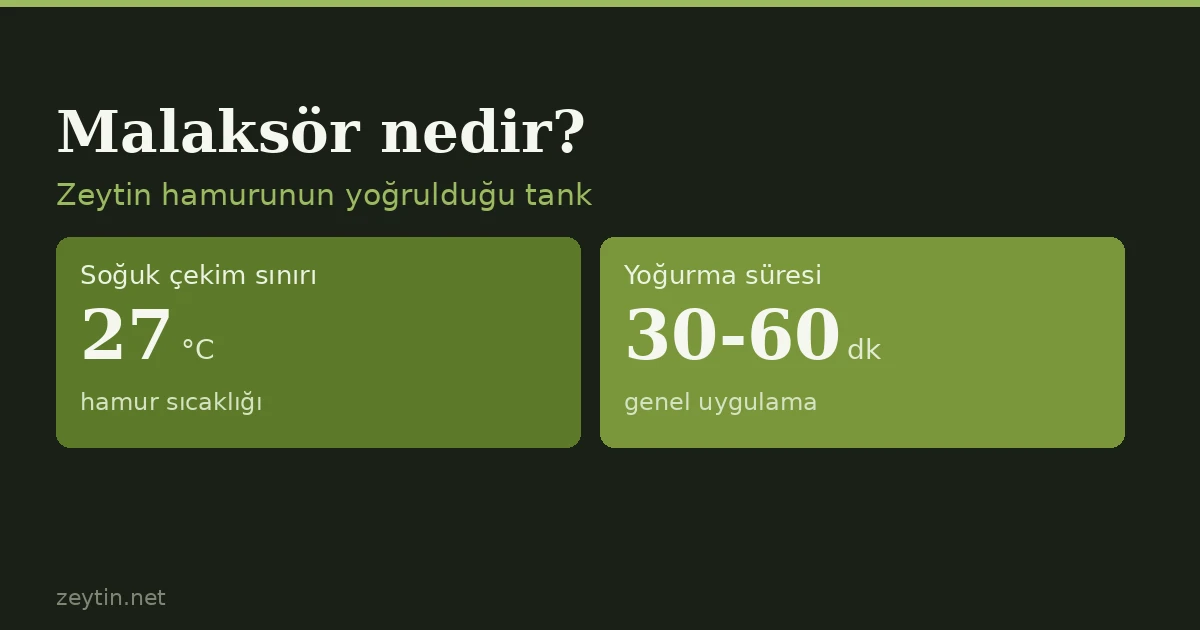
What is a malaxer? The tank where olive paste is kneaded, and the 27 °C limit
A malaxer is the stainless steel kneading tank where crushed olive paste is slowly mixed so that oil droplets can merge. Time and temperature decide both yield and aroma, and this is also where the limit for "cold extraction" is drawn.
Article
What is a malaxer? The tank where olive paste is kneaded, and the 27 °C limit
A malaxer is the stainless steel kneading tank where crushed olive paste is slowly mixed so that oil droplets can merge. Time and temperature decide both yield and aroma, and this is also where the limit for "cold extraction" is drawn.
 Article
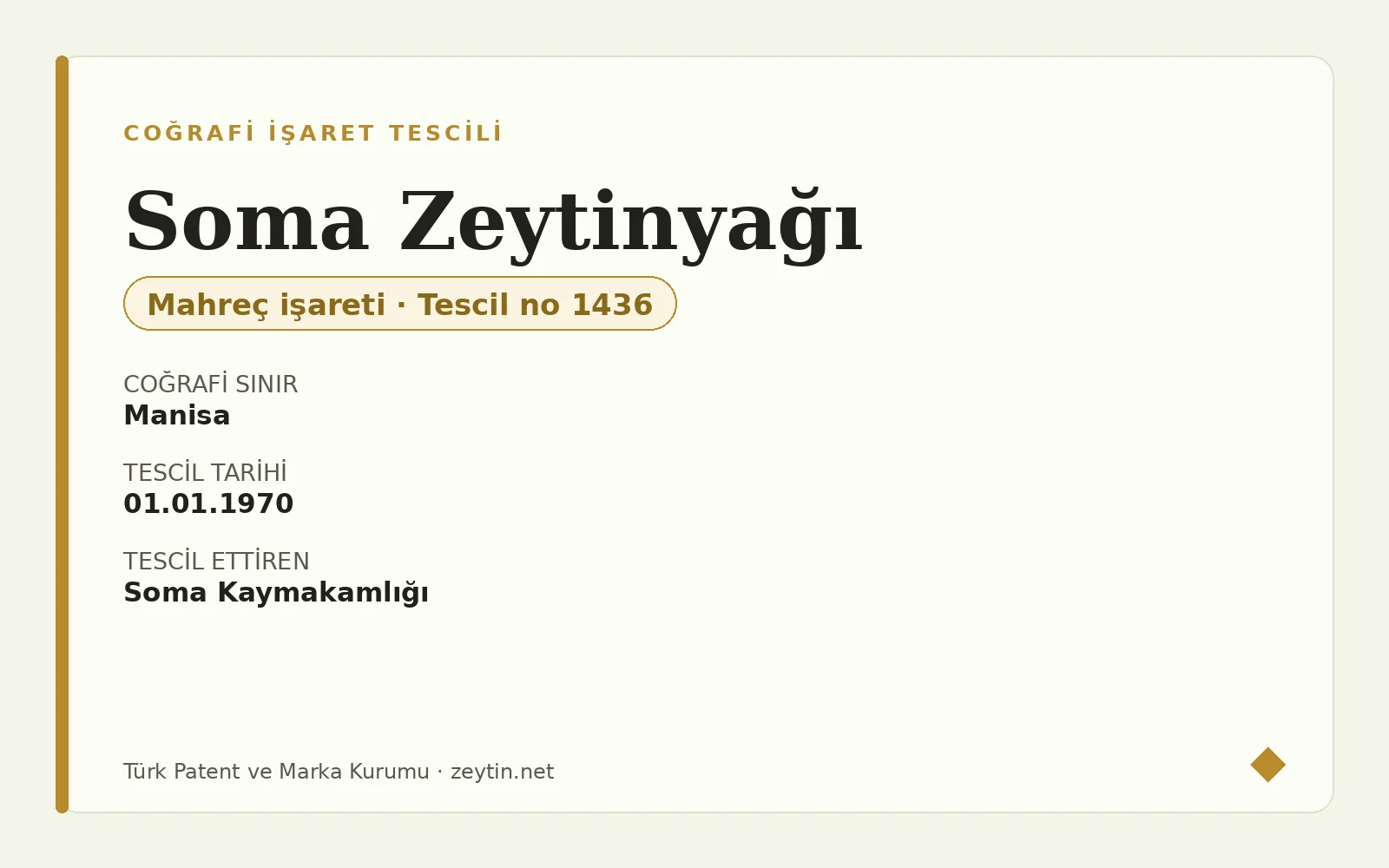
Soma Olive Oil: how a cooler climate lifts yield in a lignite basin
Registered in 2023. Mean temperature 15.3 °C; the certificate ties that relative coolness to yields reaching 796 kg/da. Free acidity 0.18-0.55.
Article
Soma Olive Oil: how a cooler climate lifts yield in a lignite basin
Registered in 2023. Mean temperature 15.3 °C; the certificate ties that relative coolness to yields reaching 796 kg/da. Free acidity 0.18-0.55.
 Article
What are waxes (wax esters) in olive oil, and what do they catch?
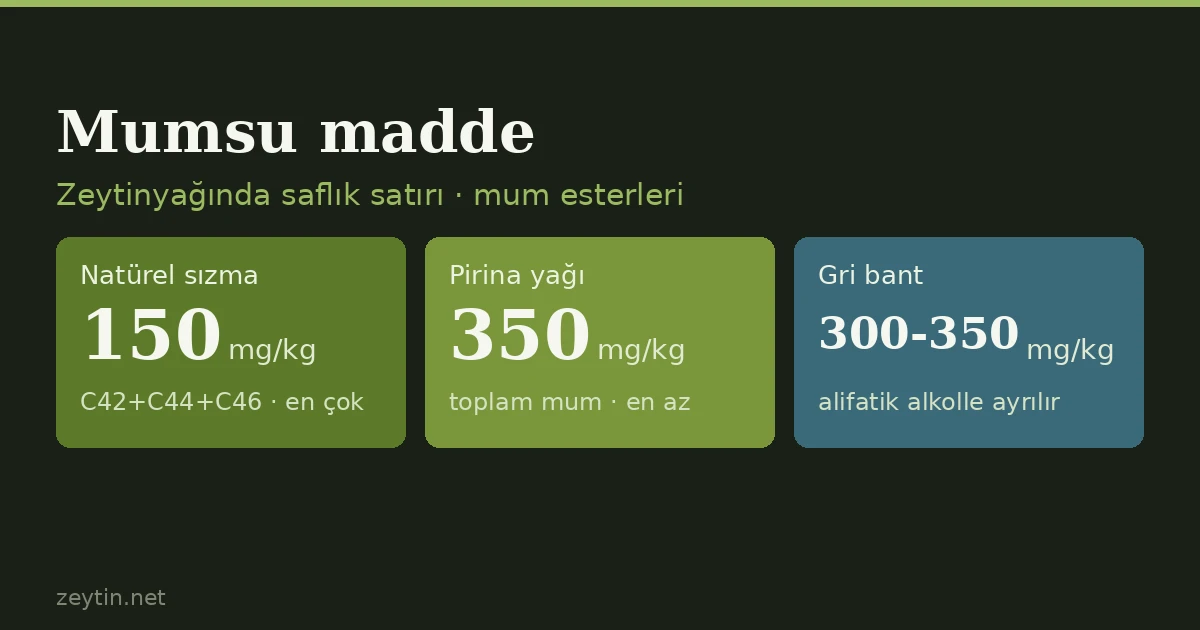
If a label states the acidity, the wax content has to be printed too. Wax comes from the protective layer on the olive skin; little of it passes into mechanically pressed oil, while solvent extraction from pomace pulls out many times as much. That makes it a purity indicator rather than a quality one: it tells you by what route the oil was obtained. In the International Olive Council standard, extra virgin oil must stay below 150 mg/kg for C42+C44+C46, while the pomace grades must exceed 350 mg/kg in total. In the grey band between 300 and 350 the decision is taken with aliphatic alcohols and erythrodiol plus uvaol.
Article
What are waxes (wax esters) in olive oil, and what do they catch?
If a label states the acidity, the wax content has to be printed too. Wax comes from the protective layer on the olive skin; little of it passes into mechanically pressed oil, while solvent extraction from pomace pulls out many times as much. That makes it a purity indicator rather than a quality one: it tells you by what route the oil was obtained. In the International Olive Council standard, extra virgin oil must stay below 150 mg/kg for C42+C44+C46, while the pomace grades must exceed 350 mg/kg in total. In the grey band between 300 and 350 the decision is taken with aliphatic alcohols and erythrodiol plus uvaol.
 Article
Erdek Kapıdağ Olive Oil: an oil whose grade changes in dry years
Registered in 2024. The certificate admits something rare: in dry periods the oil can fall from extra virgin to virgin grade.
Article
Erdek Kapıdağ Olive Oil: an oil whose grade changes in dry years
Registered in 2024. The certificate admits something rare: in dry periods the oil can fall from extra virgin to virgin grade.