The Çelebi olive: the green table cultivar of İznik
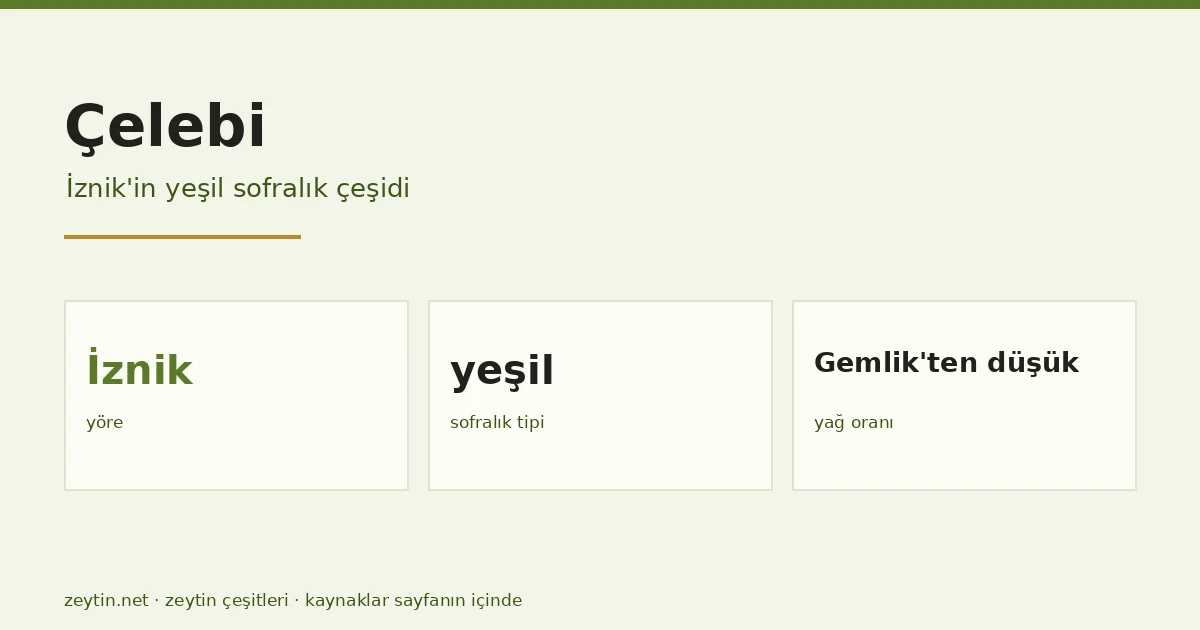
Grown around İznik in Bursa, Çelebi is a green table cultivar. Its oil content is lower than Gemlik's — which is no drawback for a table olive.
Çelebi is an olive variety grown around İznik in Bursa. It is used mostly as a green table olive, and its oil content is lower than Gemlik's.
Çelebi in numbers
| Property | Value | Note |
|---|---|---|
| Main use | green table olive | |
| Oil content | lower than Gemlik | Gemlik 29–30% |
| Region | Bursa · İznik | Marmara |
Why low oil content isn't a problem
For a table variety, low oil content is not a disadvantage — it can even be the opposite.
What a table olive is judged on is flesh ratio, fruit size and how cleanly the flesh leaves the stone, not oil content. A fruit high in oil can soften faster in brine. This is why varieties separate by purpose:
- Oil varieties — oil content decides: Memecik 25–28%, Ayvalık 23–26%
- Table varieties — size and flesh ratio decide: Domat 89% flesh, Gemlik 6.4 flesh-to-stone
Çelebi belongs to the second group. The same logic in detail: olive varieties.
İznik and Gemlik: the same registered area
İznik, where Çelebi grows, is also part of the geographical indication area registered for Gemlik olives — the registration covers Gemlik, Orhangazi and İznik.
So two varieties grow in the same district: one is the country's best-known black table olive, the other a local variety that goes to green table use.
Note on sources
Where a measurement has not been published for this variety, the figure is left blank rather than estimated. Turkey's full variety distribution and comparative tables: olive varieties.
Where it stands among measured varieties
Values are those published on each variety's own page; the comparison covers only varieties with a measured figure, so it is a comparison of what is known — not of every Turkish variety. See the full ranking and how it is built →
One rating per visitor; you can change yours at any time. Ratings are real reader votes — no seeded or default scores.
Related
 Article
Where do olives grow in Türkiye, and where don't they?
What limits the olive is frost, not a provincial border. Where it grows in Türkiye, with cold thresholds and altitude limits.
Article
Where do olives grow in Türkiye, and where don't they?
What limits the olive is frost, not a provincial border. Where it grows in Türkiye, with cold thresholds and altitude limits.
 Article
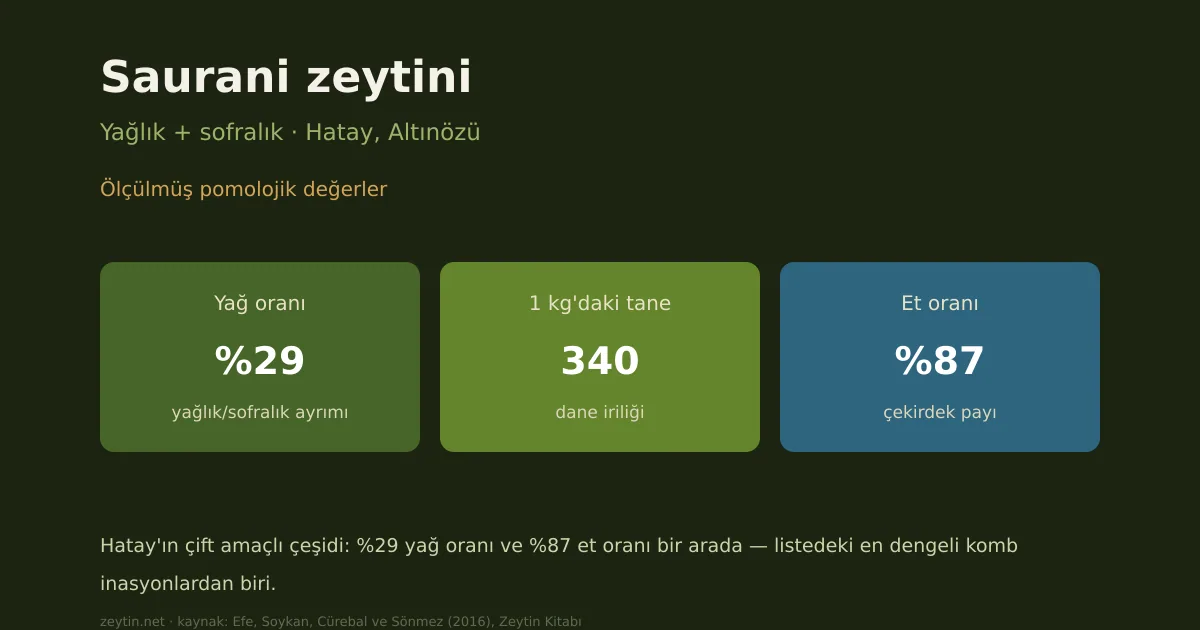
Saurani olive: characteristics, oil content and growing areas
Hatay's dual-purpose variety: 29% oil with 87% flesh — one of the most balanced combinations on the list.
Article
Saurani olive: characteristics, oil content and growing areas
Hatay's dual-purpose variety: 29% oil with 87% flesh — one of the most balanced combinations on the list.
 Article
Hursuki olive
Hursuki is a recorded variety of south-eastern Anatolia. No measured pomological data published.
Article
Hursuki olive
Hursuki is a recorded variety of south-eastern Anatolia. No measured pomological data published.
 Article
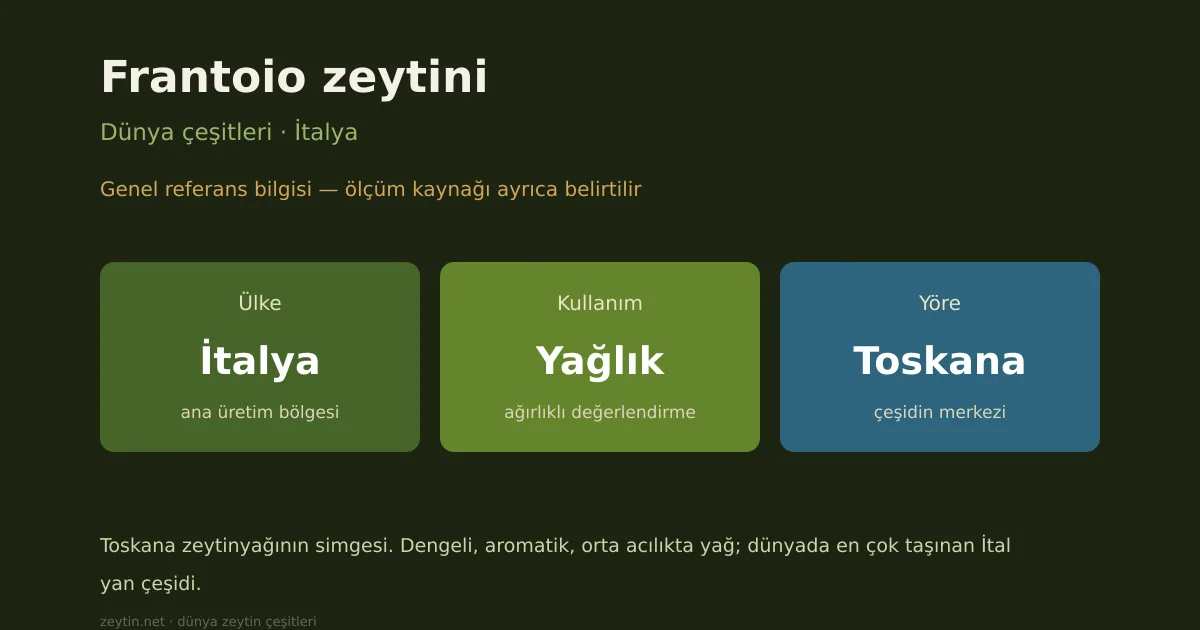
Frantoio olive: Italy's oil variety
The emblem of Tuscan olive oil. A balanced, aromatic, moderately bitter oil, and the most widely exported Italian variety.
Article
Frantoio olive: Italy's oil variety
The emblem of Tuscan olive oil. A balanced, aromatic, moderately bitter oil, and the most widely exported Italian variety.