The Çekişte olive: the Aegean's lesser-known oil cultivar
Çekişte accounts for 1.5% of Turkey's olive trees — more widespread than Domat or Uslu, yet a cultivar whose name is almost never heard.
Çekişte is an Aegean oil variety making up 1.5% of Turkey's tree stock. That share makes it the country's eighth most widespread variety — more common than Domat (1.4%) and Uslu (1%), whose names you see in shops every day.
Yet almost nobody has heard of it. This page exists to fill that gap.
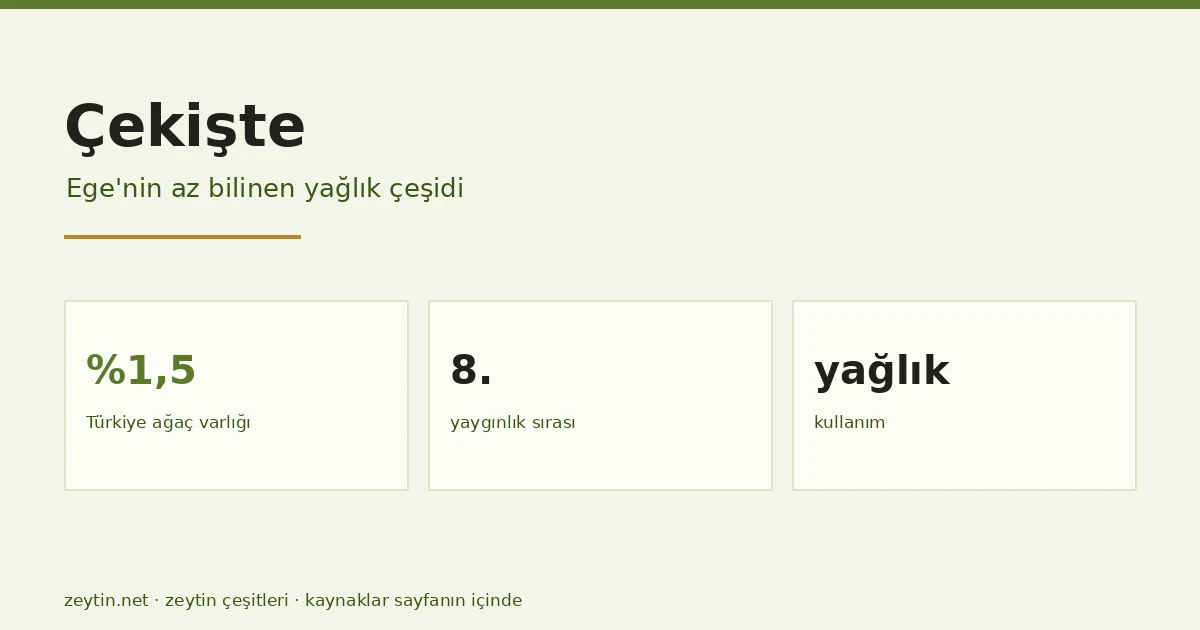
Çekişte in numbers
| Property | Value | Note |
|---|---|---|
| Share of Turkey's tree stock | 1.5% | eighth place |
| Main use | oil | |
| Region | Aegean |
Why it isn't known
How well a variety is known depends not on how widespread it is but on which product it ends up in. The rule goes:
- A variety that goes to the table gets known. The jar says "Gemlik" or "Domat"; the shopper learns the name.
- A variety that goes to oil stays unknown. The bottle rarely names the variety; it says "extra virgin".
Çekişte is an oil variety, so its produce travels namelessly. The same applies to Memecik — 45% of the country, and still unknown to the shopper.
This is a structural visibility problem in Turkish olive growing: most of the production goes to oil, and oil carries no variety name. Yet the variety directly shapes the character of the oil.
Its place in the Aegean
Aegean olive growing is dominated by Memecik at 45% — more than half the region's trees. Ayvalık at 19% holds the northern Aegean. Çekişte is among the local varieties living between these two giants.
Turkey's full variety distribution and what the table reveals: olive varieties.
Missing data — stated plainly
For Çekişte we have no verified pomological measurement: we could not find an accessible source giving fruit weight, oil content, flesh-to-stone ratio or chilling requirement.
This page does not fill those values in by estimation. That measured data is hard to find for a variety making up 1.5% of the national tree stock says something about the gap between Turkey's variety inventory and its pomological record.
The page will be updated when measurements are found; the update date appears at the foot of the page.
In short
Çekişte ranks eighth in tree stock and yet goes unheard of — an Aegean oil variety. That invisibility isn't particular to it but structural: varieties destined for oil never get their names on the bottle.
Published measurement data on the variety is limited; whatever is found will be added here.
Registered names built on this variety
The registration covers the product of a defined area — not this variety wherever it is grown.
- Ödemiş Çekişte Zeytinyağı designation of origin · reg. no 579
- Milas Çekişke Zeytini designation of origin · reg. no 1109
Where it stands among measured varieties
Zeytin Kitabı — Efe, Soykan, Cürebal, Sönmez (2016), Kitabevi Yay. s.37-80
Zeytin Kitabı — Efe, Soykan, Cürebal, Sönmez (2016), Kitabevi Yay. s.37-80
Zeytin Kitabı — Efe, Soykan, Cürebal, Sönmez (2016), Kitabevi Yay. s.37-80
Zeytin Kitabı — Efe, Soykan, Cürebal, Sönmez (2016), Kitabevi Yay. s.37-80
Zeytin Kitabı — Efe, Soykan, Cürebal, Sönmez (2016), Kitabevi Yay. s.37-80
Values are those published on each variety's own page; the comparison covers only varieties with a measured figure, so it is a comparison of what is known — not of every Turkish variety. See the full ranking and how it is built →
One rating per visitor; you can change yours at any time. Ratings are real reader votes — no seeded or default scores.
Related
 Article
Zoncuk olive
Zoncuk is a recorded variety of south-eastern Anatolia. No measured pomological data published.
Article
Zoncuk olive
Zoncuk is a recorded variety of south-eastern Anatolia. No measured pomological data published.
 Article
What is an olive pit good for?
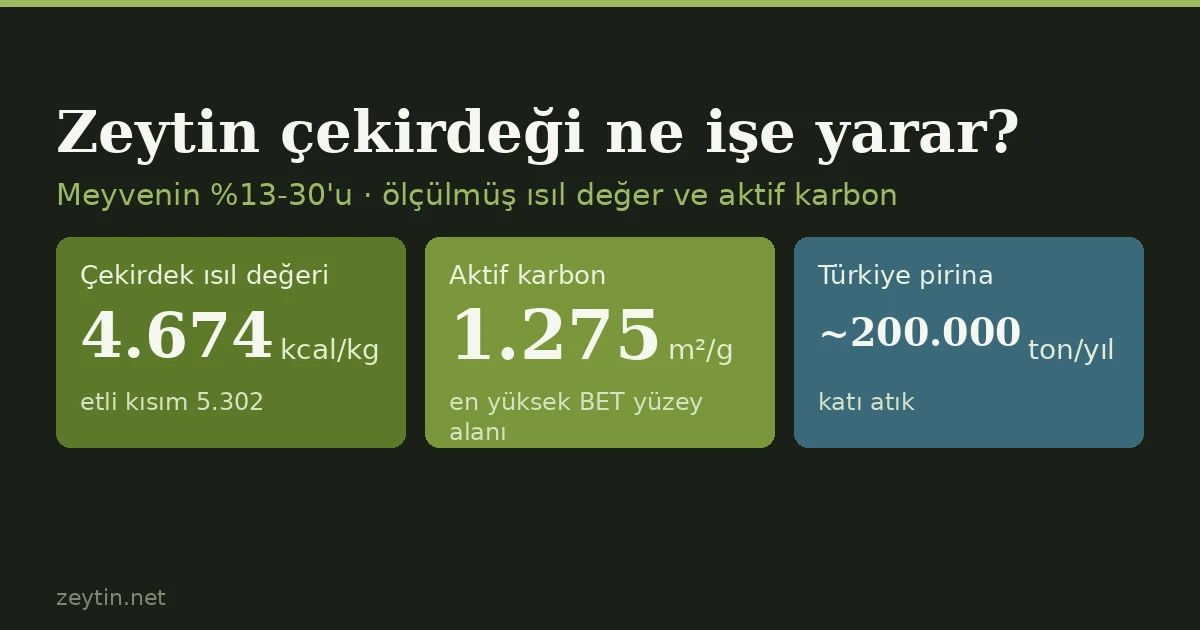
The pit makes up 13-30 percent of the fruit and its measured calorific value is 4,674 kcal/kg. But the laboratory result upsets intuition: the largest contribution to pomace energy comes from the flesh, not the pit. In activated carbon it yields 1,275 m²/g of surface area; in the nursery it is a seed that germinates poorly and demands grafting. Turkey produces roughly 200,000 tons of pomace a year.
Article
What is an olive pit good for?
The pit makes up 13-30 percent of the fruit and its measured calorific value is 4,674 kcal/kg. But the laboratory result upsets intuition: the largest contribution to pomace energy comes from the flesh, not the pit. In activated carbon it yields 1,275 m²/g of surface area; in the nursery it is a seed that germinates poorly and demands grafting. Turkey produces roughly 200,000 tons of pomace a year.
 Article
What are green olives, and how do they differ from black?
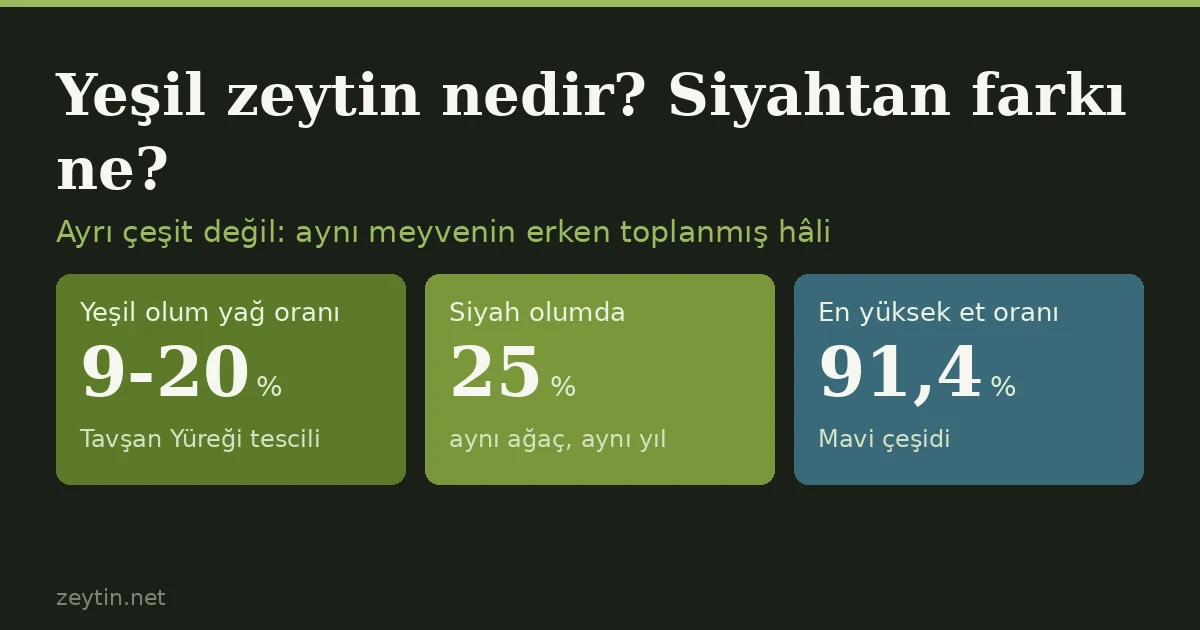
Green olives are not a separate variety but the same fruit picked early. What sets the colour, why pick green, and where the difference from black begins.
Article
What are green olives, and how do they differ from black?
Green olives are not a separate variety but the same fruit picked early. What sets the colour, why pick green, and where the difference from black begins.
 Article
World olive varieties: from Picual to Kalamata
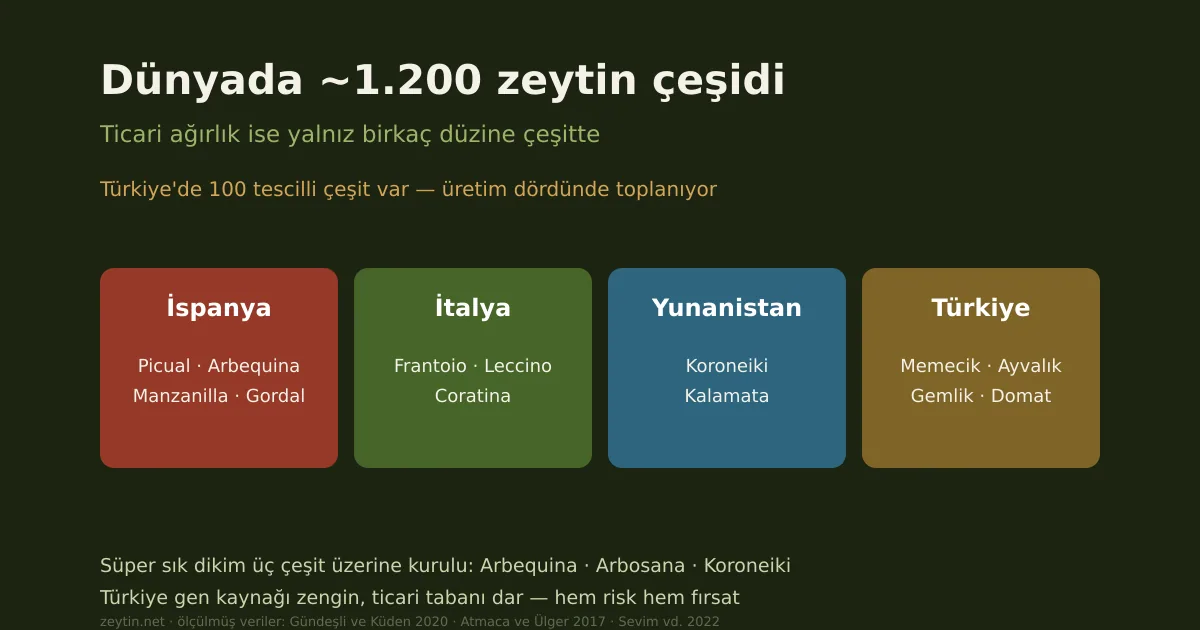
About 1,200 cultivars exist; commercial weight sits in a few dozen. Picual, Arbequina, Koroneiki, Kalamata, Frantoio — compared with Türkiye.
Article
World olive varieties: from Picual to Kalamata
About 1,200 cultivars exist; commercial weight sits in a few dozen. Picual, Arbequina, Koroneiki, Kalamata, Frantoio — compared with Türkiye.