Are ants harmful to olive trees? Scale, olive moth and sticky bands
Ants do not eat olive leaves or fruit; ants on a tree usually signal black scale. For the honeydew they can shield scale from parasites, yet the same ants are key predators of the olive moth and fruit fly. Measurements from Spain and Portugal, Turkey's official guidance and a spray-free approach: decide on the scale, not the ants.
Short answer: ants do not eat the leaves or fruit of an olive tree, so they cause no direct damage. They can do indirect harm: while feeding on the sweet secretion (honeydew) of insects such as black scale, they protect those insects from their natural enemies. But the same ants are among the important predators of the olive moth and the olive fruit fly. Seeing ants on a tree is therefore not in itself a reason to spray; the first thing to establish is why they are climbing it.
What are the ants after?
What draws ants to an olive tree is usually a sugary food. Black scale (Saissetia oleae) leaves a sugary secretion as it sucks the tree's sap, and ants feed on it. A fungus growing on the same secretion produces the black, soot-like layer that coats leaves and twigs — sooty mould. The scale's life cycle and the sooty mould are covered in our article on olive black scale and sooty mould.
The University of Florida's grove guide, revised in 2024, treats this as a practical warning sign: ants on a tree can indicate a bigger problem, very often a scale insect problem. The University of California's olive pest management guidelines (UC IPM) suggest a simple observation: if ants coming down the trunk have swollen, translucent abdomens, they are collecting honeydew in the canopy.
Which ants?
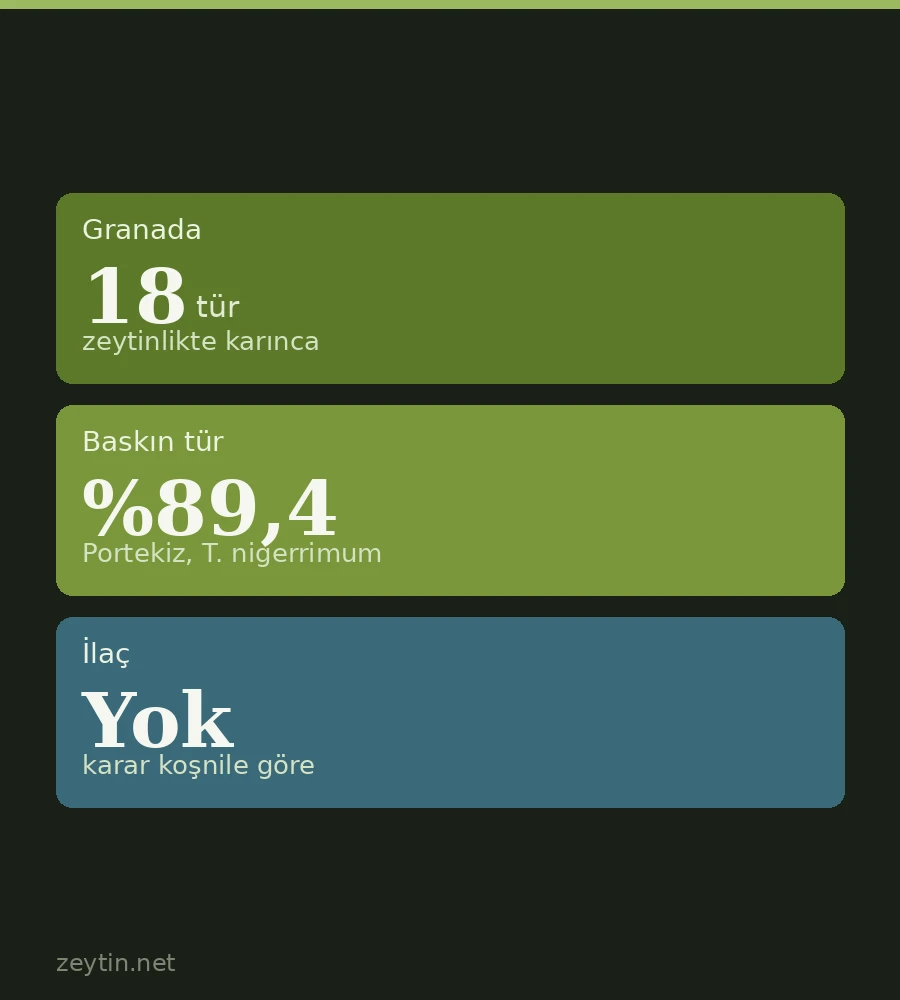
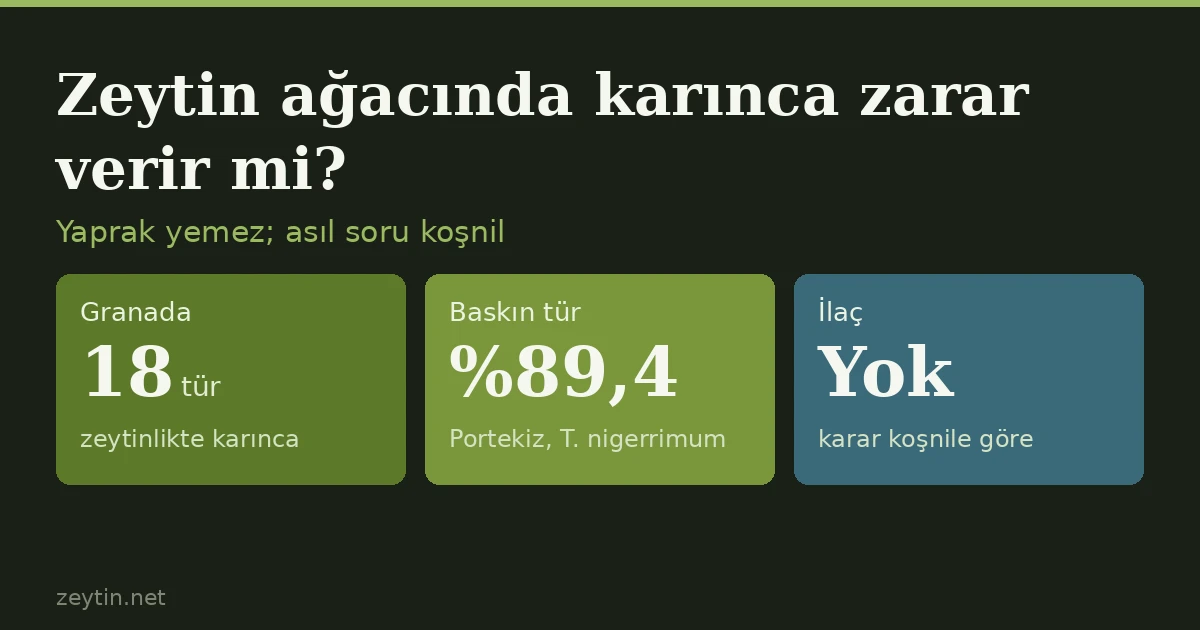
The ant fauna of olive groves has been studied mostly in Spain and Portugal. A 1999 study in three groves near Granada recorded 18 species; Tapinoma nigerrimum was the only species found in every sample, and most species nested in the soil beneath the canopy. A study published in 2002 from a grove in north-eastern Portugal that had not been sprayed for ten years found 10 species; of the 719 ants collected, 89.4 per cent were again T. nigerrimum.
We did not find any study that measures ant species, or the ant–scale relationship, in Turkish olive groves. Most of the findings below therefore come from the western Mediterranean.
How do ants protect scale?
According to UC IPM, ants protect honeydew-producing insects from predators and parasites. The most important enemies of black scale are tiny parasitoid wasps that lay their eggs inside the scale. When ants chase them away, the scale multiplies more freely.
The experiments that show this effect most clearly were not done on olives. In a trial in California on potted oleander plants (Barzman and Daane, 2001), when ants were present 55.3 per cent of the individuals of one parasitoid species managed to lay eggs, while a second species laid none; plants tended by ants carried more scale and lower parasitism. In a citrus orchard in Australia (Dao and colleagues, 2014), ants were excluded with a sticky band applied to the trunks and the black scale population collapsed: with no ants left to collect the honeydew, most of the scale insects drowned in their own secretion.
On olives the picture is more mixed. A study carried out in olive groves in northern Portugal and presented as a doctoral thesis at the University of León in 2017 found that trees from which ants were excluded yielded more parasitoids from black scale in late spring; there was no difference in autumn. But excluding ants did not change scale density in any season. So the idea that "remove the ants and the scale disappears" is not supported by these data for olives.
The useful side: hunters of moth and fly
The ant's second role in the olive grove is as a predator. In studies by Morris and colleagues near Granada in the 1990s, ants were the most commonly found predators of the olive moth (Prays oleae). The researchers were also candid about a limitation: laboratory tests suggested that ants ate a great deal of moth, but because ants pass food to one another and scavenge, direct observation showed fewer moths being taken.
In the 2002 Portuguese study, 6 of 9 ants seen carrying prey were carrying moth larvae, and T. nigerrimum was observed attacking moth larvae that had fallen to the ground and carrying them straight back to the nest. This matters because the larvae of the moth's fruit generation leave the fruit in late summer and autumn, and some of them go down to the soil to pupate. The moth's three generations are described in our article on the olive moth.
The olive fruit fly is similar. A 2007 study in California that followed fly pupae placed in the soil found that ants were the most numerous predators observed; a study published in Portugal in 2016 found that earwigs dominated predation of pupae in winter and ants in spring. The rest of fly control is covered in olive fruit fly control.
There is a cost, too
Ants are not selective predators. In Portugal, ants consumed 97.8 per cent of the eggs on Trichogramma cards released into a grove against the moth within seven days (Pereira and colleagues, 2004). A study near Granada found that ants also ate the eggs of the green lacewing (Chrysoperla carnea), itself a predator of moth eggs. So while ants hunt pests, they can also eat beneficial insects, whether released by growers or arriving on their own.
A review published in Turkish sums up this balance well. According to Turguter and Ülgentürk, writing in the Journal of Agricultural Sciences in 2007, ants increase scale populations but, by preying on other pests, have a positive effect on the overall health of the plant; killing ants as part of scale control leads to an increase in other pests.
What to do
1. Look at the scale first. If there is heavy ant traffic on the trunk, check the shoots and the undersides of the leaves for black scale, sticky shiny leaves and sooty mould. If there is a problem, the decision is made on the basis of the scale. Turkey's Ministry of Agriculture and Forestry, in its 2022 technical instruction on integrated pest management in olives, does not mention ants at all; for black scale it states that crop losses can reach 60-70 per cent in heavy infestations, and that chemical control should not be applied when natural enemies are keeping the scale more than 50 per cent under control. Counts and thresholds are in our article on the olive pest calendar and intervention thresholds.
2. Do not spray for ants. UC IPM recommends managing ants only when they are disrupting the biological control of scale; if a chemical route is chosen, baits are preferred to sprays. The same guidelines point out that broad-spectrum insecticides disrupt biological control by killing the scale's natural enemies as well.
3. A sticky band if needed. The University of California's ant guide for home gardens says a sticky band applied to the trunk stops ants from climbing a tree. On young trees the sticky material should go not directly on the bark but on a collar of paper or cloth wrapped around the trunk; branches should be kept from touching walls, fences or the ground, and the band checked every week or two, otherwise dust and dead ants build a bridge across it. This is not an olive-specific official recommendation: Andalusia's integrated production regulation for olives, published in August 2026, recommends trunk bands not for ants but only for a weevil.
4. Check the trunk for nests. Carpenter ants (Camponotus) do not eat wood the way termites do; they excavate it to nest, and according to the University of California this usually starts in wood that is water-damaged or decaying. A study in Italy also recorded the species Crematogaster scutellaris nesting inside olive trunks. An ant nest in the trunk may point to decay that was already there; for the care of large pruning cuts, see our article on olive pruning.
Summary
- Ants do not eat olive leaves or fruit; ants on a tree are very often a sign of scale.
- For the honeydew, they can protect scale from parasites; but the one olive study that excluded ants with measurements found no difference in scale density.
- The same ants are important predators of the olive moth and the olive fruit fly; they can also eat the eggs of beneficial insects.
- Make the decision on the basis of the scale, not the ants; do not spray for ants, and use a sticky trunk band if needed.
One rating per visitor; you can change yours at any time. Ratings are real reader votes — no seeded or default scores.
Related
 Article
What is the olive bark beetle? Symptoms, and why pruning waste is the key to control
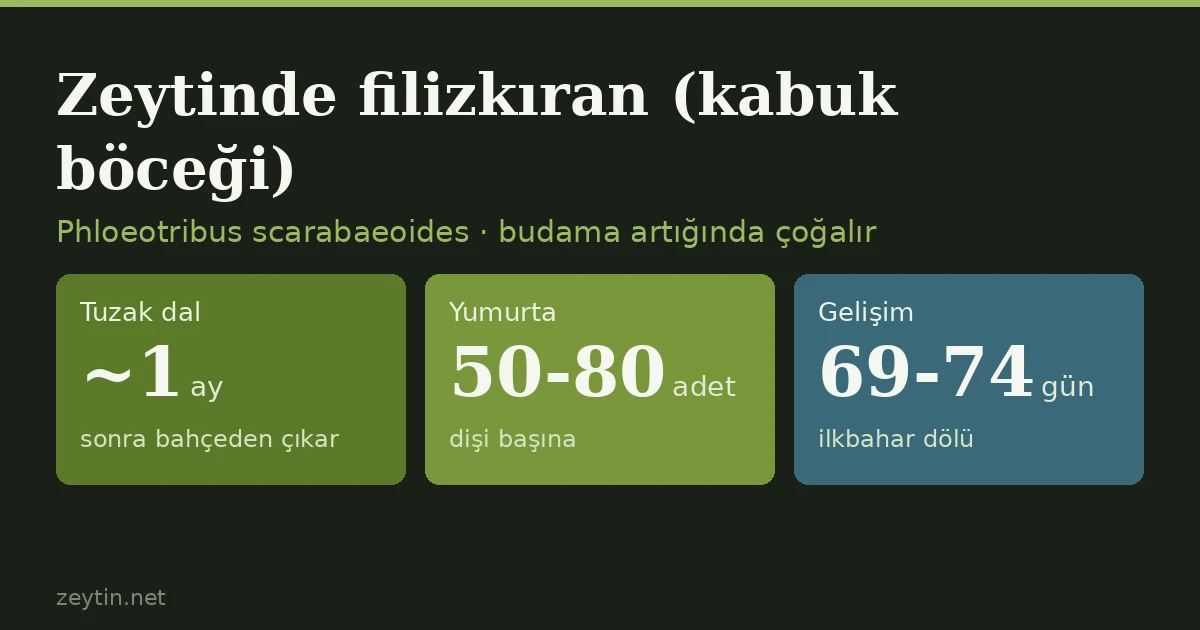
The olive bark beetle (Phloeotribus scarabaeoides) bores into branch forks and dries out shoots. It breeds in pruning waste and favours weak trees. A guide to recognising and controlling it, based on field studies from Mut and Mardin, the Dalmatian calendar and the IOC's trap-branch method.
 Article
Other olive pests: jasmine moth, psyllid and olive scale
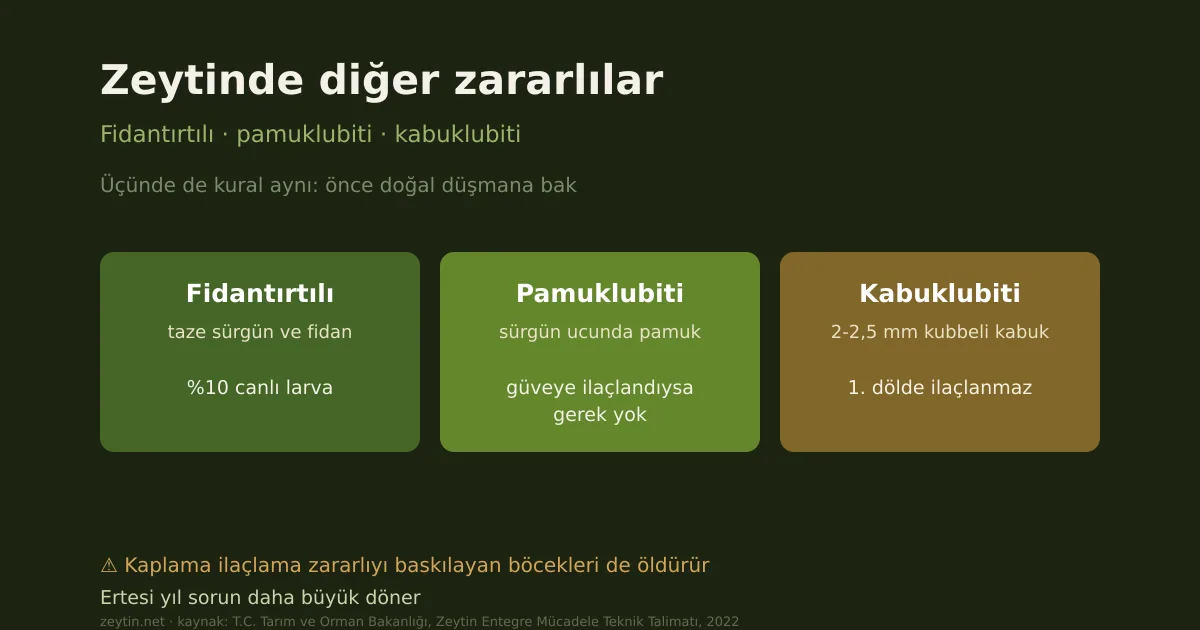
Three olive pests overshadowed by the fruit fly: the jasmine moth on tender shoots, the cottony psyllid, and olive scale.
 Article
The olive moth: three generations, three kinds of damage
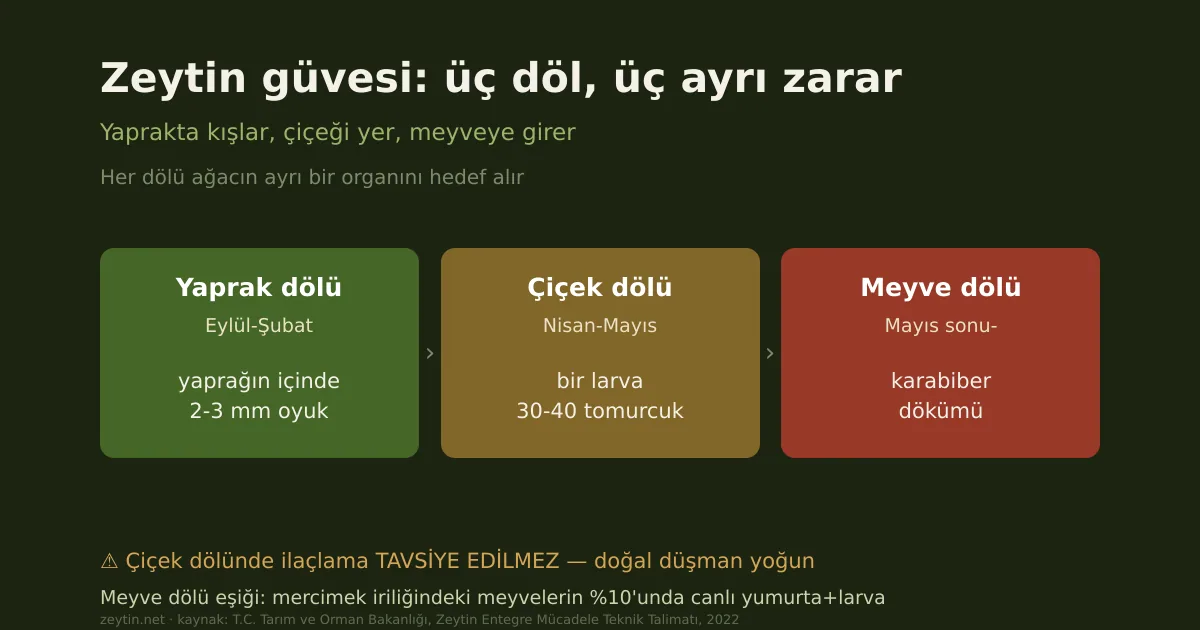
The olive pest with three generations: it winters in the leaf, eats the flowers, enters the fruit. One larva can take 30-40 buds.
 Article
Why do olives drop from the tree before harvest?
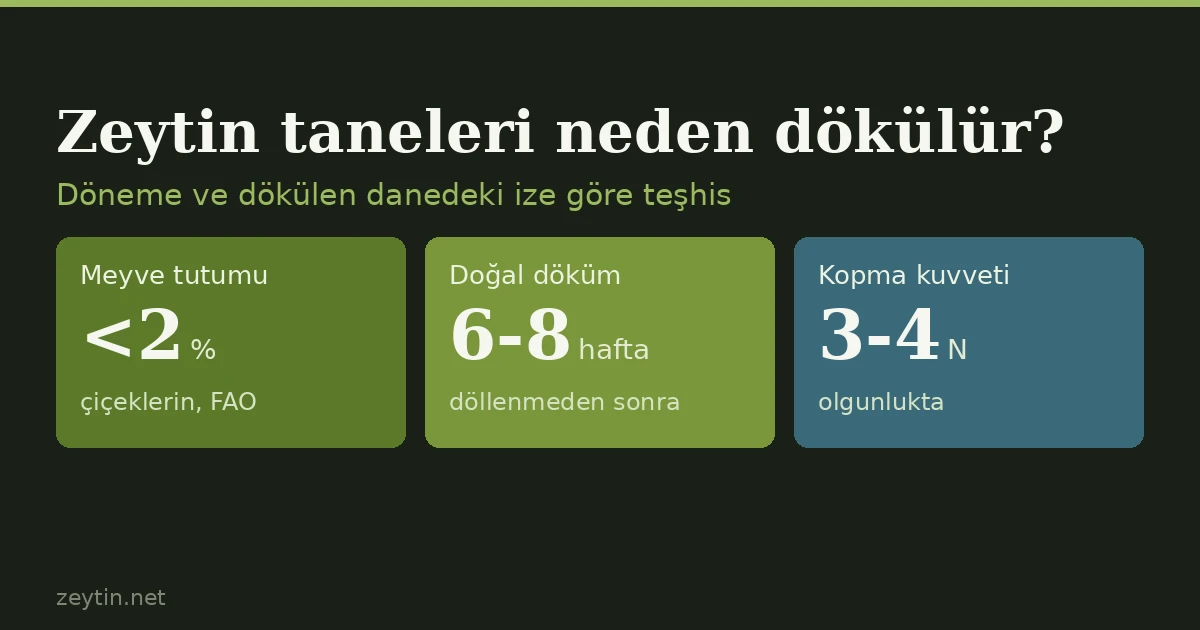
Fewer than 2 percent of olive flowers become fruit, so drop in the 6-8 weeks after bloom is normal. June peppercorn drop, fruit fly from summer, anthracnose and moth exit holes at ripening: a diagnosis table based on marks on the fallen olive.