Black olive harvest paused for ten days in Akköy, Didim: a price ladder from 30 to 100 lira
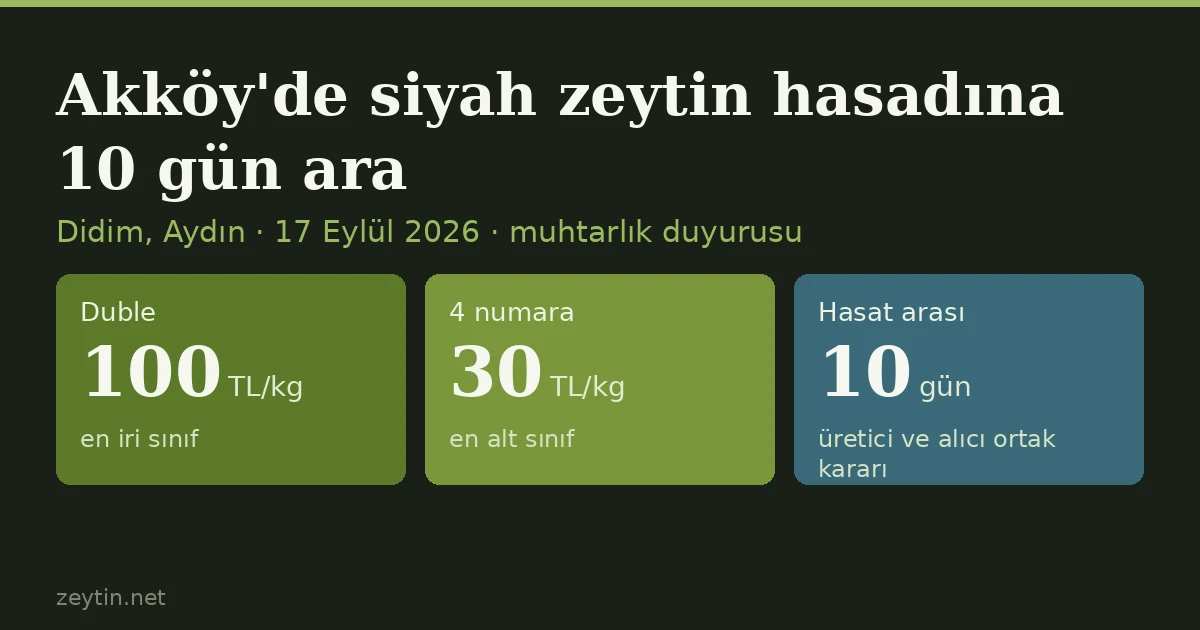
In Akköy, a village in the Didim district of Aydın, growers and olive buyers have jointly agreed to suspend black olive harvesting and buying for ten days, saying announced prices do not cover costs. The price ladder published by the village headman's office runs from 100 lira a kilo for the largest grade down to 30 lira for the smallest. Growers say picking costs alone exceed the price on the lower grades.
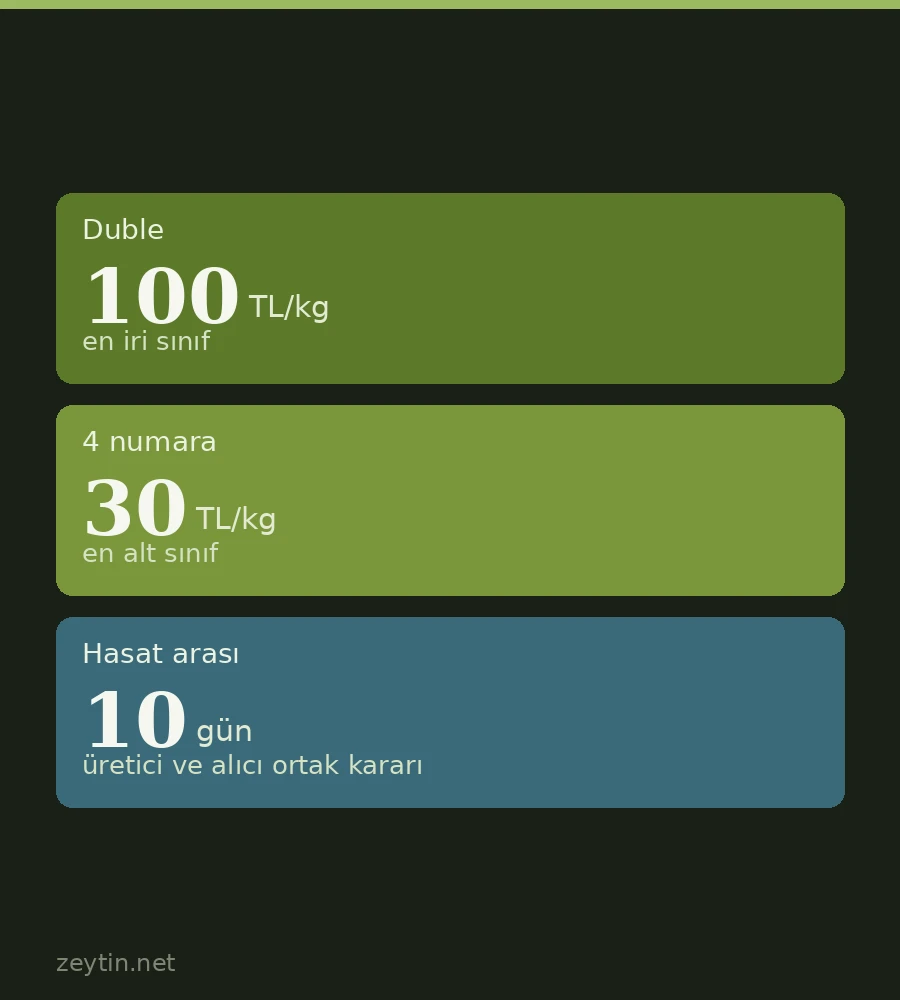
The first price protest of the table olive season in Türkiye has come from Aydın. According to an announcement by the Akköy Village Headman's Office in the Didim district, olive growers and olive buyers in the village met and reached a joint decision: for ten days no black olives will be harvested within Akköy's boundaries, and buyers will not purchase during that period.
The unusual part of the decision is that second clause. Price protests in Turkish agriculture are usually one-sided — growers stop picking and buyers wait them out. In Akköy the buyers appear to have sat at the same table and signed on to the pause. What growers expect from the ten days is that prices will be reassessed and a higher purchase price will form.
The announced price ladder
The buying prices published by the headman's office, per kilogram:
| Grade | Price |
|---|---|
| Double | 100 TL |
| No. 1 | 80 TL |
| No. 2 | 60 TL |
| No. 3 | 40 TL |
| No. 4 | 30 TL |
In the Turkish table olive trade this numbering reflects fruit size: the fewer olives it takes to make a kilo, the higher the grade, with "double" denoting the largest class. Why classification matters so much, and where quality is lost along the way, is something we examined in quality problems in table olives.
The shape of the ladder tells its own story. There is a 3.3-fold gap between the top and bottom grades. Olives picked from the same tree on the same day land anywhere between 100 and 30 lira purely on the basis of fruit size. And size is largely determined by irrigation, fertilisation and the crop load carried per tree — that is, by what the grower spent across the season. The cost is incurred before the grade is known.
The basis of the objection: the cost of picking
The growers' position in the announcement is blunt: they cannot get the value of their labour, and when the cost of picking alone exceeds the announced price, harvesting only deepens their debt.
On the lower grades this is concrete arithmetic rather than rhetoric. Black table olives are picked by hand, and labour is the single largest cost item of the harvest period. Once fertiliser, crop protection, diesel and irrigation are added, a purchase price of 40 lira for No. 3 or 30 lira for No. 4 may not cover the picking wage. Faced with that, a grower will leave fruit on the tree rather than pay to harvest at a loss — a decision that removes supply from the market without any formal boycott being declared.
The pressure is not specific to Akköy. We have covered the pre-harvest cost squeeze and the effect of carry-over stock on prices in costs and carry-over stock before the harvest, and the reasons a minimum price is being debated as harvest forecasts rise in the harvest forecast and the minimum price debate. The Akköy decision is the first concrete expression of that debate on the ground.
Where the ladder sits in the chain
The Akköy figures are the price at the very start of the chain: what a grower is paid for freshly picked, unprocessed black olives. That is worth keeping in mind before comparing them with anything else. On the exchange data we track on our market page, the Türkiye-wide price for black olives in brine stood at 150 lira a kilo as of 3 September 2026 — but that is a product that has been cured, graded, has lost weight to processing and has been held in store for months. It is not the same thing as Akköy's 30 to 100 lira; the two are different links in the same chain.
The distance between the two numbers still shows what the growers' objection rests on. Curing, fermentation, grading and storage are real costs and account for part of the gap. The grower's question is not where the whole difference goes, but whether the share reaching the branch covers the cost of picking it.
Leaving fruit on the tree is not the only alternative either: olives grown for the table can be diverted to the mill. That, however, writes off the irrigation and fertiliser spent on producing large fruit, and selling table-grade fruit at oil-olive prices means dropping below the very ladder being protested.
The other cost of ten days
Delaying a harvest is not free either. Only days earlier the same district was issued a pre-harvest olive fruit fly warning, with growers asked to inspect their groves at regular intervals. In a grove under pest pressure, leaving fruit on the tree for an extra ten days can raise the risk of infestation and quality loss.
In table olives that risk bites harder than it does in oil. Damaged fruit destined for the mill can still be pressed, with some loss of quality; damaged fruit destined for the brine tank is downgraded outright — which means dropping a rung on the very ladder the growers are protesting. The pause therefore asks each grower to balance bargaining power against grove risk. Where fly pressure is low the waiting cost is limited; where it is high, ten days can be expensive.
Why the table olive price problem is different
Table olives carry substantial weight in Türkiye's olive exports and are worth several times more per fruit than oil olives — a gap we measured in the same olive, six times the price. But that value only reaches the grower after passing through processing, grading and packing. The longer the distance between the branch and the shelf, the wider the gap between what the grower receives and what the consumer pays. A fixed harvest cost at one end and a graded, discounted price at the other is exactly the structure that produces a village-level standstill.
What happens at the end of the ten days depends on whether buyers move the price up within the window. Whether the decision spreads to neighbouring villages will matter far more for the rest of the season than the pause itself. For background on how black table olives are produced and classified, see how black table olives are made.
One rating per visitor; you can change yours at any time. Ratings are real reader votes — no seeded or default scores.
Related
 Article
EIA approval for a 200 t/day olive oil plant in Mudanya
A 9.5 million lira olive oil plant planned in Mudanya, Bursa, has received a positive environmental impact decision: 200 tonnes of olives a day, around 100 operating days a season.
Article
EIA approval for a 200 t/day olive oil plant in Mudanya
A 9.5 million lira olive oil plant planned in Mudanya, Bursa, has received a positive environmental impact decision: 200 tonnes of olives a day, around 100 operating days a season.
 Article
A 282-member doctors' cooperative puts sensors in the olive grove
A cooperative founded by doctors in Adana is monitoring water and fertiliser with buried sensors across 100 of its 135 dönüm of bearing olive grove, funded with 2 million lira.
Article
A 282-member doctors' cooperative puts sensors in the olive grove
A cooperative founded by doctors in Adana is monitoring water and fertiliser with buried sensors across 100 of its 135 dönüm of bearing olive grove, funded with 2 million lira.
 Article
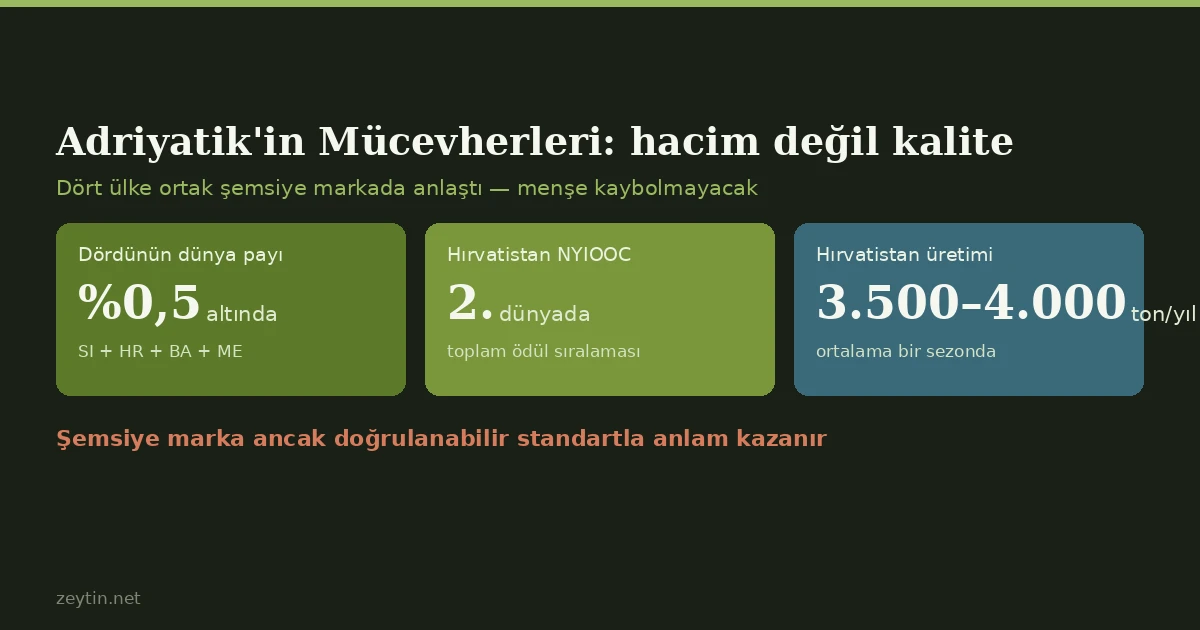
"Jewels of the Adriatic": four countries choose to compete on quality, not volume
Slovenia, Croatia, Bosnia and Herzegovina and Montenegro together produce under 0.5% of the world's olive oil — yet Croatia finished second worldwide at the NYIOOC. A panel in Mostar proposed a shared umbrella brand: origin stays, common rules are the condition.
Article
"Jewels of the Adriatic": four countries choose to compete on quality, not volume
Slovenia, Croatia, Bosnia and Herzegovina and Montenegro together produce under 0.5% of the world's olive oil — yet Croatia finished second worldwide at the NYIOOC. A panel in Mostar proposed a shared umbrella brand: origin stays, common rules are the condition.
 Article
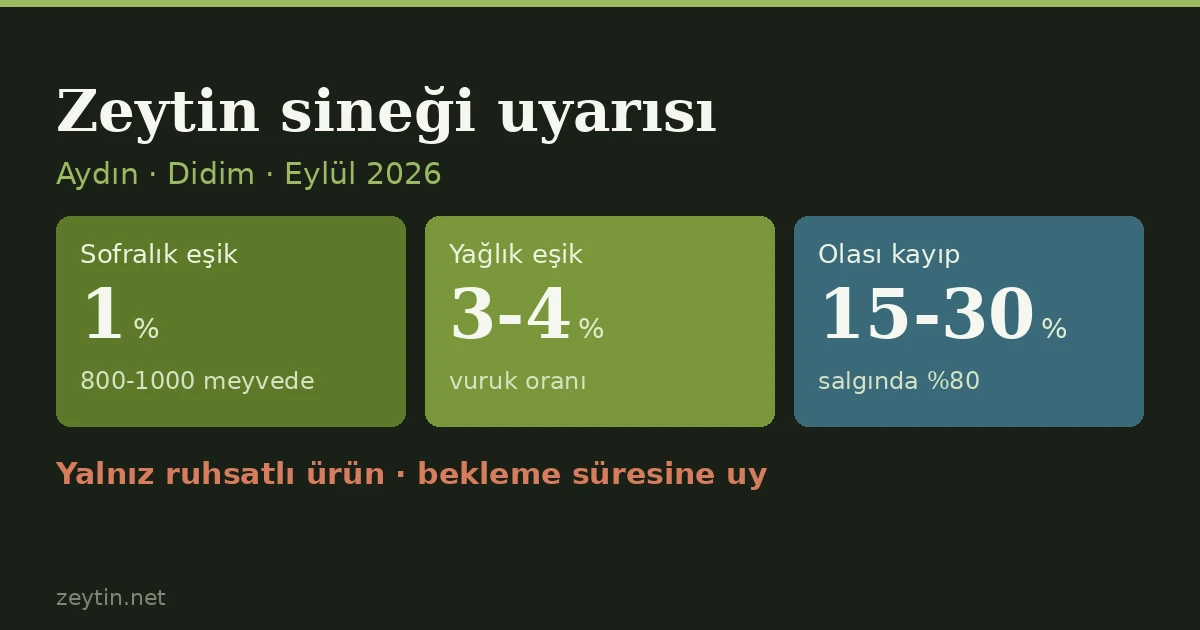
Olive fruit fly warning before harvest in Aydın: check groves, spray only above the threshold
The Didim District Directorate of Agriculture and Forestry, together with the Aydın Provincial Directorate, has warned growers about the olive fruit fly ahead of the harvest. Growers were asked to check groves regularly, monitor pest density and, if needed, act only with products licensed for olives and at the right time. Fly pressure rising in autumn cuts both yield and oil quality.
Article
Olive fruit fly warning before harvest in Aydın: check groves, spray only above the threshold
The Didim District Directorate of Agriculture and Forestry, together with the Aydın Provincial Directorate, has warned growers about the olive fruit fly ahead of the harvest. Growers were asked to check groves regularly, monitor pest density and, if needed, act only with products licensed for olives and at the right time. Fly pressure rising in autumn cuts both yield and oil quality.