The UN names 2026 the Year of the Woman Farmer: in olives the labour is women's, the records are not
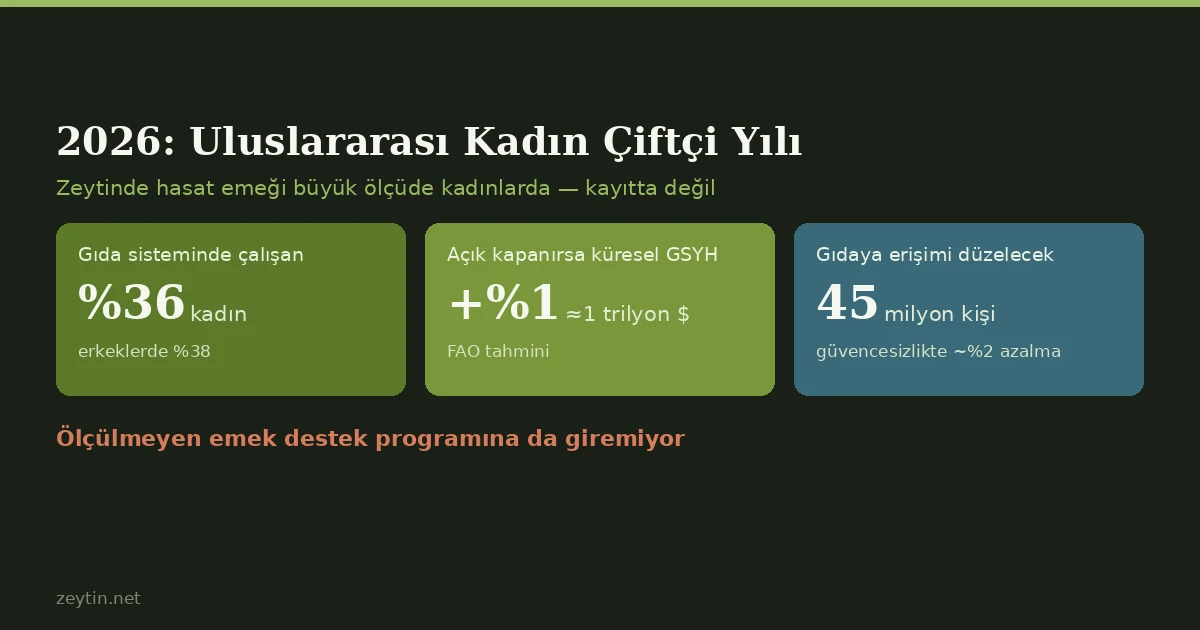
FAO reports that agrifood systems employ 36% of working women and 38% of working men; closing the gender gap would add 1% to global GDP (about $1 trillion) and improve food access for 45 million people. In olives, most harvest labour is women's — title deeds and decisions are not.
The United Nations has declared 2026 the International Year of the Woman Farmer. The aim is to make women's role in agrifood systems visible — and olive oil is one of the clearest illustrations of the argument: much of the harvest labour is done by women, while ownership and decision-making largely are not.
The numbers
| Item | Value |
|---|---|
| Share of working women employed in agrifood systems | 36% |
| Share of working men | 38% |
| Global GDP gain if the gender gap closes | 1% |
| In money | ~$1 trillion |
| Reduction in food insecurity | ~2% |
| People with improved access to food | 45 million |
How wide is the gap?
According to The status of women in agrifood systems, a report by the Food and Agriculture Organization of the United Nations (FAO), agrifood systems employ 36 percent of working women and 38 percent of working men worldwide. Presence in the sector is therefore close to equal.
What is not equal are the conditions. Women's roles are frequently marginalised, and the work clusters in irregular, informal, low-skilled and labour-intensive segments — particularly in low- and middle-income countries.
FAO's estimate puts a figure on the cost of that difference: closing the gender gap would raise global gross domestic product by 1 percent, close to one trillion dollars. The same progress would cut global food insecurity by roughly 2 percent, improving food access for an estimated 45 million people.
What the numbers say is simple: this is not a question of representation but of output.
Where olive oil sits
Olive oil illustrates the argument well because its labour structure is visible. The harvest is seasonal, intensive and largely manual, and a significant share of the picking is done by women. Title deeds, cooperative membership and the decision to sell, meanwhile, are registered in men's names in most producing countries.
Cristina Stribacu, who produces extra virgin olive oil from Koroneiki olives in the village of Filiatra in Greece's Messinia, defines the work as something beyond production: "Being a woman farmer, to me, is closely connected to stewardship of the land, resilience and responsibility. It goes beyond production and is about continuity: caring for the soil, making thoughtful decisions season after season."
Her company also runs the LIÁ Olive Oil Hub, conceived as a space for knowledge and exchange; it recently launched Re:Olive, an educational programme aimed at the problems small producers face.
The difficulties she lists match this season's headlines exactly: "climate instability, rising production costs and the uncertainty that accompanies each harvest. For small producers, resilience is a daily practice based on observation, learning and constant adaptation."
Why they do it
In the accounts of women growing olives in Greece, one frame recurs: the work is described less as an occupation than as a relationship of continuity.
For Maria Martinaki, olive farming is "a way of life, a responsibility, and a deep emotional connection with the land." She lists what the trees teach: "patience, resilience, respect for nature, and humility." The work, she says, gives a strong sense of purpose and identity, and what motivates her is "the feeling of creating something pure and real with my own hands" and the fact "that every bottle carries the soul of the land it comes from."
The producer Rose Bechara Perini (Darmmess) ties the same idea to the year itself: "Being a woman farmer today means carrying the future in your hands. The IYWF 2026 reminds us that without women farmers, there is no future for food."
What these accounts share is that they do not contradict the sector's present difficulties: the same people also list cost, climate and uncertainty. Attachment shows not that conditions are good but that the work has not been abandoned.
Invisible labour, invisible records
The real problem here is not that women's labour is scarce — it is that it is not measured. Seasonal harvest work is informal in most countries, and unpaid family labour may not enter the statistics as "employment" at all. Labour that is not measured cannot be targeted by support programmes, credit or training either.
FAO's trillion-dollar estimate points at precisely this gap: the loss arises not because women do not work but because the conditions they work in cap productivity.
Seen from Türkiye
Türkiye's olive harvest fits the same picture in labour intensity. We calculated the table-olive harvest in Söke in terms of what one worker's day is worth: the daily wage came in below the value of roughly ten kilograms of olive oil from that day's picking. A large share of the labour inside that calculation is women's — yet it appears nowhere in the calculation separately.
Türkiye has no regularly published, sex-disaggregated labour series specific to the olive sector. So the question "how much of the olive harvest is women's labour?" has no public, comparable answer either. The most concrete thing the Year of the Woman Farmer could mean for this sector would be starting that measurement.
What to watch
The sectoral data FAO and the International Olive Council publish through the year — and whether cooperative membership and support applications are reported with a gender breakdown. Visibility begins with disaggregated data, not with a declaration.
One rating per visitor; you can change yours at any time. Ratings are real reader votes — no seeded or default scores.
Related
 Article
Syria's crop doubles to 954,000 tonnes — and the oil still only feeds itself
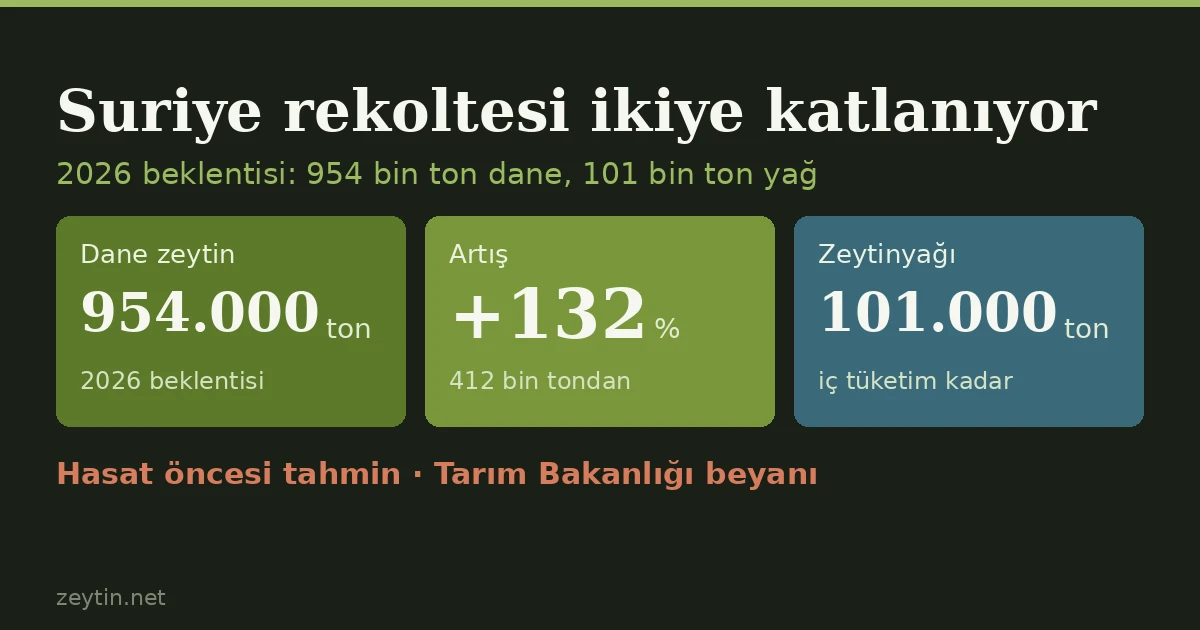
Syria's Ministry of Agriculture expects 954,000 tonnes of olives in 2026, up from 412,000 last season. The 101,000 tonnes of oil that implies barely covers domestic consumption — a doubled crop that still produces no export surplus.
Article
Syria's crop doubles to 954,000 tonnes — and the oil still only feeds itself
Syria's Ministry of Agriculture expects 954,000 tonnes of olives in 2026, up from 412,000 last season. The 101,000 tonnes of oil that implies barely covers domestic consumption — a doubled crop that still produces no export surplus.
 Article
EIA approval for a 200 t/day olive oil plant in Mudanya
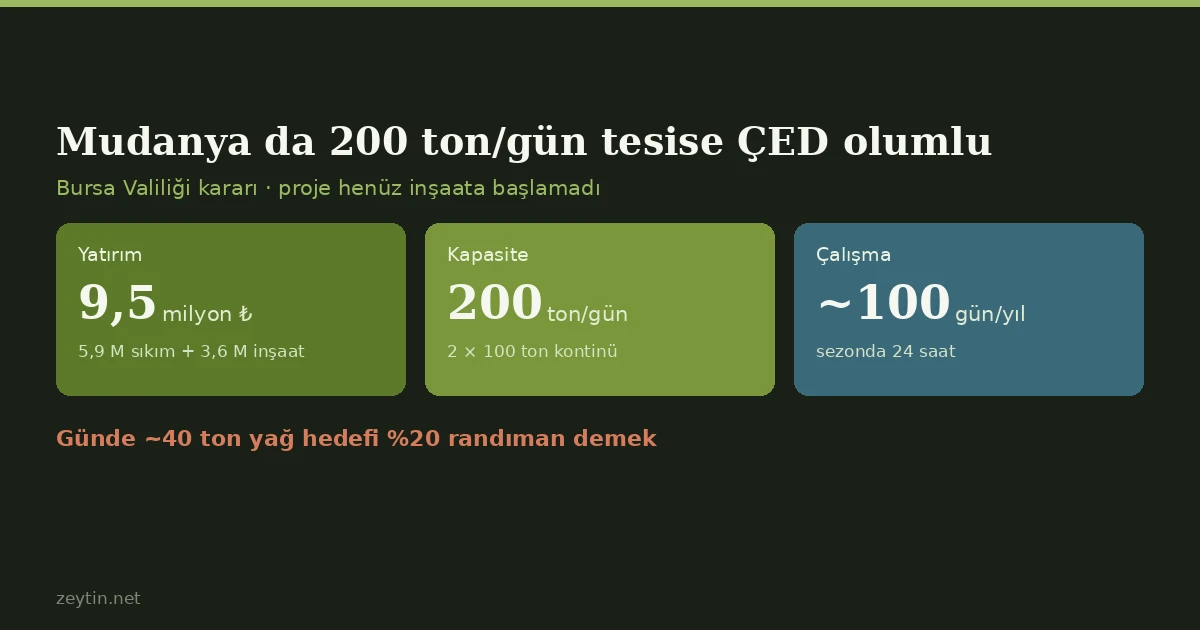
A 9.5 million lira olive oil plant planned in Mudanya, Bursa, has received a positive environmental impact decision: 200 tonnes of olives a day, around 100 operating days a season.
Article
EIA approval for a 200 t/day olive oil plant in Mudanya
A 9.5 million lira olive oil plant planned in Mudanya, Bursa, has received a positive environmental impact decision: 200 tonnes of olives a day, around 100 operating days a season.
 Article
Tunisia's output falls from 500,000 to 300,000 tonnes — revenue may hold
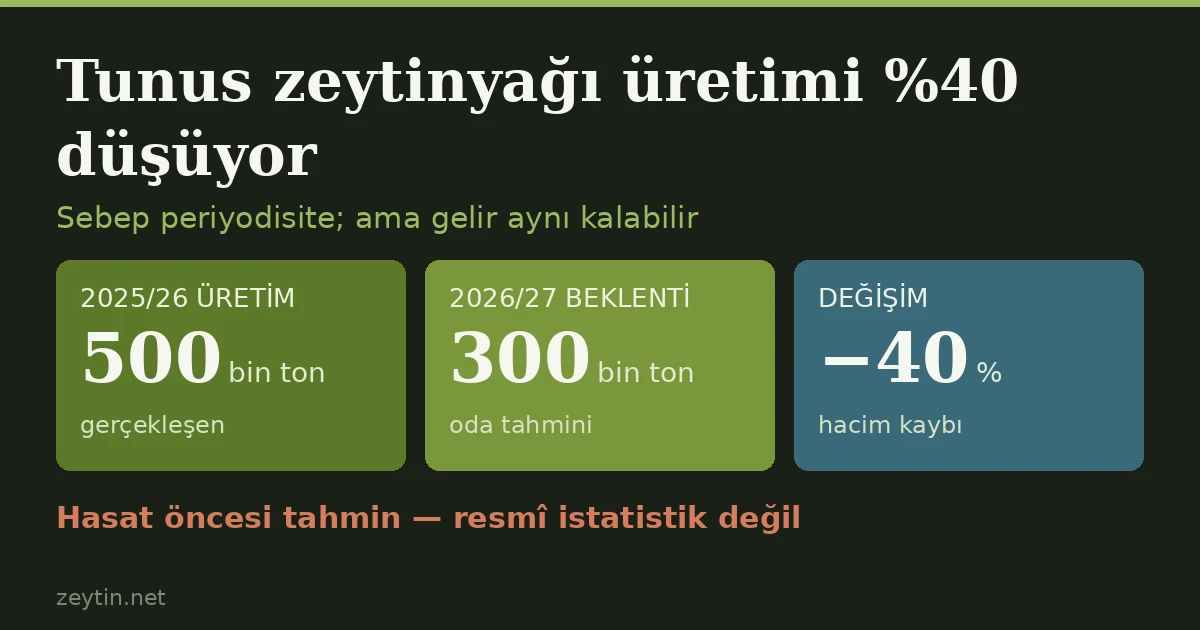
Tunisia's National Chamber of Olive Producers expects olive oil output to fall from 500,000 to 300,000 tonnes in 2026/27, citing alternate bearing. Revenue is still expected to match last season because prices are higher. Türkiye's most direct bulk competitor is shrinking.
Article
Tunisia's output falls from 500,000 to 300,000 tonnes — revenue may hold
Tunisia's National Chamber of Olive Producers expects olive oil output to fall from 500,000 to 300,000 tonnes in 2026/27, citing alternate bearing. Revenue is still expected to match last season because prices are higher. Türkiye's most direct bulk competitor is shrinking.
 Article
Olive oil exports still down 62% at the end of August: bulk loses 73%
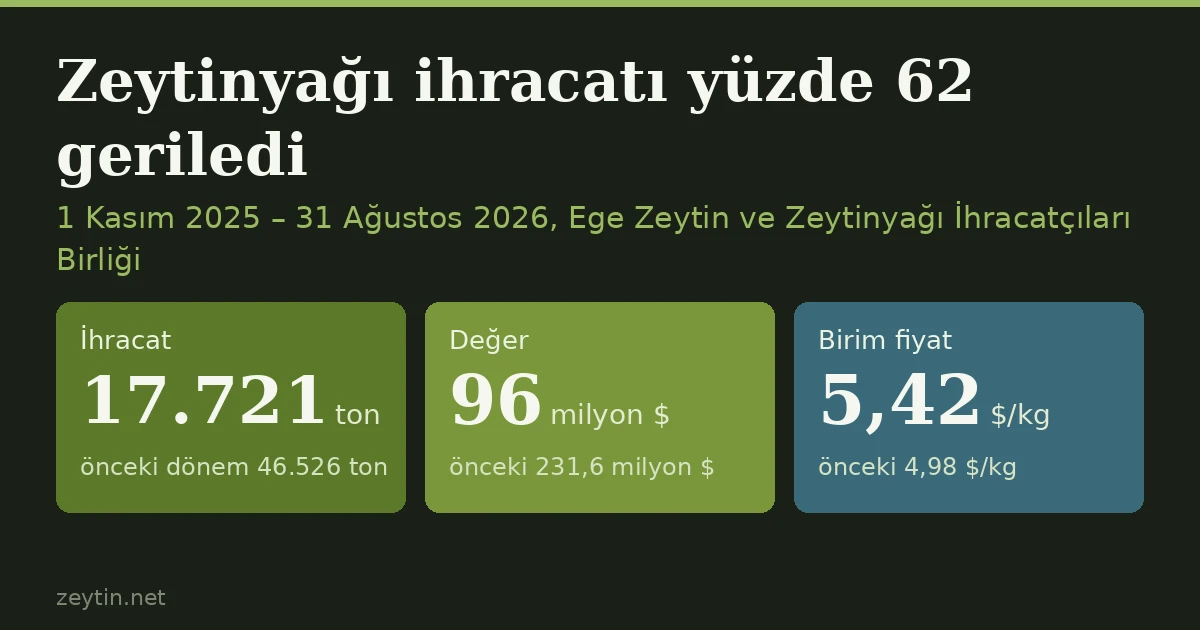
According to the Aegean Olive and Olive Oil Exporters' Association, olive oil exports between 1 November 2025 and 31 August 2026 fell 62% in volume and 59% in value. Bulk sales lost 73%, the US market 70%. Table olives, by contrast, held their ground.
Article
Olive oil exports still down 62% at the end of August: bulk loses 73%
According to the Aegean Olive and Olive Oil Exporters' Association, olive oil exports between 1 November 2025 and 31 August 2026 fell 62% in volume and 59% in value. Bulk sales lost 73%, the US market 70%. Table olives, by contrast, held their ground.