What are olive rust mites? Pitted, curled leaves and rusty fruit
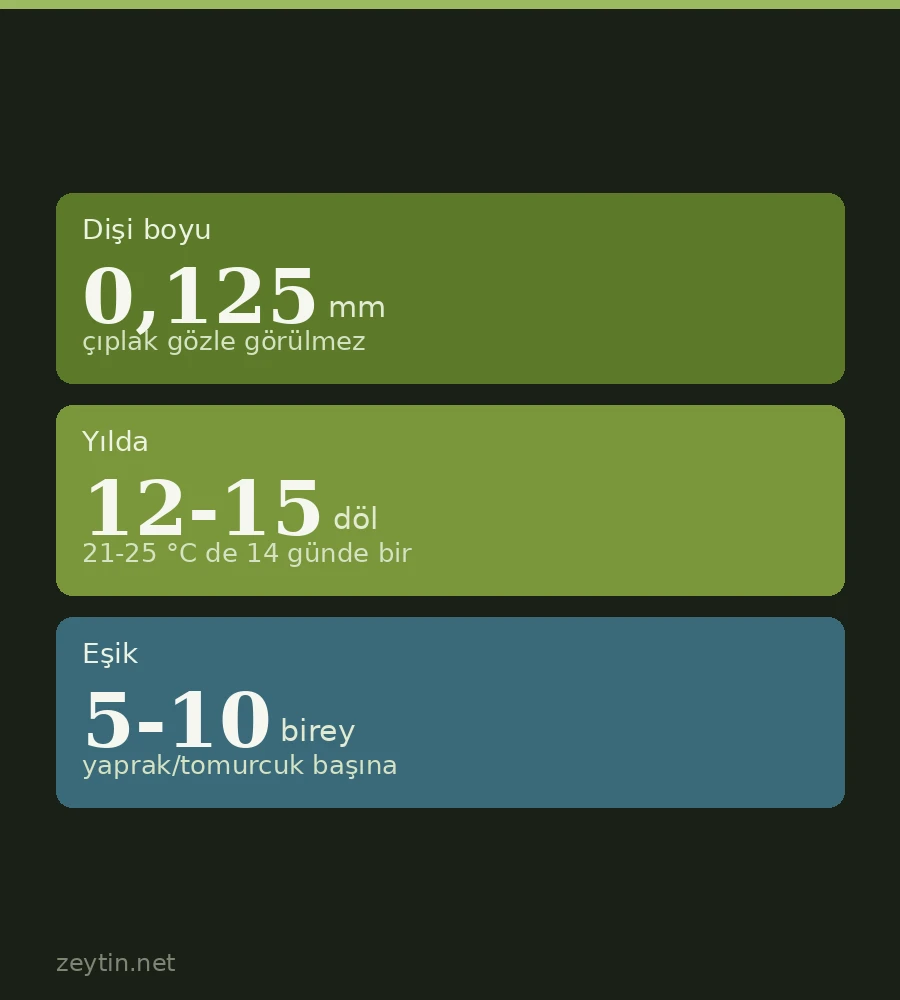
Olive rust mites are eriophyid mites about a tenth of a millimetre long, invisible to the naked eye. They cause pits, blisters and curling on young leaves, blackened buds, misshapen fruit and a rusty skin. Under Türkiye's ministry guidance they are counted weekly from April; an average of 5-10 mobile individuals per leaf or bud is the spray threshold. In Hatay, 64 per cent of orchards were found infested.
Growers who look closely at their olive leaves in autumn often notice the same thing: pale green pits on young leaves, blisters on the underside, curled or humped leaves, and, earlier in the summer, misshapen fruit with a rusty-looking skin. There is no visible insect anywhere. One common cause of this picture is a group of mites too small to see with the naked eye: olive rust mites.
The Integrated Pest Management Technical Instructions for Olives, published in 2022 by Türkiye's Ministry of Agriculture and Forestry, deals with these pests under the name "olive rust mites" (pasakarları). In this article we explain what they look like, when they do their damage, how they are counted and when to intervene, drawing on the ministry's guidance and on field studies carried out in Türkiye.

What a rust mite is
Rust mites are microscopic mites of the family Eriophyidae. According to the measurements in the ministry's guidance, females are 125 × 40 microns and males 100 × 35 microns — a little over a tenth of a millimetre long. They are pale yellow, cylindrical and taper from the head backwards, giving them a carrot-like shape. Their eggs measure 44 to 47 microns. A creature this small can only be seen under a strong hand lens or a microscope; growers usually recognise it only by the marks it leaves.
The guidance lists two species: Aceria oleae and Aculus olearius. The more widespread of the two is Aceria oleae.
Why the name is confusing
Common names vary from source to source. The ministry's guidance groups both species together as "rust mites". A 2024 study from Hatay province, however, calls Aceria oleae the "olive bud mite" and uses "olive rust mite" for Tegolophus hassani, another species of the same family. So "rust mite" is sometimes the name of a group and sometimes the name of a single species.
For the grower, the distinction changes little: the species belong to the same family, feed in a similar way, leave similar marks, and in the guidance they are counted by the same method and judged against the same threshold.
Symptoms
The guidance describes the damage on four parts of the plant:
- Leaves: pale green pits on the upper surface of young leaves, swellings on the underside, irregular leaf margins, humping and curling. Shortened midribs with a blunted leaf tip have also been observed.
- Buds and flowers: blackening, deformation and drying.
- Fruit: feeding in the stalk cavity and on the fruit surface leads to deformed fruit, a rust-like appearance and early fruit drop. The group takes its name from this rusty look.
According to the guidance, populations and damage peak in the late stages of bud development and the early fruit stage, and fruit deformation has been found to be more severe in irrigated orchards. Neglected groves and groves beside dusty roads suffer more damage.
The mite's year
The mite overwinters as an adult female on the underside of leaves. The guidance gives this calendar:
| Period | Where the mite is and what it does |
|---|---|
| December-March | Population at its lowest; females overwinter under leaves |
| Early April | Newly emerging leaves and leaf axils |
| From late April | Flower buds |
| From early June | Fruit stalks and petals; dense colonies |
| May-August | Population at its highest |
| Until late October | Leaf deformations remain visible |
At 21-25 °C Aceria oleae completes its life cycle in about 14 days and produces 12 to 15 generations a year. The guidance reports that in the Mediterranean region the first individuals appear at the base of the flower bud in late April and remain on the fruit until the end of August, while under Bursa conditions they are found on the plant from April to August. A study carried out in Balıkesir, İzmir and Manisa between 2015 and 2017 likewise found that populations peaked on buds in April and on leaves and fruit in May and June.
What this calendar means for the grower is simple: the curled, pitted leaves you see in October are the trace of spring and summer damage. By then the mite population is already falling. The autumn job is not to spray but to note which trees carry the marks; in April, those are the first trees to check.
How common it is
The Hatay study (Kaya and Denizhan, Mustafa Kemal University Journal of Agricultural Sciences, 2024) found 64.28 per cent of the olive orchards sampled to be infested. Within infested orchards, 44.52 per cent of trees and 27.41 per cent of shoots carried mites. Both species were found in every sampled district except Yayladağ; Aceria oleae was dominant with a prevalence of 67.24 per cent, against 24.13 per cent for Tegolophus hassani. T. hassani was recorded in Hatay for the first time.
These figures show that the mite is present in more than half of the orchards, but they do not mean every infested tree suffers economic damage. The decision to spray is taken not on the mite's presence but on the threshold count described below.
The study in western Anatolia (Ersin and colleagues, Turkish Journal of Entomology, 2020) identified 16 mite species on olive in total: the two pest eriophyids plus eight predatory mites of the family Phytoseiidae. The ministry's guidance also notes that studies have documented damage by these mites in the olive groves of the Aegean, Mediterranean and Marmara regions.
Do not confuse it with similar symptoms
Curled leaves alone do not mean rust mites. A tree short of water curls its leaves at midday; leaves dry and curl after frost; verticillium wilt usually shows as sudden drying on a single branch with brown leaves curled backwards. Olive psyllids leave a white, cottony secretion visible to the naked eye; nutrient deficiencies show up as colour changes.
The sign that sets rust mites apart is deformation accompanied by pits and blisters on young leaves, together with a rusty surface on the fruit. Deformation, not drying.
Control
Cultural measures. The measures the guidance puts first are about orchard care: keep the grove clean and well maintained, keep trees healthy and vigorous, do not allow dust to build up in and around the orchard, carry out pruning and winter care fully, and do not leave dead or dying trees in the grove. New orchards should be planted with certified saplings.
Counting and threshold. According to the guidance, from April onwards mobile stages (larvae, nymphs and adults) are counted weekly on newly emerging leaves and on buds. A decision to spray is taken when there is an average of 5 to 10 mobile individuals per leaf or bud. To protect the fruit, this density is checked at bud formation and at fruit set. Counting something this small requires a hand lens; if in doubt, ask the provincial or district agriculture office for help.
Choice of product. The licensed products that can be used are listed in the annex to the guidance and are available from the district agriculture office. As a general principle the guidance asks growers to avoid unnecessary spraying. With rust mites this matters all the more, because predatory mites live on the same trees. The Hatay study found four predatory mite species, the most common being Typhlodromus athiasae (45.49 per cent) and Anthoseius athenas (42.06 per cent). The western Anatolia study also observed a mite called Agistemus duzgunesae feeding on eriophyids. Broad-spectrum spraying below the threshold also reduces these natural enemies.
For the calendar of other pests alongside this one, see our article on the olive pest calendar and intervention thresholds.
Read with care
⚠ Symptoms help with identification, but a firm diagnosis requires seeing the mite under a hand lens or microscope.
⚠ The calendar and threshold values come from the ministry's 2022 guidance and may shift with region and the weather of the year.
⚠ The prevalence figures come from a single study in Hatay; they may differ in other provinces.
One rating per visitor; you can change yours at any time. Ratings are real reader votes — no seeded or default scores.
Related
 Article
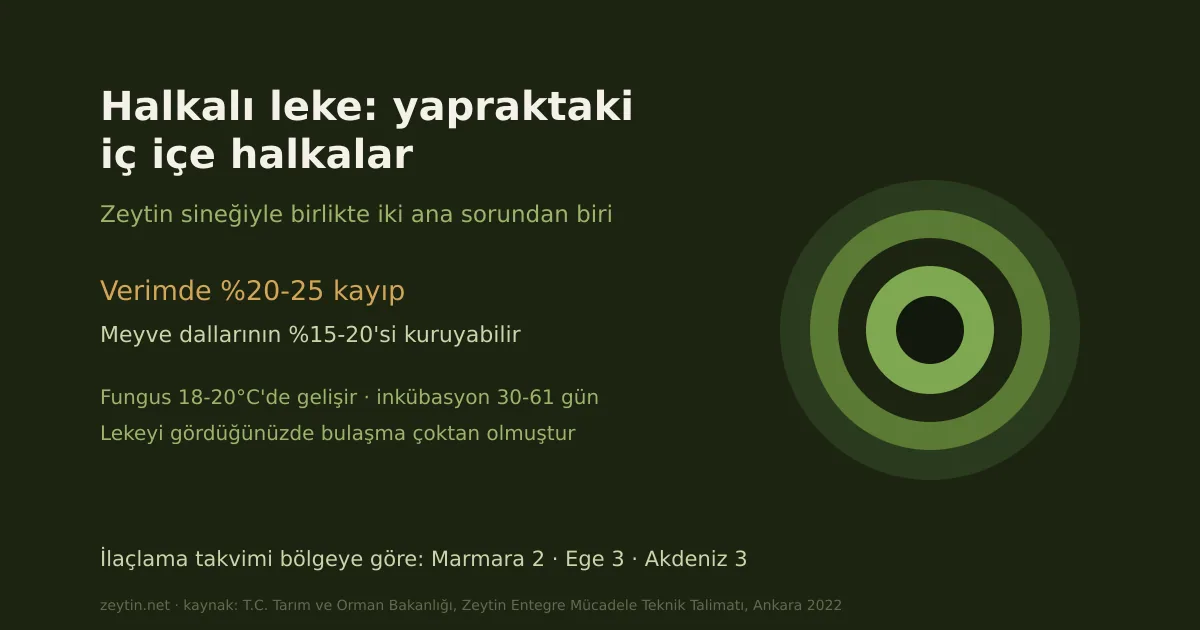
Olive peacock spot: symptoms and a region-by-region spray calendar
The commonest of olive tree diseases: concentric rings on the leaf, shedding, a shrubby tree. Yield falls 20-25%; spray timing varies by region.
 Article
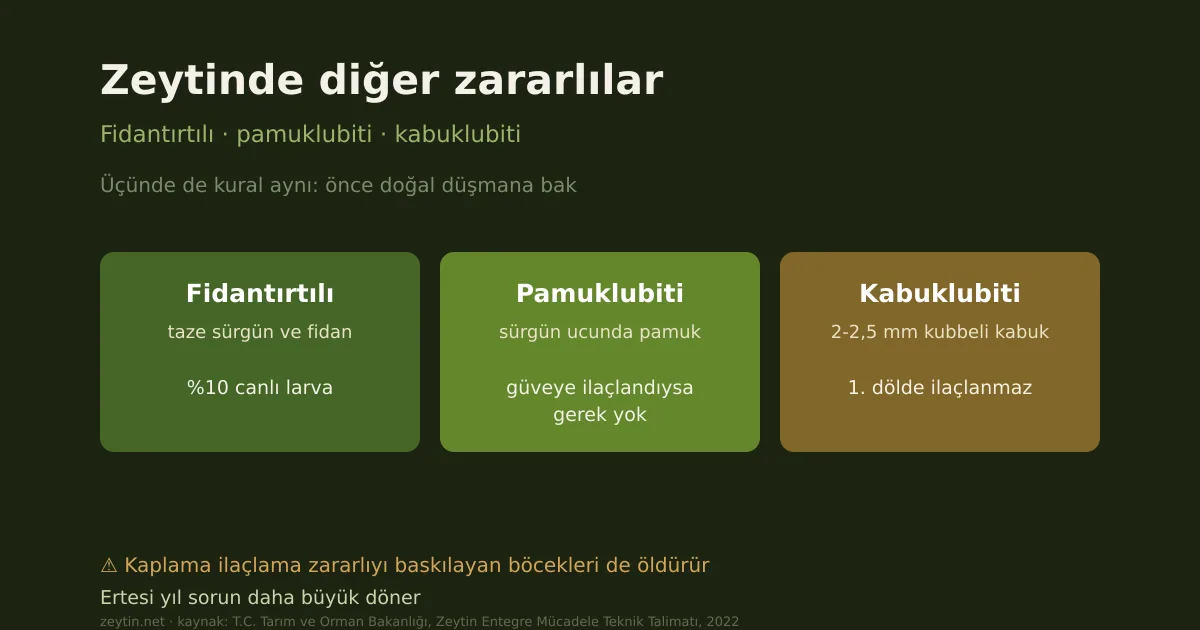
Other olive pests: jasmine moth, psyllid and olive scale
Three olive pests overshadowed by the fruit fly: the jasmine moth on tender shoots, the cottony psyllid, and olive scale.
 Article
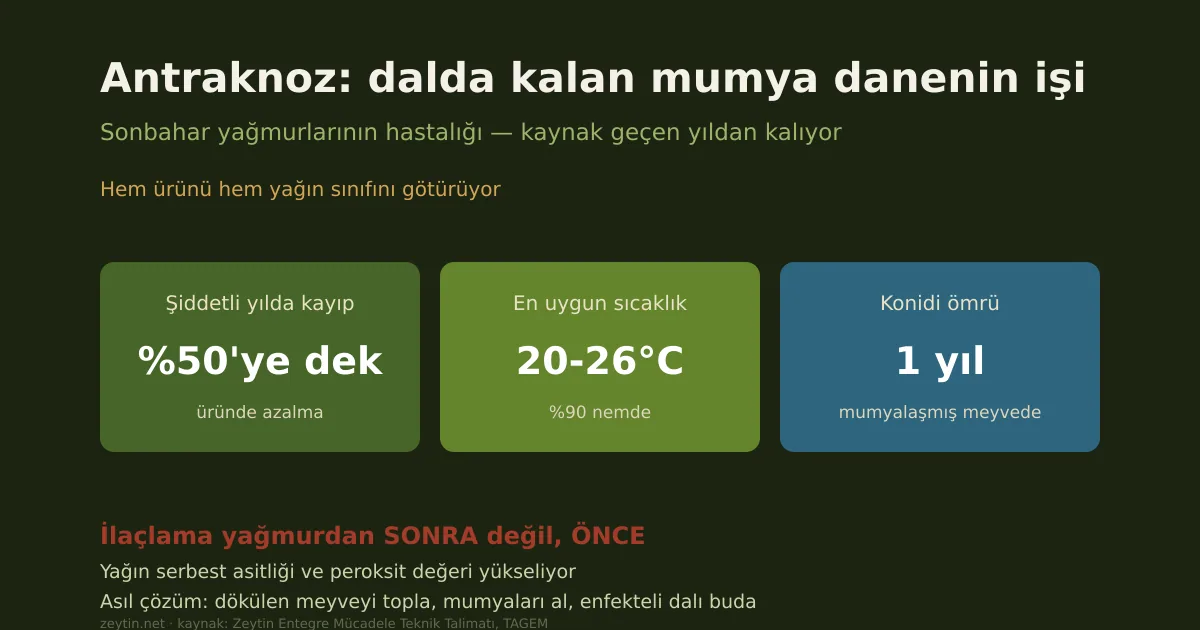
Olive anthracnose: the disease of the mummified fruit left on the branch
Up to 50% crop loss in bad years. The source is last year's mummified fruit still on the branch, and the spray goes on before the autumn rains, not after.
 Article
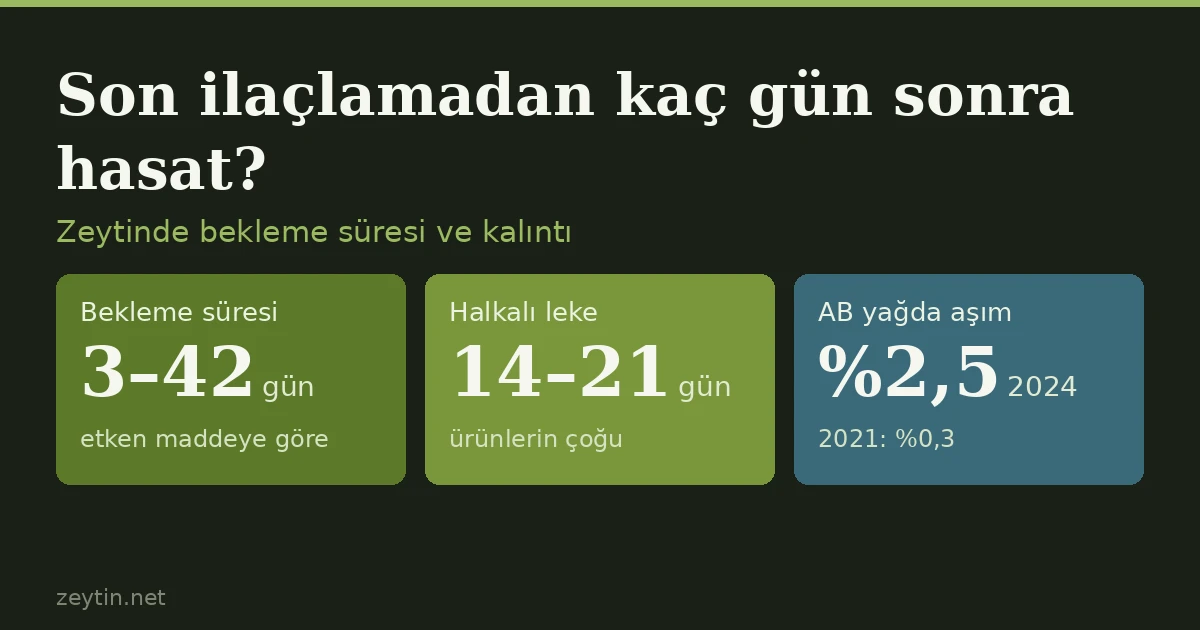
How many days after the last spray can olives be harvested? Pre-harvest interval and residues
The interval between the last spray and harvest in olives ranges from 3 to 42 days depending on the active substance; most peacock spot products carry 14–21 days. Fat-soluble residues concentrate in the oil at pressing; EU exceedances in virgin olive oil rose to 2.5% in 2024. 2026/27 is Turkey's first harvest with spraying and harvest recorded plot by plot under B-Reçete.