UZZK head Tan: 4.03 million tonnes of olives expected in 2026/27, but oil buying prices sit 40-110 lira below cost
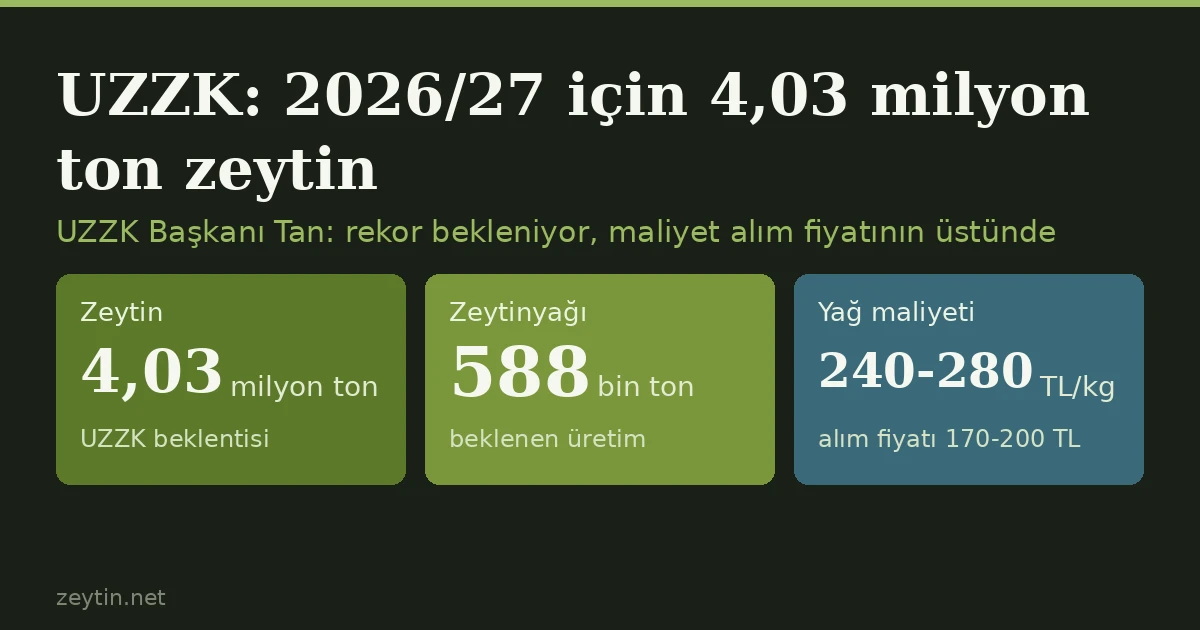
UZZK head Dr Mustafa Tan expects 4.03 million tonnes of olives and 588,000 tonnes of olive oil in 2026/27, but says olive oil that costs 240-280 TRY/kg to produce is bought at 170-200 TRY. He asked for six measures, including premiums, export rebates and storage aid.
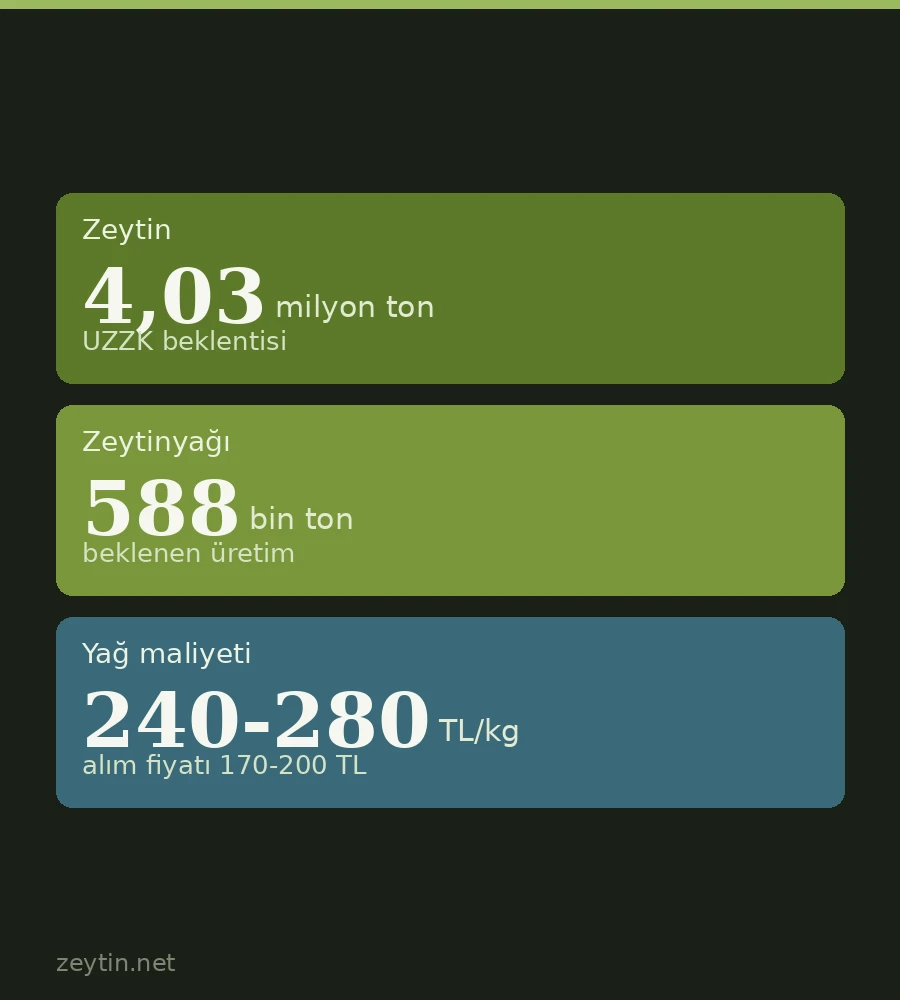
The head of Türkiye's National Olive and Olive Oil Council (UZZK), Dr Mustafa Tan, said the council expects a record olive harvest of 4.03 million tonnes in 2026/27, but that the excitement over a record has turned into worry because costs are rising while buying prices are low. The statement was carried in news reports published on 15 November 2026, and Tan listed six emergency measures in the same statement.
The figures the council gave
| Item | Value |
|---|---|
| Expected total olive harvest | 4.03 million tonnes |
| Olives going to table use | 1.163 million tonnes |
| Expected olive oil | 588,000 tonnes |
| Average production cost of 1 kg of olives | 50-70 TRY |
| Buying price in the market ("ordinary olives") | 20-35 TRY |
| Production cost of 1 kg of olive oil | 240-280 TRY |
| Buying price of olive oil in the market | 170-200 TRY |
According to Tan, these figures would make Türkiye the world's second-largest olive oil producer after Spain and the largest table olive producer. But the gap between cost and buying price is not showing up as income in the field.
We also worked out the shares these figures imply (our own arithmetic): about 28.9 per cent of the olives go to table use and 71.1 per cent to oil, and the expected 588,000 tonnes of oil is about 14.6 per cent of the total olive crop. In other words, the oil-olive price and oil yield matter most for how much of the crop is worth collecting; the table olive share is smaller.
How big is the gap?
We compared the ranges in the report ourselves; this is our own arithmetic, not UZZK's. For olive oil, the buying price falls about 17 per cent below cost in the most favourable pairing (200 TRY against 240 TRY) and about 39 per cent below in the least favourable (170 TRY against 280 TRY); the shortfall is 40 to 110 lira per kilogram. Over the same period the Edremit commodity exchange registration for extra virgin oil, which this site tracks, stood at 245.30 TRY/kg on 13 November. An exchange line is a single registered sale rather than an average, and it may not be measured the same way as the buying-price range Tan gave.
The "off year" warning and the oil yield
Tan said the fallen olives on the ground, which he put at roughly 30-40 per cent, and the fruit left on trees on rough terrain, risk going uncollected because picking them does not cover its cost. If the uncollected crop is left, he added, the picture could flip and create an "off year" effect. We have covered whether fallen olives are suitable for oil in a separate article.
The warning on oil yield is also worth noting. In the report's wording, the oil yield that should normally be 1/5 will come out between 1/6 and 1/10 this season, which means more olives are needed for the same amount of oil. The report does not calculate what this does to the 588,000-tonne expectation, so we made a rough calculation. Subtracting the 1.163 million tonnes of table olives from 4.03 million tonnes leaves about 2.867 million tonnes for oil. Dividing that by 588,000 gives about 4.9 kg of olives per kilogram of oil, so the figure rests on a yield close to 1/5. The same oil-olive volume would give about 478,000 tonnes of oil at a 1/6 yield and about 287,000 tonnes at 1/10. This is not a forecast; it simply combines two numbers from the report, and the real yield will be measured plant by plant.
The six-point package
The measures Tan listed are:
- Premium support: In line with EU rules, a difference payment of about 1 euro per kg for olive oil and 20 cents for table olives. The report does not state the unit for table olives. At the ECB's 13 November reference rate (1 euro = 55.67 lira), 1 euro is about 55.7 lira, which is large enough to cover part of the 40-110 lira gap above.
- Export rebate: For exporters, rebates of up to 100, 300 and 750 dollars per tonne for bulk, contract-packed and packaged sales respectively.
- Stockholding rules: As in Spain, storage aid through cooperatives if prices fall below cost.
- Quota increase: Raising Türkiye's duty-free export quota in concession agreements with the EU from the current 100 tonnes to the 56,400 tonnes applied to Tunisia.
- Foreign trade mechanisms: State-led sales or barter of olive oil to countries with strong trade ties, starting with the Turkic republics.
- Domestic consumption: Public service spots explaining the benefits of olive oil and table olives.
For the sector's earlier demands in the same direction, see our article on how the crop rises to 500,000 tonnes while exports fell to 17,000. None of these measures is in force at the moment; all of them are UZZK requests or proposals.
One rating per visitor; you can change yours at any time. Ratings are real reader votes — no seeded or default scores.
Related
 Article
12 October adulteration list: five of 29 records are olive oil, four with seed oil
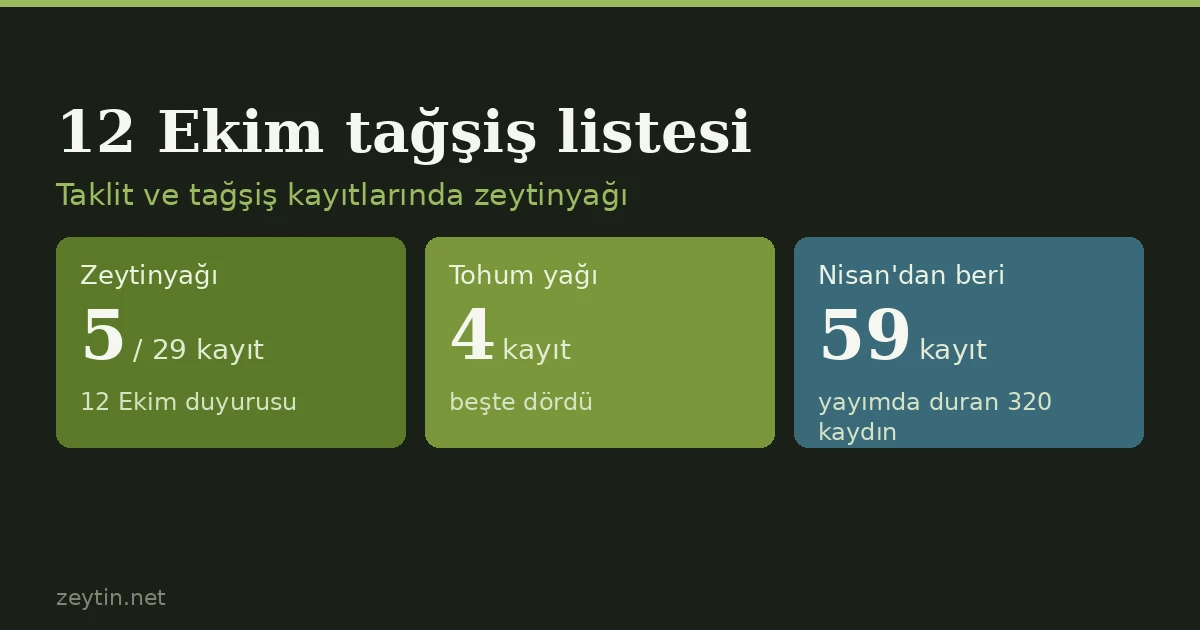
The ministry's 12 October 2026 notice added 29 records to Türkiye's counterfeit-and-adulteration list, five of them olive oil: four with seed oil blended in, one with lower-grade olive oil. Of the 320 records currently published, 59 are olive oil, and Manisa's count rose from one to three.
 Article
The International Olive Council grows: Iraq joins, Brazil and South Africa apply
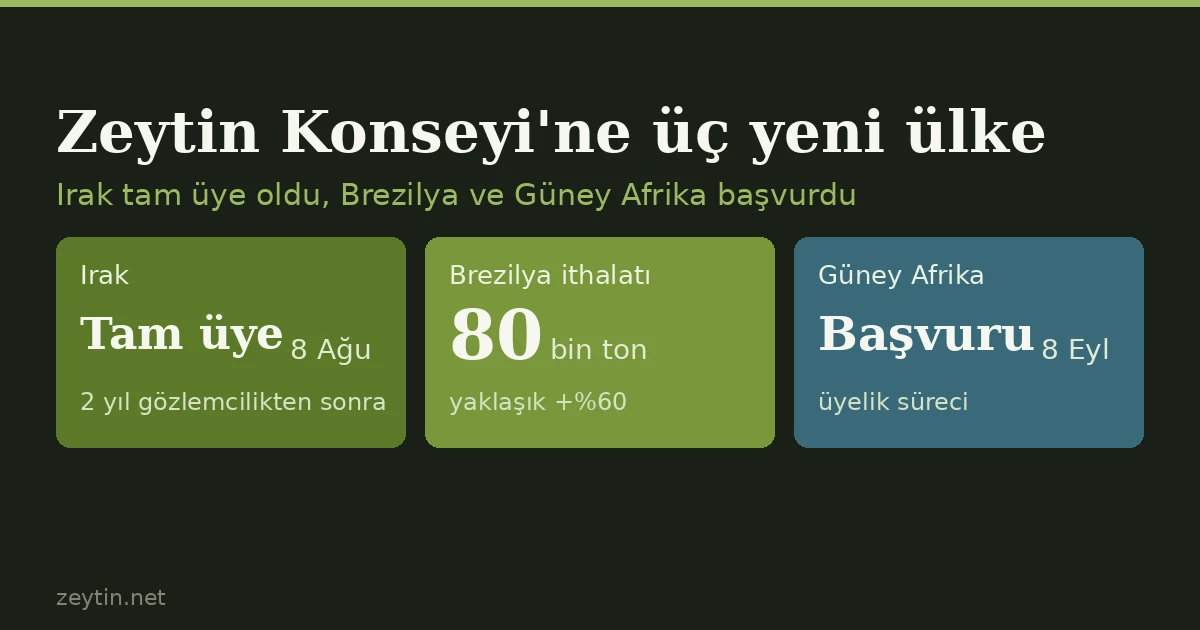
The International Olive Council (IOC) saw three developments in a month: Iraq became a full member on 8 August, South Africa submitted its membership request on 8 September and Brazil on 9 September. The expansion reflects olive oil's shift towards production and consumption areas beyond the Mediterranean.
 Article
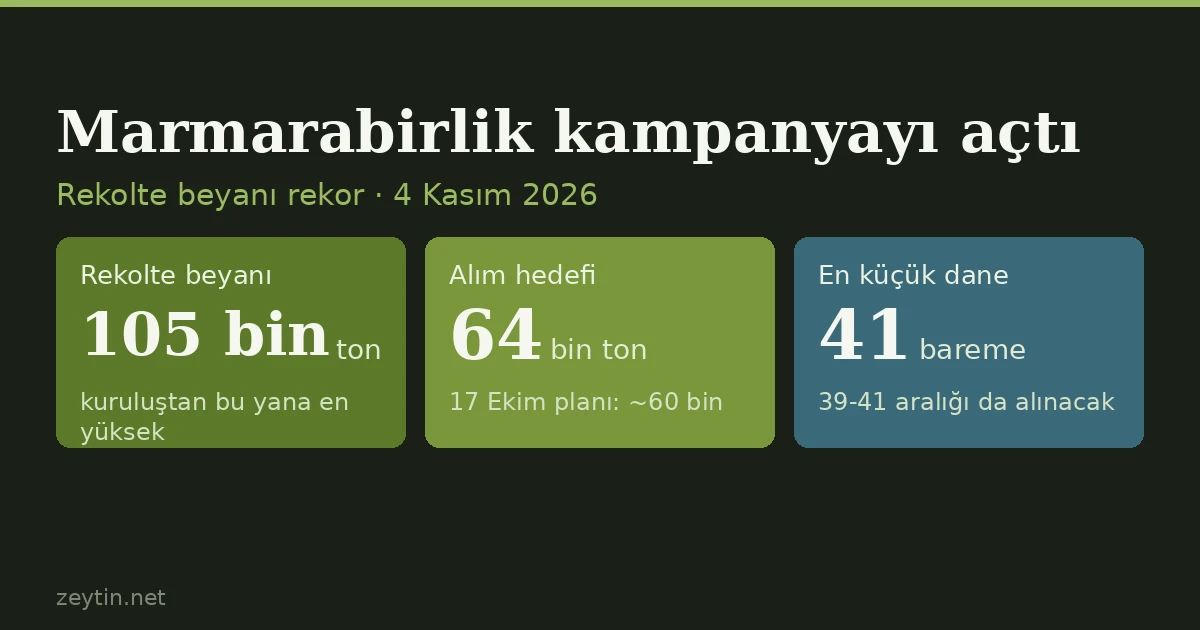
Marmarabirlik opens its purchase campaign: record 105,000-tonne declaration, 64,000-tonne target, olives bought down to size 41
Marmarabirlik opened its purchase campaign on 4 November 2026: members declared a record 105,000 tonnes and the buying target is 64,000 tonnes. Small olives will be bought down to size 41, and Erdek members hit by hail get a loan deferral and a price-difference payment.
 Article
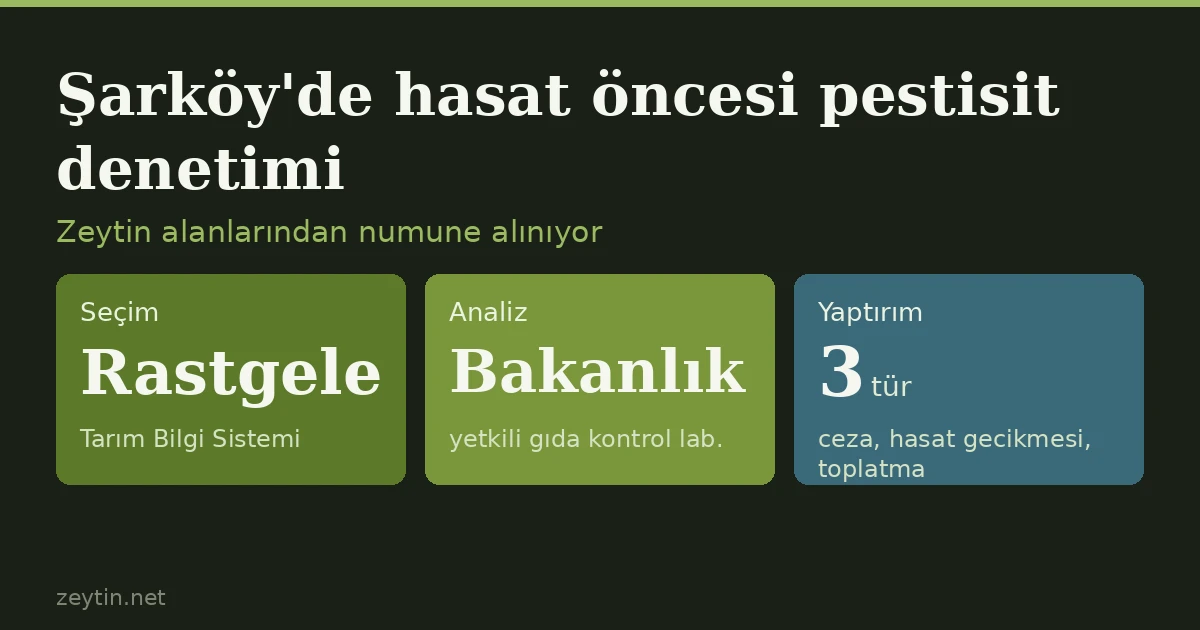
Pre-harvest pesticide inspection in Şarköy olive groves: growers picked at random, samples go to ministry-authorised labs
Samples are being taken from olive groves in Şarköy, Tekirdağ, to test for pre-harvest pesticide residue. Growers are picked at random from the Agricultural Information System; if residue is found, a fine, delayed harvest or confiscation of the crop may follow. The sample count and the residue limit are not in the report.