The crop is heading for 500,000 tonnes, exports fell to 17,000: the sector wants a premium and an exchange-rate mechanism
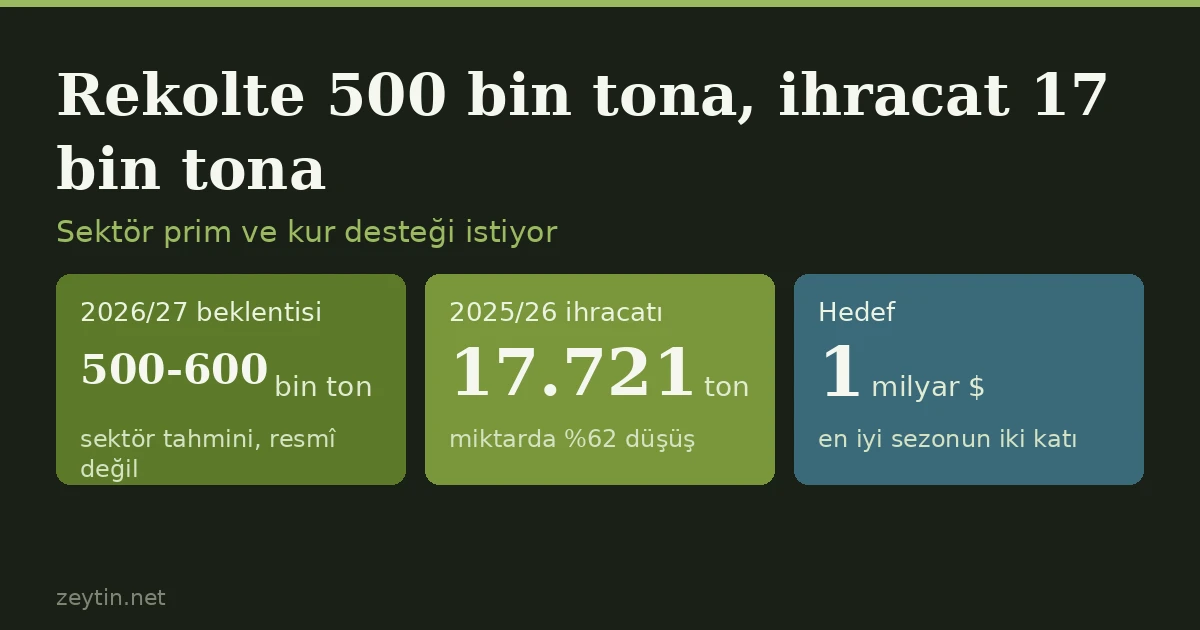
Industrialists and exporters meeting in Izmir put this season's olive oil crop at 500,000-600,000 tonnes. Last season Türkiye shipped 17,721 tonnes of olive oil: down 62% in volume and 59% in value. The crop is not the problem; selling the crop is.
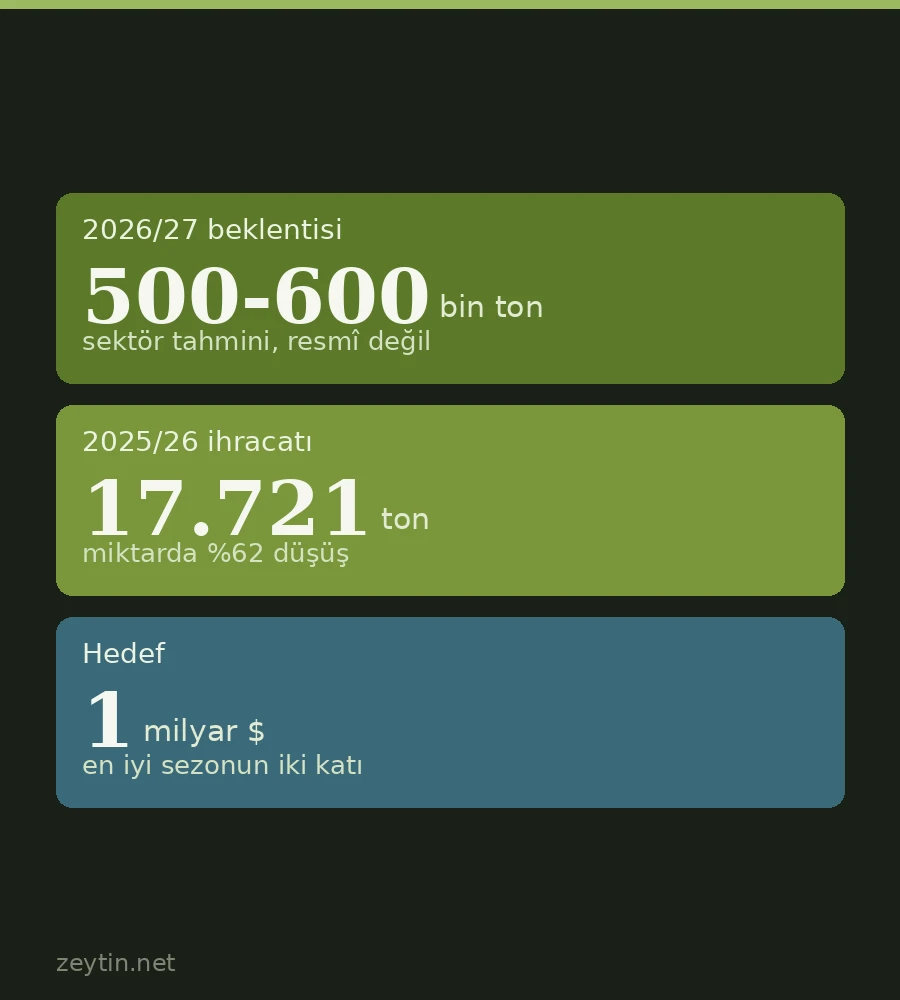
Olive oil processors and exporters who met in Izmir on 30 September put two numbers side by side. The first is an expectation: Türkiye is being talked about as capable of producing 500,000-600,000 tonnes of olive oil this season. The second is history: last season the country shipped just 17,721 tonnes.
The gap between them defines the real question of this season. The crop is not the problem; selling the crop is.
Last season's balance sheet
According to the records of the Aegean Olive and Olive Oil Exporters' Association, olive oil exports between 1 November 2025 and 31 August 2026 looked like this:
| Season (1 Nov - 31 Aug) | Volume | Value | Per tonne |
|---|---|---|---|
| 2024/25 | 46,452 t | $231.6 m | $4,986 |
| 2025/26 | 17,721 t | $96.0 m | $5,418 |
| Change | -62% | -59% | +8.7% |
The last column matters. Value fell less than volume, which means exporters sold at a higher price but had little oil to sell. This is not a picture of lost markets; it is a picture of short supply. Last season was an off year and Türkiye struggled even to cover its own domestic consumption. The rise in the price per tonne was not an exporter's achievement but a consequence of scarcity.
This season's number is not official yet
The 500,000-600,000 tonne range the sector is quoting is an expectation, not an official assessment. In Türkiye the crop is measured on the ground across 41 provinces by a committee convened under the Ministry of Agriculture and Forestry, and announced by the National Olive and Olive Oil Council. That report usually appears in November.
| Season | Olive oil | Source |
|---|---|---|
| 2024/25 | 475,000 t | Council assessment |
| 2025/26 | 310,000 t | Council assessment |
| 2026/27 | 500,000-600,000 t | sector expectation |
One caveat belongs here. The 310,000 tonnes announced for 2025/26 was considered too high by most of the sector on the day it was published; estimates circulating in the market at the time ranged from 170,000 to 200,000 tonnes, with the lowest at 150,000. When the season closed, an export figure of 17,000 tonnes stood on the side of the lower estimates. So 500,000 tonnes is also an estimate, and it will be tested as the harvest proceeds. That this is an on year is, however, confirmed from the field: in basins as far apart as Antalya and Orhangazi, the crop is doubling.
Where 500,000 tonnes would come from
The arithmetic of the expectation runs like this. The official assessment recorded 3.6 million tonnes of olives taken off the branch in 2024/25; 700,000 tonnes of that went to the table, 2.85 million tonnes were pressed, and the result was 475,000 tonnes of oil. That is one kilo of oil from six kilos of olives — a yield of roughly 17%.
| Official assessment | 2024/25 | 2025/26 |
|---|---|---|
| Bearing trees | 171.9 m | 176.7 m |
| Yield per tree | 21.0 kg | 13.9 kg |
| Total fruit | 3,600,000 t | 2,450,000 t |
| Table olives | 700,000 t | 740,000 t |
| Olive oil | 475,000 t | 310,000 t |
At the same yield, 500,000 tonnes of oil requires three million tonnes of oil-destined fruit. If the table-olive share stays at the 2024/25 level, the total crop comes to 3.7 million tonnes — three or four per cent above the highest season on record. Not impossible: the number of bearing trees rose by five million across two seasons, and young plantings are coming into production. But 500,000 tonnes is the ceiling itself, and there is as yet no field data to justify saying 600,000.
The price is not set in Türkiye
Nedim Kalpaklıoğlu, a board member of the Aegean Region Chamber of Industry, said that Spain, with production of roughly 1.5 million tonnes, sets the world price, and that Türkiye cannot compete at that level. He also pointed to Tunisia holding prices low and taking market share.
The figures support him. Andalusia's 2026/27 aforo is 1,261,200 tonnes — a single region, more than double Türkiye's entire expectation for the season. In the European Commission's weekly producer price series, extra virgin olive oil in Jaén stood at €3.42/kg in the week of 20 September; at the European Central Bank's 30 September rate that is about 190 lira a kilo. On the Edremit Commodity Exchange, the last registered average for refined cooking-grade olive oil was 225 lira a kilo. The quality classes are not the same — one is extra virgin, the other a refined blend — but the direction is clear: Türkiye's lower grade is dearer than Spain's top grade.
The table-olive leg is steadier
The sharp fall on the oil side does not appear in table olives, and the reason sits in the official assessment table: even in an off year, table-olive fruit held at 740,000 tonnes, above the 700,000 of the on year. Table olives are picked selectively, and a thinner tree shows up first in the oil-destined fruit. In 2024/25 table olive exports set a record at $255 million — more than the $231.6 million that olive oil brought in the same season. One leg of the sector swings; the other holds.
What the sector is asking for
The requests fall into two items. On the producer side, a per-kilogram premium based on productivity instead of general support payments. On the exporter side, an exchange-rate support mechanism. Emre Uygun, chairman of the board of the Aegean Olive and Olive Oil Exporters' Association, said exporter capacity is sufficient and that the problem lies in cost and financing conditions.
Putting it in scale
The target the sector voices is $1 billion in combined olive and olive oil exports. To see how large that is, it is enough to look back: in 2024/25 olive oil brought in $231.6 million and table olives $255 million. Together, $487 million. In other words, $1 billion is twice the sector's best season.
That does not make the target unreachable, but it does show the scale of the work expected from an exchange-rate mechanism and a premium. The arithmetic of getting there on bulk oil is hard: at a unit price around $5,000 a tonne, $1 billion means exporting more than 200,000 tonnes — over ten times last season. Which is why the emphasis voiced at the same meeting, shifting weight toward packaged and branded sales, may matter more than the support request. Where the value ends up along the price gap from olive to oil is a problem that does not depend on the exchange rate.
One rating per visitor; you can change yours at any time. Ratings are real reader votes — no seeded or default scores.
Related
 Article
Palestinian olive oil: output down from 33,000 to 7,000 tonnes — the cause is access, not the crop
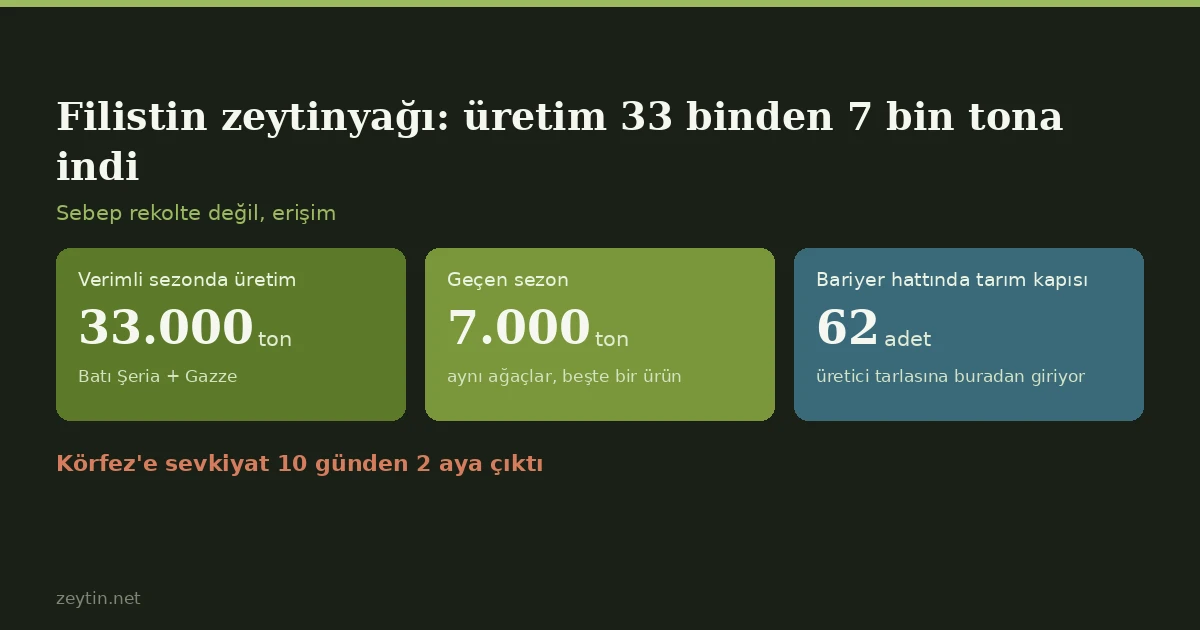
In a productive season Palestine yields 33,000 tonnes of olive oil; last season it produced 7,000. Seventy per cent of the groves sit in the northern West Bank, reached through 62 agricultural gates, and shipping times have gone from ten days to two months.
Article
Palestinian olive oil: output down from 33,000 to 7,000 tonnes — the cause is access, not the crop
In a productive season Palestine yields 33,000 tonnes of olive oil; last season it produced 7,000. Seventy per cent of the groves sit in the northern West Bank, reached through 62 agricultural gates, and shipping times have gone from ten days to two months.
 Article
The 12.5% US tariff: the competitor is exempt, the Turkish exporter is not
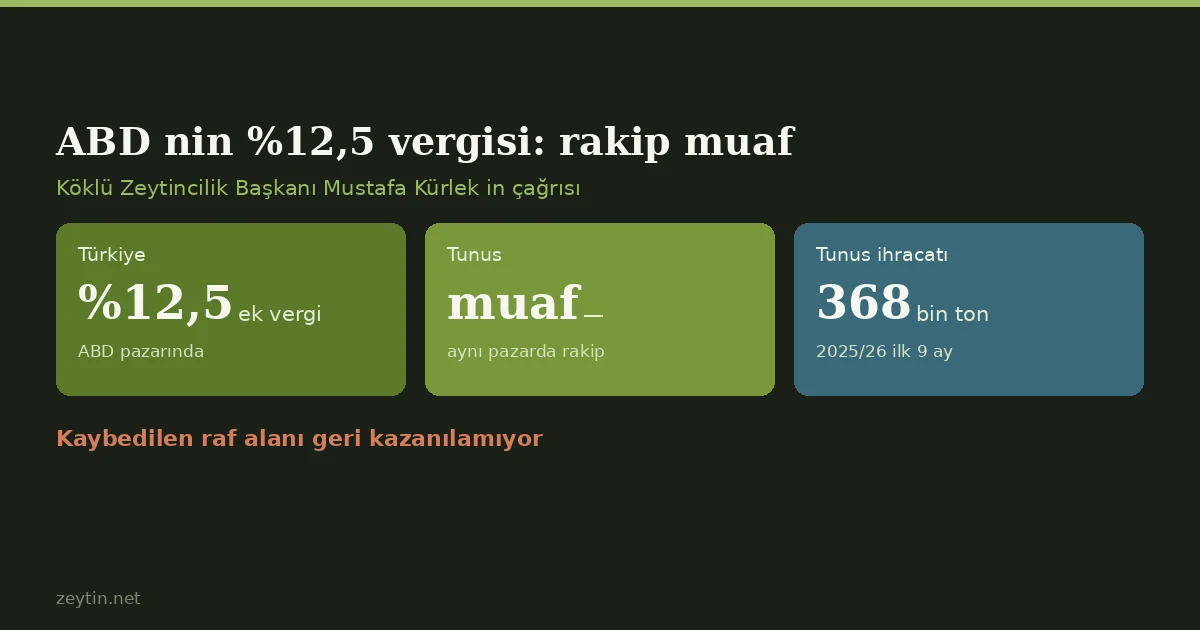
Mustafa Kürlek notes the 12.5% additional US tariff on Turkish olive products is not applied to competitors such as Tunisia, and calls for DFİF and Eximbank measures.
Article
The 12.5% US tariff: the competitor is exempt, the Turkish exporter is not
Mustafa Kürlek notes the 12.5% additional US tariff on Turkish olive products is not applied to competitors such as Tunisia, and calls for DFİF and Eximbank measures.
 Article
Edremit Chamber: olive oil needs at least 50 lira per litre in support
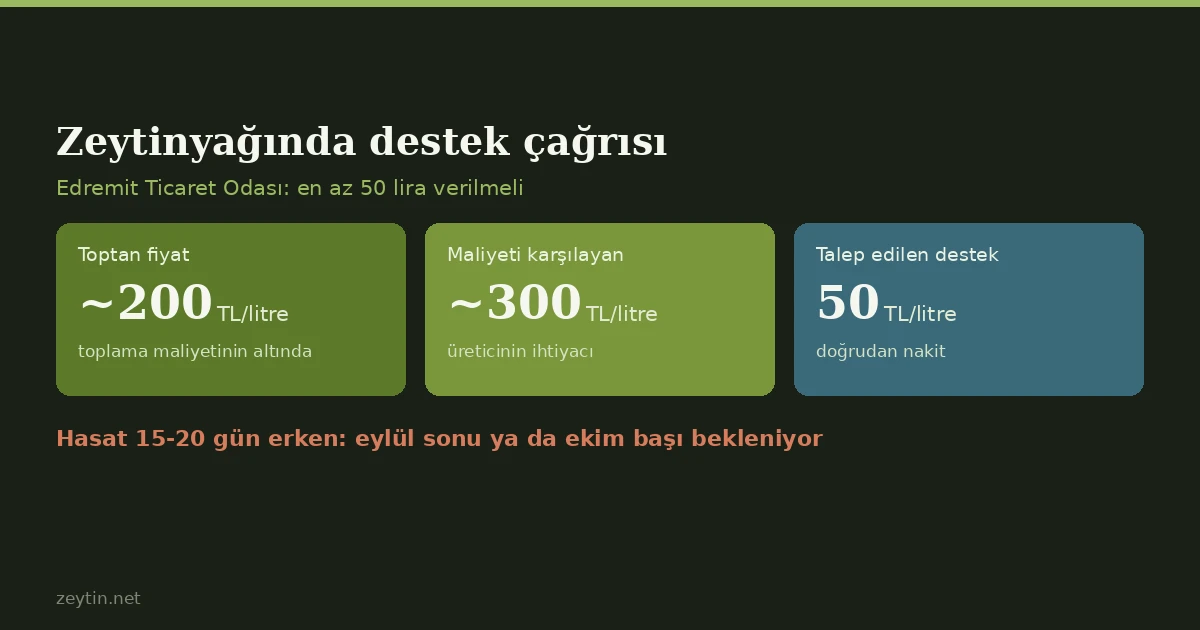
Chamber President Ahmet Çetin says the wholesale price has fallen to 200 lira, below the cost of picking. The level needed to cover costs is 300 lira. Harvest is expected 15-20 days early.
Article
Edremit Chamber: olive oil needs at least 50 lira per litre in support
Chamber President Ahmet Çetin says the wholesale price has fallen to 200 lira, below the cost of picking. The level needed to cover costs is 300 lira. Harvest is expected 15-20 days early.
 Article
Two pressures before the harvest: costs and 100,000 tonnes carried over
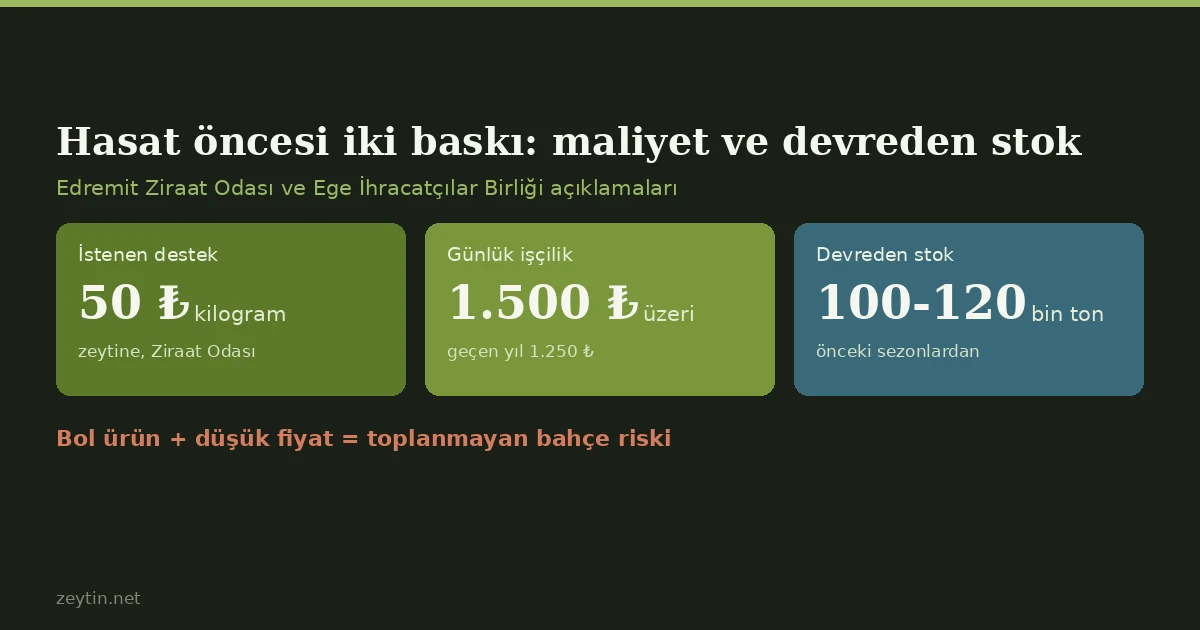
The chamber of agriculture wants 50 lira per kilo; daily labour has passed 1,500 lira. Exporters report 100,000-120,000 tonnes carried over from previous seasons.
Article
Two pressures before the harvest: costs and 100,000 tonnes carried over
The chamber of agriculture wants 50 lira per kilo; daily labour has passed 1,500 lira. Exporters report 100,000-120,000 tonnes carried over from previous seasons.