The same olive, six times the price: the quiet advantage of table olives
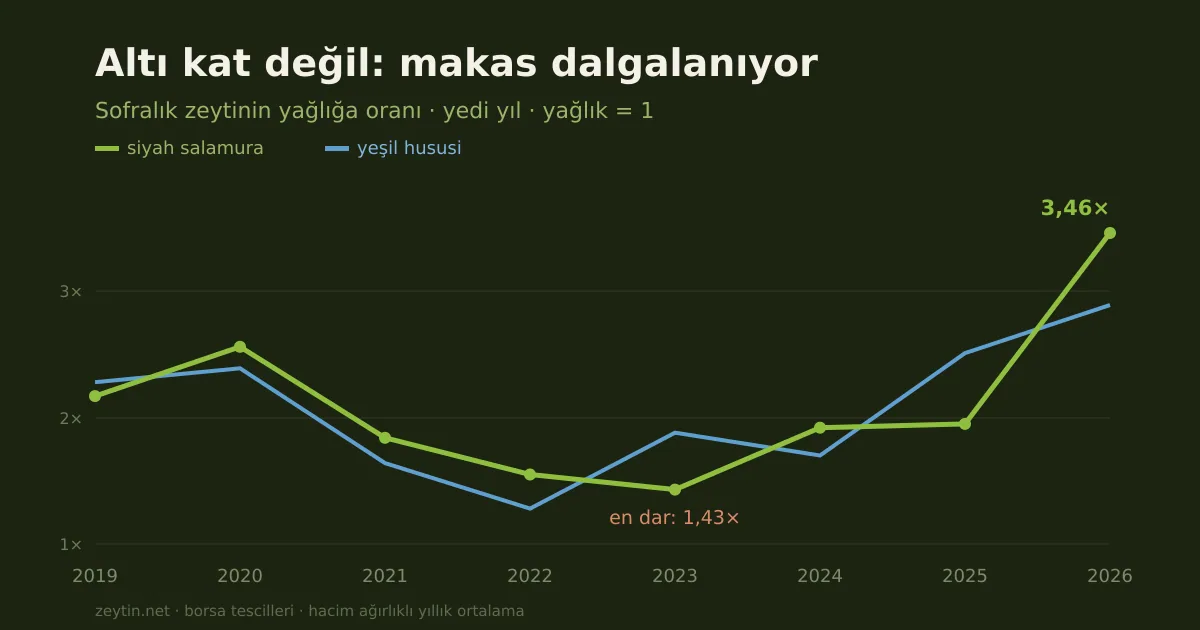
How much more does the same fruit fetch as a table olive than for oil? Measured over seven years of exchange data: 1.43 to 3.46 times.
The olive sector describes itself through olive oil. Harvest news is about oil, price debates are about oil, and most of the analyses on this site are too.
Yet the world produces almost as much table olives as olive oil. And two thirds of Türkiye's export earnings come from there.
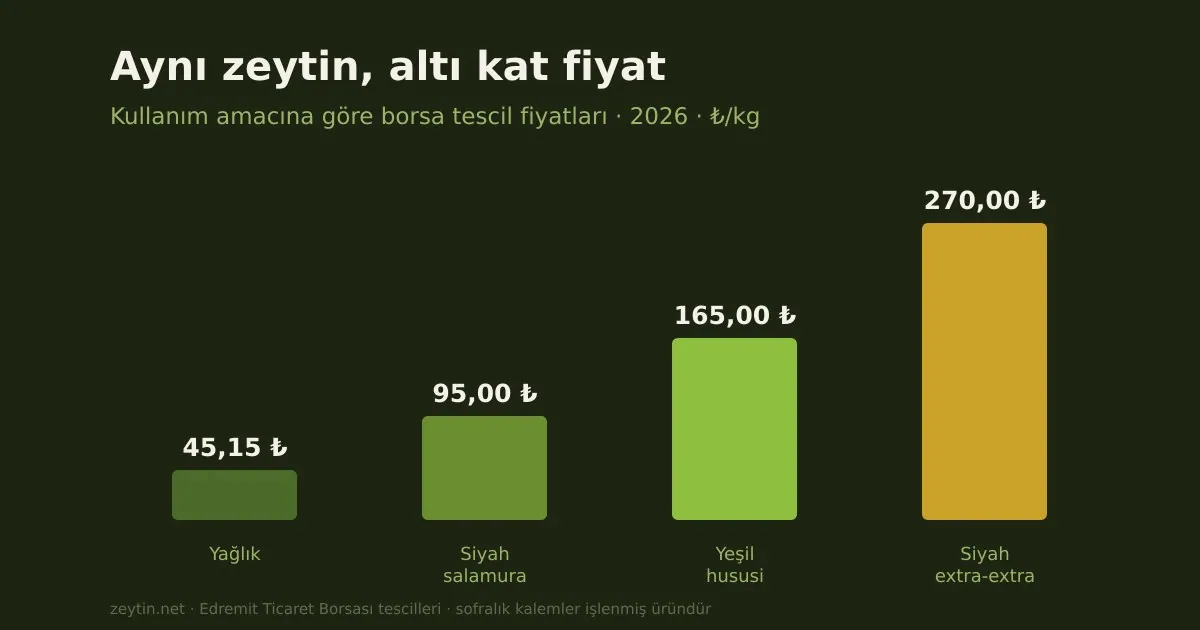
This article looks at the side that gets less attention — starting with a fairly blunt figure buried in exchange records.
The same tree, three different prices
In current registrations on the commodity exchanges, olives trade at completely different prices depending on what they are destined for:
| Product | Price TL/kg | Exchange | × oil olives |
|---|---|---|---|
| Olives, for oil | 45.15 | Edremit | 1.0× |
| Olives, black brined | 95.00 | Edremit | 2.1× |
| Olives, green select | 165.00 | Edremit | 3.7× |
| Olives, black extra-extra | 270.00 | Edremit | 6.0× |
The oil olive figure is the 2026 volume-weighted average; the others are the most recent registrations (black brined 17.07.2026, green select 24.08.2026, black extra-extra 19.06.2026). Table items are processed product; oil olives are raw fruit. Read the comparison with that difference in mind.
A kilogram of olives is 45 lira if it goes to oil, and 270 lira if it is set aside as large-calibre black table olives.
Six times.
t; Update (26 August 2026): The ratios here came from a single day's registrations. After pulling seven years of history for those four products we measured the gap across the series: it ranges from 1.43 to 3.46 depending on the year, and "six times" is not a rule but this year's position. Detail: Was it six times? Seven years of the table olive gap
Why isn't this a like-for-like comparison?
Leaving the figure as it stands would mislead. Part of the gap is genuine added value; part of it is cost and selection.
There is processing. The table price is for fruit that has been brined, debittered and graded. That means months of work, tanks, salt, labour and storage. Oil olives are registered as they come off the tree.
There is loss. Not all fruit set aside for the table can be sold as such: bruised, blemished, undersized and infested fruit is graded out and generally goes to oil. The 270-lira price is the price of the fruit that survived that sorting.
There is variety. Not every olive can be a table olive. Gemlik, Domat and Uslu are bred for the table; varieties like Memecik are predominantly for oil. If your trees are an oil variety, the choice is not available to you.
There is harvesting. Table olives are picked by hand, fruit by fruit, without bruising. Oil olives can be shaken down with poles or harvested mechanically. Labour costs are markedly higher on the table side.
Even so, the gap remains large after all of these are accounted for. And the core point is this: table olives change hands as a packaged product, not as a bulk commodity.
What carries exports
That structural difference shows up in export figures. In the 2025-2026 season Türkiye's olive and olive oil exports were $260 million, split like this:
| Item | Value | Share | Year on year |
|---|---|---|---|
| Table olives | $172.5 million | 66% | comparatively resilient |
| Olive oil | $69 million | 27% | −62% |
| Other | $18.5 million | 7% | — |
Olive oil exports collapsed 62% by value while table olives held up. We measured the reason separately: bulk oil is pure price competition and Türkiye's price sits above Spain's. Table olives, by contrast, differentiate by variety, calibre and preparation — a Gemlik is not a like-for-like substitute for a Spanish Manzanilla.
The world picture
According to the International Olive Council, world table olive production in 2024/25 was 3,316,500 tonnes, up 19% on the previous season. World olive oil production in the same season was 3,572,000 tonnes.
By weight, the world produces almost as much table olives as olive oil. That balance is absent from how the sector talks about itself; it is present in the numbers.
Türkiye's table olive production rose 53% in the same season. The IOC expects a 10% global decline in 2025/26, to 2,986,000 tonnes.
⚠ We cannot give verified country-level table olive tonnages: the IOC breakdown in this report does not provide them. We do not repeat the frequently circulated claims about Türkiye's world ranking without verifying the source.
What it means for a grower
For a grower with a table-suitable variety the picture is clear: sending the fruit to oil is the lowest-return option.
A rough comparison. Five kilograms of olives:
- To oil: yields 1 kilogram of oil, 249.44 lira on the exchange. The fruit alone is 225.75 lira; milling costs come out of what remains.
- As black brined table olives: 5 × 95 = 475 lira, less losses, salt, tanks, labour and months of storage.
- As large-calibre black table olives: in theory far higher — but whether the fruit qualifies depends on variety and size.
This does not say table olives are profitable in every case; processing costs and losses are serious, and unsold product stays on your hands. What it says is that where the same fruit goes changes its price several times over.
One caution: table processing takes knowledge. A badly brined batch is both money and product lost. Our article on how olives are cured covers the basic methods.
What it means for the sector
The goal discussed for years in olive oil is moving from bulk to branded. Table olives have already done part of that.
The resilience of table olive exports is no accident: the product ships in tins or vacuum packs, under a variety name and often a brand. Its price is not tied to the raw material price alone.
The lesson applies to the oil side: the added value is inside the packaging. Build the same structure in oil and you stop being at the mercy of bulk price competition.
The missing piece should be stated too: in table olives as well, the last link — what it sells for on the shelf — is beyond what we can measure. The same gap stands for oil in our value chain article.
Summary
- The same olive: 45.15 TL for oil, 95 TL brined, 270 TL as large black table fruit.
- The gap is not pure profit — processing, losses, variety and harvest costs differ — but it is still large.
- 66% of Türkiye's olive exports are table olives; they held up while oil fell 62%.
- The world produces close to as much table olives (3.32 million tonnes) as olive oil by weight.
- Table olives are resilient because they are a packaged, differentiated product.
- The lesson for olive oil: added value sits not in production but in packaging.
Related reading: Two thirds of our exports are table olives · Tree to shelf: the value chain · Olive varieties · How are olives cured
One rating per visitor; you can change yours at any time. Ratings are real reader votes — no seeded or default scores.
Related
 Article
Was it six times? Seven years of the table olive gap
How many times the oil price does a table olive fetch? Over seven years the ratio ranged 1.43 to 3.46, never below 1.
Article
Was it six times? Seven years of the table olive gap
How many times the oil price does a table olive fetch? Over seven years the ratio ranged 1.43 to 3.46, never below 1.
 Article
Olive Oil Prices: Week 35 of 2026
Turkish exchange prices, European producer prices and exchange rates side by side: extra virgin at 300 TL/kg in Edremit, Spain's national average €3.52/kg.
Article
Olive Oil Prices: Week 35 of 2026
Turkish exchange prices, European producer prices and exchange rates side by side: extra virgin at 300 TL/kg in Edremit, Spain's national average €3.52/kg.
 Article
Olive Oil Prices: Week 37 of 2026
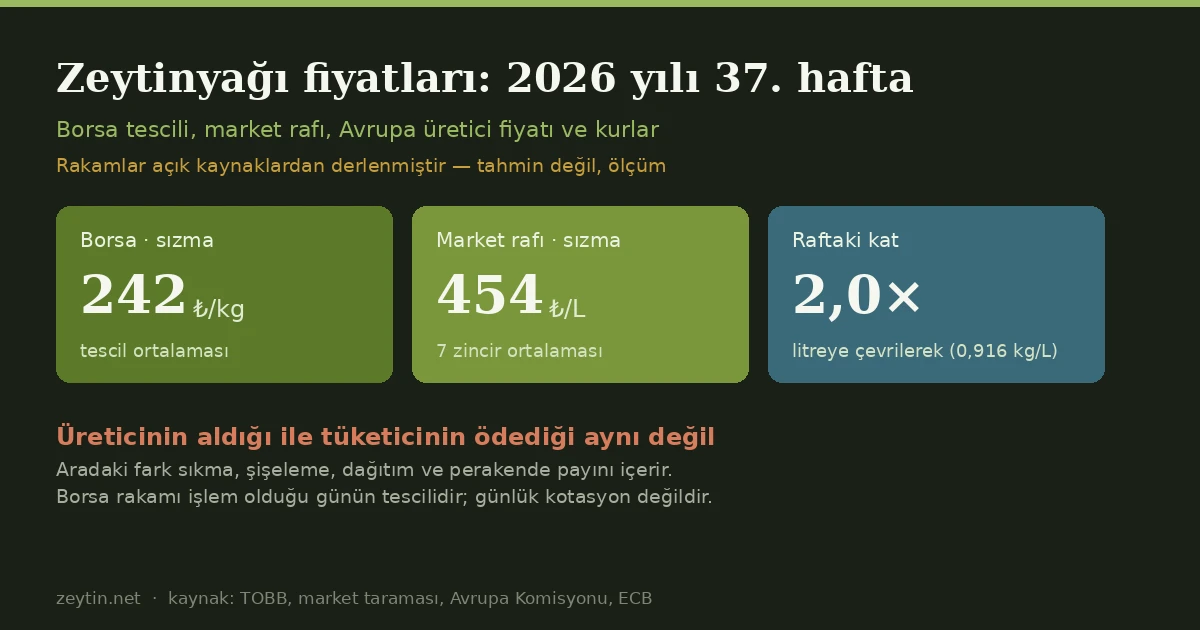
Week 37 of 2026: Turkish exchange prices, European producer prices and exchange rates side by side.
Article
Olive Oil Prices: Week 37 of 2026
Week 37 of 2026: Turkish exchange prices, European producer prices and exchange rates side by side.
 Article
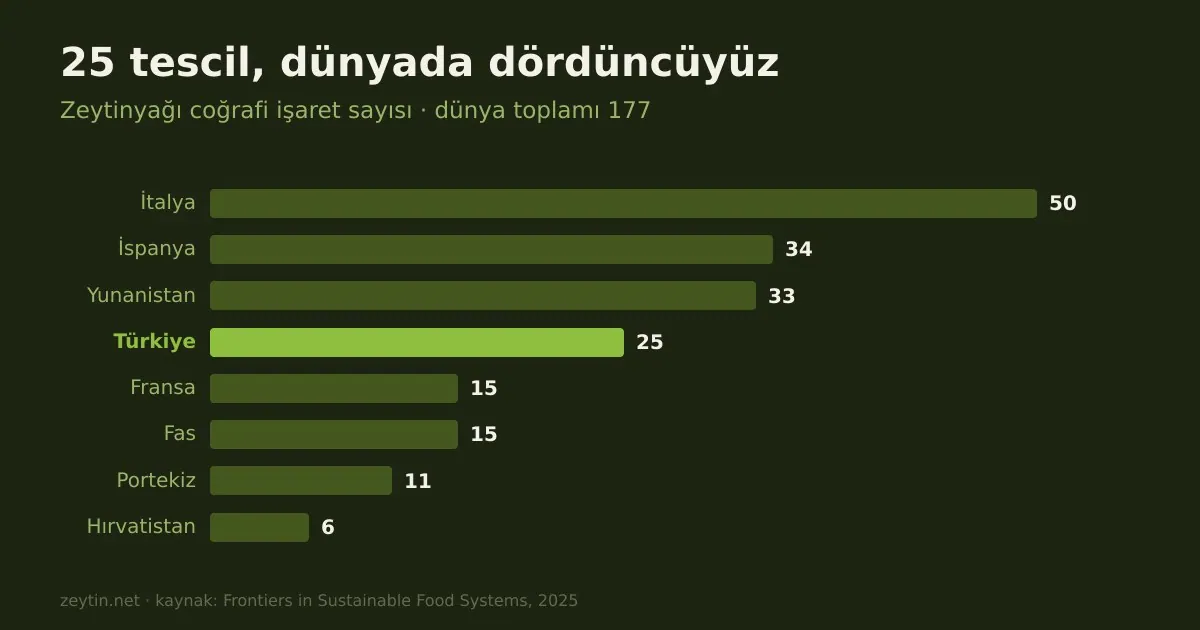
Fourth in the world with 25 registrations — but what are they doing?
Türkiye is fourth in the world with 25 olive oil GIs. Yet exports fetch $3.17/kg — the product is still priced as a commodity.
Article
Fourth in the world with 25 registrations — but what are they doing?
Türkiye is fourth in the world with 25 olive oil GIs. Yet exports fetch $3.17/kg — the product is still priced as a commodity.