Italian extra virgin has halved in a year: growers in Puglia set a Monday noon deadline
According to the European Commission's weekly producer prices, Italian extra virgin olive oil fell to €4.64 a kilo in the week of 4 October; a year earlier, in the same week, it was €9.40. Growers in Puglia have taken to the streets in the opening days of the harvest, holding sit-ins in Corato and Bitonto and giving the government until noon on 12 October to respond. Italian extra virgin stored in the region's warehouses has risen fivefold in a year.
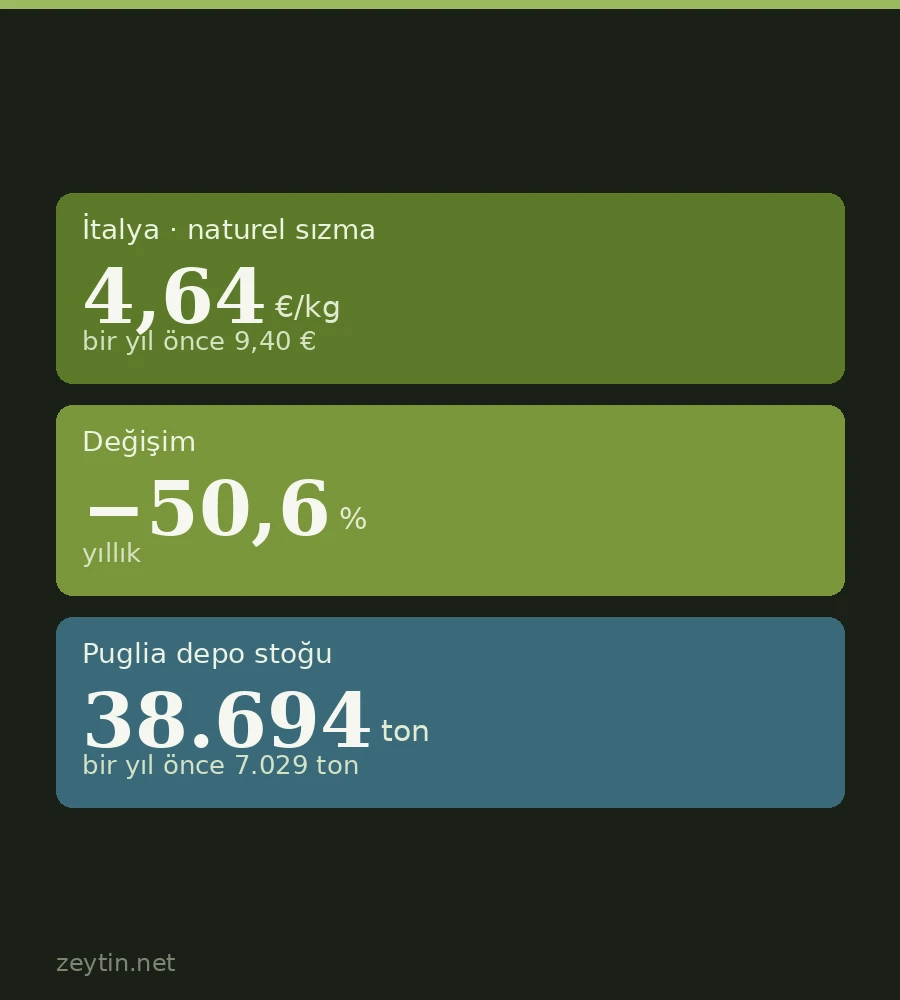
In the opening days of the harvest, Italy's producer price stands at half of what it was a year ago. According to the weekly producer prices published on the European Commission's Agri-food Data Portal, Italian extra virgin olive oil was €4.64 a kilo in the week of 4 October 2026; a year earlier, in the same week of the same series, it stood at €9.40. That is a fall of 50.6%.
What happened in a year
| Country · extra virgin | 5 Oct 2025 | 4 Oct 2026 | Change |
|---|---|---|---|
| Italy | €9.40 | €4.64 | −50.6% |
| Spain | €4.27 | €3.43 | −19.7% |
| Portugal | €4.30 | €3.45 | −19.8% |
What the table describes is not simply a price fall but the erosion of a premium. In the same week last year Italian extra virgin was priced at 2.2 times the Spanish quotation; today the gap is down to 1.35 times. The privilege Italian oil carried while its own domestic supply was short converges towards the world price once supply returns to normal.
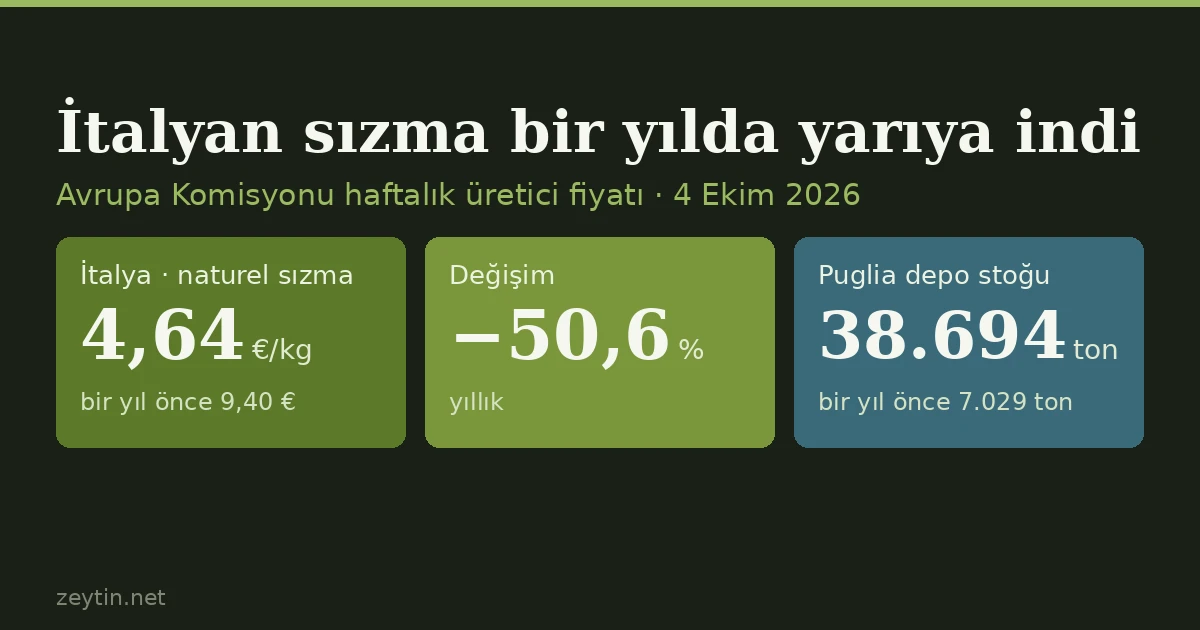
Italy's other grades moved the same way. In the same week lampante stood at €2.77, virgin olive oil at €3.20 and refined olive oil at €3.35.
In Bari and the other markets
Official quotations in the producing provinces sit below the national average. According to the Ismea quotations the growers' committees rely on, the reference market for Italian oil, Bari, registered €4.55/kg on 21 September, while Foggia was at €4.25/kg and Lecce and Taranto at €4.20/kg on 24 September. In the same series Bari's 52-week high is €9.43. In other words, growers are entering the harvest at the bottom of a curve that has travelled from the market's high to its low within a single year.
Stocks have risen fivefold
To understand why the price fell this fast, the stock side has to be read. Warehouse data presented at the general assembly of the olive and oil supply chain, organised by Coldiretti Puglia and PugliaOlive at Palo del Colle, puts the volume of Italian extra virgin olive oil held in Puglia's warehouses at 38,694 tonnes as of 23 September 2026, against 7,029 tonnes in the same period a year earlier — an increase of 450.4%.
Puglia is Italy's largest producing region, so that stock stands directly in front of the new crop as competing supply. The organisation that released the figure is careful in its own warning: a high stock level is not in itself evidence of irregularity, but it matters to know what that stored volume will do to the price as new fruit arrives at the mills.
An allegation accompanies the figure. Growers affiliated with Coldiretti in the region say part of the unsold oil is in fact imported product that has been "Italianised" after arrival. That is a producer claim, not an official finding or the outcome of an investigation. The organisation's demand follows from it: transparency on the origin of stored oil and tighter controls along the chain. We set out the methods, and what can actually be checked, in olive oil fraud and adulteration.
The protest calendar and the demands
The reaction reached the roadside on 5 October, when around 300 growers gathered on the Bitonto bypass. The "Orgoglio Olivicolo" (Olive Growing Pride) committee then widened the calendar: a sit-in in front of Corato town hall on 8 October, and another at 5pm on 9 October in front of Bitonto town hall, the second drawing more than 200 growers.
The committee has named noon on Monday 12 October as its deadline. If no answer comes from the national government and the regional administration, the demands will be handed to the prefect, the sit-ins will be extended to other municipalities in Puglia and to the southern regions, and a large demonstration will be organised in Rome.
The list of demands is specific: formal recognition of a crisis in the sector; activation of the private storage mechanism; a twelve-month deferral of loan instalments; credit guarantees through Ismea; intervention on fuel and energy costs; support for harvesting costs; and traceability along the chain through electronic transport documents and anti-fraud controls.
What competing supply costs
Behind the protest sits the price of the imported oil Italian growers are up against: producers in the region say Spanish, Greek and Tunisian oil is being offered in the €3.40-3.75/kg band. The Commission series this site tracks confirms the lower end of that range, with Spanish extra virgin at €3.43 in the week of 4 October. In a season where Spain expects 1.6 million tonnes for 2026/27, Greece has climbed to 300,000 tonnes and Tunisia has sold 381,000 tonnes in ten months, that band is not easily broken upwards.
Italy's own position sharpens the picture. The country is now a trading hub that exports more than it produces, which means imported oil is also raw material for its industry. While producer prices were falling, last season 40 million euros of interest-free finance was opened to the mills and output rose to 325,000 tonnes.
Seen from Türkiye
In the same days, the exchange registration for extra virgin olive oil in Türkiye stood at 200.46 lira a kilo in Nazilli on 8 October. At the European Central Bank's 9 October rate (€1 = ₺55.1033), that is roughly €3.64/kg — clearly below the Italian producer price and just above the Spanish one.
That makes Turkish bulk oil competitive in export markets, but the same picture also sets the ceiling. With European producer prices compressed into a €3.40-4.60 band, there is no visible basis for the domestic price in Türkiye to rise independently of that band.
Whether an institutional answer arrives in Italy before Monday noon, and whether the private storage demand is met, is the thing to watch next week. Storage would pull part of the stock out of the market and could put a floor under the price; without it, the new crop will land on top of full warehouses.
One rating per visitor; you can change yours at any time. Ratings are real reader votes — no seeded or default scores.
Related
 Article
Adulterated olive oil costs more than the real thing: price is no longer a sign of authenticity
Diker, president of the Edremit Chamber of Agriculture, says adulterated oils sold online now exceed the wholesale price of genuine oil: wholesale starts at 240 lira, the fake sells above 300. Our exchange data complicates the picture — genuine extra virgin in Aydın is already 307.60 lira.
Article
Adulterated olive oil costs more than the real thing: price is no longer a sign of authenticity
Diker, president of the Edremit Chamber of Agriculture, says adulterated oils sold online now exceed the wholesale price of genuine oil: wholesale starts at 240 lira, the fake sells above 300. Our exchange data complicates the picture — genuine extra virgin in Aydın is already 307.60 lira.
 Article
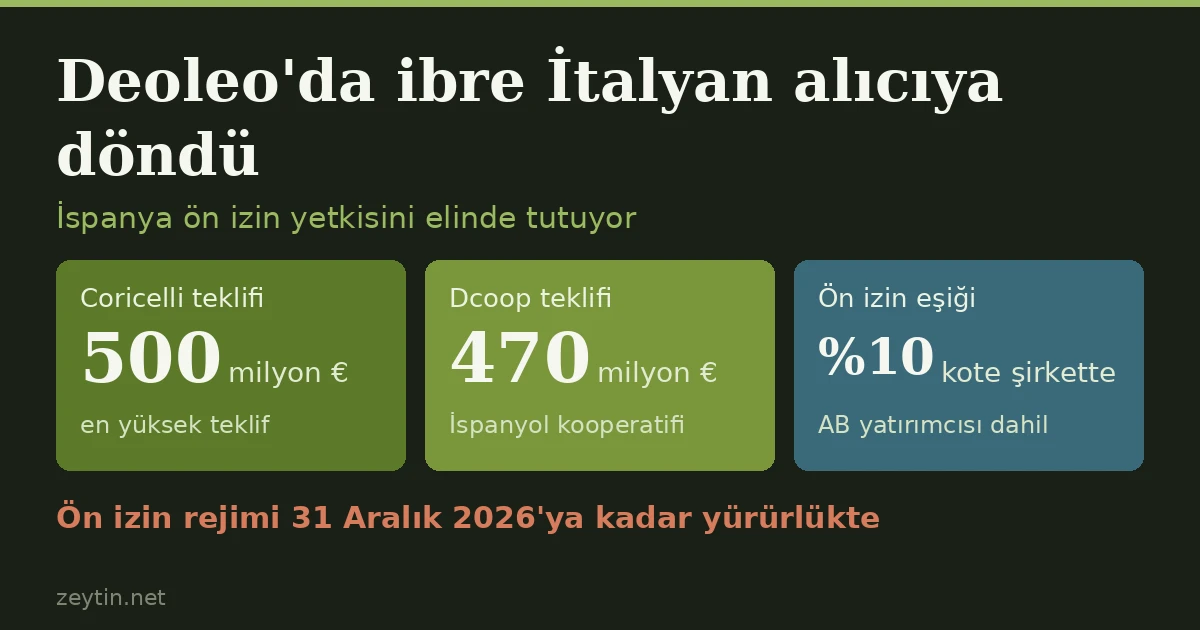
Spain steps back from vetoing Deoleo's sale: the door opens for Italy's Coricelli
Madrid's position on the sale of the world's largest olive oil bottler has shifted: in early September a Spanish buyer was preferred, and on 18 September Italy's Coricelli was reported to be seen as the best-positioned candidate. The government's lever is a foreign investment screening regime that covers EU investors too and runs to 31 December 2026. Because Deoleo is a major bulk buyer, the outcome matters to Turkish exporters.
Article
Spain steps back from vetoing Deoleo's sale: the door opens for Italy's Coricelli
Madrid's position on the sale of the world's largest olive oil bottler has shifted: in early September a Spanish buyer was preferred, and on 18 September Italy's Coricelli was reported to be seen as the best-positioned candidate. The government's lever is a foreign investment screening regime that covers EU investors too and runs to 31 December 2026. Because Deoleo is a major bulk buyer, the outcome matters to Turkish exporters.
 Article
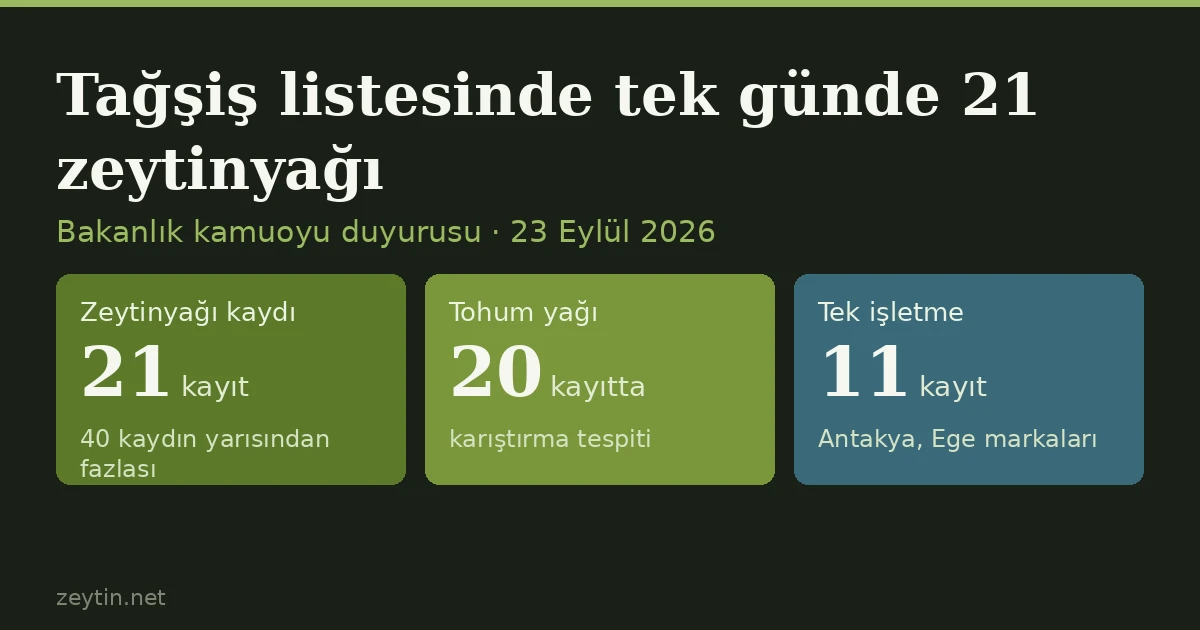
Twenty-one olive oils on the ministry's adulteration list in one day, eleven from a single Antakya business
Of the 40 records added to Turkey's counterfeit-and-adulteration list on 23 September 2026, 21 are olive oil, and 20 of those were found to contain seed oil. Eleven records belong to a single business registered in Antakya, marketing under Aegean origin names such as Ayvalık, Akçay-Altınoluk and Kazdağları. Sixteen of the containers were five litres.
Article
Twenty-one olive oils on the ministry's adulteration list in one day, eleven from a single Antakya business
Of the 40 records added to Turkey's counterfeit-and-adulteration list on 23 September 2026, 21 are olive oil, and 20 of those were found to contain seed oil. Eleven records belong to a single business registered in Antakya, marketing under Aegean origin names such as Ayvalık, Akçay-Altınoluk and Kazdağları. Sixteen of the containers were five litres.
 Article
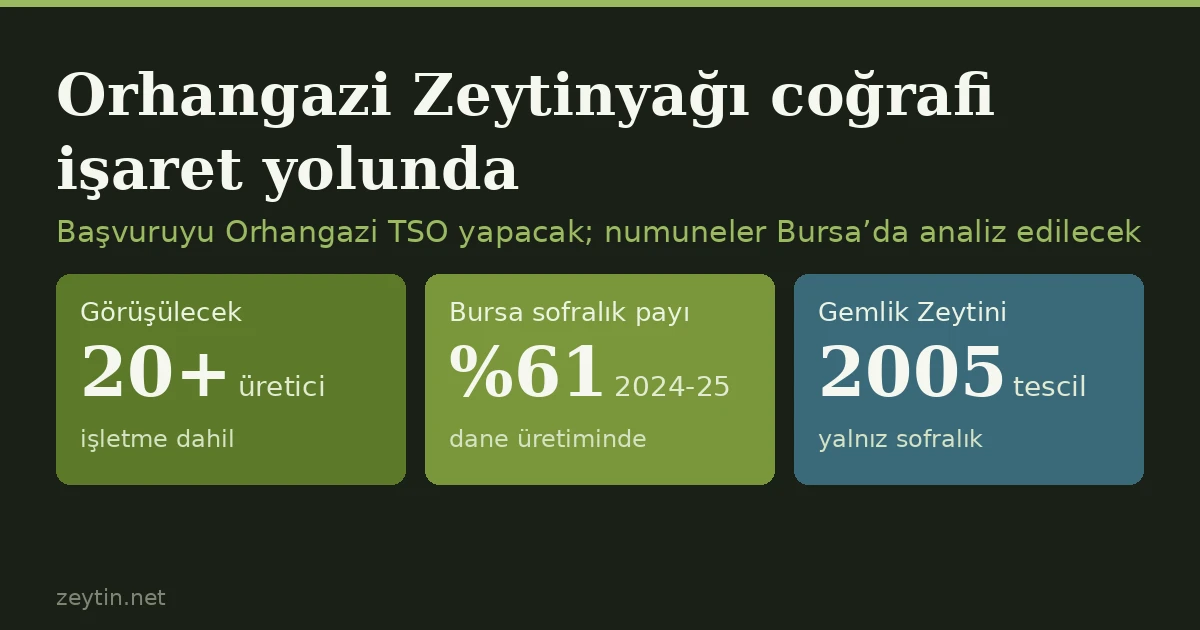
Orhangazi olive oil starts on the road to geographical indication, with samples to be tested for acidity and polyphenols
The Orhangazi Chamber of Commerce and Industry has begun preparing a geographical indication application for "Orhangazi Olive Oil". More than 20 producers will be consulted, samples tested in Bursa and the influence of the Lake İznik basin studied. The area's Gemlik Olive registration covers only table olives.
Article
Orhangazi olive oil starts on the road to geographical indication, with samples to be tested for acidity and polyphenols
The Orhangazi Chamber of Commerce and Industry has begun preparing a geographical indication application for "Orhangazi Olive Oil". More than 20 producers will be consulted, samples tested in Bursa and the influence of the Lake İznik basin studied. The area's Gemlik Olive registration covers only table olives.