Kalem Bezi olive: characteristics, oil content and growing areas
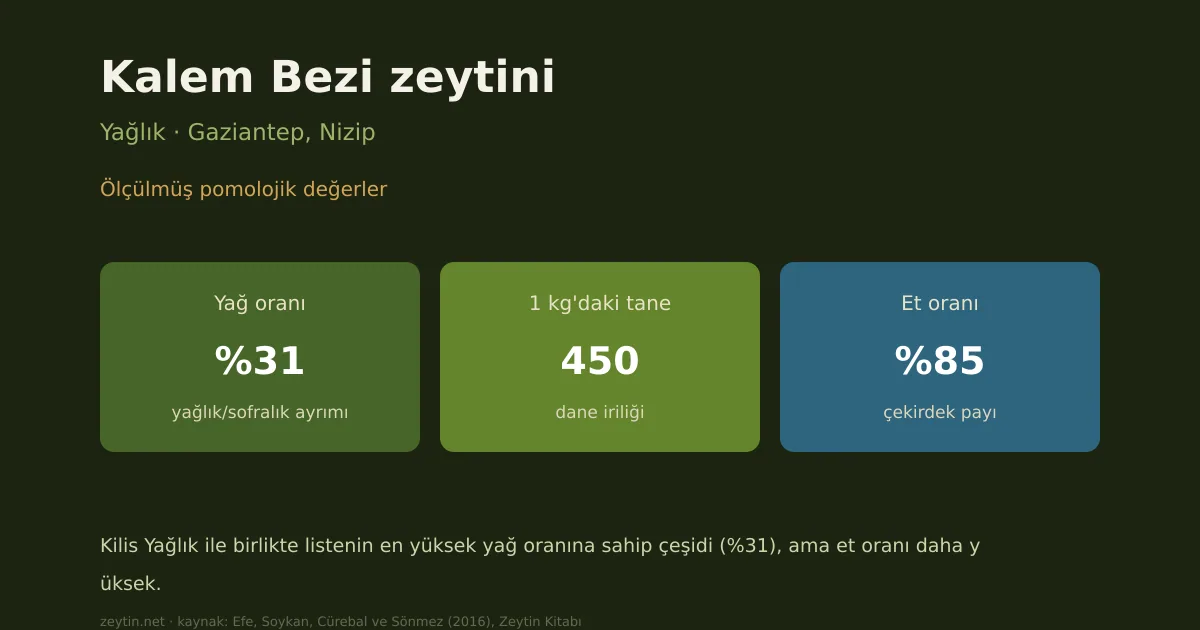
Tied with Kilis Yağlık for the highest oil content on the list (31%), but with a better flesh ratio.
Kalem Bezi is the oil variety of the Gaziantep and Nizip area. It matches Kilis Yağlık on oil content (31%) but has larger, fleshier fruit — the same oil from fewer olives.
Kalem Bezi in numbers
| Oil content | 31% |
| Fruits per kilo | 450 |
| Flesh ratio | 84-85% |
| Use | Oil |
| Main areas | Gaziantep, Nizip |
Source: Efe, Soykan, Cürebal and Sönmez (2016), Zeytin Kitabı. Fields the source leaves blank are shown as "—"; nothing has been estimated.
Why carrying both is rare
A cultivar's table value comes from size and flesh ratio, its oil value from oil content. The two usually work against each other.
Examples:
- Domat — high flesh ratio, 5.30 g fruit, but around 20% oil (table)
- Kilis Yağlık — about 30% oil, but 560 fruits to the kilo and 82% flesh (oil)
- Kalem Bezi — 31% oil and 85% flesh, at 450 fruits to the kilo
That is why Kalem Bezi can serve both purposes. The grower can send the crop to the table or to the mill according to that year's prices — a real hedge against price swings.
We measured separately how far the price of the same olive moves depending on where it goes: the same olive, six times the price.
What 450 fruits to the kilo means
Fruits per kilogram is the most practical measure of calibre. The lower the count, the larger the fruit:
| Cultivar | Fruits/kg | Approx. fruit weight |
|---|---|---|
| Gemlik | 270 | 3.7 g |
| Sarı Haşebi | 338 | — |
| Kalem Bezi | 450 | ≈ 2.2 g |
| Kilis Yağlık | 560 | ≈ 1.8 g |
At 450 to the kilo Kalem Bezi is a small fruit — which is what raises its oil content, since a smaller stone and thinner skin leave a greater share of the weight as flesh.
Its place in the south-east
Cultivars grown in south-eastern Anatolia: Eğriburun, Halhalı, Kalem Bezi, Kan Çelebi, Nizip Yağlık, Kilis Yağlık and Yağ Çelebi.
Published pomological measurements are limited for most of them, and the region holds many unnamed local genotypes besides.
Where it stands among measured cultivars
Its position on each axis is shown live in the comparison strip on this page, against every cultivar with a published figure. For the full ranking — and how that ranking is built — see olive variety rankings.
In short
Kalem Bezi is a rare variety combining 31% oil with 85% flesh. At 450 fruits per kilo it is noticeably larger than Kilis Yağlık (560). Even so it has stayed within the Gaziantep–Nizip belt and is little known elsewhere.
The figures here are measured pomological values. Variety-specific phenology and self-fertility data are absent from the official sources we hold; they will be added when found.
Where it stands among measured varieties
çeşit sayfası
çeşit sayfası
Zeytin Kitabı — Efe, Soykan, Cürebal, Sönmez (2016), Kitabevi Yay. s.37-80
Zeytin Kitabı — Efe, Soykan, Cürebal, Sönmez (2016), Kitabevi Yay. s.37-80
Zeytin Kitabı — Efe, Soykan, Cürebal, Sönmez (2016), Kitabevi Yay. s.37-80
Values are those published on each variety's own page; the comparison covers only varieties with a measured figure, so it is a comparison of what is known — not of every Turkish variety. See the full ranking and how it is built →
One rating per visitor; you can change yours at any time. Ratings are real reader votes — no seeded or default scores.
Related
 Article
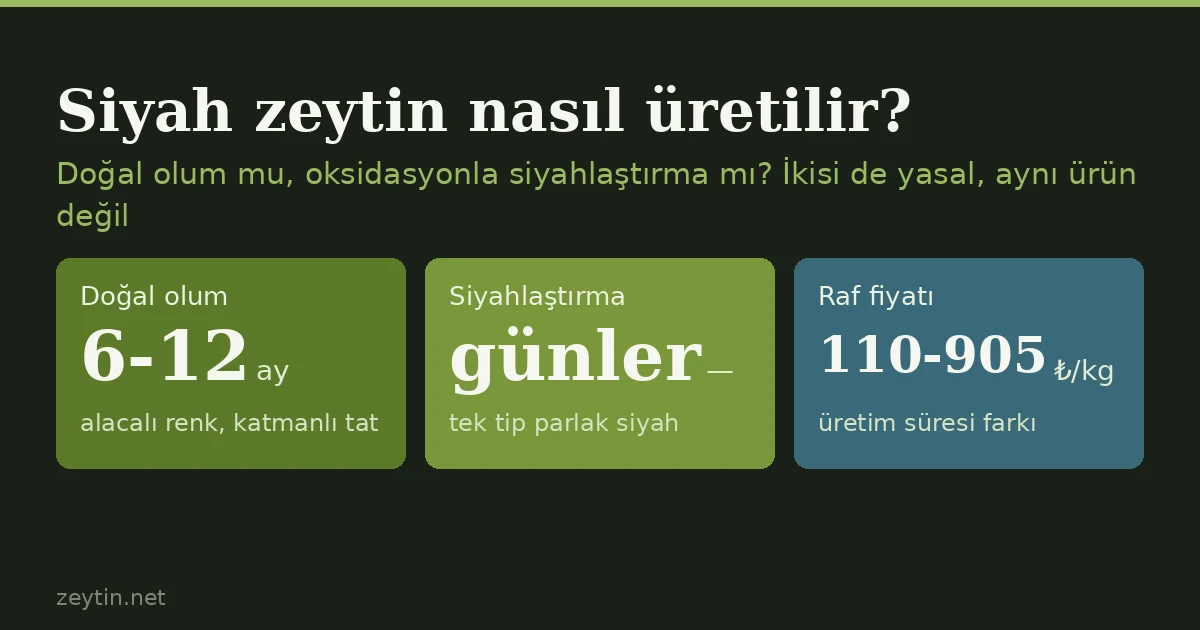
How are black table olives made? Natural ripening versus blackening
Two different black olives sit on the shelf: ripened on the tree and brined, or picked green and blackened by oxidation. Both lawful, but not the same product.
Article
How are black table olives made? Natural ripening versus blackening
Two different black olives sit on the shelf: ripened on the tree and brined, or picked green and blackened by oxidation. Both lawful, but not the same product.
 Article
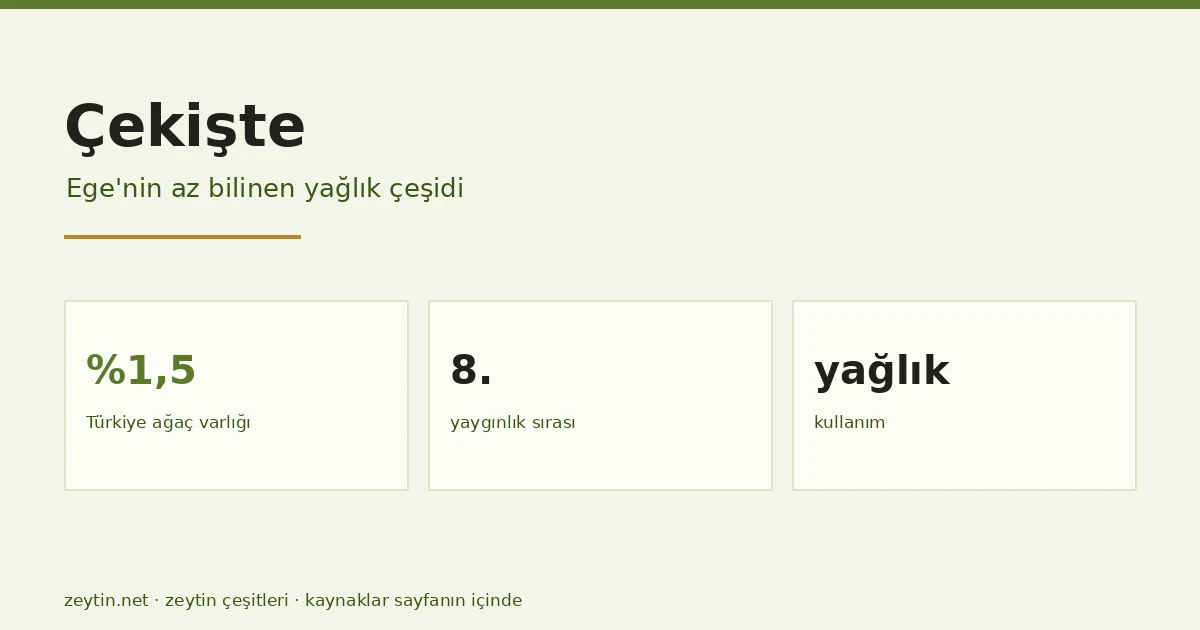
The Çekişte olive: the Aegean's lesser-known oil cultivar
Çekişte accounts for 1.5% of Turkey's olive trees — more widespread than Domat or Uslu, yet a cultivar whose name is almost never heard.
Article
The Çekişte olive: the Aegean's lesser-known oil cultivar
Çekişte accounts for 1.5% of Turkey's olive trees — more widespread than Domat or Uslu, yet a cultivar whose name is almost never heard.
 Article
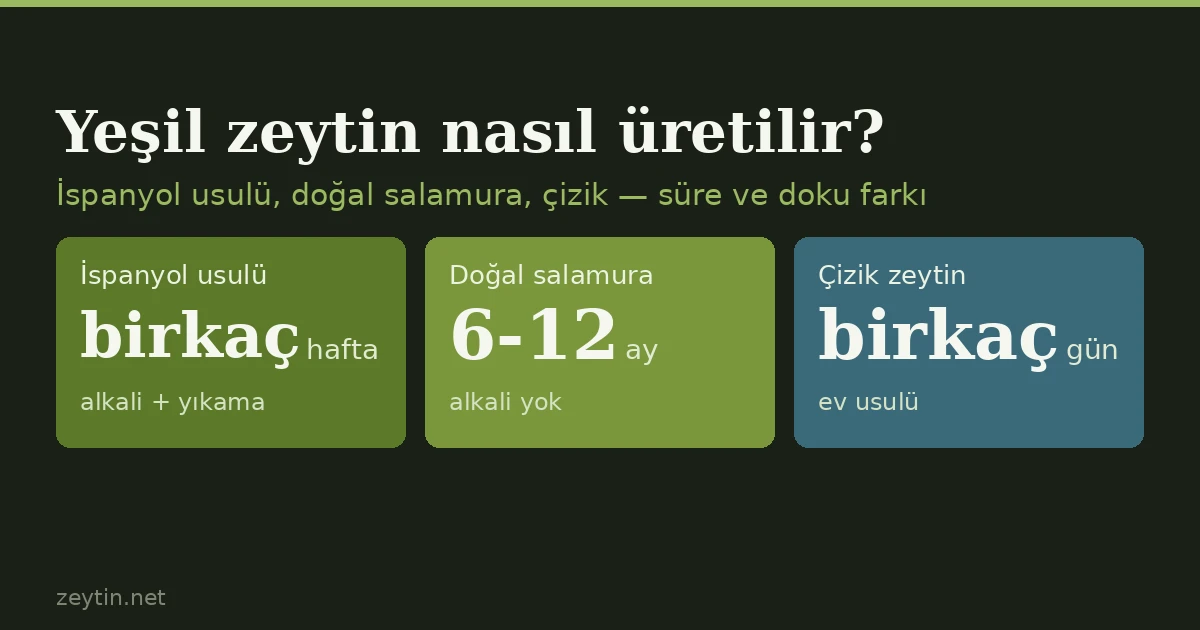
How are green table olives made? Three methods, three results
Green olives cannot be eaten off the tree; the bitterness must be removed. The difference between Spanish-style, natural brine and scored methods sets time, texture and taste.
Article
How are green table olives made? Three methods, three results
Green olives cannot be eaten off the tree; the bitterness must be removed. The difference between Spanish-style, natural brine and scored methods sets time, texture and taste.
 Article
Which is Turkey's best-quality olive?
Quality criteria and measured values for Turkey's main olive varieties — fruit weight, oil content and intended use.
Article
Which is Turkey's best-quality olive?
Quality criteria and measured values for Turkey's main olive varieties — fruit weight, oil content and intended use.