The official olive figure is measured in the grove: Türkiye's 2026 crop survey is under way
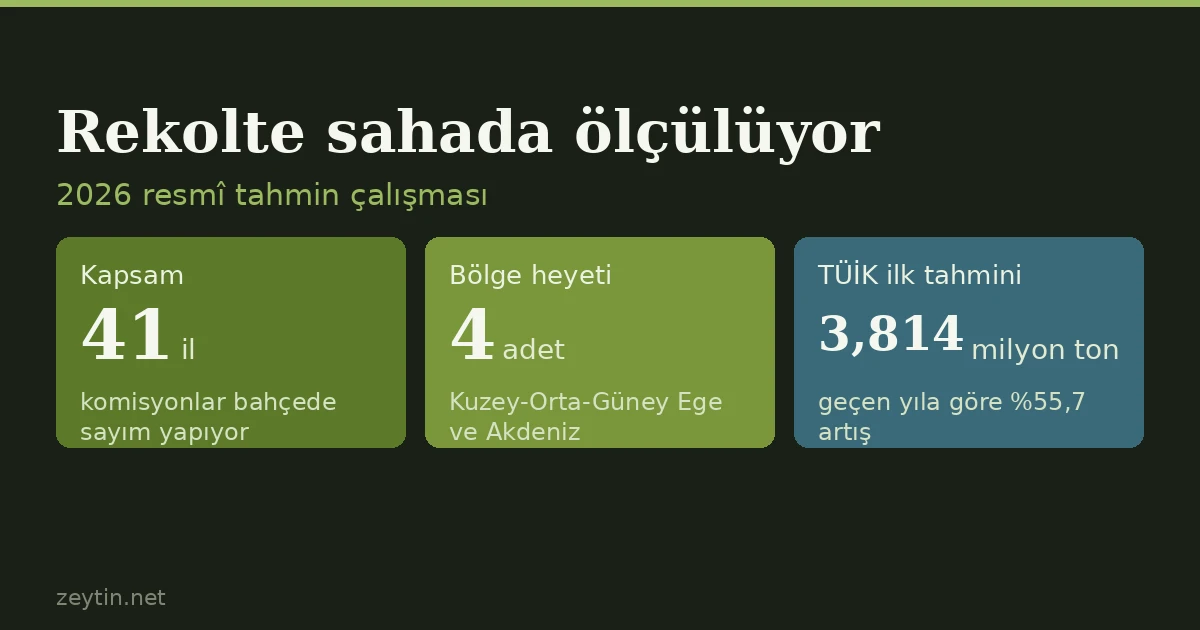
Türkiye's official olive crop figure is not produced at a desk. It comes from agricultural engineers counting fruit load tree by tree. A provincial crop estimation commission met in Denizli this week while field inspections continue in the districts. The national figure is assembled by an official delegation coordinated by the National Olive and Olive Oil Council across 41 provinces, and last season it was announced on 24 October.
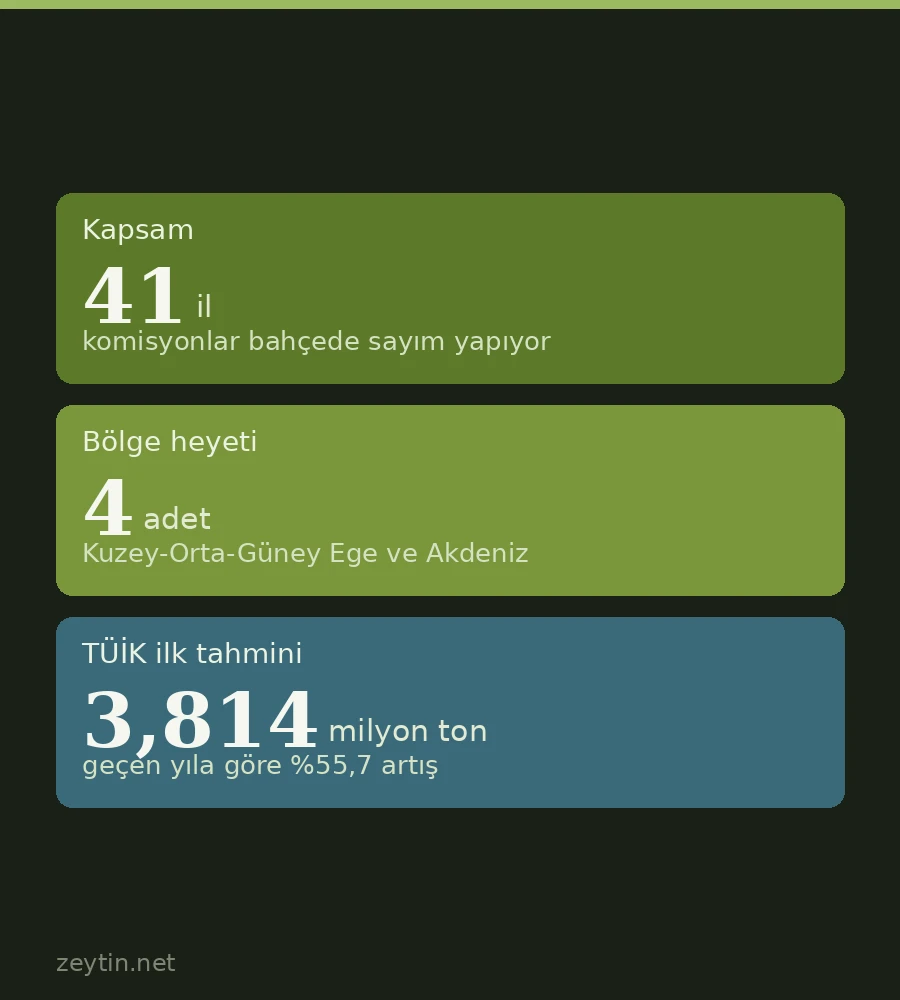
The most discussed number of the olive season — how much fruit is there this year? — is not produced at a desk. Through September, agricultural engineers walk into groves and assess the condition of the trees, the fruit load on the branches and the yield potential per tree. The official figure is the sum of those counts. Türkiye's 2026 crop survey is at exactly that stage right now.
A commission in the province, a count in the district
According to an announcement by the Denizli Provincial Directorate of Agriculture and Forestry, the 2026 Olive and Olive Oil Crop Estimation Commission met under the chairmanship of provincial director Mustafa Nevzat Zayim. The meeting reviewed the province's olive production areas, yield expectations and observations coming in from the field.
The composition of the commission explains why the resulting number is not treated as a purely governmental estimate. Around the table, alongside deputy provincial director Saffet Üge and Arzu Şengün, head of the crop production and plant health branch, sat Hamdi Gemici, chairman of the Denizli Chamber of Agriculture; Özgen Özener, representing the Denizli Commodity Exchange; Süreyya Çalışkan of the Denizli Exporters' Association; and Hatice Avcı, representing growers. It is a structure designed to get the grower, the exchange, the exporter and the administration to sign underneath the same figure.
The field work had already begun before the meeting. In an early-September briefing the provincial directorate said agricultural engineers working at district agriculture and forestry directorates were carrying out technical inspections in olive groves, assessing tree development, fruit load, yield condition and production potential on site in order to collect the data underpinning the 2026 estimate.
How the national figure is assembled
What happens in Denizli is repeated across 41 provinces. The crop estimation work is carried out by commissions established within the Ministry of Agriculture and Forestry and coordinated by the National Olive and Olive Oil Council (UZZK). Those commissions include chambers of agriculture, commodity exchanges, exporters' unions and producer unions from the growing regions.
The arithmetic is straightforward: estimated number of trees multiplied by estimated yield per tree. Production areas provide the base, the kilograms per tree come from observation in the grove, and the product gives the provincial figure.
Above the provincial layer sits what is formally called the National Official Estimation Delegation for the Olive and Olive Oil Crop. During September the delegation makes field visits across the growing regions and holds meetings with olive and olive oil businesses, institutions and individuals in the trade. Four separate delegations are formed along geographical lines: Northern Aegean, Central Aegean, Southern Aegean, and Mediterranean-Southeastern Anatolia.
The output is a single national estimate covering both table olives and olive oil. Last season's figure was announced on 24 October 2025: 2.45 million tonnes of olives, 740,000 tonnes of table olives and 310,000 tonnes of olive oil. That season was an "off" year in the alternate bearing cycle, and the estimate pointed to a decline of roughly 35 per cent against the preceding season.
Why several different numbers circulate
Outside observers are often confused by the fact that the Turkish sector discusses two or three crop numbers at once. They are not competing figures; they do different jobs.
The first is the Turkish Statistical Institute's first crop production estimate. For 2026 it puts olive production at 3.814 million tonnes, a rise of 55.7 per cent on last year's 2.45 million tonnes. That estimate is published in early summer, before the fruit has filled, and rests on area and climate data. Because 2026 is an "on" year in the alternate bearing cycle, a high figure was expected. If it holds, it would pass the record of 3.75 million tonnes set in 2024; the lowest output of the past five years was 1.52 million tonnes in 2023. The gap between those two figures is a reminder of how violently alternate bearing swings a Mediterranean olive crop.
The second is the official delegation estimate coordinated by UZZK. It arrives in the autumn, after the fruit load can actually be seen on the branch, and it is the reference that commercial decisions in the sector are built on.
The third is not a national estimate at all but a commercial commitment: the declarations cooperatives collect from their members. At Marmarabirlik, crop declarations for the 2026-27 business year open on 21 September, and a member's declared quantity is a pledge to deliver rather than a forecast. The union's purchase price is built on that aggregate.
Why the number carries weight
None of this is academic. The crop estimate shapes price expectations before the harvest, determines how carry-over stock is interpreted, drives export planning and frames the argument over a floor price for growers. That argument is already open this season: we looked at why a minimum price is being debated even as the forecast climbs in harvest forecast and the minimum price debate.
When an estimate becomes final is a separate question, and one that every producing country wrestles with. In Spain, growers publicly disputed the official preliminary forecast; we examined that episode in when does a crop estimate become final. The pattern repeats across the Mediterranean because the incentives differ: a high early forecast tends to soften prices, which suits buyers and worries growers.
One caution is unavoidable. The crop is not the same thing as the volume traded on an exchange, and the two are regularly confused in coverage of the Turkish market; we showed how in exchange volume is not the harvest. Between the fruit load counted in a grove in September and the olives that reach the scales in December stand hail, pests, drought, labour availability and the cost of picking. The official figure is the best photograph available before any of those variables has finished playing out — which is precisely why it is taken so carefully, and why the people who will trade against it are asked to sit on the commission that produces it.
One rating per visitor; you can change yours at any time. Ratings are real reader votes — no seeded or default scores.
Related
 Article
The 12.5% US tariff: the competitor is exempt, the Turkish exporter is not
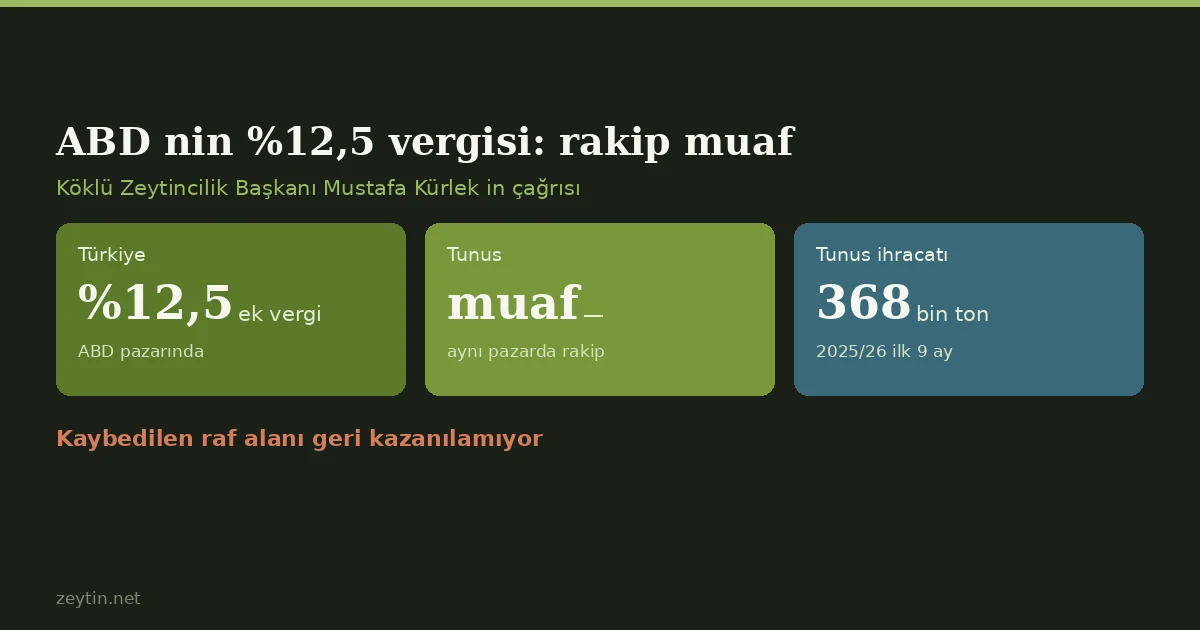
Mustafa Kürlek notes the 12.5% additional US tariff on Turkish olive products is not applied to competitors such as Tunisia, and calls for DFİF and Eximbank measures.
Article
The 12.5% US tariff: the competitor is exempt, the Turkish exporter is not
Mustafa Kürlek notes the 12.5% additional US tariff on Turkish olive products is not applied to competitors such as Tunisia, and calls for DFİF and Eximbank measures.
 Article
Pakistan to plant 2 million olive trees in three years to cut edible oil imports
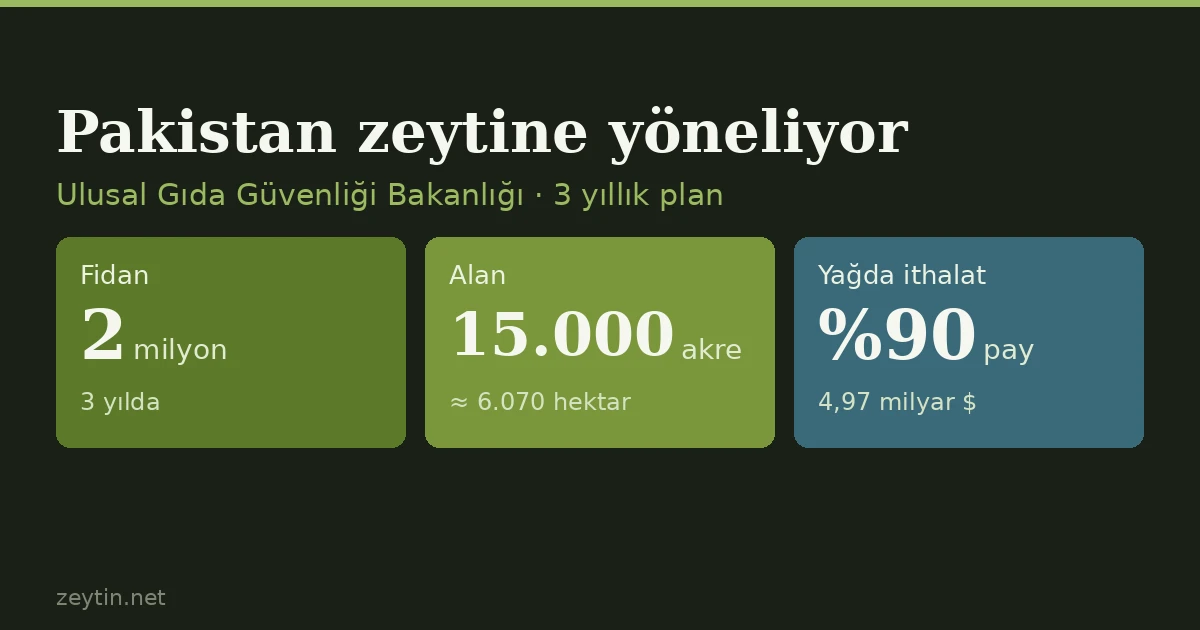
Pakistan's Ministry of National Food Security and Research plans to establish olive groves on 15,000 acres (about 6,070 hectares) over three years and supply 2 million plants in that period. The country imports roughly 90 per cent of its edible oil; the import bill reached 4.97 billion dollars in 2024-25.
Article
Pakistan to plant 2 million olive trees in three years to cut edible oil imports
Pakistan's Ministry of National Food Security and Research plans to establish olive groves on 15,000 acres (about 6,070 hectares) over three years and supply 2 million plants in that period. The country imports roughly 90 per cent of its edible oil; the import bill reached 4.97 billion dollars in 2024-25.
 Article
Adulterated olive oil costs more than the real thing: price is no longer a sign of authenticity
Diker, president of the Edremit Chamber of Agriculture, says adulterated oils sold online now exceed the wholesale price of genuine oil: wholesale starts at 240 lira, the fake sells above 300. Our exchange data complicates the picture — genuine extra virgin in Aydın is already 307.60 lira.
Article
Adulterated olive oil costs more than the real thing: price is no longer a sign of authenticity
Diker, president of the Edremit Chamber of Agriculture, says adulterated oils sold online now exceed the wholesale price of genuine oil: wholesale starts at 240 lira, the fake sells above 300. Our exchange data complicates the picture — genuine extra virgin in Aydın is already 307.60 lira.
 Article
"Not definitive until November": Andalusian growers push back on the crop estimate
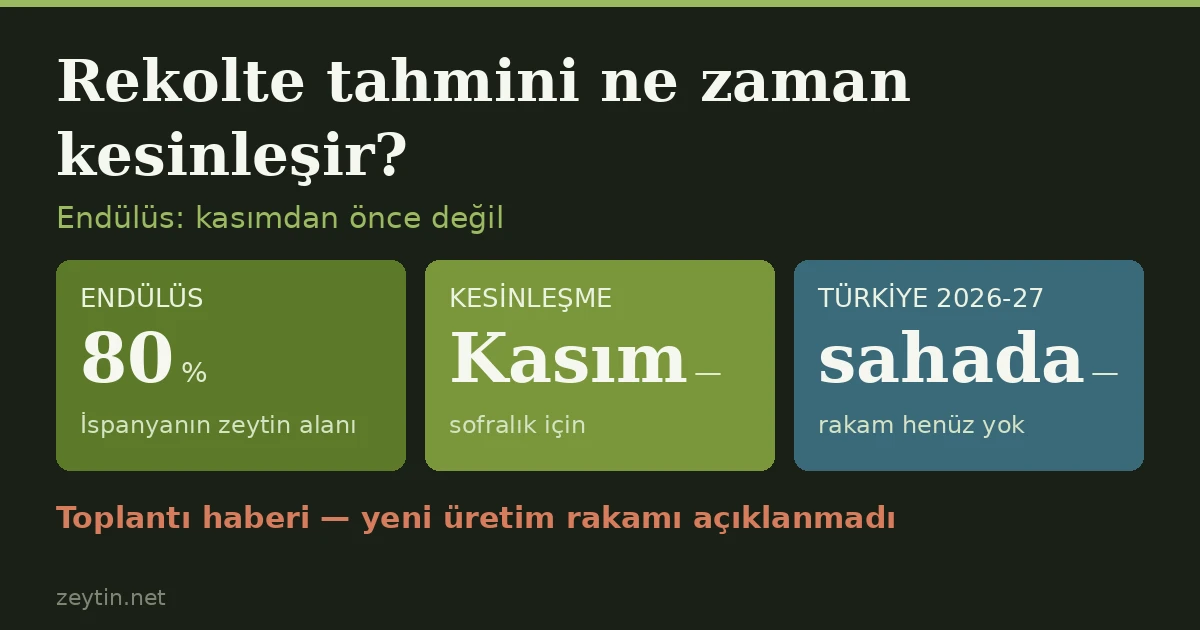
Andalusia's agriculture ministry called its first crop estimate "high production"; cooperatives and COAG in Seville objected: recent heat will affect the crop and the estimate is not definitive until November. Türkiye is making its 2026-27 estimate in the field the same week — the same caution applies here.
Article
"Not definitive until November": Andalusian growers push back on the crop estimate
Andalusia's agriculture ministry called its first crop estimate "high production"; cooperatives and COAG in Seville objected: recent heat will affect the crop and the estimate is not definitive until November. Türkiye is making its 2026-27 estimate in the field the same week — the same caution applies here.