Greece opens the season at €4: no scarcity in the Mediterranean, but pressure on price
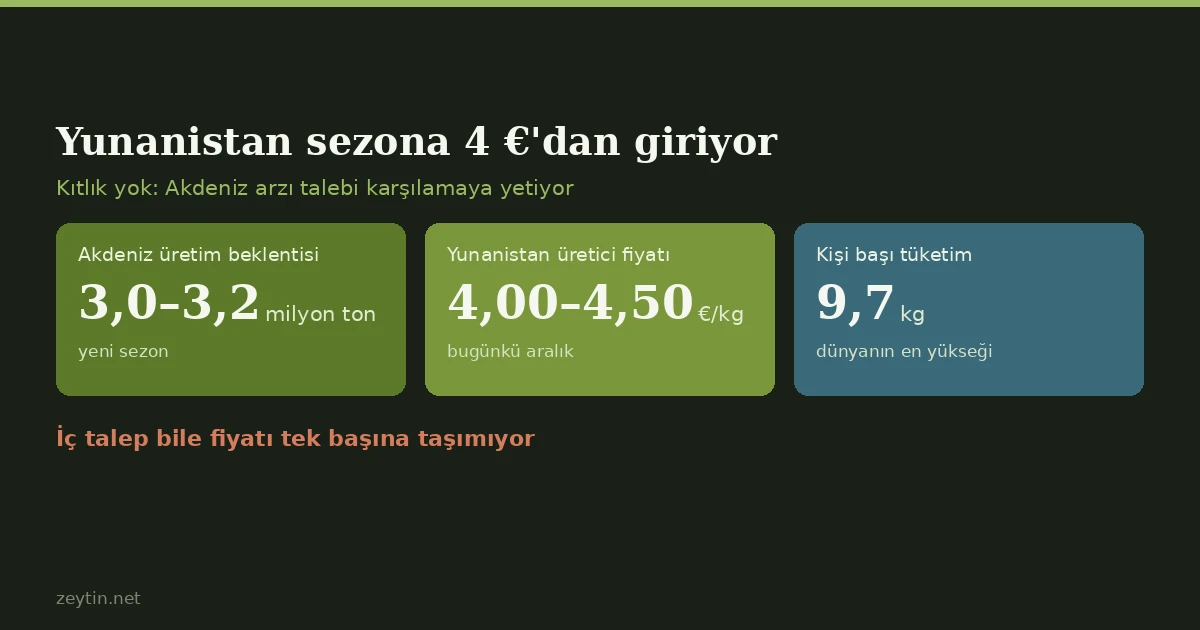
Manolis Giannoulis, president of the National Interprofessional Olive Oil Organization, expects the season to open at around €4 per kilogram. Mediterranean output is forecast at 3–3.2 million tonnes: no record, but enough to meet demand. The market is quiet, buyers are few, and costs plus North African imports keep the pressure on.
Greece's new olive oil season is opening on a picture in which price looks down rather than up. Manolis Giannoulis, president of the country's National Interprofessional Olive Oil Organization, says the season is expected to open at around €4 per kilogram. The market is currently quiet: few buyers, low domestic consumption, weak external demand.
The numbers
| Item | Value |
|---|---|
| Mediterranean output expected (new season) | 3.0–3.2 million t |
| Greek producer price (today) | €4.00–4.50/kg |
| Expected opening price | ~€4.00/kg |
| Greek per-capita consumption | 9.7 kg |
| Spanish producer price (30.08.2026) | €3.46/kg |
| Türkiye · Edremit registration (25.08.2026) | 254.33 TL/kg |
Not abundance — sufficiency
What is pulling the price down is not a record crop. Mediterranean output for the new season is expected between 3 and 3.2 million tonnes — not a boom, but enough to meet demand. What lifts prices in this market is the expectation of scarcity; the moment supply looks sufficient, that expectation disappears.
In Greece a second layer sits on top: few active buyers and thin trading volume. Growers are in no hurry to sell, and buyers are in no hurry to buy. In such periods the quoted price stops being a market price and becomes an indicator that has not been tested by a transaction.
The squeeze is in the same place: cost
The other half of the price pressure is on the production side. Harvesting and cultivation costs remain high, and that cost directly threatens the viability of olive growing. The logic is the same as in Spain: costs rise while prices fall, and the gap is absorbed by the grower's margin.
One difference matters. In Spain the cost is measured by a regular study and published per kilogram, so it can be set against price. In Greece the discussion stays at the level of "costs are high"; no comparable per-kilogram figure is public.
The cost of waiting
In a quiet market a grower's first instinct is to wait: prices will recover, and I will sell then. In olive oil that wait has a price, and the price grows with the calendar.
Oil sells at its highest polyphenol content and freshest aroma in the first months after harvest. Every month in storage pushes free acidity and peroxide value up and the sensory score down — faster still where temperature and light control are weak. The batch being held does not stay the same batch; it carries a risk of dropping a grade.
The second cost is the calendar itself. When the new harvest starts in October, oil held back competes on the same shelf with fresh oil. For a buyer, the difference between "last season" and "this season" is not only a label; it is leverage in the price negotiation.
A quiet market therefore leaves the grower a narrower window than it appears: waiting is free, but the longer the wait, the weaker — not stronger — the selling position.
North African pressure
The third factor is imports. The presence of cheap Tunisian olive oil in the European market is among the complaints of Greek producers. We wrote separately about Tunisia's export volume and its falling revenue per tonne: the issue is not that Tunisia sells dearly but that it is obliged to sell cheaply. That cheapness drags the reference price down across the EU market.
The Andalusian cooperatives' demand for oversight of duty-free quotas and the inward processing regime belongs to the same chain. The complaint in Athens and the one in Córdoba are the same: domestic costs rising while external price pressure persists.
Even 9.7 kilos is not enough
Greece's per-capita olive oil consumption is 9.7 kg, the highest in the world. That domestic demand is nonetheless described as low shows that even a market like this cannot carry the price alone. What sets the price in olive oil is not the size of domestic consumption but the ratio of export demand to supply.
There is a direct lesson here for Türkiye, where consumption is largely confined to producing regions; we treated this as the narrowness of the domestic market in our piece on structural problems. The Greek case shows that growing the domestic market is not by itself a price guarantee — but it is clearly a buffer: a 9.7-kilo home market means the oil has somewhere to go when exports stall.
Seen from Türkiye
The prices are strikingly close. Extra virgin was registered at 254.33 TL/kg on the Edremit exchange (25 August 2026); at the European Central Bank rate of 4 September (€1 = 56.2995 TL) that is about €4.52/kg. Greece's current range is €4.00–4.50. Growers in the two countries are seeing almost the same price in euro terms, while Spain sits below both at €3.46.
That proximity means direct competition in export markets. When two countries compete for the same shelf with different cost structures and different levels of branding, a similar producer price does not produce a similar outcome.
What to watch
The first real transaction price in October will confirm or break the €4 expectation. The second indicator is Spain's crop, which will largely decide whether Mediterranean supply settles at 3.2 million tonnes or below. The third is whatever step the EU takes on oversight of third-country imports.
One rating per visitor; you can change yours at any time. Ratings are real reader votes — no seeded or default scores.
Related
 Article
Tunisian banks lent 3.3 billion dinars to the olive oil season; the 2027 draft budget earmarks bulk export duties for a sector fund
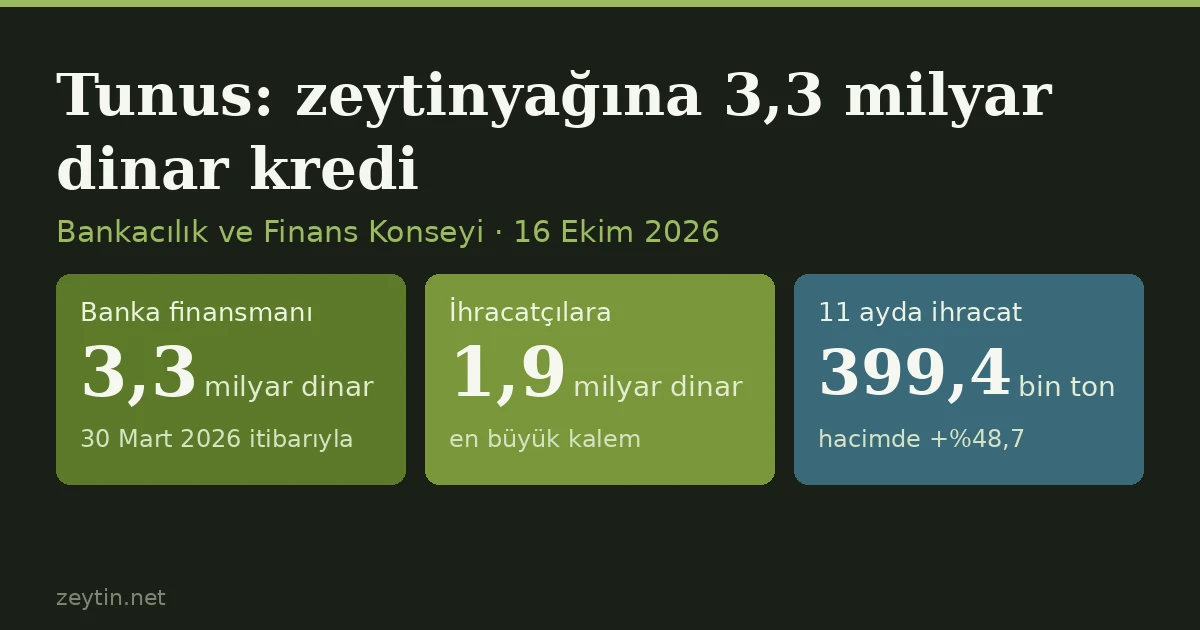
According to Néji Ghandri, president of the Tunisian Banking and Financial Council, banks extended 3.2-3.3 billion dinars to the 2025/26 olive oil season by 30 March, up from 2.2 billion the season before; 1.9 billion went to exporters. Tunisia exported 399,400 tonnes in eleven months. The 2027 draft budget opens a 100-million-dinar credit line for small growers and earmarks 10 per cent of bulk export duty revenue for a sector fund; it is not a new tax.
Article
Tunisian banks lent 3.3 billion dinars to the olive oil season; the 2027 draft budget earmarks bulk export duties for a sector fund
According to Néji Ghandri, president of the Tunisian Banking and Financial Council, banks extended 3.2-3.3 billion dinars to the 2025/26 olive oil season by 30 March, up from 2.2 billion the season before; 1.9 billion went to exporters. Tunisia exported 399,400 tonnes in eleven months. The 2027 draft budget opens a 100-million-dinar credit line for small growers and earmarks 10 per cent of bulk export duty revenue for a sector fund; it is not a new tax.
 Article
Andalusia bans night harvesting again for 2026/27: 8,127 birds counted on 137 hectares
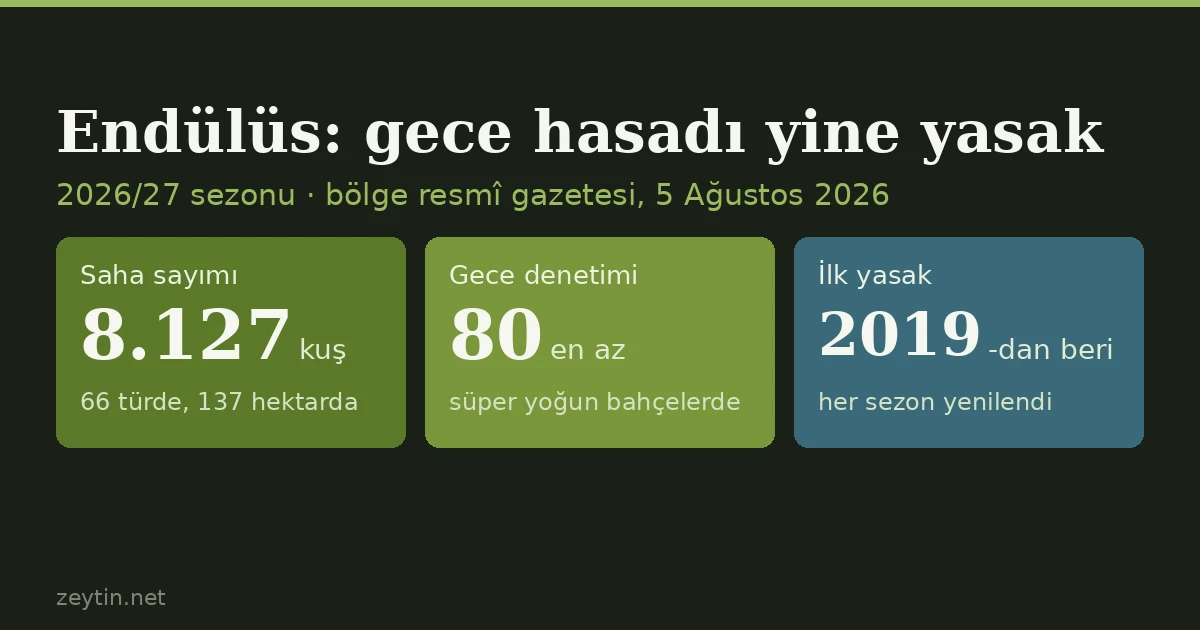
Andalusia has again suspended night-time mechanical harvesting in super-intensive hedgerow olive groves for the 2026/27 season. The resolution is dated 30 July 2026, was published in the regional official gazette on 5 August and is valid for one year. The justification is field counting: 8,127 birds from 66 species on 137 hectares. The suspension was first introduced in 2019 and has been renewed every season since.
Article
Andalusia bans night harvesting again for 2026/27: 8,127 birds counted on 137 hectares
Andalusia has again suspended night-time mechanical harvesting in super-intensive hedgerow olive groves for the 2026/27 season. The resolution is dated 30 July 2026, was published in the regional official gazette on 5 August and is valid for one year. The justification is field counting: 8,127 birds from 66 species on 137 hectares. The suspension was first introduced in 2019 and has been renewed every season since.
 Article
Olive oil got cheaper in the UK and Filippo Berio lifted its share to 15%
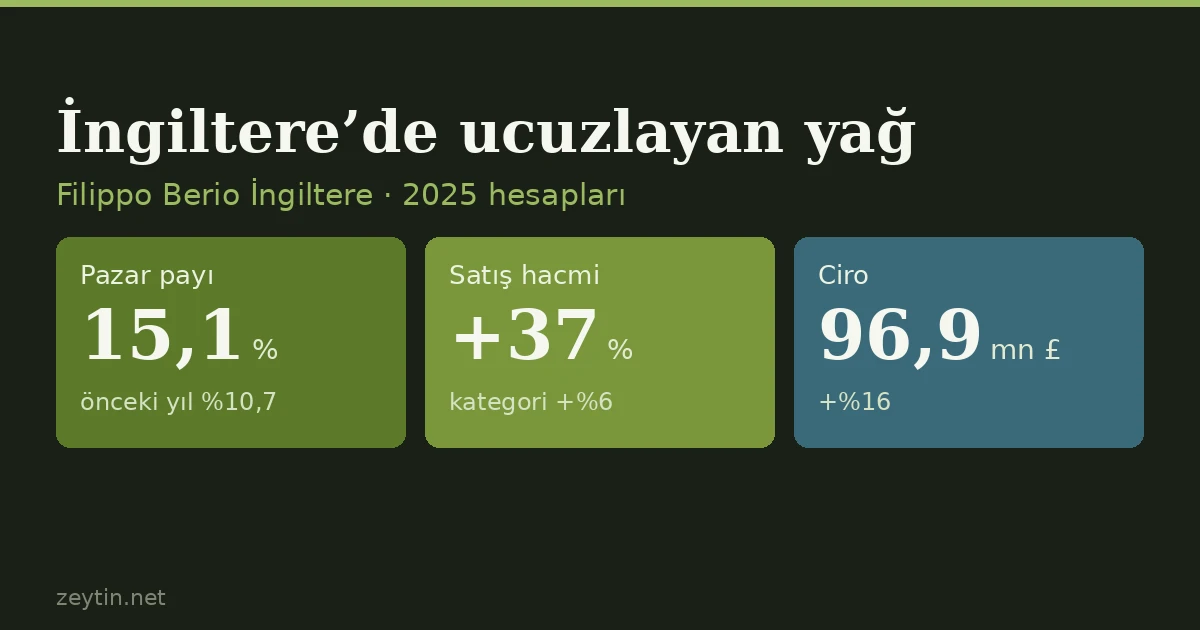
The 2025 accounts of Filippo Berio's UK company show how falling prices reached the shelf: volumes up 37%, revenue up 16%, market share from 10.7% to 15.1%. The category grew 6% and lower wholesale costs were passed on to shoppers.
Article
Olive oil got cheaper in the UK and Filippo Berio lifted its share to 15%
The 2025 accounts of Filippo Berio's UK company show how falling prices reached the shelf: volumes up 37%, revenue up 16%, market share from 10.7% to 15.1%. The category grew 6% and lower wholesale costs were passed on to shoppers.
 Article
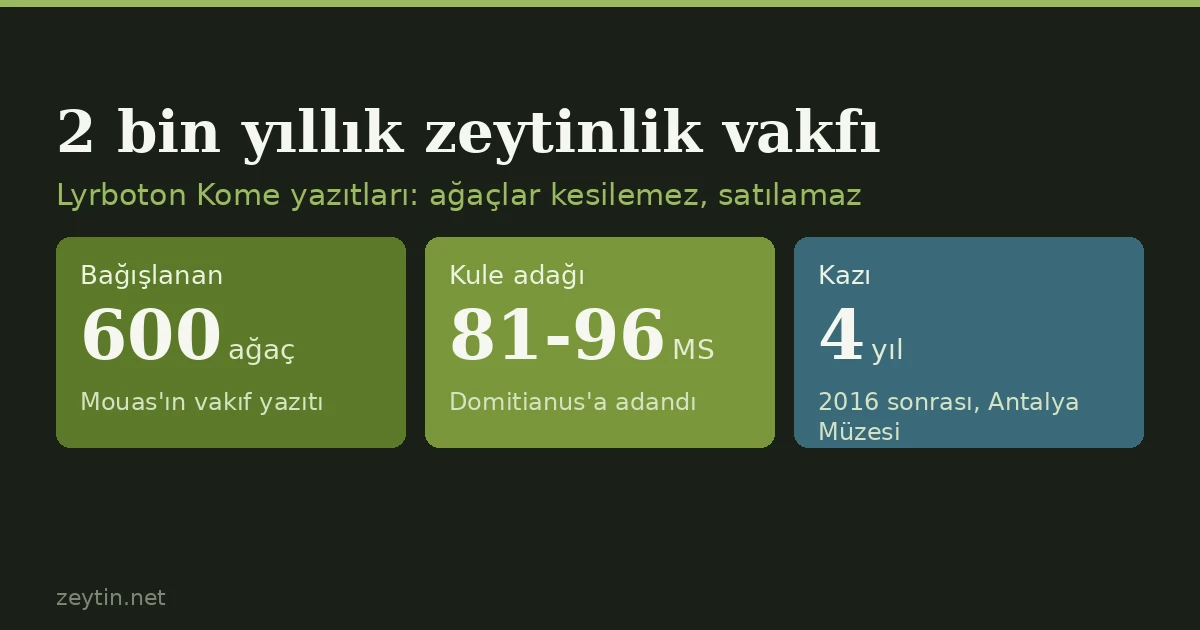
A 2,000-year-old olive grove endowment in Antalya: 600 trees, “never to be cut or sold”
The excavation results from Lyrboton Kome in Antalya have been presented. Inscriptions record a family endowing its farm and 600 olive trees in perpetuity, with an explicit clause: these trees can never be cut, sold or put to another use.
Article
A 2,000-year-old olive grove endowment in Antalya: 600 trees, “never to be cut or sold”
The excavation results from Lyrboton Kome in Antalya have been presented. Inscriptions record a family endowing its farm and 600 olive trees in perpetuity, with an explicit clause: these trees can never be cut, sold or put to another use.