Edremit's ETOLAB tasting panel wins ISO 17025 accreditation: why the report matters in the US
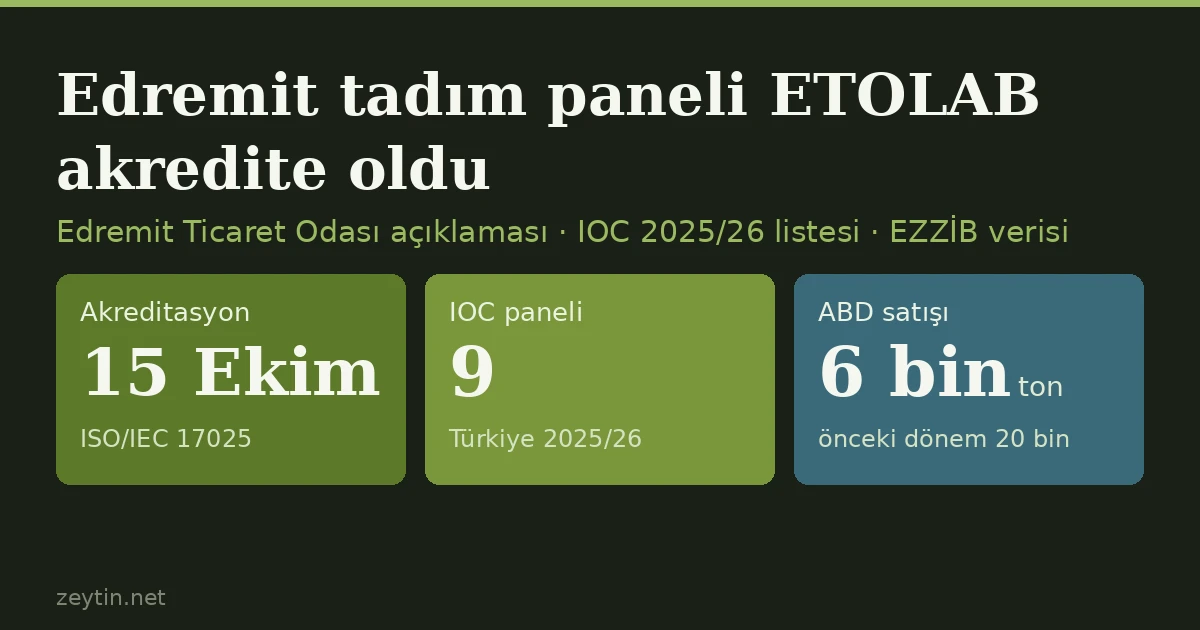
ETOLAB, the olive oil sensory analysis laboratory of the Edremit Chamber of Commerce, completed ISO/IEC 17025 accreditation on 15 October 2026. The panel is one of nine Turkish panels on the International Olive Council's 2025/26 list. The chamber says accredited reports will help Edremit and Havran producers sell to the United States, where Turkish olive oil sales fell from 20,000 to 6,000 tonnes this season.
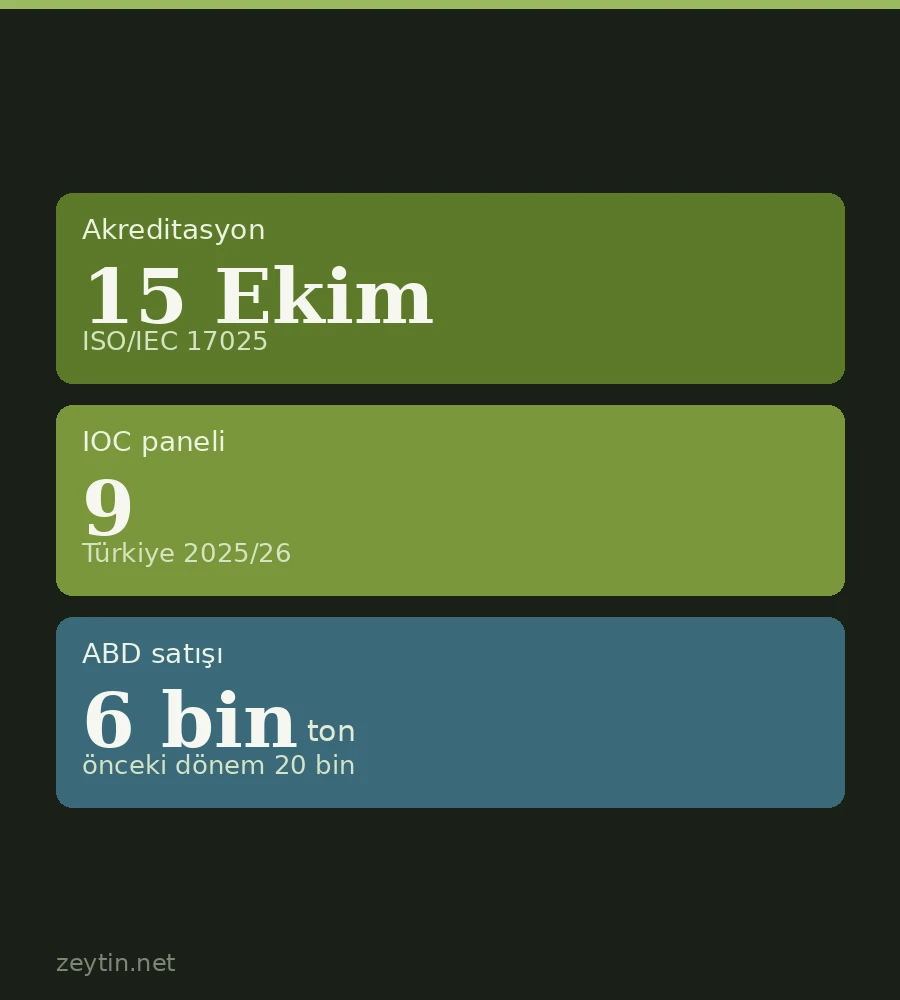
ETOLAB, the olive oil sensory analysis laboratory run by the Edremit Chamber of Commerce in western Türkiye, has been accredited to the ISO/IEC 17025 standard. According to the chamber's announcement, the process was completed on 15 October 2026. The accreditation was granted by a body that is a signatory to the mutual recognition arrangement of the International Laboratory Accreditation Cooperation (ILAC). The chamber's president, Ahmet Çetin, said ETOLAB is the fifth laboratory in Türkiye to hold accreditation in this field and that the preparation took about eight years.
At first sight this looks like a certificate ceremony. In practice it touches one of the two gates that decide what grade an olive oil can be sold under. Chemistry is one gate; the tasting panel is the other. The question is how far a panel report written in Edremit will carry once the oil leaves the country.
What the laboratory measures
ETOLAB does not run chemical tests. It scores the aroma and taste of an oil with a trained panel. For an oil to qualify as extra virgin, it has to pass the chemical limits on free acidity, peroxide value and the rest, and the panel has to return a median of defects of zero and a median of fruitiness above zero. Türkiye's food code, the Olive Oil and Olive-Pomace Oil Communiqué, sets out this test in its Annex 2. It also says that taste and aroma terms on a label may only be used on the basis of a panel test (the communiqué, article by article). We have covered the defects and positive attributes a panel scores in our guide to olive oil tasting.
The chamber says the panel works with 12 tasters under panel leader Zülal Taçar. The laboratory's own website states that samples from firms wishing to use the Edremit Olive Oil geographical indication are assessed there, and that the chamber issues a hologram to those that qualify. The registration document for the indication puts numbers on the sensory profile; bitterness and pungency, for example, must stay below an intensity of 4.0 (the Edremit Olive Oil registration). The panel's verdict, in other words, ends up on the label of a protected regional product.
The verdict is also tied to money. On the commodity exchange, olive oil trades in separate lines by grade. At the Edremit Commodity Exchange, the first extra virgin trades of the new season cleared at a daily average of 273.60 lira per kilogram on 12 October (13,240 kg) and 330.00 lira on 19 October (6,215 kg). Oil sold as extra virgin has to meet that grade when it is checked; an oil in which the panel detects a defect drops a class.
IOC recognition and accreditation are not the same thing
ETOLAB was already on the International Olive Council's list of recognised sensory panels. The IOC list for the period 1 December 2025 to 30 November 2026 names nine sensory analysis laboratories in Türkiye:
| Institution | Location | Type |
|---|---|---|
| National Olive and Olive Oil Council of Türkiye (UZZK) | Bornova | sector body |
| Olive Research Institute | Bornova | Ministry of Agriculture and Forestry |
| Central Research Institute of Food and Feed Control | Bursa | Ministry of Agriculture and Forestry |
| Ayvalık Chamber of Commerce | Ayvalık | chamber |
| Edremit Chamber of Commerce (ETOLAB) | Edremit | chamber |
| Aydın Commodity Exchange | Efeler | exchange |
| Muğla Commodity Exchange | Menteşe | exchange |
| Kristal | Bornova | private company |
| Zeytindostu Association | Alsancak | association |
Four of the nine are run by a chamber of commerce or a commodity exchange. They sit in the districts where the oil is made, inside the institutions the producers belong to. The IOC list is renewed every year. According to the chamber, ETOLAB has stayed on it for four years by passing the IOC's proficiency tests.
ISO/IEC 17025 answers a different question. Under it, an independent accreditation body audits the laboratory's methods, record keeping, staff competence and impartiality. Because accreditations granted by ILAC signatories are treated as equivalent to one another, the resulting report becomes a document that is recognised in other countries too. That is where Çetin's emphasis on the United States comes from. According to the chamber, American importers prefer suppliers that bring reports from laboratories recognised by their own accreditation system.
The view from the United States
There is no mandatory federal rule in the United States on olive oil grades. The grade standards of the US Department of Agriculture (USDA), in force since 2010, are voluntary. For "U.S. Extra Virgin" they require a sensory assessment as well as chemical criteria, and their methods are very close to the IOC's. With no legal obligation in place, proof of quality is something the buyer asks for. An accredited report does its job in that negotiation, as a document the buyer can rely on.
The weight of such a document comes from the size of the market, and the market is shrinking. According to the Aegean Olive and Olive Oil Exporters' Association, Turkish olive oil sales to the United States fell from 20,000 tonnes to 6,000 tonnes in the period from 1 November 2025 to 31 August 2026, compared with the same period a season earlier (the export data). The 12.5% additional tariff applied to Turkish olive products is still in place (the tariff and the competition). An accredited tasting report does not remove that tariff and does not close the price gap with competitors. Its effect is limited to removing one missing document on the way to a sale.
For Edremit, the US angle has a specific shape. The Gulf of Edremit makes a delicate oil from the Ayvalık variety, and the geographical indication is one of the ways producers there set their oil apart from bulk oil. A regional label only works abroad if the buyer trusts the paperwork behind it. Until now, a firm in Edremit could get an IOC-recognised panel report locally; it can now get one from a panel whose quality system has also been audited under an internationally recognised standard.
What is still unknown
The announcement does not give the scope of the accreditation in detail. It is not clear whether it covers only the sensory analysis of virgin olive oils or other methods as well. The name of the accreditation body also appears under different abbreviations in press reports. The announcement does not list the other four accredited sensory laboratories in Türkiye either. Once the scope document is published, it will become clear for which products, and under which method, accredited reports can be issued.
As milling for the new season begins around the Gulf of Edremit, the practical result for local businesses is this: the tasting report used in geographical indication checks can now come from the same panel as an accredited report that a foreign buyer may ask for.
One rating per visitor; you can change yours at any time. Ratings are real reader votes — no seeded or default scores.
Related
 Article
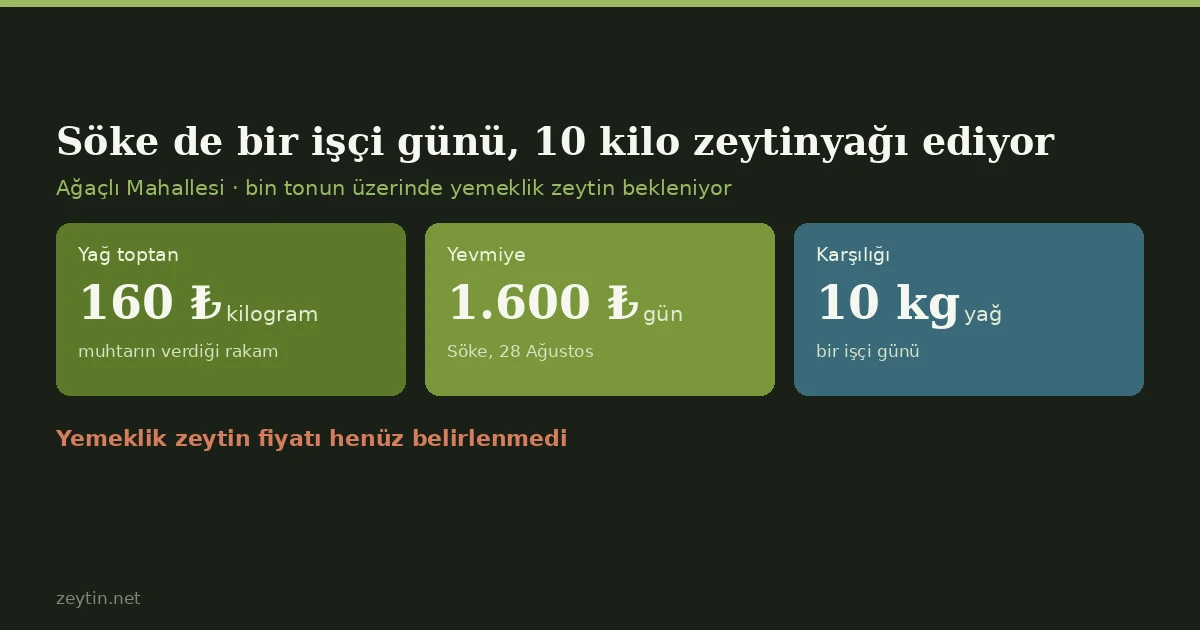
In Söke, one day's wage costs ten kilos of olive oil
Over 1,000 tonnes of table olives are expected in Söke's Ağaçlı. Two figures given by the headman sum up the season: oil at 160 lira wholesale, a day's wage at 1,600.
 Article
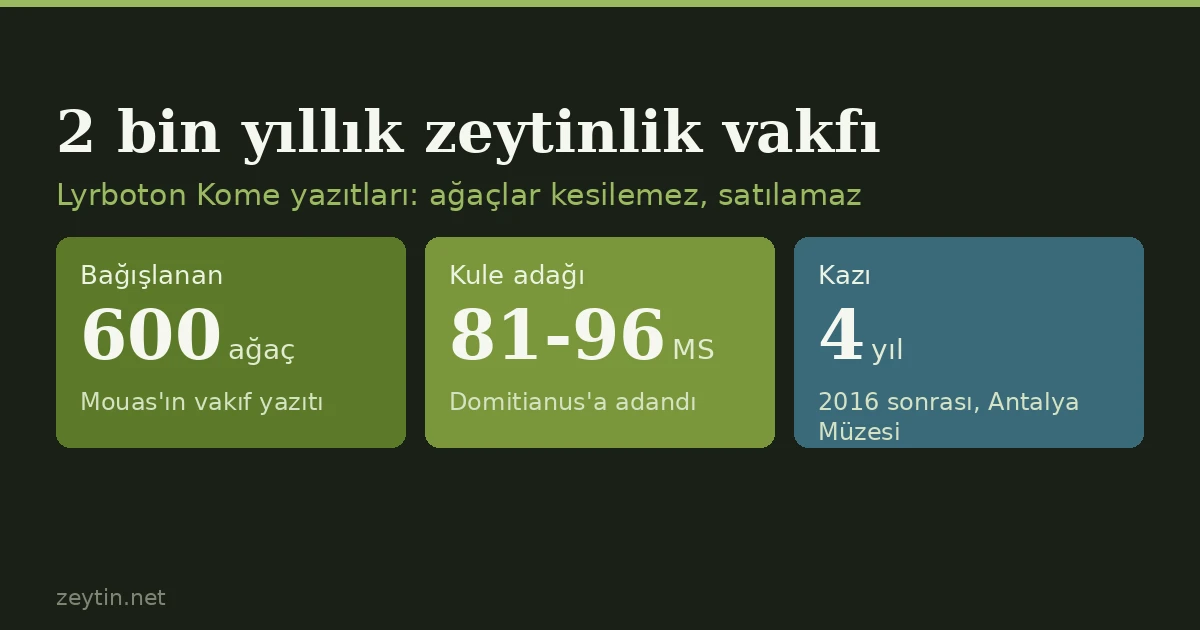
A 2,000-year-old olive grove endowment in Antalya: 600 trees, “never to be cut or sold”
The excavation results from Lyrboton Kome in Antalya have been presented. Inscriptions record a family endowing its farm and 600 olive trees in perpetuity, with an explicit clause: these trees can never be cut, sold or put to another use.
 Article
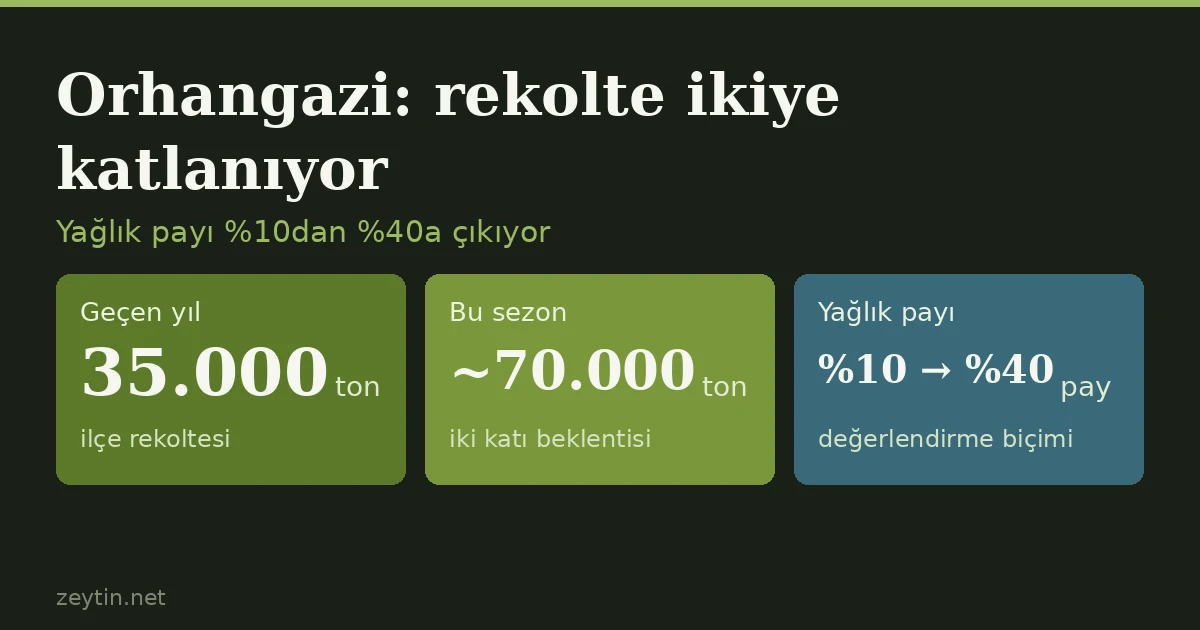
Orhangazi's crop is doubling: the oil olive share climbs from 10% to 40%
According to figures from the Orhangazi District Directorate of Agriculture and Forestry, last season's crop of roughly 35,000 tonnes could double this year. But in Türkiye's table olive heartland the real shift is in the split: the share pressed for oil is expected to rise from 10% to 40%. Mills are already in maintenance, and the grower's income now depends on fruit size.
 Article
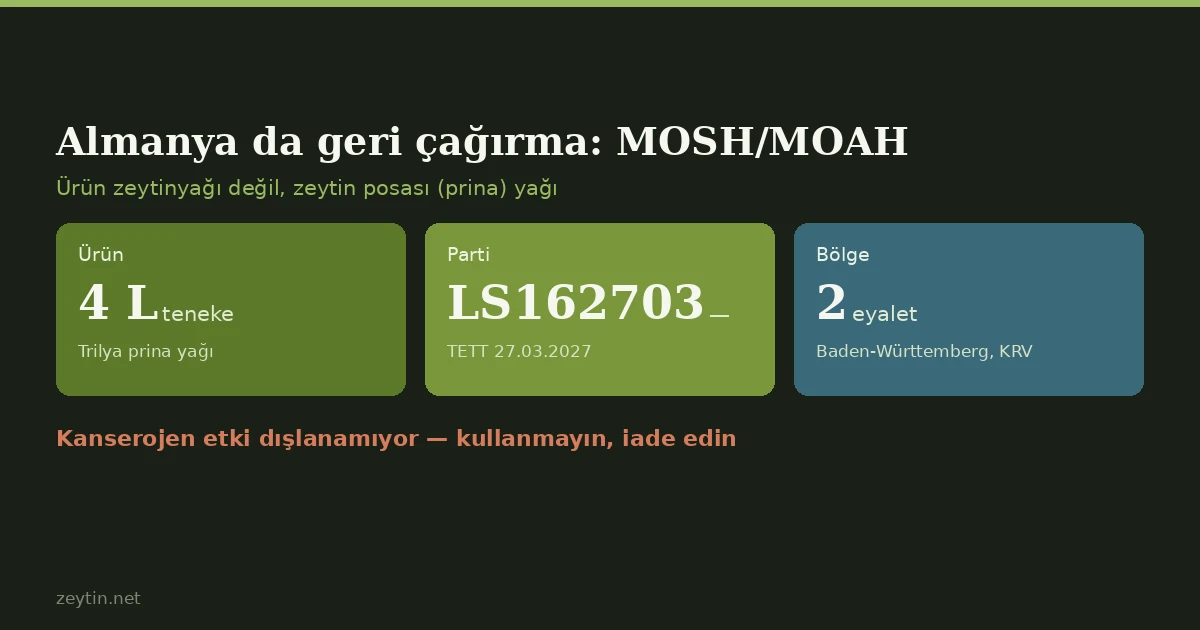
Recall in Germany: MOSH/MOAH in pomace oil — not olive oil
Germany's official food safety portal has recalled a 4-litre pomace oil sold in Turkish shops. The product is not olive oil but olive pomace oil; we explain the difference and what MOSH/MOAH are.