Sieves shut until 16 October in Akhisar: the table-olive price protest spreads to a second basin
In Akhisar's Zeytinliova neighbourhood, growers and commission agents have shut their sieves and halted harvesting and sales until Friday 16 October; purchases also stopped in Ballıca and Bünyaniosmaniye. In Ataeymir, in Aydın's Karacasu district, buying was suspended for three days from 8 October. Türkiye has no state floor price for table olives, and the cooperative union treated as the reference has not yet announced its 2026/27 purchase prices.
Türkiye's table-olive harvest has opened with a price protest in a season of heavy crop. In the Zeytinliova neighbourhood of Akhisar, growers and commission agents shut their sieves on 10 October and halted harvesting and selling until Friday 16 October. Purchases were reported stopped the same day in the neighbourhoods of Ballıca and Bünyaniosmaniye. Two days earlier, on 8 October, growers in Ataeymir, in Aydın's Karacasu district, had suspended buying for three days by joint decision.
Where the decisions were taken
| Place | Decision | Duration |
|---|---|---|
| Zeytinliova · Akhisar | Sieves closed, harvest and sales halted | until 16 October |
| Ballıca · Akhisar | Purchases halted | not stated |
| Bünyaniosmaniye · Akhisar | Purchases halted | not stated |
| Ataeymir · Karacasu, Aydın | Purchases halted | 3 days from 8 October |
The headman of Zeytinliova, Gülten Demir, says buying stopped because prices are too low and that nobody will pick olives for a week. The headman of Ballıca, Muhammet Dönmez, and the chairman of the Akhisar Headmen's Association, İhsan Gümüş, joined the decision; the statement to the press was made in Zeytinliova on the afternoon of 10 October.
Which price is being argued over
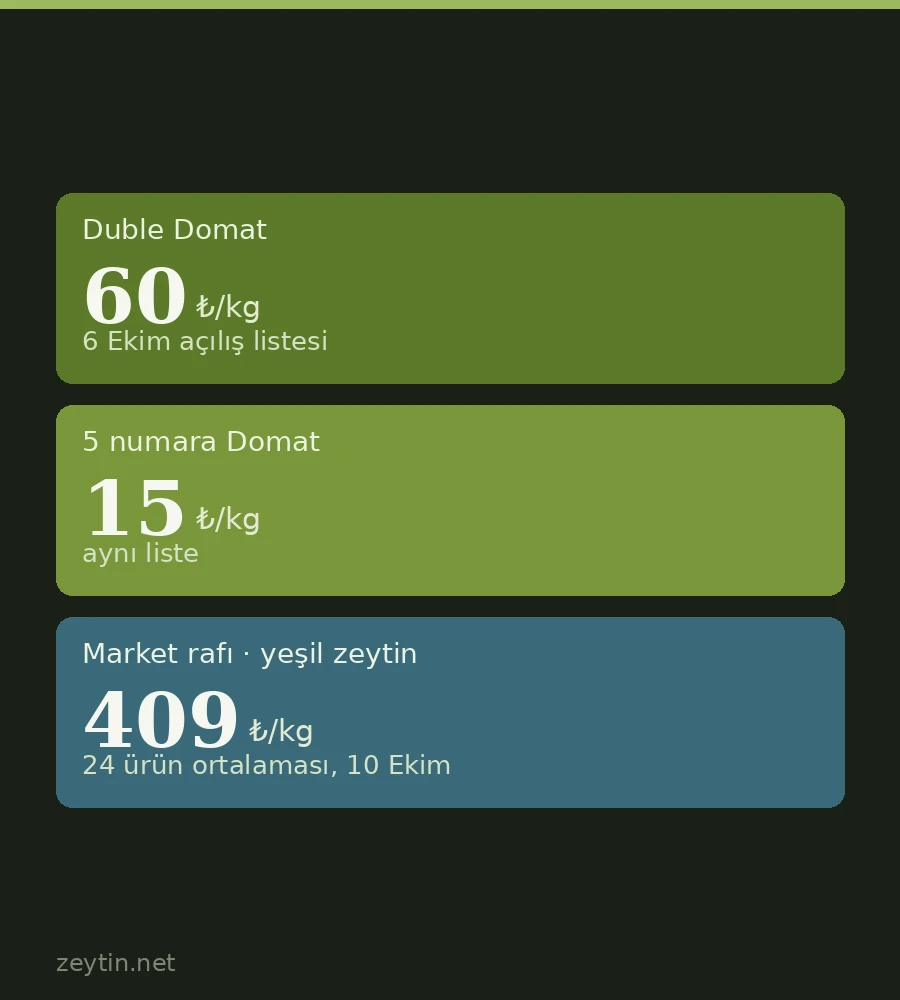
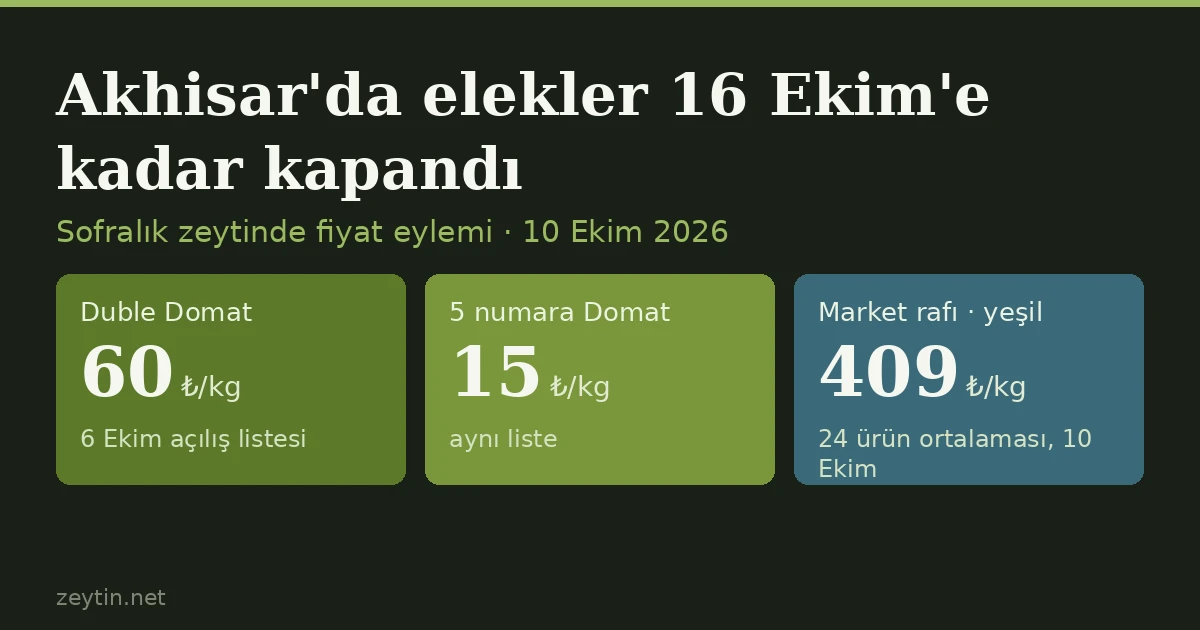
The measured figure on record here is the opening list published in Akhisar on 6 October: for Domat olives, 60 lira for double, 50 for grade 1, 40 for grade 2, 35 for grade 3, 25 for grade 4, 15 for grade 5, and 10 lira for fruit diverted to milling.
The picture described by the growers behind the protest points below that list. According to Demir, the season opened at 70-80 lira, fell to 45, and is now being discussed at an average of 20-30 lira; after expenses, she says, the grower is left with 5-7 lira a kilo. ⚠ These are growers' statements, not a published purchase list. Much of the difference comes from size class: which calibre the fruit from a given grove falls into can change the price per kilo by up to fourfold.
The list posted in Karacasu read, by variety: Domat 15-60, Memecik 15-35, donkey olive 15-40, and kaba olive 10-35 lira. The ceiling and the floor match Akhisar's opening list, which means the price level under discussion in the two basins is close.
What the cost side shows
According to the Turkish Statistical Institute's Agricultural Input Price Index, input prices rose 27.62% year on year in July, while the Agricultural Producer Price Index was up 21.91% in August. The gap of roughly six points between the two indices shows that the grower's costs are rising faster than the price of the product.
In Karacasu, growers put their cost at 104 lira a kilo. ⚠ That is a grower's statement; this site holds no cost measurement corresponding to it, and the per-kilo cost of table olives varies across a wide range with grove yield, irrigation and the local labour rate. What can be said with measured figures is narrower: a calibre price of 15 lira barely covers harvest labour under any cost calculation. That is where the warning that "tonnes of olives will be left on the branch" comes from.
The distance between grove and shelf
In this site's retail measurement, as of 10 October the shelf price of green table olives ranged from 194 to 1,470 lira a kilo across 24 products, averaging 409 lira. In the same days, grade 5 Domat was finding buyers at 15 lira in the grove and double Domat at 60.
⚠ These are not two prices for the same good: brining, loss, sorting, packaging, cold chain, distribution and tax all sit in between. Even so, the size of the gap explains why the protest has moved from an argument about calibres to an argument about the chain.
Is there such a thing as a floor price
Türkiye has no state-declared floor price for table olives, and the product is not covered by intervention buying. The de facto reference is the purchase price set by the cooperative union in the Marmara basin. For the 2025/26 season the union announced a table-olive ceiling of 160 lira (18 count), a floor of 55 lira (41 count) and 53 lira for milling fruit. No purchase price announcement for 2026/27 had been made as of the morning of 11 October; meanwhile crop declarations are still being collected.
Tarım-Sen, the agricultural workers' union, wants the government to set a floor price urgently and to provide a per-unit subsidy. On the subsidy side, this season's support paid for olives in Manisa sits in the same frame as the province's tree count rising by 8 million in three years: capacity is growing while the depth of the buying side is not keeping pace.
Exchange registrations show how much the basin matters. At the Edremit Commodity Exchange on 7 October, special-grade green olives were registered at 140 lira a kilo over 3,571 kilograms. That is a price formed in a large calibre and a different basin, so it cannot be compared directly with the Akhisar calibre table — but it does show how decisive size and region are in the price.
What the protest's leverage depends on
Shutting the sieves does not remove supply; it delays it. The harvest window in Domat is narrow: as the fruit ripens, the risk of dropping out of the table class rises and its suitability for brine changes. At the end of a week, the crop will come back in front of the same group of buyers. The effect on price will therefore depend on the buying side — the union, the traders and the stuffing industry — and on how full their warehouses are and how much cash they hold.
The same week brought a similar picture in Europe's largest oil producer: Italy's producer price has halved in a year, and growers in Puglia have given the government until noon on 12 October. What the two countries have in common is a heavy crop landing in the same season as a jump in costs.
When the sieves reopen on 16 October, the direction of the price is expected to be set jointly by the purchase price the cooperative union announces and by the supply that loads onto the market as the harvest accelerates.
One rating per visitor; you can change yours at any time. Ratings are real reader votes — no seeded or default scores.
Related
 Article
Skilled operators for olive mills: training ends in Milas, Muğla trains women operators
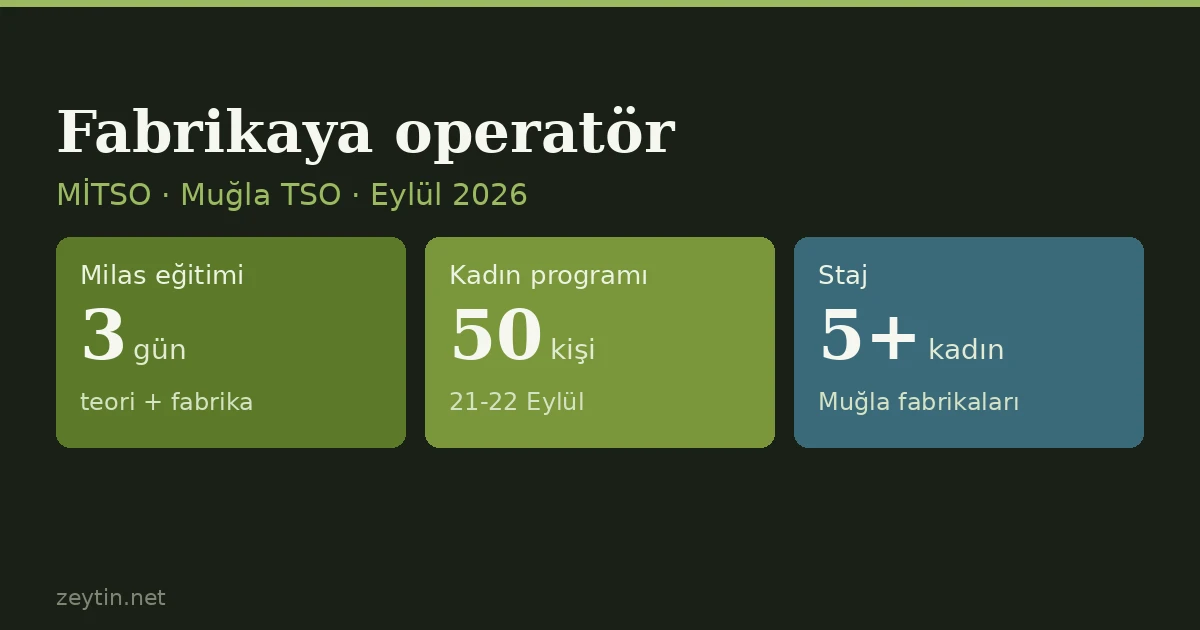
Ahead of the harvest, two training programmes in Muğla focus on operators, the most critical link in olive mills. A three-day operator course run by MİTSO, Milas Tariş and HAUS Makine has ended in Milas, and the Muğla Chamber of Commerce and Industry is launching a 50-place "Women's Hands in Industry" programme to train women as mill operators.
Article
Skilled operators for olive mills: training ends in Milas, Muğla trains women operators
Ahead of the harvest, two training programmes in Muğla focus on operators, the most critical link in olive mills. A three-day operator course run by MİTSO, Milas Tariş and HAUS Makine has ended in Milas, and the Muğla Chamber of Commerce and Industry is launching a 50-place "Women's Hands in Industry" programme to train women as mill operators.
 Article
Orhangazi olive oil starts on the road to geographical indication, with samples to be tested for acidity and polyphenols
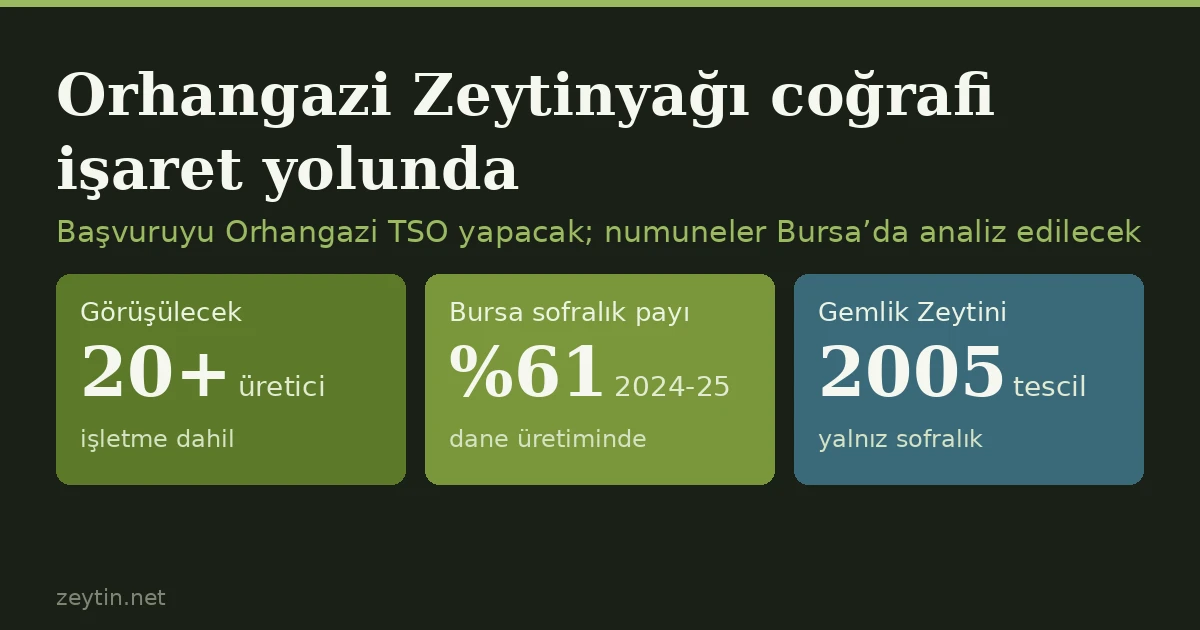
The Orhangazi Chamber of Commerce and Industry has begun preparing a geographical indication application for "Orhangazi Olive Oil". More than 20 producers will be consulted, samples tested in Bursa and the influence of the Lake İznik basin studied. The area's Gemlik Olive registration covers only table olives.
Article
Orhangazi olive oil starts on the road to geographical indication, with samples to be tested for acidity and polyphenols
The Orhangazi Chamber of Commerce and Industry has begun preparing a geographical indication application for "Orhangazi Olive Oil". More than 20 producers will be consulted, samples tested in Bursa and the influence of the Lake İznik basin studied. The area's Gemlik Olive registration covers only table olives.
 Article
The world's largest bottler is for sale: a €500 million race for Deoleo
Deoleo, owner of Bertolli and Carbonell, holds 22% of global bottled olive oil sales. Italy's Coricelli leads at €500 million, Spain's Dcoop cooperative at €470 million. The Spanish government regards the company as nationally strategic. Because Deoleo is a major bulk buyer, the outcome matters to Turkish exporters too.
Article
The world's largest bottler is for sale: a €500 million race for Deoleo
Deoleo, owner of Bertolli and Carbonell, holds 22% of global bottled olive oil sales. Italy's Coricelli leads at €500 million, Spain's Dcoop cooperative at €470 million. The Spanish government regards the company as nationally strategic. Because Deoleo is a major bulk buyer, the outcome matters to Turkish exporters too.
 Article
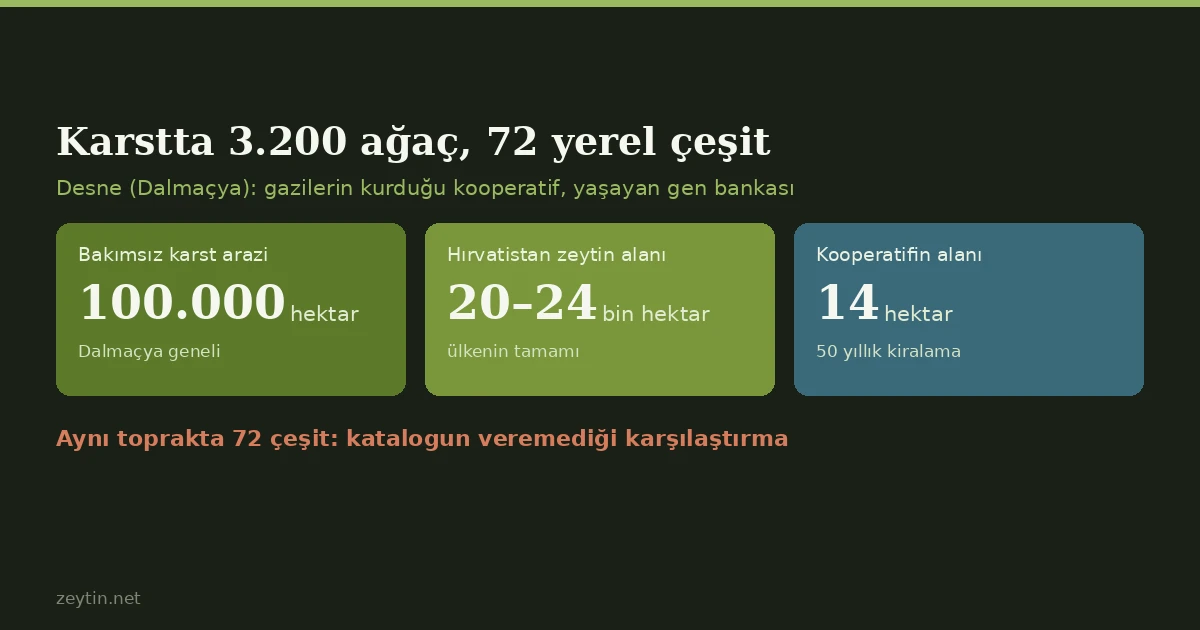
3,200 trees and 72 varieties on 14 hectares of stone: the cooperative turning Dalmatian karst into groves
Some 100,000 hectares of karst lie neglected in Dalmatia while all of Croatia has 20,000–24,000 hectares under olives. In Desne a veterans' cooperative has grown 3,200 trees of 72 native varieties on 14 hectares of rock — a grove that doubles as a natural laboratory for climate resilience.
Article
3,200 trees and 72 varieties on 14 hectares of stone: the cooperative turning Dalmatian karst into groves
Some 100,000 hectares of karst lie neglected in Dalmatia while all of Croatia has 20,000–24,000 hectares under olives. In Desne a veterans' cooperative has grown 3,200 trees of 72 native varieties on 14 hectares of rock — a grove that doubles as a natural laboratory for climate resilience.