"Not definitive until November": Andalusian growers push back on the crop estimate
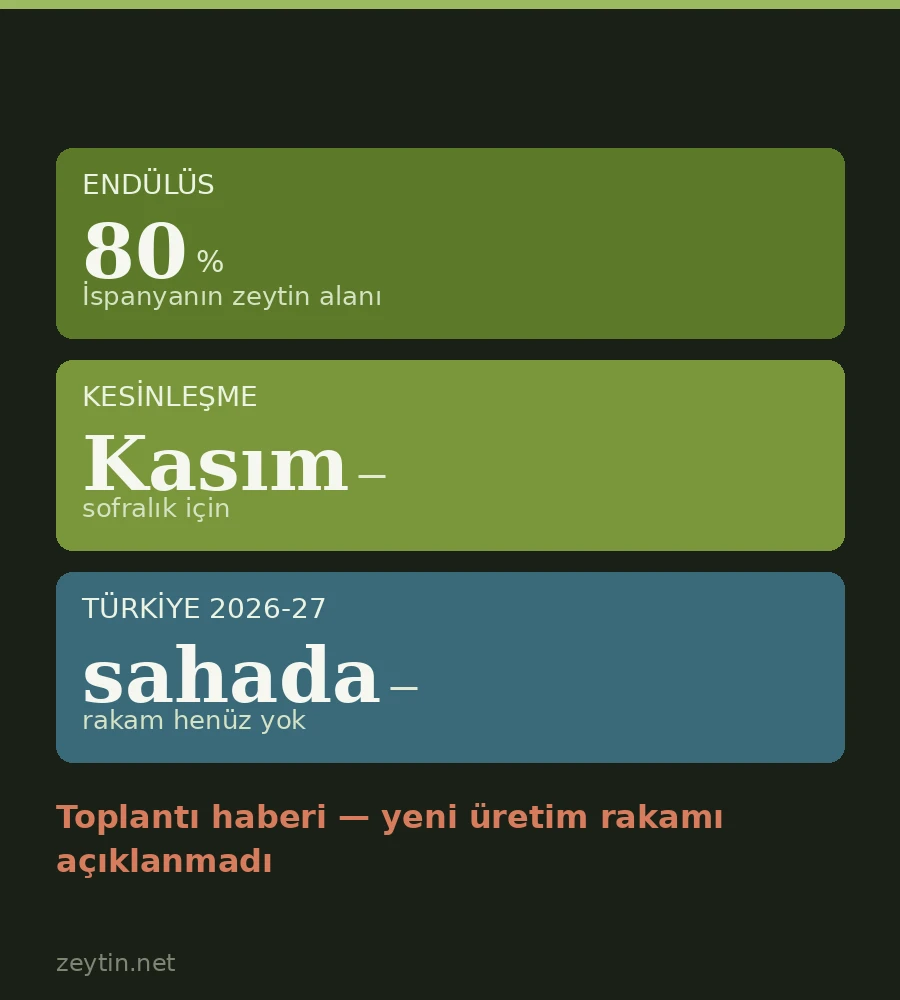
Andalusia's agriculture ministry called its first crop estimate "high production"; cooperatives and COAG in Seville objected: recent heat will affect the crop and the estimate is not definitive until November. Türkiye is making its 2026-27 estimate in the field the same week — the same caution applies here.
Türkiye's 2026-27 crop estimate is being made in the field right now: commissions began work in Manisa's 17 districts on 3 September. In the same week, growers in Spain publicly pushed back against their own ministry's estimate — and the reason they gave applies here too.
What happened
On 4 September the 8th BusinessAGRO Olive Industry Roundtable met in La Puebla de Cazalla, Seville. Consolación Vera Sánchez, Andalusia's Deputy Minister of Agriculture, said initial crop estimates pointed to high production and that the regional government was optimistic about the season.
Two grower organisations in the same room disagreed:
- Cooperativas Agro-alimentarias de Sevilla and COAG Sevilla said the high temperatures of recent days would certainly affect production.
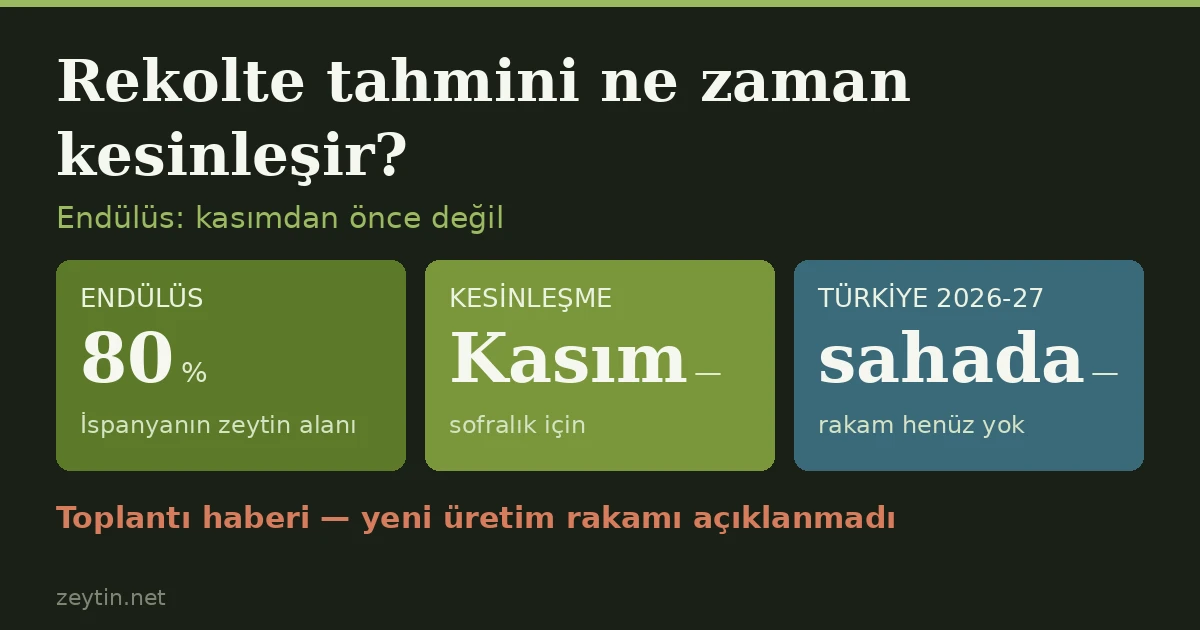
- Cooperative president Gabriel Cabello López set a precise standard: "caution is needed when considering these crop estimates, which will not be definitive — at least for table olives — until November."
- Francisco Manuel Fernández Pérez, COAG's national representative for table olives, advised growers to wait until the heatwave passes.
For scale: Andalusia holds 80% of Spain's olive-growing area, and Seville is Andalusia's table-olive centre. This is not an argument at the margins — it is at the heart of the world's largest producer.
The real question: when does an estimate become a figure?
The disagreement is not about optimism versus pessimism. It is about the calendar. A crop estimate is made before harvest, and everything that grows or shrinks the fruit between then and harvest moves the number. A heatwave is the harshest of those: it reduces fruit size, shifts oil content and damages table-grade quality.
Cabello López's "November" is not arbitrary. Table olives are picked in September and October; until the harvest is in the crates, no estimate is final. For oil olives that date is later still.
⚠ This does not make estimates useless. An estimate is a planning instrument: processors reserve capacity, exporters prepare contracts, growers hire labour. But it is not realised output, and presenting it as such misleads.
What it means for Türkiye
Every provincial and national production figure on this site is UZZK's season-based crop estimate — not TurkStat's calendar-year realised output. We give that distinction with its source on the olive page, and the note under the table says: a pre-harvest estimate, not realised output.
For 2026-27 there is no figure yet. The fieldwork in Manisa is what will produce it. When it arrives it deserves the same caution:
- The figure will rest on observations made in early September.
- Türkiye carries heat risk too; September heat in the Aegean and Marmara affects fruit development.
- The alternate-bearing rhythm suggests 2026-27 should be an on year — but as we wrote in the opposite-phase piece, that is an inference, not a published forecast.
What the Andalusian cooperative said is this site's long-standing point in Spanish: just as mistaking exchange volume for the harvest misleads, so does mistaking an early estimate for realised output.
And note where the objection comes from
The detail worth noticing is the direction of the objection. Grower organisations usually want the crop shown as small — a low crop expectation lifts prices. Here it runs the other way: the ministry says "high production" and the growers say "not so fast."
There is a commercial reading. A high crop estimate announced early pulls prices down from the start. If "there is plenty" is said before the season opens, buyers wait and growers lose bargaining power. Even if the figure is later revised down, the price expectation has already formed.
The same mechanism works here. Our piece on Andalusia's objection to North African imports showed a similar structure: both the figure and the timing of its release are instruments in the market.
Reading with care
⚠ This is a conference report; no new production figure was published. The numerical value of Andalusia's initial estimate is not given in this source.
⚠ "Not definitive until November" was said about table olives. Oil olives run on a different calendar.
⚠ The effect of the heat is a claim here, not a measurement. Its size will only be visible after harvest.
One rating per visitor; you can change yours at any time. Ratings are real reader votes — no seeded or default scores.
Related
 Article
The official olive figure is measured in the grove: Türkiye's 2026 crop survey is under way
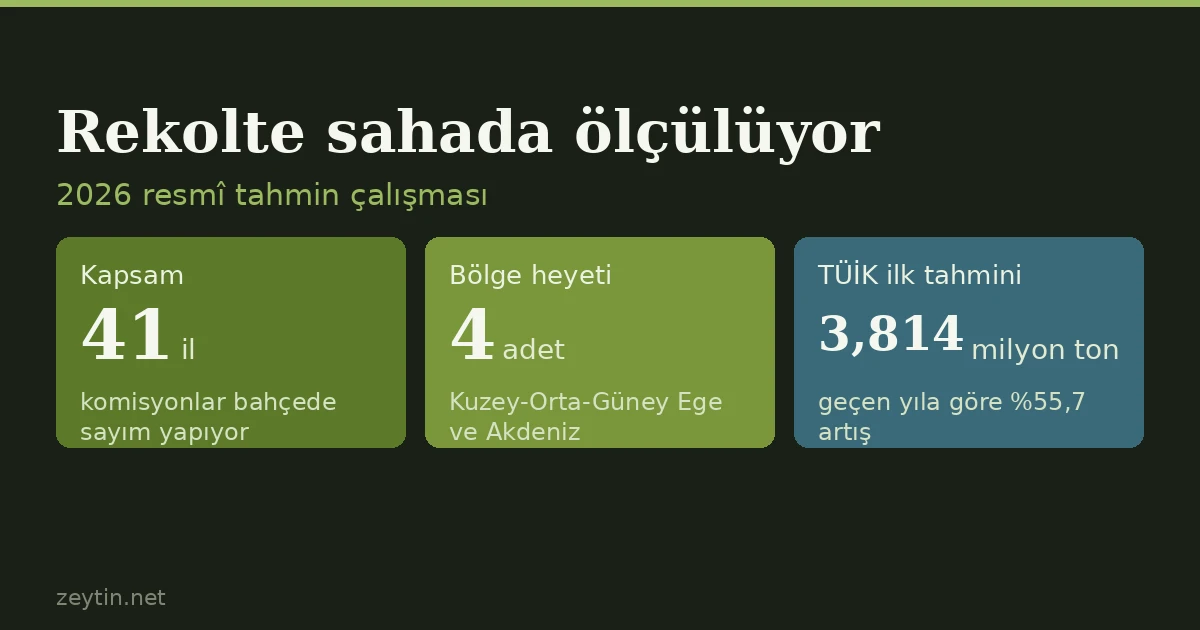
Türkiye's official olive crop figure is not produced at a desk. It comes from agricultural engineers counting fruit load tree by tree. A provincial crop estimation commission met in Denizli this week while field inspections continue in the districts. The national figure is assembled by an official delegation coordinated by the National Olive and Olive Oil Council across 41 provinces, and last season it was announced on 24 October.
Article
The official olive figure is measured in the grove: Türkiye's 2026 crop survey is under way
Türkiye's official olive crop figure is not produced at a desk. It comes from agricultural engineers counting fruit load tree by tree. A provincial crop estimation commission met in Denizli this week while field inspections continue in the districts. The national figure is assembled by an official delegation coordinated by the National Olive and Olive Oil Council across 41 provinces, and last season it was announced on 24 October.
 Article
17th Advanced Course in Olive Growing opens in Córdoba as the IOC and IFAPA move towards genetic resources cooperation
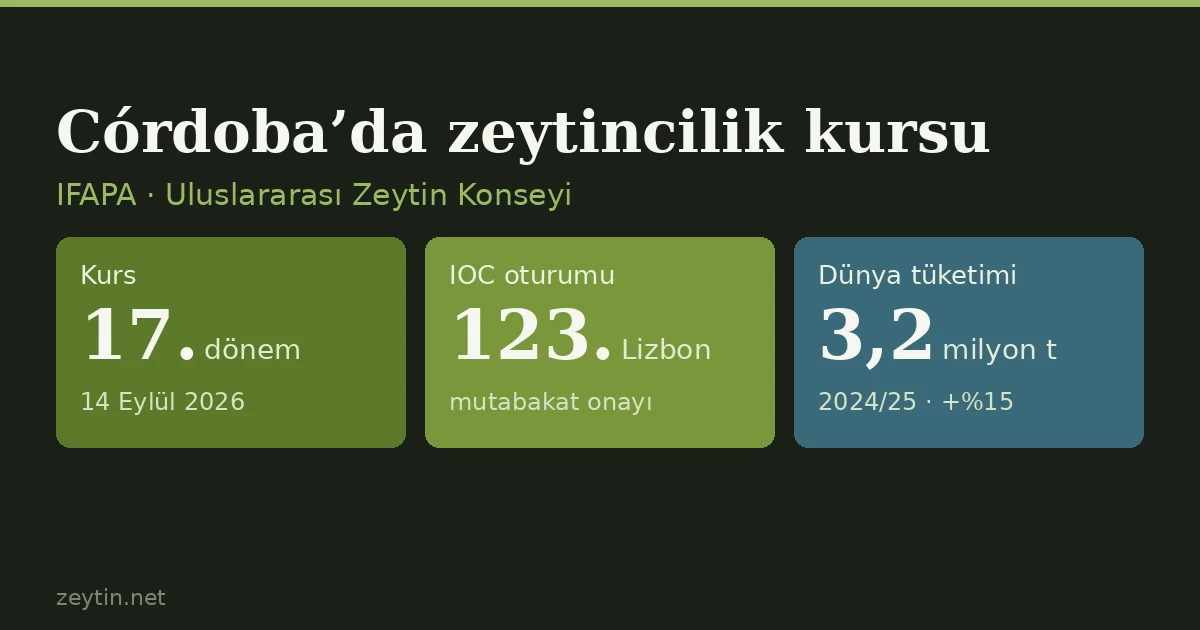
Andalusia's Institute of Agricultural and Fisheries Research and Training (IFAPA) opened its 17th Advanced Specialisation Course in Olive Growing in Córdoba on 14 September, with the International Olive Council giving the opening lecture. The Council has approved signing a memorandum of understanding with IFAPA, which hosts one of the world's key olive germplasm collections.
Article
17th Advanced Course in Olive Growing opens in Córdoba as the IOC and IFAPA move towards genetic resources cooperation
Andalusia's Institute of Agricultural and Fisheries Research and Training (IFAPA) opened its 17th Advanced Specialisation Course in Olive Growing in Córdoba on 14 September, with the International Olive Council giving the opening lecture. The Council has approved signing a memorandum of understanding with IFAPA, which hosts one of the world's key olive germplasm collections.
 Article
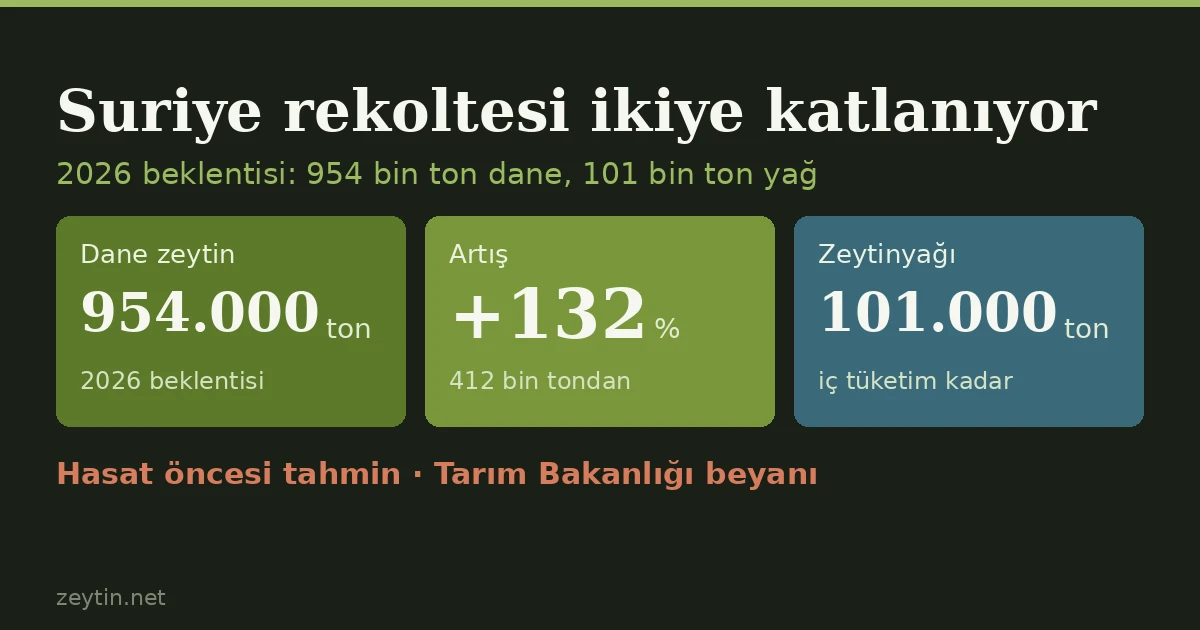
Syria's crop doubles to 954,000 tonnes — and the oil still only feeds itself
Syria's Ministry of Agriculture expects 954,000 tonnes of olives in 2026, up from 412,000 last season. The 101,000 tonnes of oil that implies barely covers domestic consumption — a doubled crop that still produces no export surplus.
Article
Syria's crop doubles to 954,000 tonnes — and the oil still only feeds itself
Syria's Ministry of Agriculture expects 954,000 tonnes of olives in 2026, up from 412,000 last season. The 101,000 tonnes of oil that implies barely covers domestic consumption — a doubled crop that still produces no export surplus.
 Article
The world's largest bottler is for sale: a €500 million race for Deoleo
Deoleo, owner of Bertolli and Carbonell, holds 22% of global bottled olive oil sales. Italy's Coricelli leads at €500 million, Spain's Dcoop cooperative at €470 million. The Spanish government regards the company as nationally strategic. Because Deoleo is a major bulk buyer, the outcome matters to Turkish exporters too.
Article
The world's largest bottler is for sale: a €500 million race for Deoleo
Deoleo, owner of Bertolli and Carbonell, holds 22% of global bottled olive oil sales. Italy's Coricelli leads at €500 million, Spain's Dcoop cooperative at €470 million. The Spanish government regards the company as nationally strategic. Because Deoleo is a major bulk buyer, the outcome matters to Turkish exporters too.