Tunisian banks lent 3.3 billion dinars to the olive oil season; the 2027 draft budget earmarks bulk export duties for a sector fund
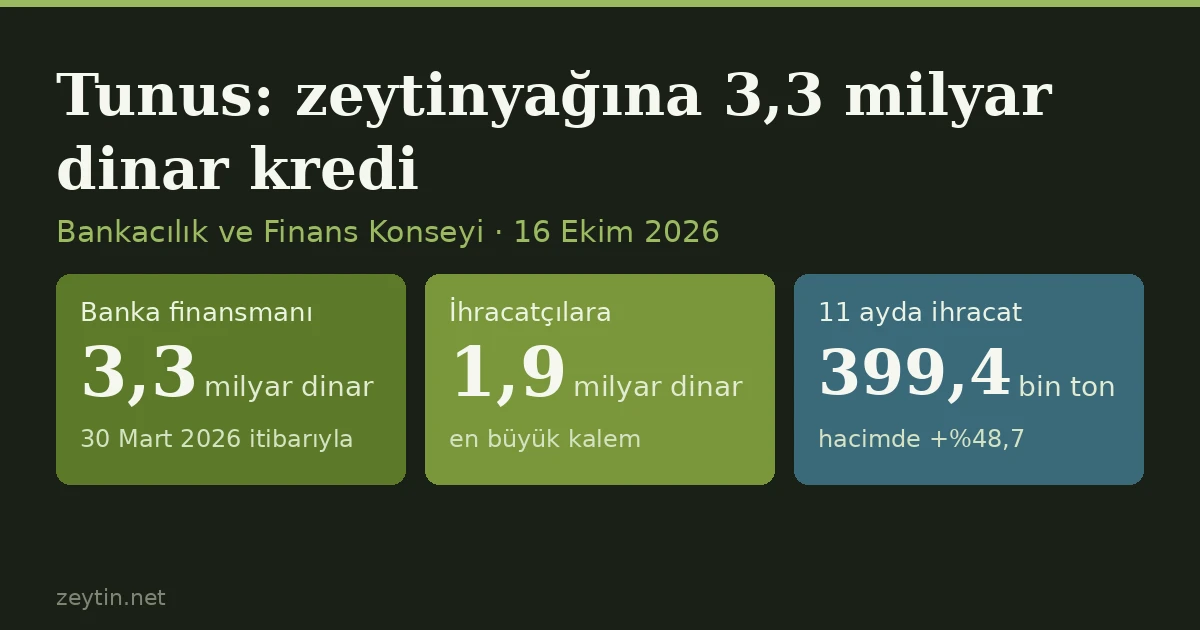
According to Néji Ghandri, president of the Tunisian Banking and Financial Council, banks extended 3.2-3.3 billion dinars to the 2025/26 olive oil season by 30 March, up from 2.2 billion the season before; 1.9 billion went to exporters. Tunisia exported 399,400 tonnes in eleven months. The 2027 draft budget opens a 100-million-dinar credit line for small growers and earmarks 10 per cent of bulk export duty revenue for a sector fund; it is not a new tax.
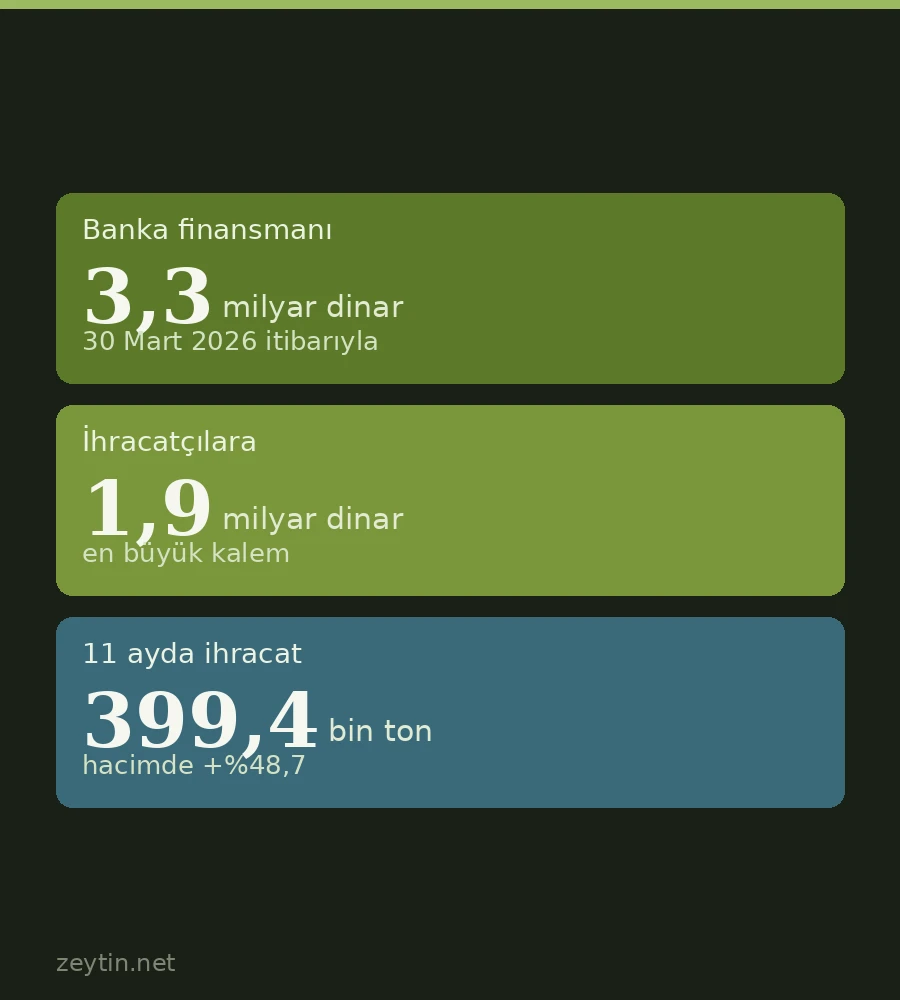
Tunisian banks put 3.2 to 3.3 billion dinars of financing into the 2025/26 olive oil season. The figure was given by Néji Ghandri, president of the Tunisian Banking and Financial Council (CBF), on 16 October 2026 at a meeting on the financing of olive oil and date exports, held at the council's headquarters with the Ministry of Trade and Export Development. The previous season the figure had been 2.2 billion dinars, so the increase is about 50 per cent.
In the same week the government's 2027 draft budget was made public, and it contains two articles for the sector: a 100-million-dinar credit line for small growers and a dedicated sector fund to be fed from the duties collected on bulk olive oil exports. Türkiye's most direct competitor in the bulk market is closing a record export year and trying to make its financing machinery permanent.
Where the money went
Ghandri's breakdown shows the financing extended by the banking sector up to 30 March 2026:
| Borrower | Million dinars |
|---|---|
| Olive oil exporters | 1,900 |
| Oil mills | 1,100 |
| National Oil Office (ONH) | 202 |
| Small growers | 46 |
| Sum of items | 3,248 |
Of the 46 million dinars for small growers, 18 million was subsidised credit channelled through the Tunisian Solidarity Bank. Ghandri described the total as "more than 3.3 billion"; another report of the same meeting gave 3.2 billion. The items add up to 3.25 billion.
The split itself tells a story. About 58 per cent of the money goes to exporters and a third to mills; the share that reaches growers directly is under 1.5 per cent. In the Tunisian model, bank credit flows to the link in the chain that collects the olives and sells the oil, and the grower is paid in cash by that link. The National Oil Office, the state body for the olive oil sector, takes a smaller slice than either.
The numbers of a record year
According to the official figures presented at the meeting, Tunisia exported 399,400 tonnes of olive oil in the first eleven months of the season that began in November 2025, earning 5,016.3 million dinars. Compared with the same period of the previous season, volume rose 48.7 per cent and value 39.4 per cent. Around 90 per cent of the exports were extra virgin, but only 15 per cent left the country in packaged form.
That matches the picture in the ten-month data. In our earlier report based on figures from ONAGRI, the national agricultural observatory, we showed that 85.5 per cent of 381,200 tonnes had been shipped in bulk. It is also why revenue grew more slowly than volume: the average export price over the eleven months works out at about 12.6 dinars per kilogram. According to data shared at the meeting, olive oil alone made up 61 per cent of Tunisia's agri-food exports in the first nine months of 2026, and Tunisian officials describe the country as the largest exporter outside the EU and the second in the world after Spain.
Ghandri's message was therefore about packaged exports. Alongside short-term export credit, he said, banks offer medium-term loans for investment in mills and collection centres, cover against exchange-rate risk, guarantees and export insurance, storage financing and advances against goods. He urged exporters to move towards packaged oil and to diversify into new markets in Asia and Africa. This time the call came from the lenders, who are the ones carrying the risk of the bulk trade.
The draft budget: not a new tax, a tenth of an existing duty
Article 37 of the 2027 draft budget opens a 100-million-dinar credit line to be used between 1 January 2027 and 31 December 2030. The money will be lent at preferential interest rates, as seasonal and investment credit, to small farmers and agricultural service cooperatives working in olive growing. It will be managed by the National Agricultural Bank (BNA) under an agreement with the Ministry of Finance.
Article 38 creates a special Treasury account called the "olive oil sector account". Its resources include 10 per cent of the revenue from duties applied to exports of bulk olive oil and bulk olive-pomace oil, plus donations. How the account will spend its money is to be set by decree.
Some outlets reported this article as a "10 per cent tax on bulk exports". That is not what the draft says. It does not impose a new duty; it earmarks a tenth of the revenue from an existing one for the sector fund. A bulk exporter's cost does not change under this article; what changes is where that money ends up. The distinction matters for buyers in Spain and Italy, who take most of Tunisia's bulk oil and would have faced a price shock if a new 10 per cent levy had been introduced.
Seen from Türkiye
Tunisia's crop is falling this season. The national growers' union expects 300,000 tonnes for 2026/27, down from 500,000 tonnes last season. The banks are keeping their credit machinery in place as the country goes into a smaller but higher-priced season. Türkiye is in the opposite position, heading into a record crop; at a meeting in İzmir sector representatives asked for premium and exchange-rate support, after olive oil exports fell to 17,721 tonnes last season.
The difference between the two countries is visible in a single number: in Tunisia, bank credit to exporters alone came to 1.9 billion dinars. That credit is what allows one of the world's largest bulk suppliers to get oil onto ships quickly after every harvest — and to do so in a year when its export volume rose by almost half. A Turkish exporter competing for the same Italian and Spanish buyers is up against a supplier whose working capital is lined up before the olives are picked.
Read with care
⚠ The financing figures cover amounts extended up to 30 March 2026, not the whole season.
⚠ The export figures cover eleven months of the season; final twelve-month data has not yet been published.
⚠ The 100-million-dinar line and the sector fund are in a draft budget and may change in parliament. The draft text does not specify the base on which the duty is calculated.
⚠ The 58 per cent, 1.5 per cent and 12.6 dinars per kilogram are our own calculations, dividing the announced items and export totals by one another.
One rating per visitor; you can change yours at any time. Ratings are real reader votes — no seeded or default scores.
Related
 Article
Italy to track olive oil with an electronic document: first positive response from the regions on the DAO, imported oil left out
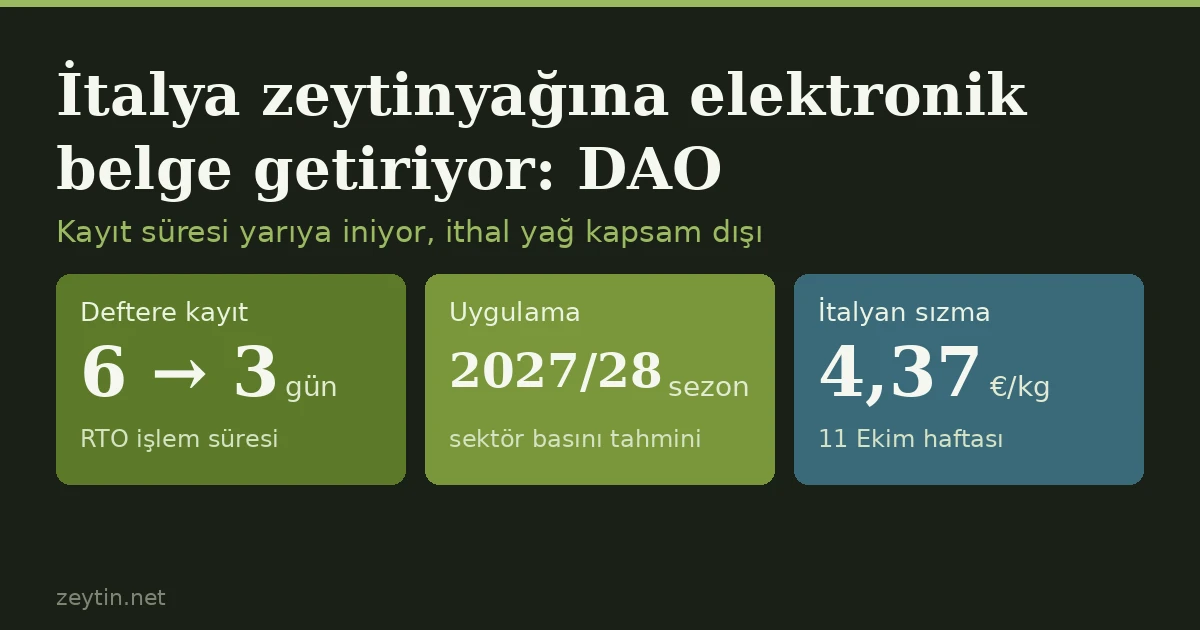
A draft decree announced on 9 October by Italian agriculture minister Lollobrigida introduces the DAO, an electronic accompanying document that links olive and olive oil movements to the SIAN and RTO systems and cuts the register deadline from six days to three. According to the growers' committee, the state-regions conference gave a first positive response on 15 October. But the document only tracks domestic oil leaving a facility; oil from other EU states and third countries will keep entering with conventional paperwork. The trade press expects it to apply from the 2027/28 season.
 Article
In Spain the cost sits above the price: €5.31 in a traditional grove, €3.46 at the gate
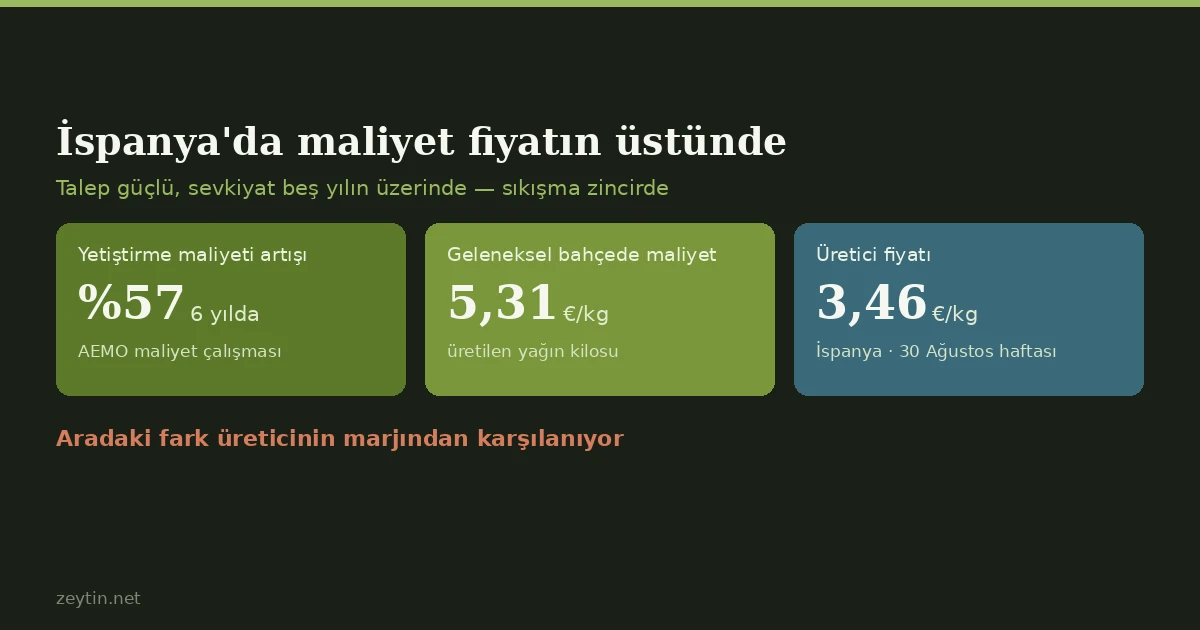
Olive cultivation costs have risen 57% in six years and reach €5.31 per kilogram in the most traditional groves, according to an AEMO study. The same week, Spain's producer price was €3.46. The Andalusian cooperative federation, with 342,000 members, is asking not for aid but for a change to the Food Chain Law.
 Article
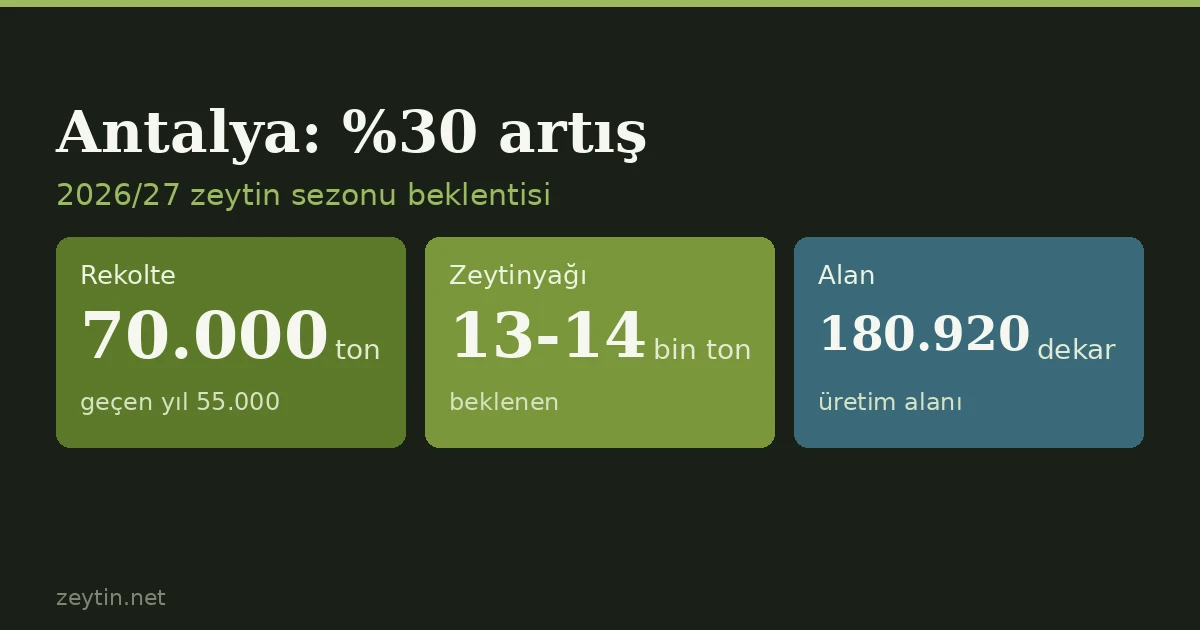
Antalya's crop is up 30%: of 70,000 tonnes of olives, 55,000-60,000 head for the mill
According to the Antalya Commodity Exchange, the province's olive crop is rising about 30% from some 55,000 tonnes last season to around 70,000 tonnes, with 13,000-14,000 tonnes of olive oil and 10,000-15,000 tonnes of brined fruit expected. Harvest opened on 15 September. There is movement on the registration front too: an EU application has been filed for the Tavşan Yüreği olive, and a geographical indication file is under way for the Beylik variety.
 Article
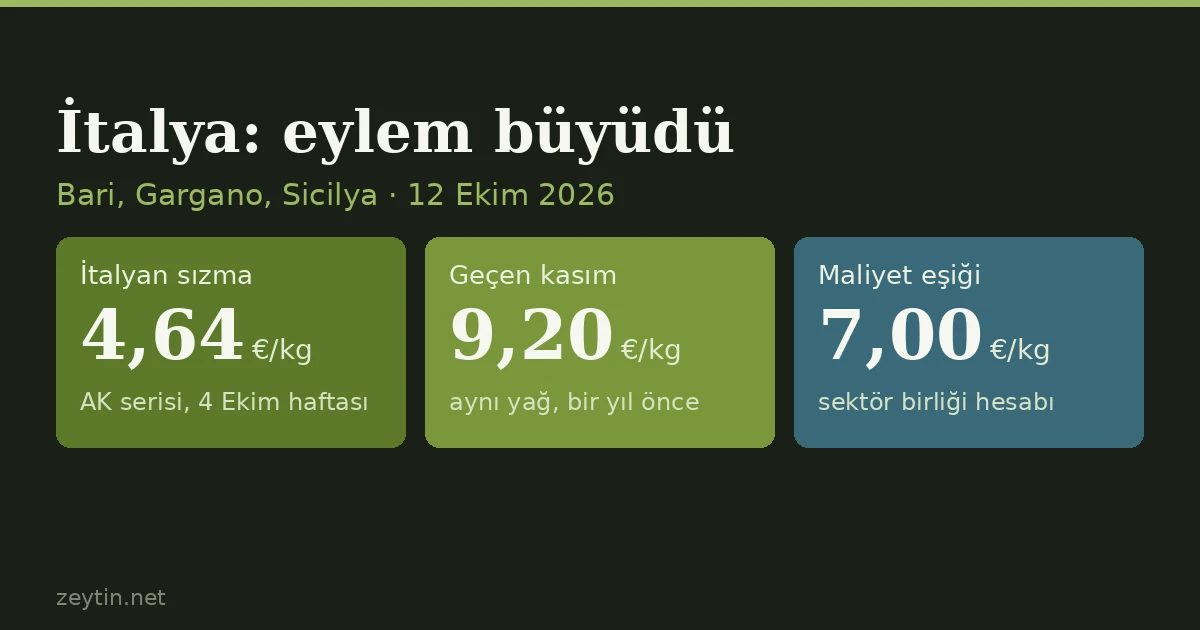
Italy's protest widens: thousands of growers in Bari, mills idle in Sicily, still no crisis status
The deadline given in Puglia expired without crisis status being granted: on 12 October thousands of growers gathered in front of the Bari prefecture, hundreds of tractors blocked roads on the Gargano, and harvesting and milling have been suspended since 5 October across nine municipalities in Sicily. Two of the four demands concern anti-fraud controls and an electronic transport document for olives. In the European Commission series, Italian extra virgin stood at 4.64 €/kg in the week of 4 October; the figure quoted in the field is 4 euros, against 9.20 € last November. The next threshold is 15 October.