Pollination and pollinator varieties in olive
98% of olive flowers drop. Whether the remaining 1-2% holds depends on having a pollinator in the grove. Gemlik is only partially self-fertile: in a single-variety grove harvest falls to a third.
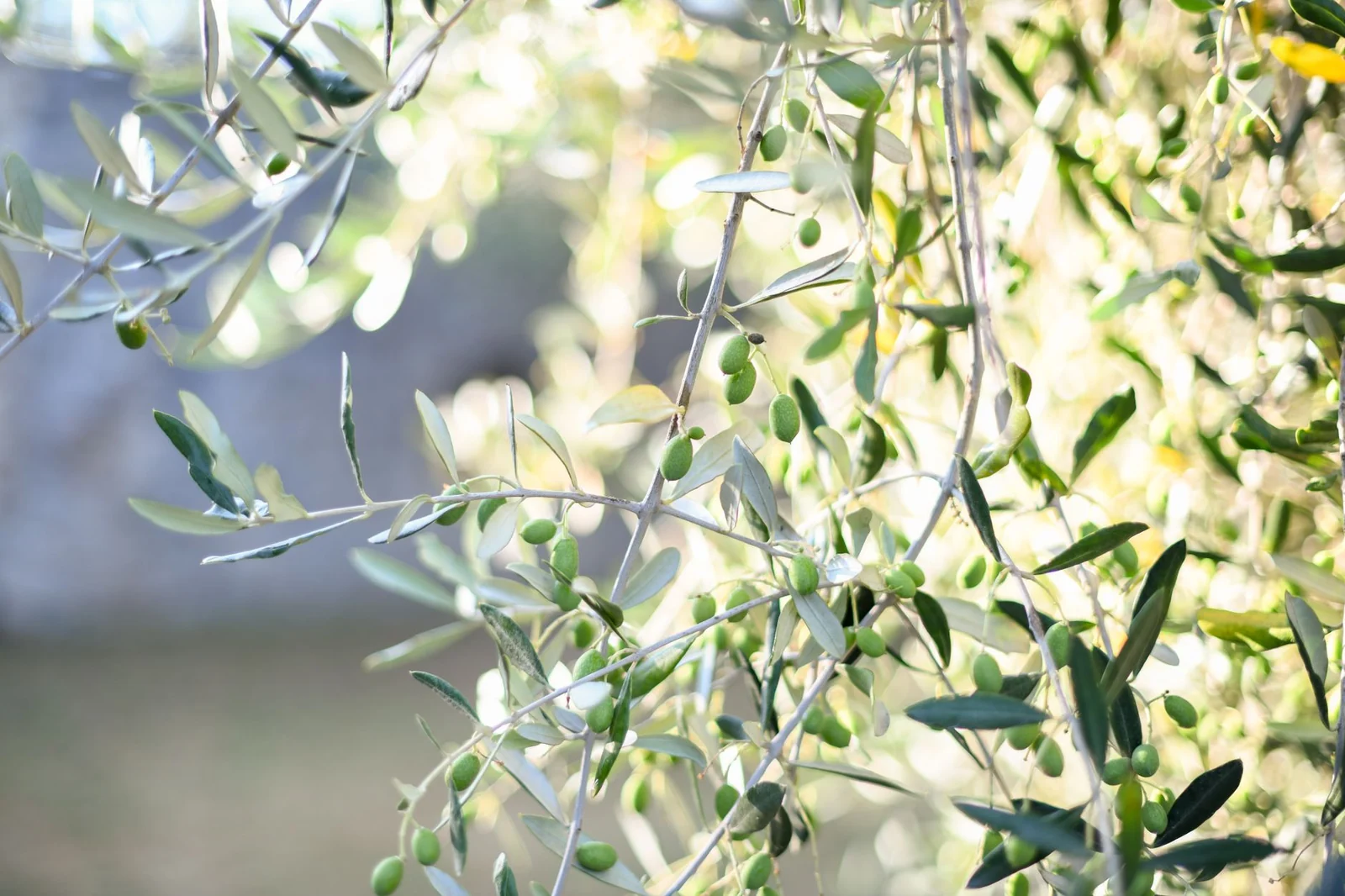
An olive tree in an on-year opens thousands of flowers. 98% of them drop. Only 1-2% set fruit.
That ratio is normal — it is how the olive works. But how much of that 1-2% holds depends on something most growers are unaware of: is there a pollinator variety in the grove?
How the olive is pollinated
The olive is wind-pollinated (anemophilous). It needs no bee or other insect; the wind carries the pollen.
The problem is not in the pollen travelling but in the travelled pollen being of use.
A common condition in olives is self-incompatibility. Although the sexual organs and cells of a flower develop perfectly well, fertilisation fails when the flower is pollinated by pollen from the same variety.
This is entirely genetic, controlled by incompatibility genes (S genes).
The mechanism: in self-pollination the pollen tube usually fails to reach the ovule, unable to grow down the style far enough for fertilisation. In cross-pollination the tube grows faster and reaches the ovary.
The result: yield falls in a grove planted with a single variety.
The self-fertility index
How much fruit a variety can set on its own is measured as a ratio:
t; R = fruit set from self-pollination ÷ fruit set from open pollination
And that ratio gives three classes:
| R value | Class | What it means in practice |
|---|---|---|
| 0.00 - 0.15 | Self-infertile | a pollinator is obligatory |
| 0.15 - 0.30 | Partially self-fertile | yield drops sharply without a pollinator |
| 0.30 - 1.00 | Self-fertile | can bear alone, though cross-pollination still helps |
That last note matters: research reports that cross-pollination benefits even self-compatible varieties. A "self-fertile" label does not mean "no pollinator needed".
Five varieties, measured results
Five varieties were tested in a grove planted in 1990 at the Koruklu Talat Demirören Research Station
of the GAP Agricultural Research Institute.
The method is direct: while the flowers were still at the balloon stage they were isolated with
paper bags (self-pollination), and other shoots on the same tree were left open (open pollination).
Fruit was counted four times — 20 days after full bloom, in midsummer and at harvest.
The resulting classification:
| Variety | R index | Class | When planting |
|---|---|---|---|
| Delice | 1.13 | self-fertile | sufficient on its own |
| Nizip yağlık | 0.34 | self-fertile | a pollinator still helps |
| Domat | 0.29 | partial | pollinator needed |
| Gemlik | 0.29 | partial | pollinator needed |
| Yuvarlak halhalı | 0.14 | self-infertile | pollinator obligatory |
For the count-by-count detail and regional assessment of the trial, see south-eastern Anatolia's nameless olives.
The real message: an early count misleads
The most instructive part of the trial is its timing. Early fruit set under self-pollination is sometimes
even higher than under open pollination. But the olive later drops what it cannot carry.
Which is why walking the grove in May and calling it a good year is premature. The difference emerges at
harvest, and in self-infertile varieties it can reach sevenfold.
The count-by-count figures and the full comparison table:
South-eastern Anatolia's nameless olives
The Gemlik question
The finding with the most practical consequence concerns Gemlik.
Gemlik is partially self-fertile (R = 0.29), and at harvest its yield from its own pollen is about one third of what it achieves with foreign pollen.
Why that matters has to do with what certified-sapling support produced: recent years saw intensive planting of Gemlik in Turkey and a rapid expansion of table-olive plantations. We touched on that trend in the article on table olive quality.
If those groves were established as single-variety Gemlik, then even with healthy trees, correct husbandry and a suitable climate, yield will remain structurally low. And that is not a deficiency fertiliser or irrigation can fix — it is a genetic incompatibility.
The remedy is simple and cheap: mix a suitable pollinator variety into the grove.
How to choose a pollinator
A pollinator variety should be chosen against four criteria:
1. Economic productivity — the pollinator tree should bear a crop too, not just occupy space
2. Pollen quality — it must produce abundant, viable pollen
3. Compatibility with the variety to be pollinated — they must be genetically compatible
4. Matching flowering time — they must bloom in the same period; if one opens earlier or later, the pollen is wasted
The fourth is the most often overlooked. A good pollinator can be entirely useless simply because it flowers at the wrong time.
Turkey's unmeasured varieties
The study notes one further gap:
t; Research to date on the reproductive biology of olive varieties in Turkey has covered, broadly, 14 varieties.
Given that Turkey has 100 registered olive varieties, the self-fertility status of most of them is unknown.
And in the study's own words: uncertainty remains about the appropriate pollinators for the varieties in already-established groves.
This is another face of the same gap seen in south-eastern Anatolia's unmeasured genotypes: we have the varieties, but not the measurements.
Summary for anyone planting a grove
- 98% of olive flowers drop anyway; protecting the 1-2% that hold is what counts
- Planting a single-variety grove is risky — especially when that variety's self-fertility is unknown
- For self-infertile or partially fertile varieties a pollinator is obligatory
- Even self-fertile varieties benefit from cross-pollination
- Do not neglect matching flowering time when choosing a pollinator
- Known results: Delice and Nizip yağlık self-fertile · Domat and Gemlik partial · Yuvarlak halhalı self-infertile
Related: olive varieties · Gemlik · Domat · alternance
Sources
- Korkmaz, Ş. & Ak, B.E. (2018) — Determination of self-fertility status of some olive cultivars grown in the GAP Region, Harran Journal of Agricultural and Food Science 22(4): 471-477 (trial conducted 2015)
- Moutier, N. (2002) — the self-fertility index and its classification
- Martin (1990) — flower drop rates in olive
- Cuevas, J. & Polito, V. (1997) — pollen tube growth
- Lavee, S. (1998) — criteria for selecting pollinator varieties
- Sibbett & Osgood (1994) — benefit of cross-pollination in self-compatible varieties
- Eti, S. (2009) — sexual incompatibility and S genes
One rating per visitor; you can change yours at any time. Ratings are real reader votes — no seeded or default scores.
Related
 Article
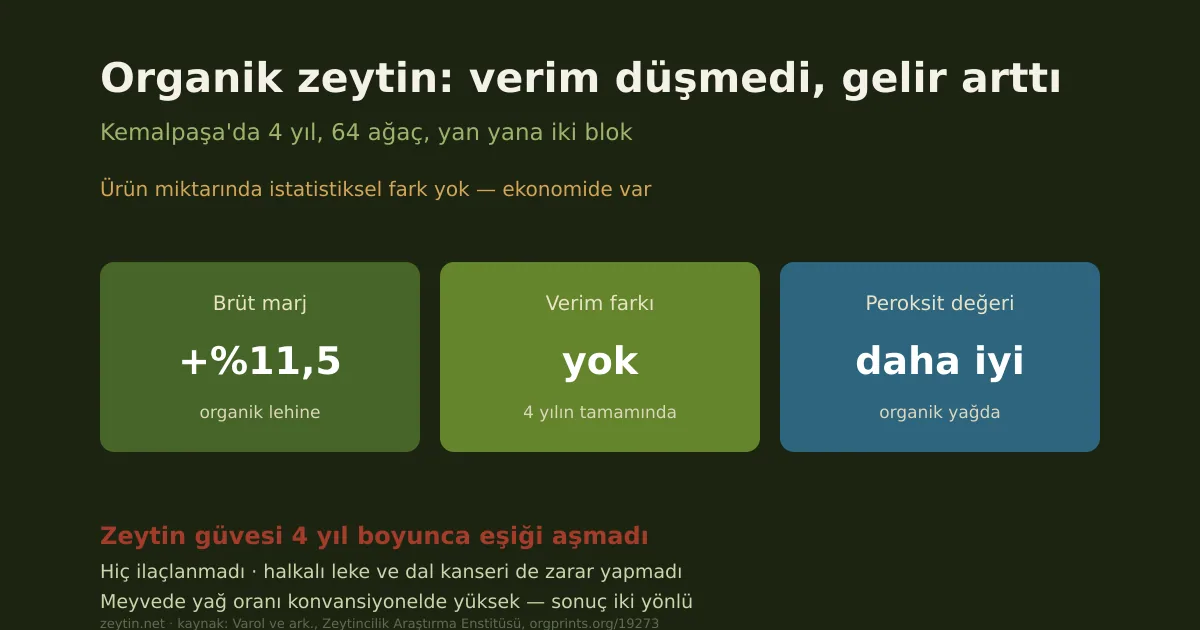
Organic olive growing: what a four-year trial found
A four-year organic vs conventional trial at Kemalpaşa: no yield difference, 11.5% higher gross margin for organic, lower peroxide value, but higher fruit oil content under conventional management.
Article
Organic olive growing: what a four-year trial found
A four-year organic vs conventional trial at Kemalpaşa: no yield difference, 11.5% higher gross margin for organic, lower peroxide value, but higher fruit oil content under conventional management.
 Article
Irrigating Olives: When, How Much, How
Olive water requirements, critical periods, drip system layout, deficit irrigation and water quality.
Article
Irrigating Olives: When, How Much, How
Olive water requirements, critical periods, drip system layout, deficit irrigation and water quality.
 Article
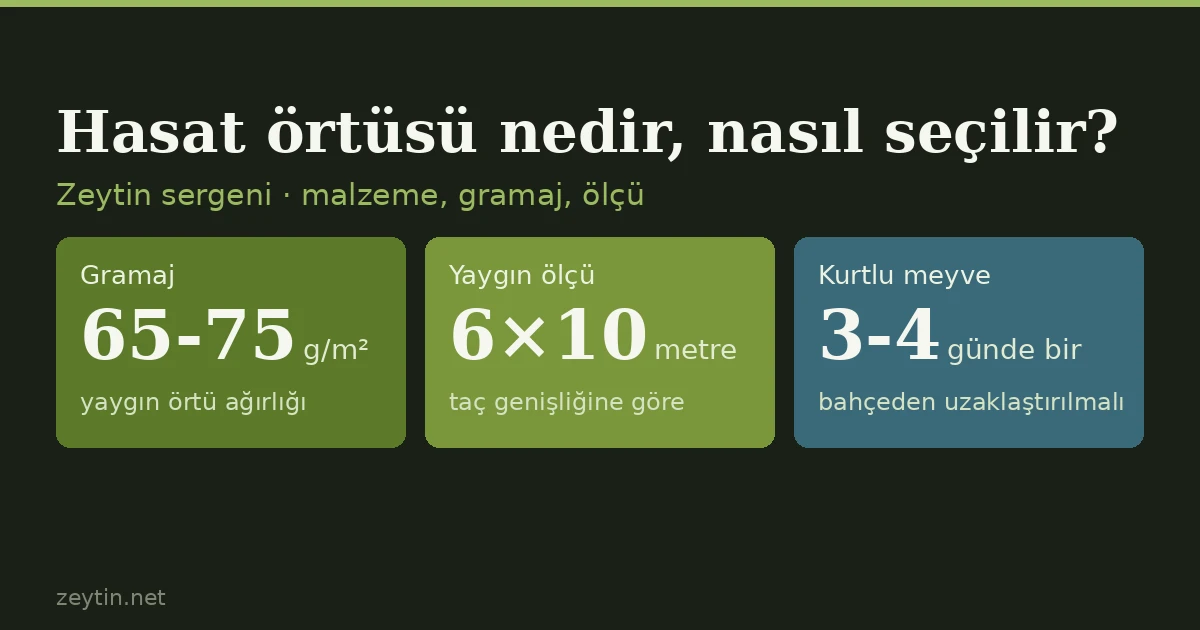
What is an olive harvest net, and how do you choose one?
A net spread under the tree does two jobs at once: it keeps the fruit off the soil and it speeds up collection. Olives that touch the ground give higher-acidity oil, and fruit left on the ground feeds the next generation of olive fruit fly. Here is how to choose a net — material, weight, size — and how to lay it.
Article
What is an olive harvest net, and how do you choose one?
A net spread under the tree does two jobs at once: it keeps the fruit off the soil and it speeds up collection. Olives that touch the ground give higher-acidity oil, and fruit left on the ground feeds the next generation of olive fruit fly. Here is how to choose a net — material, weight, size — and how to lay it.
 Article
When does the olive harvest begin?
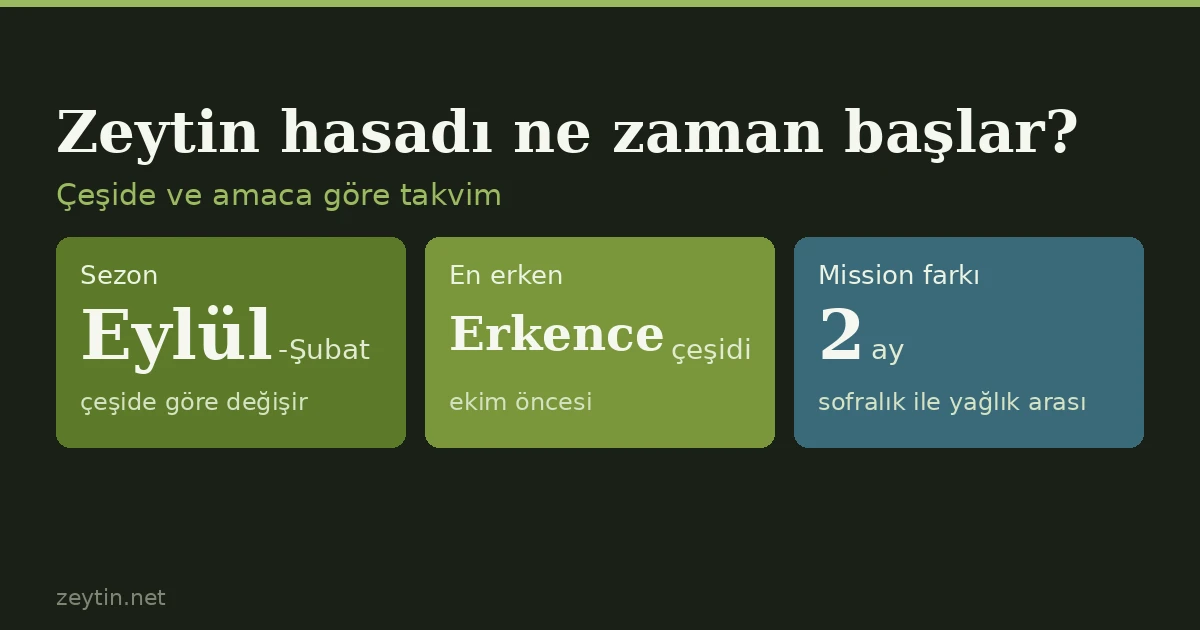
The harvest starts in late September and runs into February. Erkence is earliest, Memecik hangs into mid-December, and Mission's table and oil harvests are two months apart.
Article
When does the olive harvest begin?
The harvest starts in late September and runs into February. Erkence is earliest, Memecik hangs into mid-December, and Mission's table and oil harvests are two months apart.