Olive oil enterprises in Mut: a field study
More than 4% of Turkey's olive production comes from Mut. In a 2025 study of 14 enterprises, raw material quality ranks last among their problems. All eight websites of firms wanting to export are monolingual.
When the problems of the olive oil sector come up, the Aegean comes to mind first. Yet more than 4% of Turkey's entire olive production comes from a single district: Mut, in Mersin province.
A field study published in 2025 conducted in-depth interviews with 14 of the 25 olive oil enterprises registered with the Mut Chamber of Commerce and Industry, and examined the websites of the 8 that had one. The resulting picture shows with unusual clarity where the sector gets stuck.
Where Mut stands
Mersin took an 8.4% share of Turkey's olive production in 2024. Mut olive oil carries a geographical indication, and its registration document records a free fatty acid level of 0.58% — low acidity being a direct marker of quality.
So there is no problem on the product side. The study's findings say exactly that.
The problem ranking: the product comes last
Enterprises rated 15 problem areas on a scale from 1 (no effect) to 5 (very strong effect):
| Problem area | Mean | Std. dev. |
|---|---|---|
| Economic uncertainty | 4.29 | 1.13 |
| Insufficient capital | 4.16 | 1.19 |
| High production costs | 4.08 | 1.11 |
| Shortage of qualified staff | 3.77 | 1.42 |
| Packaging problems | 3.66 | 1.30 |
| Low prices in foreign markets | 3.66 | 1.55 |
| Logistics shortcomings | 3.46 | 1.20 |
| Difficulty finding markets | 3.41 | 1.16 |
| Not knowing how to use state support | 3.36 | 1.12 |
| Inadequacy of state support | 3.27 | 1.27 |
| Keeping up with and adopting technology | 3.18 | 1.47 |
| Failure to build a brand | 2.66 | 0.99 |
| Standardisation and quality | 2.66 | 1.61 |
| Consumer preferences and taste | 2.36 | 1.50 |
| Inadequate raw material (olive) quality | 2.25 | 1.38 |
The shape of the list is unmistakable:
All four problems at the top lie outside the enterprise — economic uncertainty, capital, cost, staffing.
All four at the bottom concern the product — branding, standardisation, taste, and last of all raw material quality.
Mut's olive oil enterprises are not saying "our oil isn't good." They are saying "our oil is good but the road ahead is blocked."
That maps exactly onto what we saw in the export profitability study: the product is competitive, the problem lies outside it.
What happens in exporting
Of the 14 enterprises:
- 1 exports directly
- 5 export indirectly (through an intermediary firm)
- 6 do not export at all
The export problems fall into two groups:
| Group | Problem | Firms |
|---|---|---|
| Internal | Inadequate incentives | 4 |
| Procedures and lack of knowledge | 3 | |
| Shortage of qualified personnel | 3 | |
| Foreign language problem | 2 | |
| Promotion / branding | 2 | |
| Insufficient capital | 2 | |
| External | Low foreign prices / exchange rate | 3 |
| Difficulty sourcing packaging | 3 | |
| Standardisation | 2 | |
| Export restrictions | 2 |
The participants' own words tell it better than the table:
t; "This year we exported indirectly through a firm. Our knowledge is lacking. We couldn't find anyone who knows how. We lack packaging. We have no foreign language." (Participant 1)
t; "We struggle with packaging. It comes from İzmir. It's costly. Konya's industry doesn't supply packaging of sufficient quality and variety for our product range." (Participant 13)
t; "We made attempts at direct exporting. Our product prices were higher than in the destination countries, not at a competitive level." (Participant 5)
The packaging problem is especially telling: olive oil is produced in Mut but its bottle travels 500 km. The absence of a local supporting industry is a concrete barrier to exporting.
Website analysis: the door is shut
This is the study's most concrete finding. Only 8 of the 25 enterprises have a website, and all 8 were assessed against 25 criteria.
What is done (present on most of the 8): coupons and discounts, free shipping, product search, call centre, card payment, delivery information, sizes and dimensions, mobile-friendly design, cross-promotion.
What is not done (absent from all eight):
| Missing feature | What it means |
|---|---|
| Multiple languages | the site is Turkish only |
| Currency options | prices in lira only |
| Customer acquisition programme | no mechanism for winning new customers |
| Cash on delivery | — |
| Help tools | — |
The first two rows sum up the whole export debate on their own.
All eight enterprises that want to export have websites that are Turkish only and lira only.
A buyer arriving from abroad can neither read the site nor understand the price. Currency and language are two gaps far cheaper to close than packaging or incentives — and neither has been closed.
A loyalty programme exists on 1 site, customer reviews on 2. There is almost no mechanism in place for winning and keeping customers.
Promotion still runs through trade fairs
The enterprises' promotional channels:
| Channel | Firms | Share |
|---|---|---|
| Trade fair attendance | 12 | 85% |
| Website | 8 | 57% |
| Social media | 7 | 50% |
| Google Ads, SEO | 4 | 28% |
| Personal selling | 2 | 14% |
| Brochure | 1 | 7% |
Trade fairs still dominate at 85%. Digital channels exist, but the search side is weak: only 4 enterprises do SEO or paid search.
Sales channels show the same pattern: traditional wholesale at 71% is the most common route; factory outlet and website at 57%, marketplaces and social media at 35%.
The bulk-sale question
Another figure the study reports sums up Turkey's overall position:
t; Only 30% of Turkish olive oil is packaged and branded; 70% is sold in bulk.
Around 320,000 family holdings grow olives in Turkey, and only 14% of them belong to unions such as TARİŞ and Marmarabirlik.
Bulk selling means handing the added value to someone else. In branded, packaged sales the value added to the product ranges between 50% and 100%.
The takeaway
The Mut case shows very clearly where the sector's problem is not.
The product is good — geographically indicated, low in acidity. 85% of enterprises consider their technology adequate against competitors, 85% have their own brand, 50% hold more than one standardisation certificate.
But:
- 32% have a website
- None of those sites has a foreign language
- Of 14 enterprises, only 1 exports directly
- The bottle comes from 500 km away
The problem is not in production but in the bridge between production and market. And most of the missing pieces of that bridge — language, currency, promotion, knowledge — could be built for far less than a new factory.
Related: profitability in olive oil exports · quality in table olives · structural problems
Sources
- Süygün, M.S. & Can, M. (2025) — A study on the challenges and export potential of olive oil enterprises: the case of Mut district, Mersin, Turkish Journal of Agricultural Economics 31(1): 189-203
- Turkish Patent and Trademark Office (2018) — Mut olive oil geographical indication registration
- IOC (2025) — world olive and olive oil production data
- Marangoz et al. (2012) — website analysis criteria
- Mülayim (2019) · Özözen (2024) — branded versus bulk sales shares
One rating per visitor; you can change yours at any time. Ratings are real reader votes — no seeded or default scores.
Related
 Article
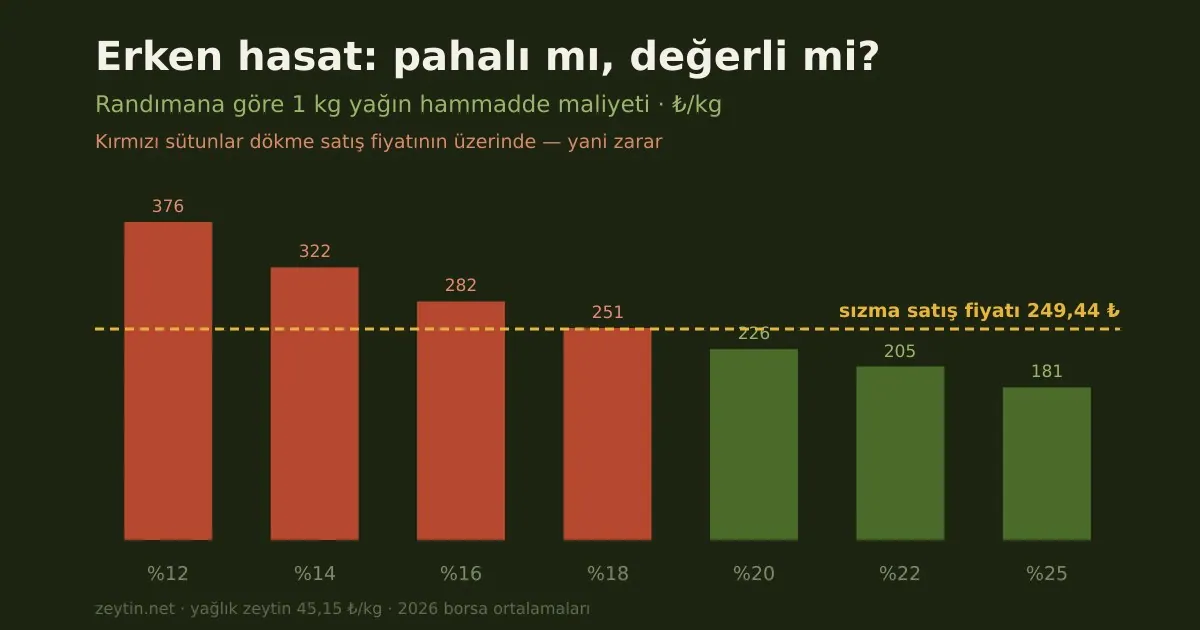
Early harvest: expensive or valuable? The arithmetic of yield
Below 18% yield the raw material costs more than the bulk price. Early-harvest oil needs a 43% premium to break even.
Article
Early harvest: expensive or valuable? The arithmetic of yield
Below 18% yield the raw material costs more than the bulk price. Early-harvest oil needs a 43% premium to break even.
 Article
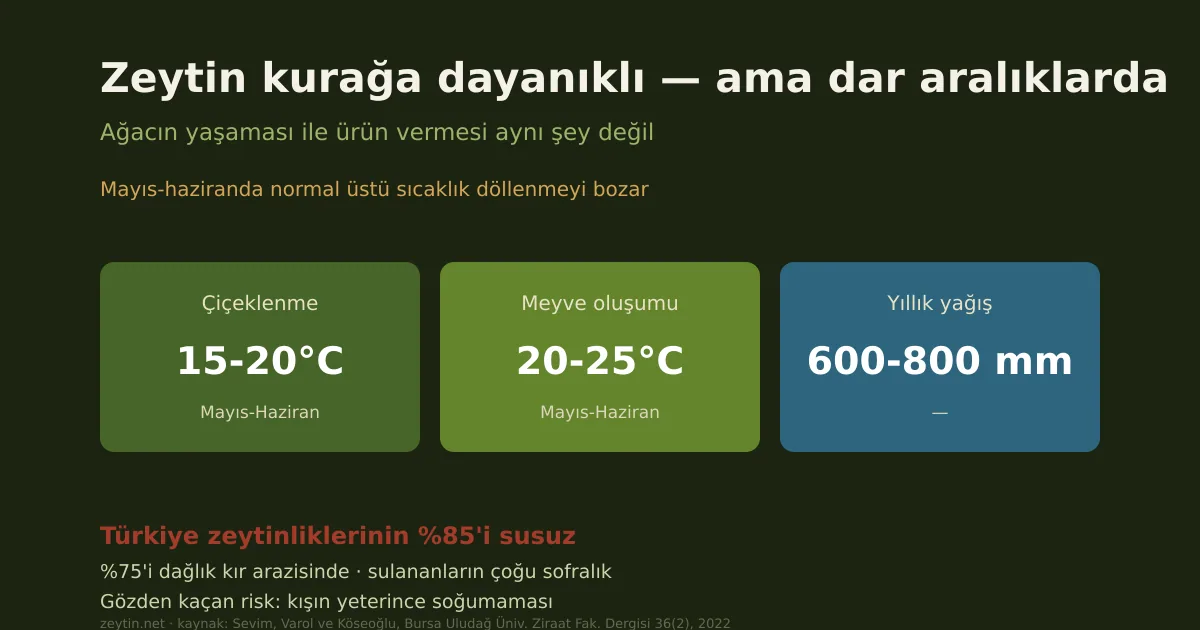
Climate change and the olive: the tree survives, but will it crop?
The olive is drought-hardy but works in narrow bands. 85% of Türkiye's groves are unirrigated, 75% on mountainous land.
Article
Climate change and the olive: the tree survives, but will it crop?
The olive is drought-hardy but works in narrow bands. 85% of Türkiye's groves are unirrigated, 75% on mountainous land.
 Article
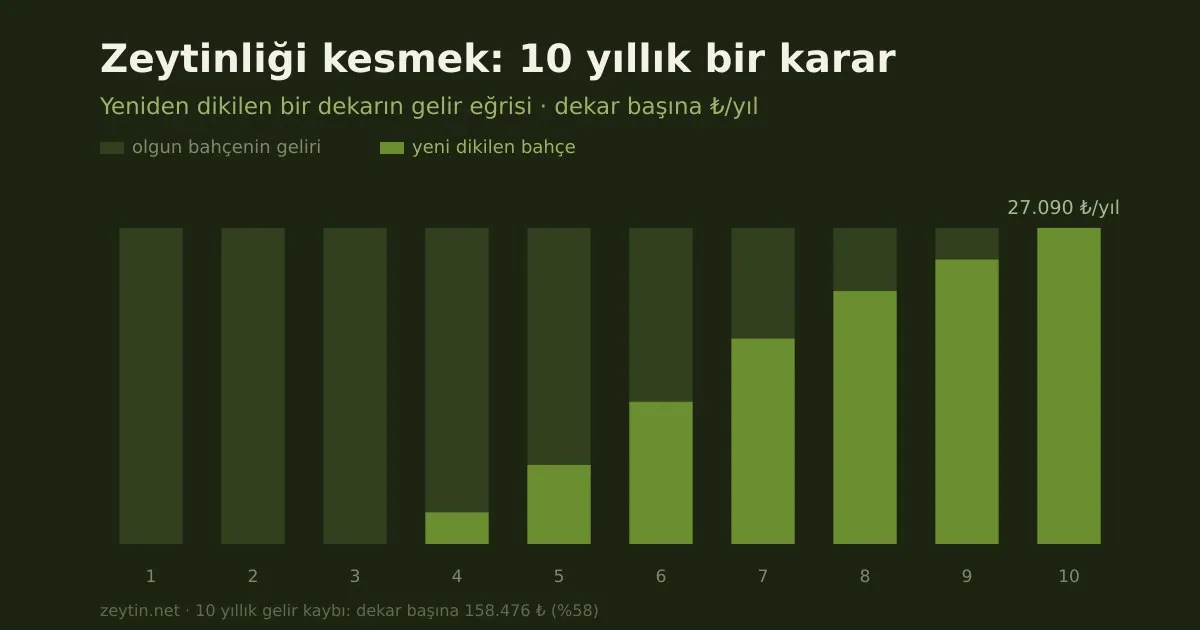
Felling an olive grove: the arithmetic of a ten-year decision
The ten-year cost of clearing a grove for another crop: establishment, years to bearing and forgone income, per decare.
Article
Felling an olive grove: the arithmetic of a ten-year decision
The ten-year cost of clearing a grove for another crop: establishment, years to bearing and forgone income, per decare.
 Article
What temperatures can the olive withstand?
Ideal 15–20 °C, an upper limit of 40 °C (with irrigation), a lower limit of −7 °C. Temperature thresholds, chilling requirement, and the climate risk of production narrowed to four varieties.
Article
What temperatures can the olive withstand?
Ideal 15–20 °C, an upper limit of 40 °C (with irrigation), a lower limit of −7 °C. Temperature thresholds, chilling requirement, and the climate risk of production narrowed to four varieties.