Edremit's monumental olives: four old trees, measured
At an estimated 1,100 years and a 7.20 m girth, Kavaktarla is Edremit's oldest olive. All four are hollowed and galled, none is registered, and the real threat is that they are still in production.
You cannot tell an olive tree's age by looking at its trunk — the olive keeps living long after its heartwood has rotted and hollowed out. That is why phrases like "thousand-year-old olive tree" are usually unmeasured claims.
Four monumental olive trees in the Edremit district have been documented by geographers measured on site. This page reports those measurements.
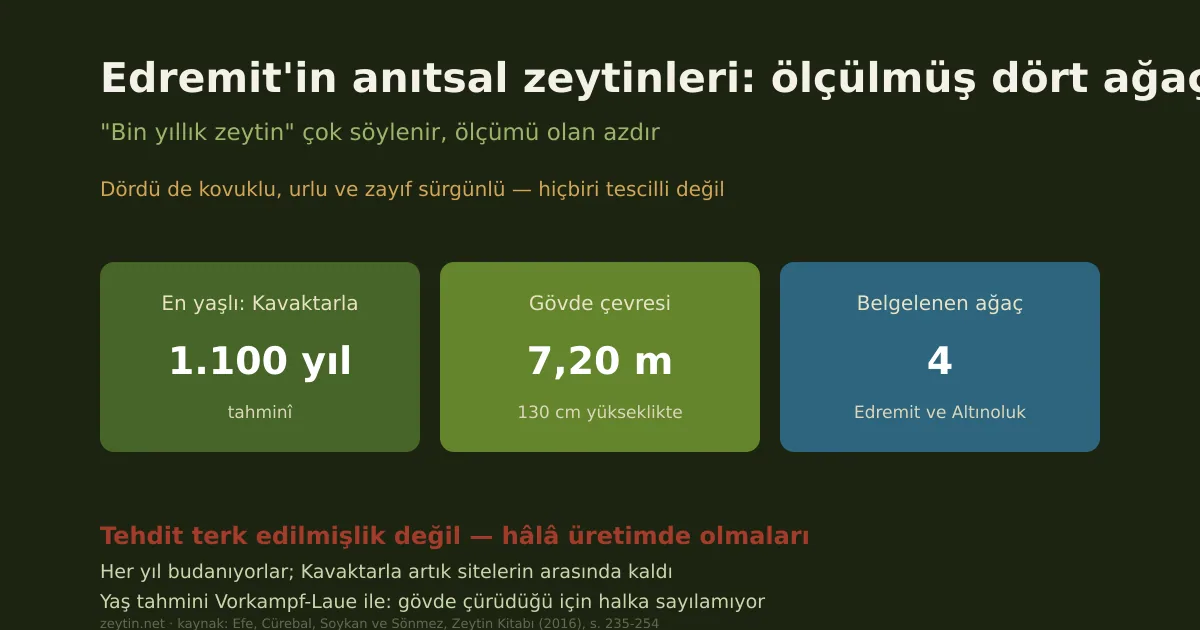
What is a monumental tree? Being large is not enough
The common misconception is that a monumental tree simply means a very large tree. The definition is narrower:
t; A tree whose age, diameter and height exceed the usual dimensions of its species; whose trunk and branch form evokes something in the memory of those who see it; which holds a special place in local folklore, culture and history; and whose natural lifespan is long enough to link the past to the future.
Monumental trees fall into four groups: historical, mystical, folkloric and dimensional. For the first three, measurements such as age, height or diameter are irrelevant — a tree can qualify because something happened beneath it or because it features in a belief.
Only dimensional monumental trees are judged on concrete measurements. The four below belong to that group.
Edremit's four monumental olives
| Tree | Estimated age | Height | Trunk diameter | Trunk girth | Canopy |
|---|---|---|---|---|---|
| Kavaktarla | 1,100 years | 8 m | 2.29 m | 7.20 m | 7.5 m |
| Altınoluk | 800 years | 8 m | 2.07 m | 6.50 m | 9.5 m |
| Koca Zeytin | 500 years | 6 m | 1.54 m | 4.85 m | 9 m |
| Şahindere | 480 years | 6 m | 1.65 m | 5.20 m | 11 m |
Diameter and girth were measured at 130 cm above ground — the standard height in forest mensuration (breast height). Age was estimated by the Vorkampf-Laue method; because the olive's heartwood decays, ring counting is usually impossible, so these figures are estimates.
The striking row is Kavaktarla: at an estimated 1,100 years, the oldest known olive in Edremit. Its trunk girth is 7.20 metres — three people with arms outstretched would barely encircle it.
Where do they stand?
All four are around Edremit and Altınoluk, on the narrow strip between Mount Ida (Kazdağı) and the Gulf of Edremit.
- Koca Zeytin — Edremit centre, behind the state hospital at the Delicelik site. Among groves at the crossing of field tracks, 43 m above sea level, on foundation land.
- Kavaktarla — Altınoluk, at the Kavaktarla site, on the Şahindere delta, 10 m above sea level. The tree now stands inside a built-up area.
- Şahindere and Altınoluk trees lie along the same belt.
The local climate is the same for all four: annual rainfall 667 mm, mean annual temperature 16.1 °C, extremes 40.5 °C / −7.6 °C.
Those conditions are close to ideal for the olive — as explained under chilling requirement in olives, the tree needs winter cold, but not too much. Edremit's low of −7.6 °C stays above the −12 °C at which olives suffer damage.
All four are ailing
The most telling part of the survey is the health section. All four show the same picture:
| Trunk cavity | Present in all four, decay ongoing (30–50 cm across) |
| Foliage | Weak compared with other trees of the species |
| Shoot growth | Last year's growth slower than previous years |
| Trunk galls | Present |
| Insects | Established in the cavities |
| Pruning | Many interventions over time |
On the galls, see olive knot — this bacterial disease enters through pruning wounds and produces exactly this kind of swelling. In a tree pruned repeatedly for centuries, the accumulation is no surprise.
The real threat: these trees are still in production
The survey states the threat plainly: these trees stand inside working groves and are pruned every year. What endangers them is not neglect but continued use.
The Kavaktarla tree has a further problem: its surroundings have been built over, and it is now hemmed in by housing.
The recommendation is unambiguous: they should be registered as monumental trees and given protected status, with care carried out by specialists. Without registration, calling a tree "monumental" gives it no legal protection.
Why do they matter?
Three separate reasons:
1. Genetics. A tree that has lived in one place for centuries is a genotype adapted to that place. Türkiye has 100 registered olive varieties, but most production rests on four or five; old trees carry diversity that has fallen outside that narrowing pool.
2. Tourism. The survey notes their value for cultural, eco- and geo-tourism. On how olive oil tourism works: oleotourism.
3. Evidence. A tree living 1,100 years is living proof that olive growing has continued on that soil at least that long. In Hatay the archaeological counterpart is visible in the 43 workshops of Antiokheia; in Edremit the evidence is still alive.
In short
The oldest of the four monumental olives measured around Edremit is Kavaktarla, estimated at 1,100 years, with a trunk girth of 7.20 m. All four are hollowed, galled and weak in growth — all four need care. And none of them is registered.
"Thousand-year-old olive tree" is a phrase used often in Türkiye, but examples backed by measurement are rare. These four are among the ones that are.
One rating per visitor; you can change yours at any time. Ratings are real reader votes — no seeded or default scores.
Related
 Article
History of the Olive Tree
From remains dated to 6000 BC to modern plantations: the olive tree's journey alongside humanity, and one of farming's longest stories.
Article
History of the Olive Tree
From remains dated to 6000 BC to modern plantations: the olive tree's journey alongside humanity, and one of farming's longest stories.
 Article
The Olive in Religion
The tree sworn by in the Qur'an, blended into the holy anointing oil of the Torah, and burned in the lamp. The olive holds a shared place in all three faiths.
Article
The Olive in Religion
The tree sworn by in the Qur'an, blended into the holy anointing oil of the Torah, and burned in the lamp. The olive holds a shared place in all three faiths.
 Article
The Olive Oil Trade in the Ancient World
Amphorae, sea routes and a Roman hill made of broken jars: olive oil was one of the Mediterranean's first large-scale commodities.
Article
The Olive Oil Trade in the Ancient World
Amphorae, sea routes and a Roman hill made of broken jars: olive oil was one of the Mediterranean's first large-scale commodities.
 Article
Why Is the Olive Branch a Symbol of Peace?
From the dove of the flood narrative to the emblem of the United Nations: how a tree branch has carried the same meaning for thousands of years.
Article
Why Is the Olive Branch a Symbol of Peace?
From the dove of the flood narrative to the emblem of the United Nations: how a tree branch has carried the same meaning for thousands of years.