Marmarabirlik opens crop declarations on 21 September: no declaration, no purchase
Crop declarations for the 2026-27 business year open on 21 September and close on 23 October at cooperatives affiliated with Marmarabirlik, Türkiye's largest table olive cooperative union. Members who do not file cannot sell to the cooperative, and the declared figure is a binding commitment covering oil olives too. In Orhangazi some 300 members are close to expulsion under the union's fifty-percent delivery rule.
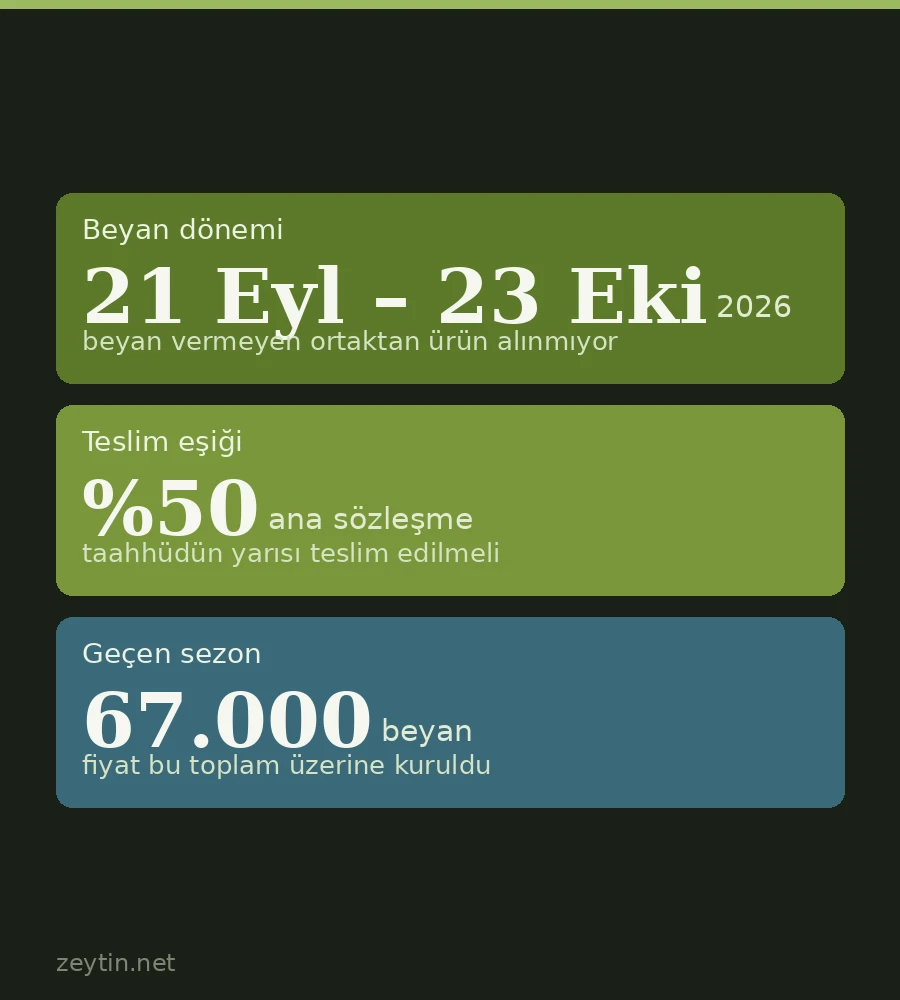
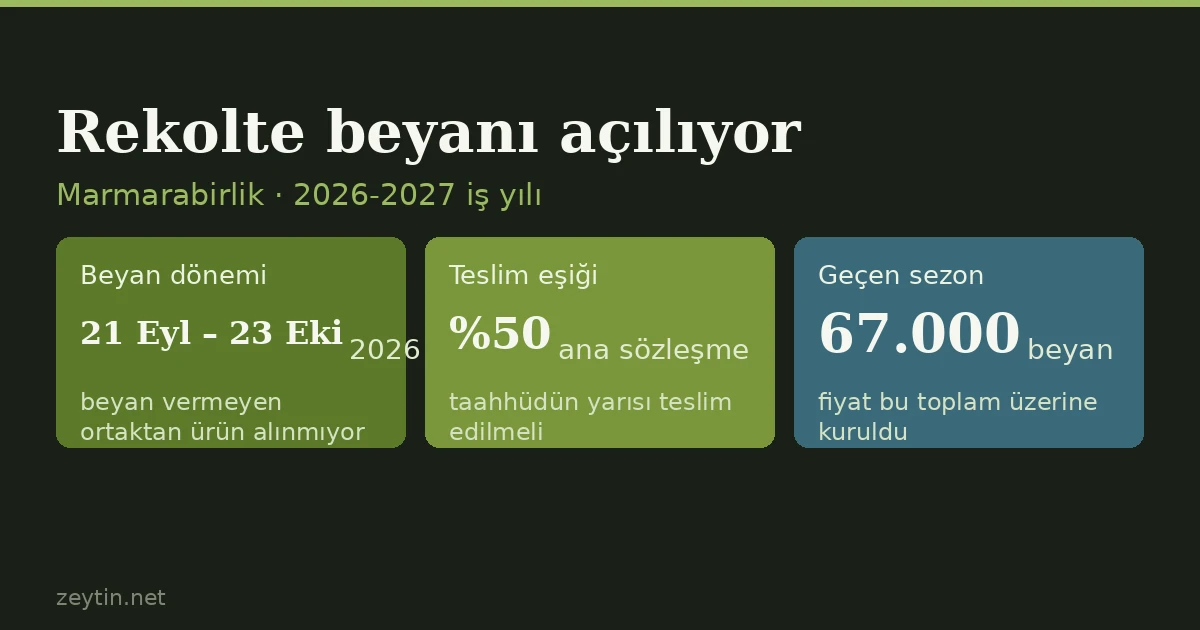
The table olive season in the Marmara region does not open with the harvest. It opens with a piece of paper. At cooperatives affiliated with Marmarabirlik — the union of olive agricultural sales cooperatives that effectively sets the producer price for black table olives in north-western Türkiye — crop declarations for the 2026-27 business year open on Monday 21 September and close on 23 October 2026.
According to the notice published by the Gemlik Olive Agricultural Sales Cooperative to its members, the condition is unambiguous: a member who does not file a declaration cannot sell olives to the cooperative this season. And the declared quantity is not limited to fruit destined for the table. It covers the entire crop the member plans to deliver, oil olives included.
The declaration is a commitment, not a forecast
Seen from outside, a crop declaration looks like a survey: the grower writes down how much fruit they expect this year. Inside a cooperative system the document does considerably more. With the same form, the member commits to how much olive they will actually deliver. The union's intake capacity, its processing plan and, at the end of the process, the price it announces are all built on that aggregate. Last season's final prices were calculated on the basis of 67,000 declarations received from members.
The commitment has teeth. Under Marmarabirlik's articles of association, a member who fails to file a crop declaration in five consecutive business years — or who fails to deliver at least 50 per cent of the quantity pledged in that declaration — may be expelled from membership. The same fifty-per-cent threshold appears among the conditions for attending the general assembly: a member who has not filed, or who has not delivered half of what they pledged, falls outside the union's decision-making body as well.
This is a structural point that outside observers of the Turkish table olive trade often miss. Marmarabirlik is not a buyer of last resort that growers can use opportunistically. It is a membership organisation whose purchasing capacity is planned a season ahead, and the declaration is the instrument that makes the planning possible. A member who declares a large crop and then sells it on the open market when private buyers offer more is, in the union's framework, breaking a commitment rather than exercising a commercial choice.
Around 300 members on the threshold in Orhangazi
The clearest illustration that the rule is not theoretical comes from Orhangazi, one of the largest olive districts in Bursa province. According to a statement by Hüseyin Sevdi, chairman of the Marmarabirlik Orhangazi Olive Agricultural Sales Cooperative, roughly 300 members of that cooperative are at a critical threshold this season because of their delivery record over the past four years. If they again fail to meet their obligation in the 2026-27 season, the five-year period set out in the articles of association will be complete.
Sevdi says the Orhangazi cooperative expects declarations totalling around 8,000 tonnes from its members this year, and his message to growers is a single one: declare realistically, and write down the quantity you can genuinely deliver at harvest.
Why a record crop makes declaring harder
The timing of that warning is not accidental. In olive cultivation 2026 is an "on" year in Türkiye, and expectations are high. According to the Turkish Statistical Institute's first crop production estimate for 2026, olive production is expected to rise 55.7 per cent, from 2.45 million tonnes last year to 3.814 million tonnes. If the estimate holds, it would surpass the previous record of 3.75 million tonnes set in 2024. For reference, the lowest figure of the past five years was 1.52 million tonnes in 2023 — the swing between an "on" and an "off" year in Türkiye is larger than the entire annual output of most producing countries.
A large crop makes over-declaring attractive. If the cooperative ends up applying a quota at intake, a grower who declared more stands to capture a larger share, and the temptation is to write down a figure above real expected production. Marmarabirlik has warned against precisely this behaviour in previous seasons.
The risk also runs the other way, and this is where the calendar bites. The declaration is filed in September; the fruit is delivered in December; and a great deal can happen in a grove in between. In Erdek, on the Kapıdağ peninsula, a hailstorm on 13 July struck roughly 420 hectares and caused an estimated loss of around 3,500 tonnes, according to the assessment of the 162 Erdek Olive Agricultural Sales Cooperative. A declaration written optimistically in September can end up below the fifty-per-cent threshold by December through no fault of the grower.
Membership reopens after eight years
This season the declaration window coincides with a second process. Marmarabirlik is accepting new members for the first time since 2018. Following a decision taken in June, applications opened at the eight cooperatives affiliated with the union. As of early August, 40 growers had applied to the Orhangazi cooperative alone, and applications are expected to remain open until the end of the crop declaration period. That makes 23 October a deadline not only for existing members but for growers seeking to join.
The price comes after the declaration
The number growers care about most — the purchase price — arrives at the end of this calendar, not the beginning. Marmarabirlik sets it after the declarations are collected, at a coordination meeting attended by the chairs of the member cooperatives. In last season's final list the ceiling price was 160 lira per kilo for 18-count fruit, the floor 55 lira for 41-count, and oil olives 53 lira; the detail is in our piece on Marmarabirlik purchase prices. Why fruit size divides the price so sharply is something we examined in the economics of caliber.
What pressures will shape this season's price is a separate argument; we looked at why a floor price is being debated while the harvest forecast climbs in harvest forecast and the minimum price debate.
The rest of the season is tight. The 162 Erdek cooperative, founded in 1954, has around 4,500 members, and its chairman Abdullah Şenol says the harvest should be finished by 15 December for quality reasons. With the declaration window closing on 23 October, that leaves a member roughly seven weeks of picking to make good on the commitment. The distance between those two dates is what will decide the season in Marmara: the figure written in September, and the olives that reach the scales in December.
One rating per visitor; you can change yours at any time. Ratings are real reader votes — no seeded or default scores.
Related
 Article
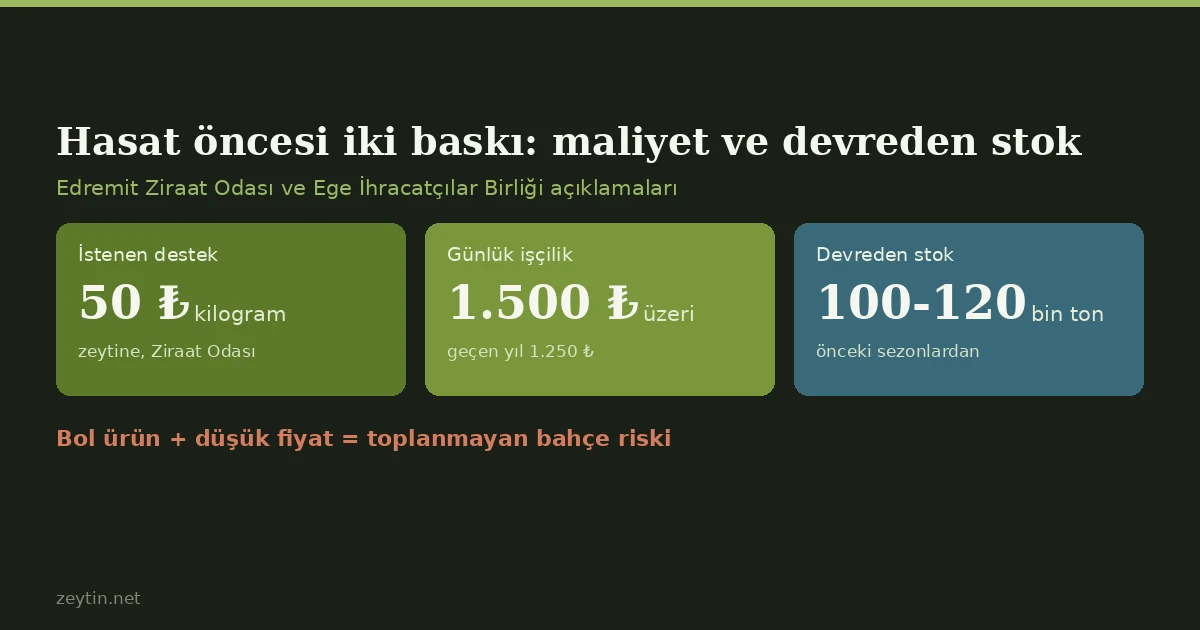
Two pressures before the harvest: costs and 100,000 tonnes carried over
The chamber of agriculture wants 50 lira per kilo; daily labour has passed 1,500 lira. Exporters report 100,000-120,000 tonnes carried over from previous seasons.
Article
Two pressures before the harvest: costs and 100,000 tonnes carried over
The chamber of agriculture wants 50 lira per kilo; daily labour has passed 1,500 lira. Exporters report 100,000-120,000 tonnes carried over from previous seasons.
 Article
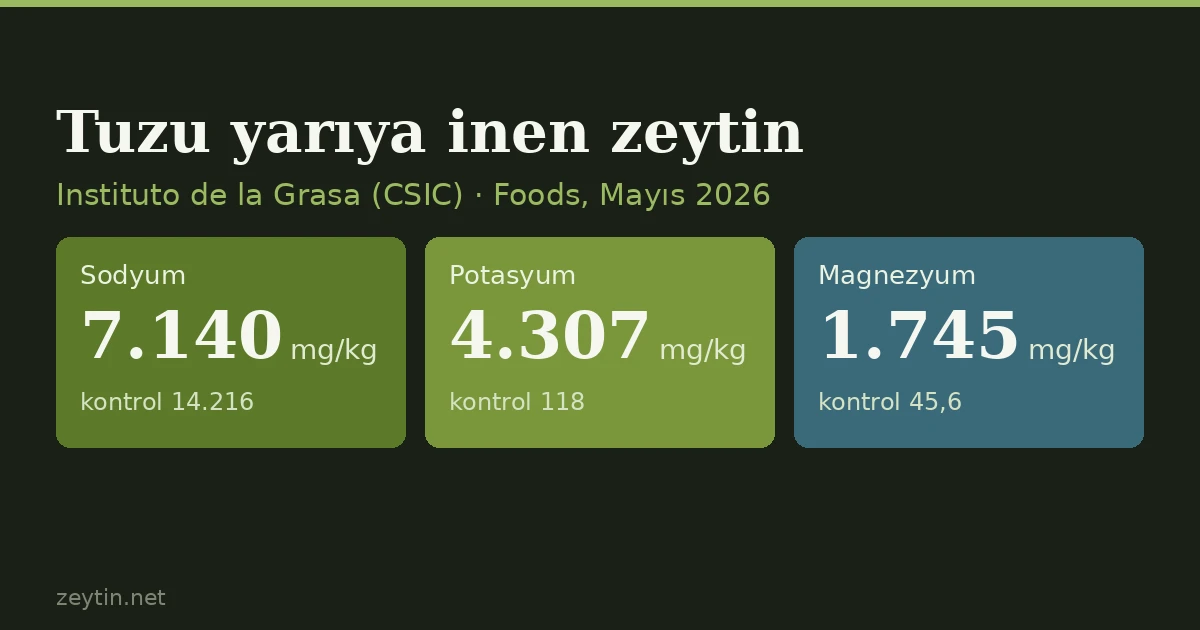
Table olives with half the salt: potassium, calcium and magnesium instead of sodium
Researchers at Spain's Instituto de la Grasa (CSIC) cut sodium in pimento-stuffed green Manzanilla olives from 14,216 mg to about 7,100 mg per kilogram. Potassium, calcium and magnesium salts added to the packing brine made the olives a source of these minerals.
Article
Table olives with half the salt: potassium, calcium and magnesium instead of sodium
Researchers at Spain's Instituto de la Grasa (CSIC) cut sodium in pimento-stuffed green Manzanilla olives from 14,216 mg to about 7,100 mg per kilogram. Potassium, calcium and magnesium salts added to the packing brine made the olives a source of these minerals.
 Article
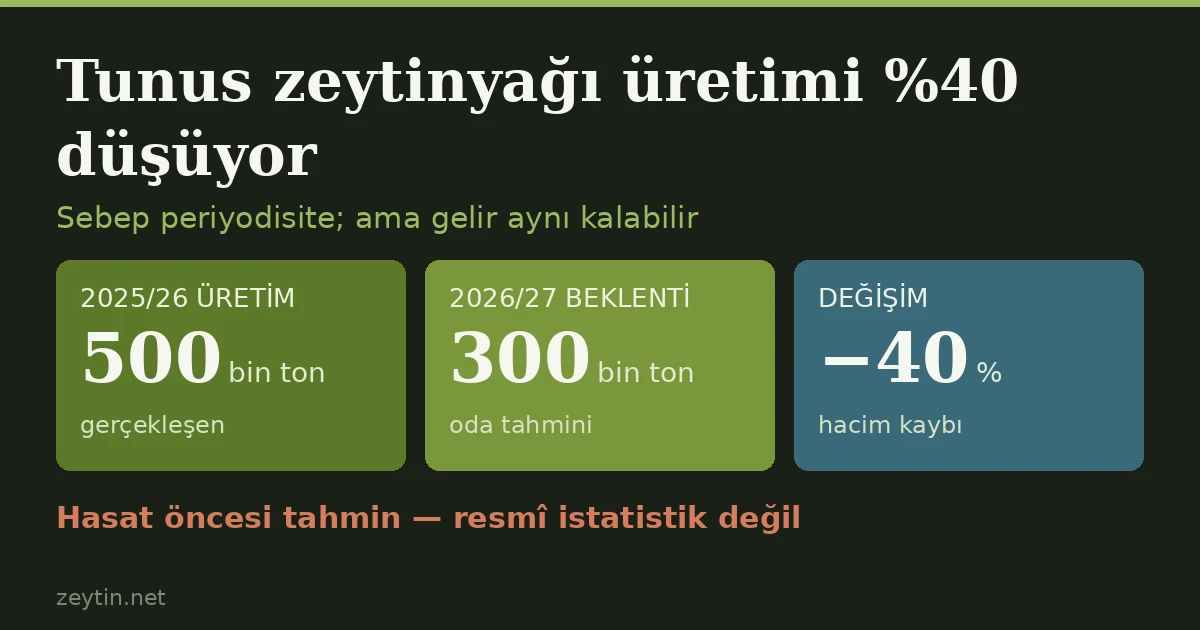
Tunisia's output falls from 500,000 to 300,000 tonnes — revenue may hold
Tunisia's National Chamber of Olive Producers expects olive oil output to fall from 500,000 to 300,000 tonnes in 2026/27, citing alternate bearing. Revenue is still expected to match last season because prices are higher. Türkiye's most direct bulk competitor is shrinking.
Article
Tunisia's output falls from 500,000 to 300,000 tonnes — revenue may hold
Tunisia's National Chamber of Olive Producers expects olive oil output to fall from 500,000 to 300,000 tonnes in 2026/27, citing alternate bearing. Revenue is still expected to match last season because prices are higher. Türkiye's most direct bulk competitor is shrinking.
 Article
The world's largest bottler is for sale: a €500 million race for Deoleo
Deoleo, owner of Bertolli and Carbonell, holds 22% of global bottled olive oil sales. Italy's Coricelli leads at €500 million, Spain's Dcoop cooperative at €470 million. The Spanish government regards the company as nationally strategic. Because Deoleo is a major bulk buyer, the outcome matters to Turkish exporters too.
Article
The world's largest bottler is for sale: a €500 million race for Deoleo
Deoleo, owner of Bertolli and Carbonell, holds 22% of global bottled olive oil sales. Italy's Coricelli leads at €500 million, Spain's Dcoop cooperative at €470 million. The Spanish government regards the company as nationally strategic. Because Deoleo is a major bulk buyer, the outcome matters to Turkish exporters too.