How to read olive oil exchange prices
Three exchanges, three averages for the same product: 201, 254 and 308 lira. In Nazilli, trades from 132.79 to 225.00 in a single day. What an exchange price measures, and why date and volume matter more than the average.
"What is the exchange price of olive oil?" has no single answer, and cannot have one. This article explains what prices published by Türkiye's commodity exchanges measure, what they do not, and how a producer can actually use them. The examples are real records from our exchanges page.
What an exchange price is
A price registered at a commodity exchange is a record of transactions that actually took place there. It is not a target, a recommendation or a forecast — it is the outcome of a completed trade.
That is what gives it its value: it is a number at which real money changed hands. But the same property sets its limit. An exchange sees only the trades brought to it. Oil sold directly to a mill, moved through a cooperative or committed under contract never enters the record. A substantial share of Türkiye's olive oil changes hands outside the exchanges.
An exchange price is therefore not "the market price" but the slice of the market visible to that exchange.
There is no single "extra virgin price"
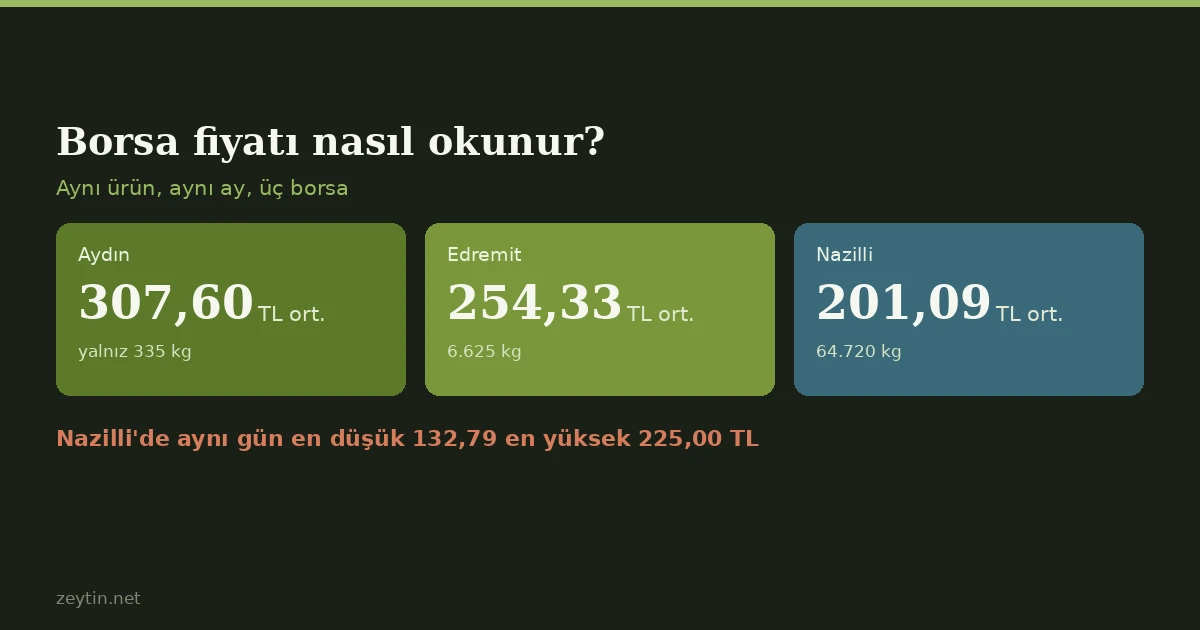
The commonest error is to take one exchange's figure as the price of olive oil. The three records below come from our own collected data, all from August 2026, all for the same product:
| Exchange | Date | Low | High | Average | Volume |
|---|---|---|---|---|---|
| Aydın | 18.08.2026 | 303.96 | 316.84 | 307.60 | 335 kg |
| Edremit | 25.08.2026 | 248.00 | 290.00 | 254.33 | 6,625 kg |
| Nazilli | 19.08.2026 | 132.79 | 225.00 | 201.09 | 64,720 kg |
The averages run from 201.09 to 307.60 lira — a 53% spread. All three are correct. No single number for "the price of extra virgin" comes out of this table.
What sits underneath the average
The real information is not in the average but in the low-to-high range.
Look at the Nazilli record: on the same day, at the same exchange, under the same product name, the lowest trade was at 132.79 lira and the highest at 225.00 — a 69% difference. The average of 201.09 does not sit at the midpoint of those two (178.90) but closer to the top, meaning most trades happened in the upper half of the range while sales still occurred at the bottom.
That range says something important: "extra virgin olive oil" is not one commodity. Within a single grade, acidity, sensory quality, harvest timing, storage conditions and lot size all move the price. A twofold price gap is two different products sold under one name.
For a producer the right question is therefore not "what is the average?" but "where in this range does my oil sit?"
Check the date: the row is not today's
The date in an exchange table is not the day the data was collected but the day the last trade in that product was recorded. If a product goes untraded for weeks, the row simply stays where it is.
Two examples from our own data:
- The Aydın row for black brined olives is dated 06.04.2026.
- The Aydın row for green speciality olives is dated 14.05.2026.
Viewed in August, those rows are still on screen — but the prices they carry are four to five months old. An exchange table read without checking the date invites mistaking a past season's price for today's.
Price cannot be read without volume
In the table above Aydın shows the highest average at 307.60 lira. But that average rests on 335 kilograms of trade. Nazilli's 201.09 rests on 64,720 kilograms — roughly two hundred times as much.
A small-volume trade reflects what one buyer paid for one lot and does not represent the market. A high-volume record averages many transactions and is more reliable.
The practical rule: do not trust an average without seeing the volume. An exchange showing a high price does not mean you can sell there at that price; it may simply be that one small, special lot traded that day.
Applying the same reasoning to crop forecasting is equally wrong; on why traded volume is not production volume, see exchange volume is not the harvest.
Product names do not mean the same thing at every exchange
Exchange product definitions are not bound to a common vocabulary. Under the heading "crude olive oil" our data holds these four records:
| Exchange | Date | Average | Volume |
|---|---|---|---|
| Edremit | 30.07.2026 | 158.40 | 750 kg |
| Aydın | 21.07.2026 | 187.40 | 23,890 kg |
| Nazilli | 26.08.2026 | 220.00 | 2,500 kg |
| Gaziantep | 06.08.2026 | 250.00 | 500 kg |
Oil recorded as "crude" in Gaziantep (250.00) is nearly double the bottom of the range for lots recorded as "extra virgin" in Nazilli (132.79). This does not mean crude oil is dearer than extra virgin — it means two exchanges are using the same word for different goods.
For the technical definitions of the grades see extra virgin, virgin and riviera explained. A grade's definition on paper and an exchange's record heading do not always coincide.
How a producer should use the figure
Do not look at one exchange. Put at least three side by side; the gap between them is information in itself.
Read the range, not the average. Estimate which end your own oil belongs to.
Check the date. How old is the row? Anything over a week may not represent today's market.
Look at volume. Do not treat a high price on a small volume as a target.
Follow the direction, not the level. A single day's figure is noisy; several weeks of movement tells you more than any one record. Current figures are on the exchanges page.
Frequently asked
Is the exchange price what the producer receives? No. The registered price is the transaction itself; commission, transport and withholding sit outside it.
Why do Edremit and Aydın always differ? Different regions, varieties, buyer structures and trade volumes. Edremit trades mainly Ayvalık, the Aydın area mainly Memecik — not the same goods.
Which exchange shows the "right" price? None on its own. Each shows its own trades accurately; none shows the whole market.
One rating per visitor; you can change yours at any time. Ratings are real reader votes — no seeded or default scores.
Related
 Article
Marmarabirlik purchase prices: what the grower actually receives in Marmara
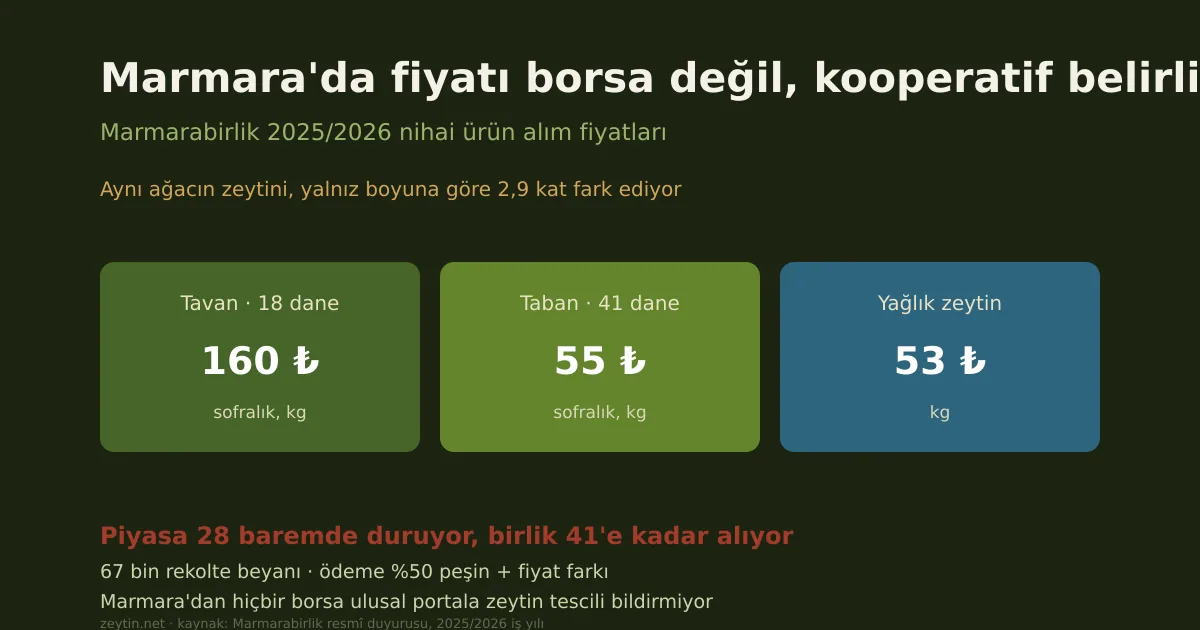
The 2025/2026 season: 160 ₺ for calibre 18, 55 ₺ for calibre 41, 53 ₺ for oil fruit. Size alone changes the price 2.9×, and the union buys down to calibre 41 where the market stops at 28.
Article
Marmarabirlik purchase prices: what the grower actually receives in Marmara
The 2025/2026 season: 160 ₺ for calibre 18, 55 ₺ for calibre 41, 53 ₺ for oil fruit. Size alone changes the price 2.9×, and the union buys down to calibre 41 where the market stops at 28.
 Article
The same olive, six times the price: the quiet advantage of table olives
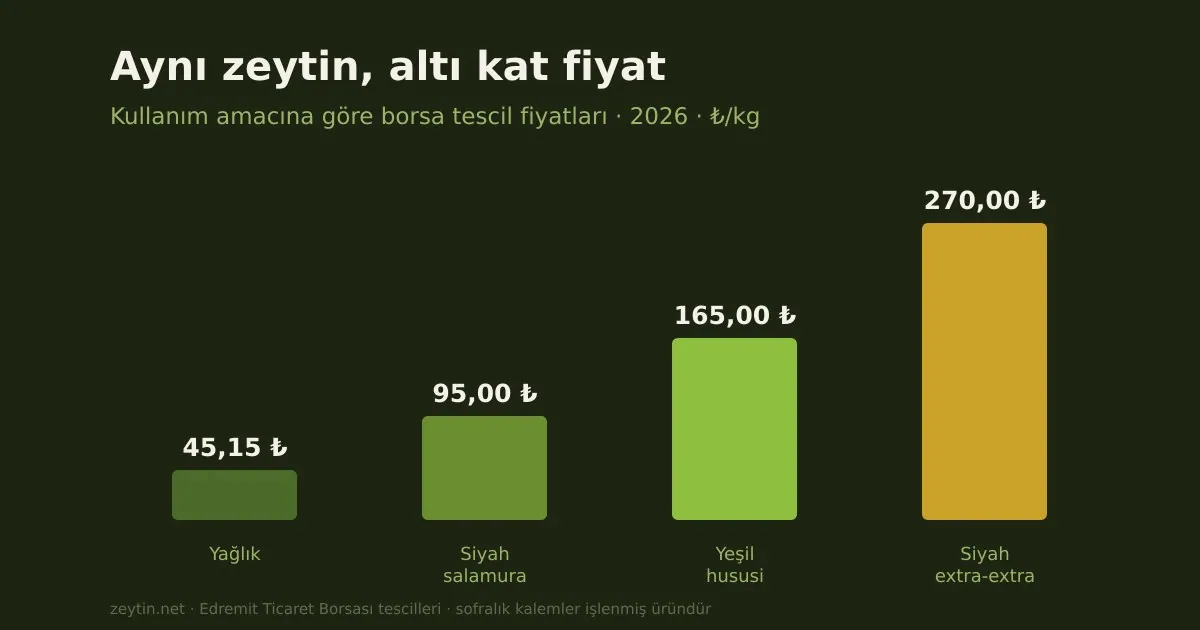
How much more does the same fruit fetch as a table olive than for oil? Measured over seven years of exchange data: 1.43 to 3.46 times.
Article
The same olive, six times the price: the quiet advantage of table olives
How much more does the same fruit fetch as a table olive than for oil? Measured over seven years of exchange data: 1.43 to 3.46 times.
 Article
Exchange volume is not the harvest: what the 2023 record actually recorded
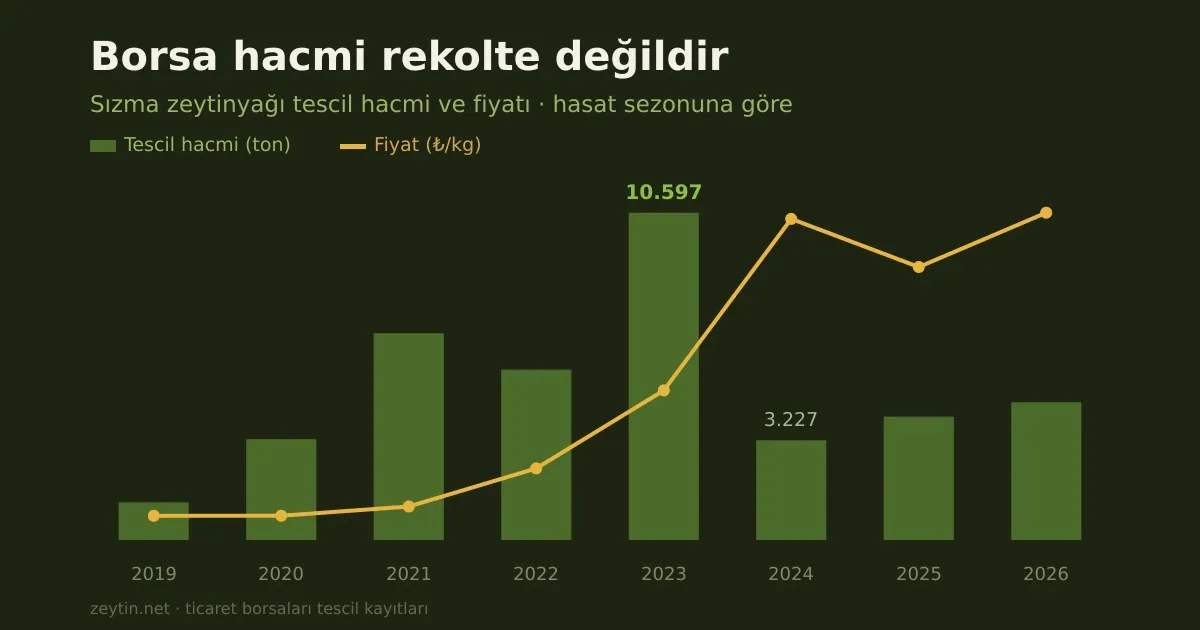
10,597 tonnes registered in 2023, down to 3,227 the next season. Harvest collapse or a change of channel? The data cannot tell them apart.
Article
Exchange volume is not the harvest: what the 2023 record actually recorded
10,597 tonnes registered in 2023, down to 3,227 the next season. Harvest collapse or a change of channel? The data cannot tell them apart.
 Article
Olive oil trade in the Ottoman Empire: Britain the buyer, the crop the price
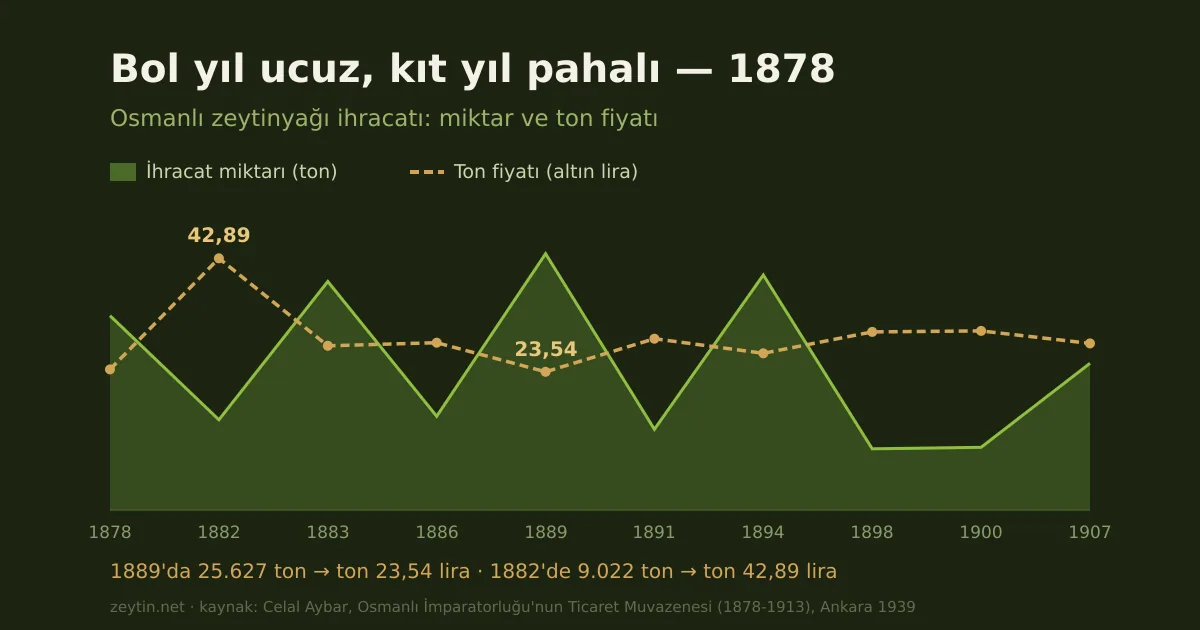
25,627 tonnes exported in 1889 at 23.54 lira a tonne; 9,022 tonnes in 1882 at 42.89. The crop-price inverse held a century ago too.
Article
Olive oil trade in the Ottoman Empire: Britain the buyer, the crop the price
25,627 tonnes exported in 1889 at 23.54 lira a tonne; 9,022 tonnes in 1882 at 42.89. The crop-price inverse held a century ago too.