Güney Ege Olive Oils: a designation of origin across three provinces
Registration no 79, published in the Official Gazette in 2004, covers more than thirty-three districts across İzmir, Aydın and Muğla. The reasoning is not administrative but varietal: the region holds almost all of Türkiye's Memecik trees.
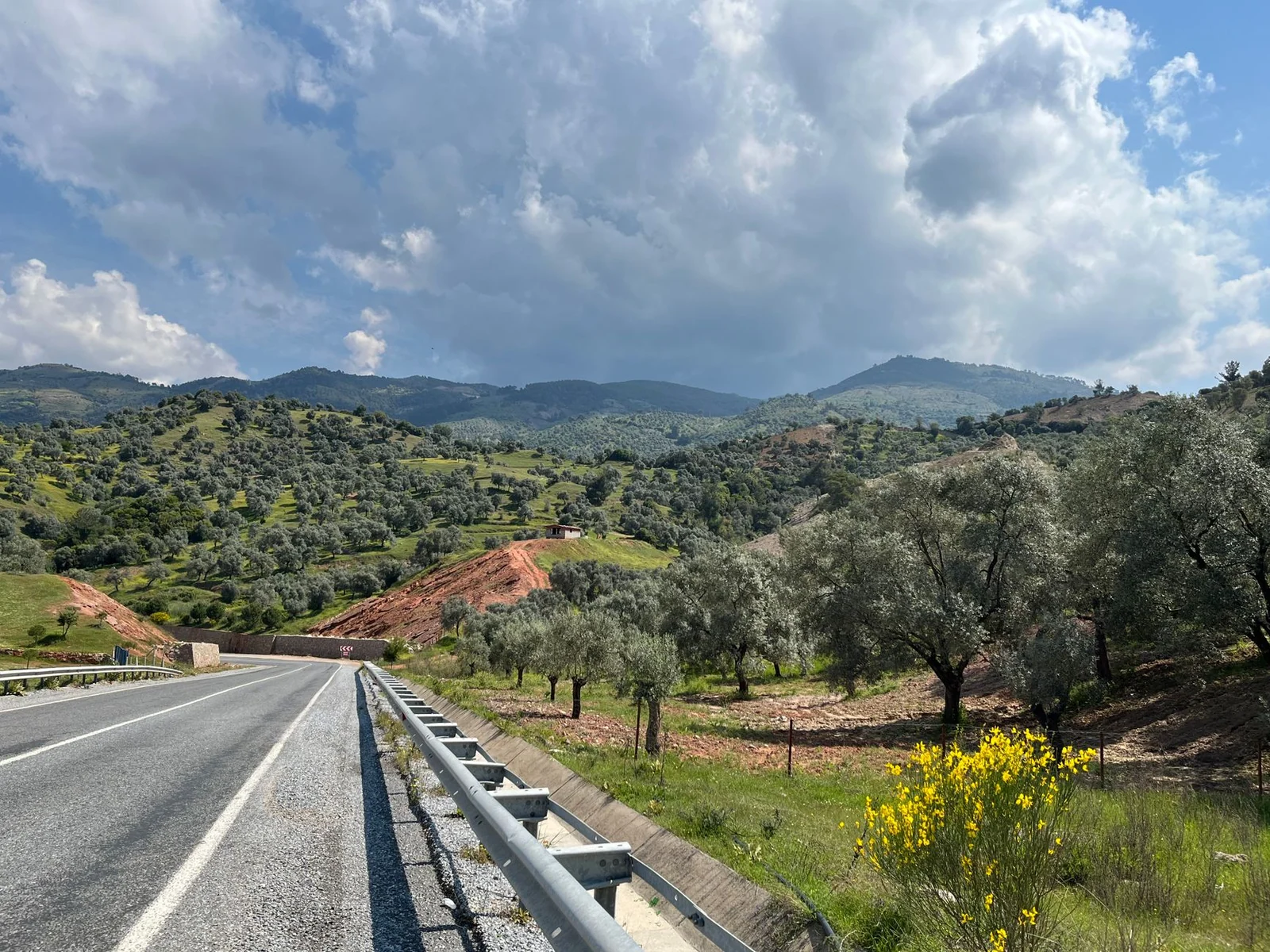
Türkiye's olive oil registrations usually cover a district, sometimes a gulf. Güney Ege Zeytinyağları covers three provinces and more than thirty districts — one of the widest geographical areas among our olive oil designations of origin.
The record
| Registration no | 79 |
| Application | C2003/016 · 29.04.2003 |
| Publication | 29.07.2004 · Official Gazette 25537 |
| Type | Designation of origin (PDO) |
| Registered by | S.S. Tariş Olive and Olive Oil Agricultural Sales Cooperatives Union |
| Cultivar | Memecik |
The registration dates from the era of Decree-Law 555 on the Protection of Geographical Indications, before today's Industrial Property Law 6769. That makes it one of Türkiye's oldest olive oil registrations.
Three provinces, thirty-three districts
The geographical area in the document, province by province:
| Province | Districts |
|---|---|
| İzmir | Foça, Menemen, Kemalpaşa, Ödemiş, Tire, Torbalı, Bayındır, Selçuk |
| Aydın | Kuşadası, Ortaklar, Germencik, Erbeyli, İncirliova, Köşk, Nazilli, Kuyucak, Atça, Sultanhisar, Buharkent, Yenipazar, Koçarlı, Söke, Dalama, Çine, Bozdoğan |
| Muğla | Milas, Yatağan, Bodrum, Fethiye, Ortaca, Köyceğiz, Marmaris, Dalaman |
Such breadth might look like a weakness — the logic of a geographical indication is to narrow. But the justification here is the cultivar: the region holds almost the whole of Türkiye's Memecik tree stock. The boundary is not administrative but the cultivar's actual range.
Memecik: named after the tip of its fruit
Defining the cultivar, the document gives its most distinctive feature in one phrase: the nipple-like protrusion at the tip of the fruit. The fruit is large and oval, its tip curving slightly to one side — asymmetric.
The cultivar's origin is recorded as Muğla. Locally it goes by several names: Taş arası, Aşıyeli, Gülümbe, Şehir, Yağlık are all the same cultivar. That a cultivar carries so many local names is a sign of long presence in one geography.
Memecik serves both oil and table use; fruit picked at the green stage is processed Spanish-style for the table. For its measured values see our Memecik page.
What the document constrains
On production the document is brief but firm: the oil must be obtained in a thermal environment that does not alter the olive's own characteristics, using only mechanical or physical operations — washing, decanting, centrifugation and filtration.
And one flat prohibition: no chemical process may be applied.
Plant type is left open — continuous systems and traditional methods meeting hygiene requirements are both accepted. Here the document binds the outcome rather than the technology, an approach common in registrations of that period.
Why it matters
Güney Ege is the region that forms the centre of gravity of Turkish production for both table and oil use. Drawing the registration this wide shows a choice: rather than creating a single district brand, it protects the cultivar-geography whole.
For comparison, Tariş's other registration, Kuzey Ege Zeytinyağları (no 392), rests on the Ayvalık cultivar and covers ten localities. Together the two separate the Aegean's two olive worlds: Ayvalık in the north, Memecik in the south.
The area as the document defines it
The short line in the record does not give the registration's full boundary. The document's own definition reads:
t; :79 :29.04.2003 :C 2003/016 29.07.2004 : Menşe Adı : S. S. Tariş Zeytin ve Zeytinyağı Tarım Satış Kooperatifleri Birliği : 1492 Sok. No: 14 Alsancak İZMİR : GÜNEY EGE ZEYTİNYAĞLARI : İzmir/Foça, Menemen, Kemalpaşa, Ödemiş, Tire, Torbalı, Bayındır, Selçuk; Aydın/Kuşadası, Ortaklar, Germencik, Erbeyli, İncirliova, Köşk, Nazilli, Kuyucak, Atça, Sultanhisar, Buharkent, Yenipazar, Koçarlı, Söke, Dalama, Çine, Bozdoğan; Muğla/Milas, Yatağan, Bodrum, Fethiye, Ortaca, Köyceğiz, Marmaris, Dalaman ilçelerini kapsayan bölge Kullanılacağı ürün : Zeytinyağı Teknik özellikleri ve denetim biçimi ekte verilen coğrafi işaret 29.07.2004 tarih ve 25537 sayılı Resmi Gazete'de ilan edilmiş ve 555 sayılı Coğrafi İşaretlerin Korunması Hakkındaki Kanun Hükmünde Kararname'nin 12 nci maddesi gereğince 29.07.2004 tarihinden geçerli olmak üzere tescil edilmiştir. Uzman : Hakan Kızıltepe 27/04/2006 KY Dai. Bşk. : Kutay Kumbasar 27/04/2006 TÜRK PATENT (ENSTİTÜSÜ
The production steps in the document
The registration describes production step by step. The document's own sequence:
1. Natürel Zeytinyağı — Zeytin ağacı meyvesinden doğal niteliklerinde bir değişikliğe neden olmayacak bir ısıl ortamda sadece yıkama, sızdırma, santrifüj ve filtrasyon işlemleri gibi mekanik veya fiziksel işlemler uygulanarak elde edilen, berrak, sarıdan…
2. Natürel Sızma Zeytinyağı — Zeytin ağacı meyvesinden doğal niteliklerinde bir değişikliğe neden olmayacak bir ısıl ortamda sadece yıkama, sızdırma, santrifüj ve filtrasyon işlemleri gibi mekanik veya fiziksel işlemler uygulanarak elde edilen, berrak, sarıdan…
3. Natürel Birinci Zeytinyağı — Zeytin ağacı meyvesinden doğal niteliklerinde bir değişikliğe neden olmayacak bir ısıl ortamda sadece yıkama, sızdırma, santrifüj ve filtrasyon işlemleri gibi mekanik veya fiziksel işlemler uygulanarak elde edilen, berrak, sarıdan…
4. Natürel İkinci Zeytinyağı — Zeytin ağacı meyvesinden doğal niteliklerinde bir değişikliğe neden olmayacak bir ısıl ortamda sadece yıkama, sızdırma, santrifüj ve filtrasyon işlemleri gibi mekanik veya fiziksel işlemler uygulanarak elde edilen, berrak, sarıdan…
5. Ham Zeytinyağı — Serbest yağ asitliği Yo3.3'ten düşük bile olsa tat, koku ve aroması iyi olmayan, kusur içeren ve bu özellikleri nedeniyle doğrudan tüketime uygun olmayan rafinasyon işlemine tabi tutulması gereken zeytinyağları ham zeytinyağı tanımına…
6. Rafine Zeytinyağı — Yüksek asitli, istenmeyen tat ve kokuda olan ham zeytinyağları, fiziksel rafinasyon işleminden geçirilir.
7. Riviera Zeytinyağı — Rafine zeytinyağı ile natürel zeytinyağlarının belli oranlarda karıştırılmasıyla elde edilen, yeşilden sarıya değişebilen renkte, kendine özgü tat ve kokuda olan, serbest yağ asitliği en çok 9b 1,5 olan zeytinyağıdır.
8. Organik Natürel Zeytinyağı — Geleneksel natürel zeytinyağı üretiminin dışında, organik kabul edilmeyen hiçbir tarım ilacı, hormon, gübre kullanılmaksızın sadece organik tarım yöntemleri uygulanan alanlarda organik zeytinyağı (ekolojik, biyolojik zeytinyağı olarak…
That this sequence is binding is what separates a geographical indication from a trade mark: a mark says who produced something, a geographical indication also sets down how it must be produced.
The cultivar behind it, measured
The registration is granted to a place, but the cultivar the definition rests on has measurable values:
| Property | Value |
|---|---|
| 1 kg’daki tane sayısı | 210 |
| Et oranı | %88 |
| Et / çekirdek oranı | 5,86 |
| Et/çekirdek oranı | 6,7 |
| Yağ oranı | %25-28 |
| Toplam fenol | 296-407 mg CAE/kg |
| α-tokoferol | 219-324 mg/kg |
| Olgunlaşma | Kasım ortası - aralık ortası |
| Kendine verimlilik | Kısmi |
| Soğuğa dayanım | Orta |
| Kullanım | Yağlık; yeşil ve siyah sofralık olarak da tüketilir |
| Ağaç | yarı dik, kuvvetli |
Oil content reaches 28% at the top of its range — on its own enough to justify pressing. The cultivar is partially self-fertile; pollinators are used to secure yield. A flesh-to-stone ratio of 5.86 is the basic measure of how much of a table olive is actually eaten.
Its place in İzmir's olive production
| Item | Value |
|---|---|
| Fruit production | 485,275 t |
| — for oil | 440,096 t |
| — for the table | 45,179 t |
| Olive oil production | 70,767 t |
| Trees | 18,177 thousand |
| Yield per tree | 26.7 kg |
91% of the province's fruit goes to oil. An oil-based registration matches how the province actually produces.
One rating per visitor; you can change yours at any time. Ratings are real reader votes — no seeded or default scores.
Related
 Article
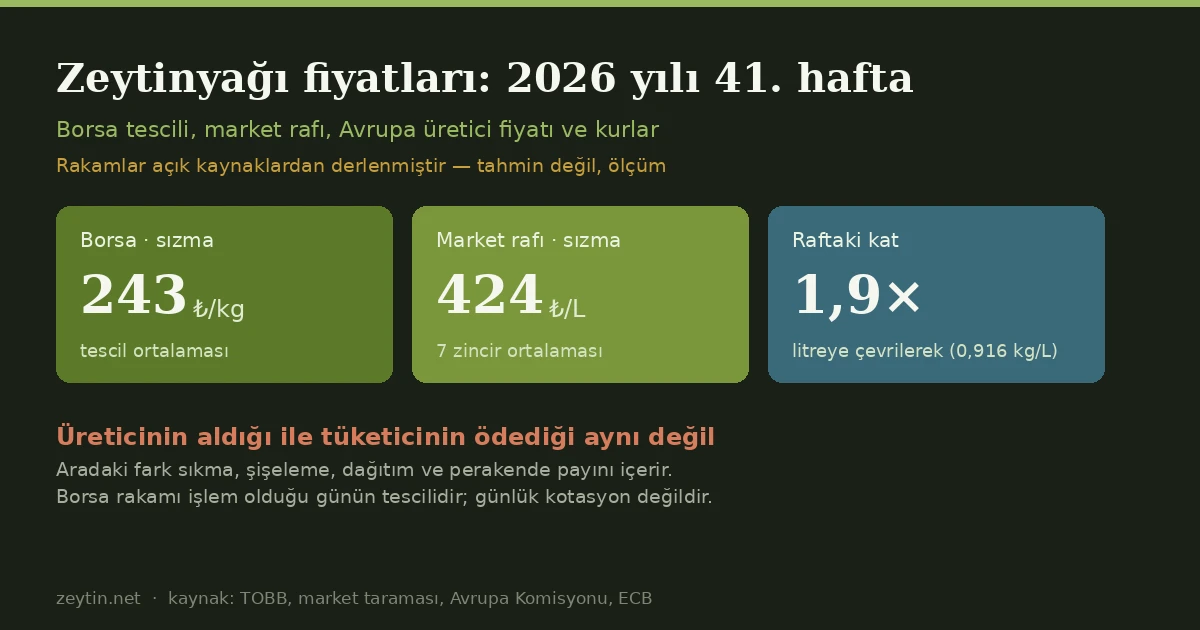
Olive Oil Prices: Week 41 of 2026
Week 41 of 2026: Turkish exchange prices, European producer prices and exchange rates side by side.
Article
Olive Oil Prices: Week 41 of 2026
Week 41 of 2026: Turkish exchange prices, European producer prices and exchange rates side by side.
 Article
Olive Oil Fraud and Adulteration: How It Is Done and How It Is Caught
Seed oil blending, refined oil sold as extra virgin, soft deodorisation… The economics of fraud, the laboratory methods, and the home tests that do not work.
Article
Olive Oil Fraud and Adulteration: How It Is Done and How It Is Caught
Seed oil blending, refined oil sold as extra virgin, soft deodorisation… The economics of fraud, the laboratory methods, and the home tests that do not work.
 Article
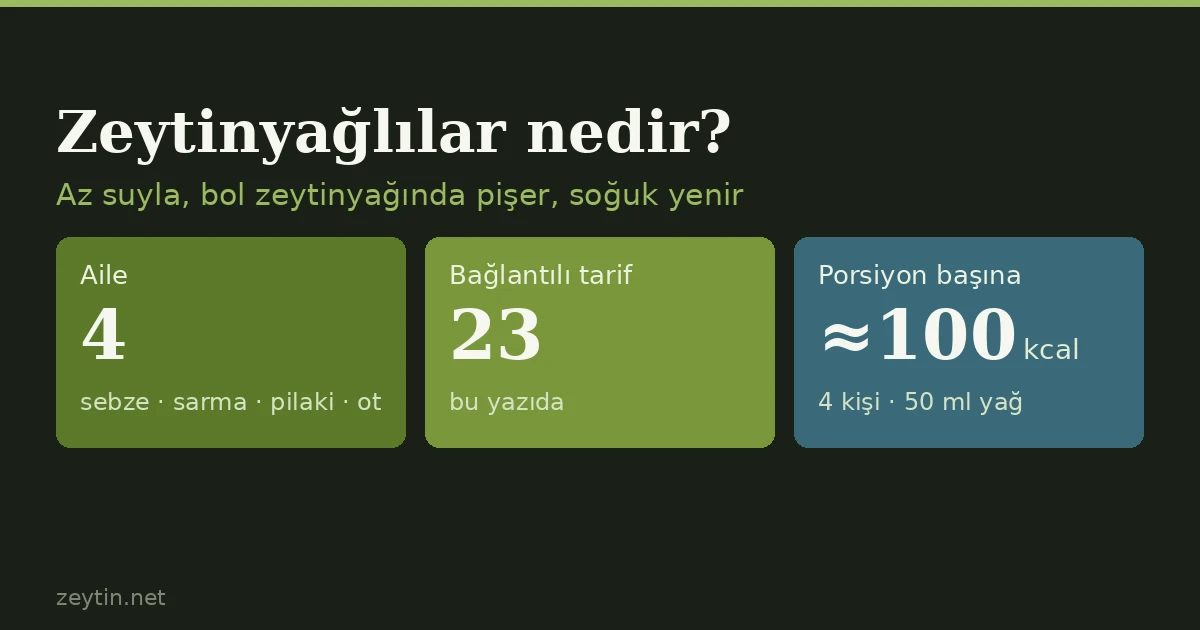
What are zeytinyağlılar? The logic of Turkish dishes cooked in olive oil
Zeytinyağlılar are Turkish dishes in which vegetables or pulses are cooked with little water in plenty of olive oil until they absorb their own juices, then eaten cold at room temperature. They contain no meat, can be made a day ahead and taste better the next day. Vegetable dishes, stuffed leaves and vegetables, pilaki beans and Aegean wild greens are the four main families.
Article
What are zeytinyağlılar? The logic of Turkish dishes cooked in olive oil
Zeytinyağlılar are Turkish dishes in which vegetables or pulses are cooked with little water in plenty of olive oil until they absorb their own juices, then eaten cold at room temperature. They contain no meat, can be made a day ahead and taste better the next day. Vegetable dishes, stuffed leaves and vegetables, pilaki beans and Aegean wild greens are the four main families.
 Article
Erdek Kapıdağ Olive Oil: an oil whose grade changes in dry years
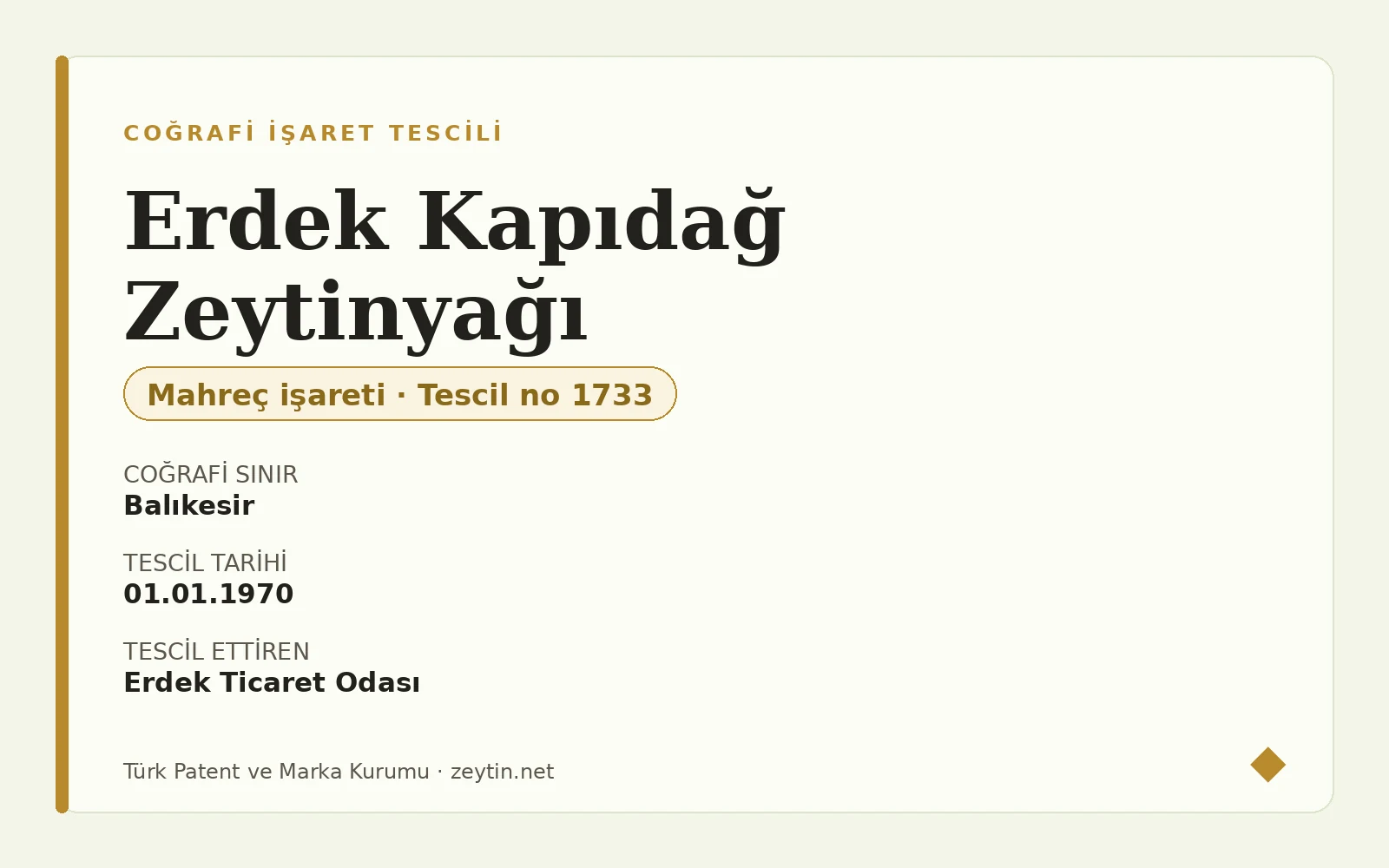
Registered in 2024. The certificate admits something rare: in dry periods the oil can fall from extra virgin to virgin grade.
Article
Erdek Kapıdağ Olive Oil: an oil whose grade changes in dry years
Registered in 2024. The certificate admits something rare: in dry periods the oil can fall from extra virgin to virgin grade.