Do starlings damage olive crops? Winter flocks and what growers can do
Starlings eat ripe olives from the tree and the ground, 15-20 grams per bird a day. In Apulia 12.6% of the expected crop was lost over three winters, 35% near roosts. Why scaring devices wear off and why harvest timing matters.
Short answer: yes, but the damage is far from even. In the regions where it spends the winter, the common starling (Sturnus vulgaris) takes ripe olives both from the branches and from the ground and swallows the fruit whole. The losses cluster around the roosts where the birds spend the night, and the groves hit hardest are those harvested late and picked up from the ground. This article looks at what three winters of measurements in Apulia, southern Italy, found, why scaring devices lose their effect so quickly, and why the harvest calendar is the strongest tool a grower has.
Why do starlings come down on olive groves?
The starling is a flocking bird with a broad diet that runs from insects to fruit. As insects become scarce in autumn, it turns to fruit. A large share of the flocks wintering around the Mediterranean come from the north: the Apulia study notes that the starlings wintering in the region arrive from a wide area stretching from Central Europe to Russia.
That migration overlaps with the months in which olives ripen and are harvested. The same study gives November to February as the period of highest starling density. As long as ripe fruit stays on the trees and on the ground, the flock has an easy and plentiful winter food supply.
How many olives does a starling eat?
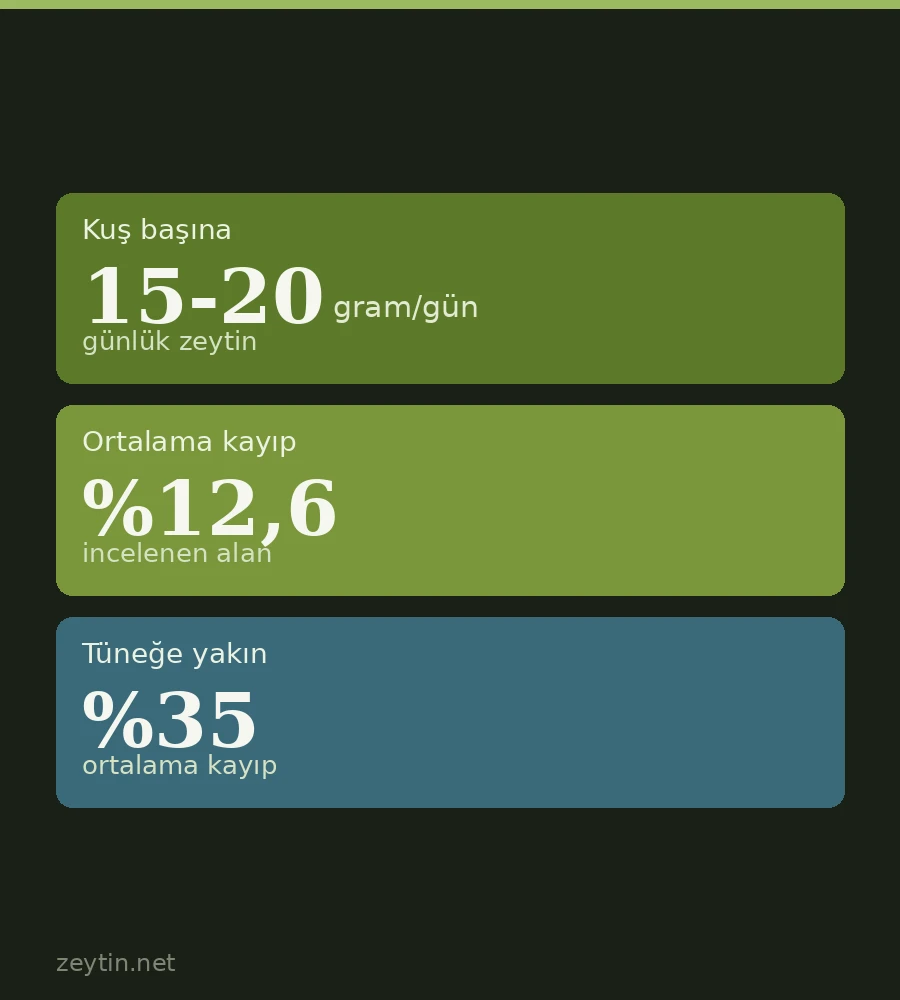
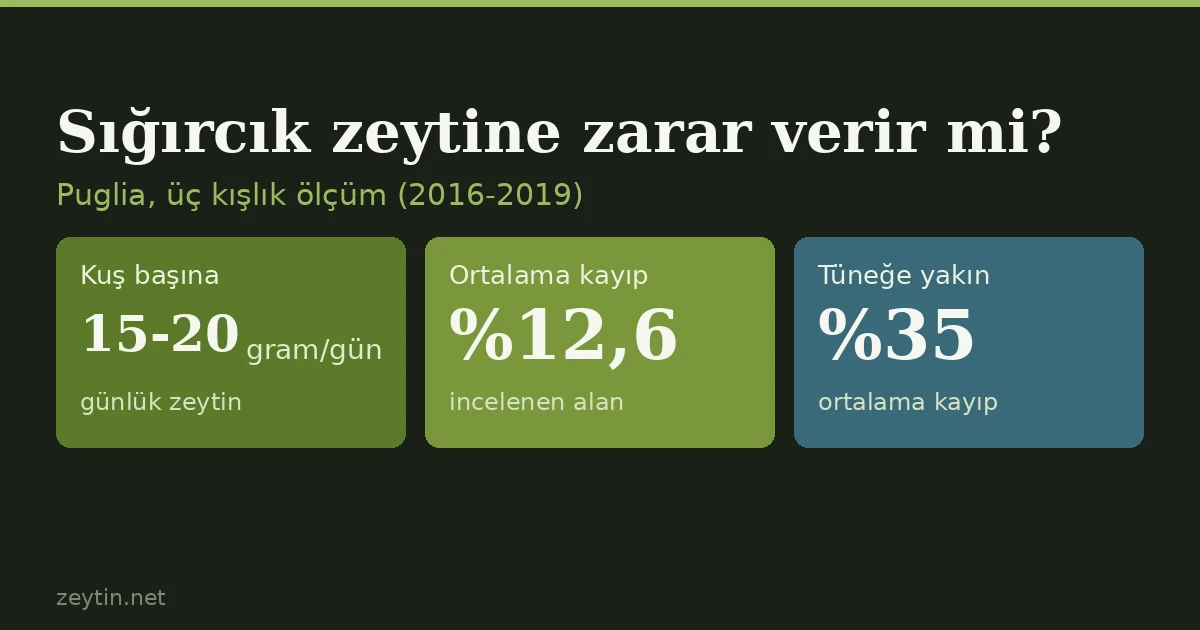
The study carried out in Apulia by researchers from the University of Bari and published in the journal Animals in 2021 (Bozzo and colleagues) answers this with a calculation. It assumes that during the harvest season about one million starlings in the region each ate five to six olives a day, each olive weighing about three grams. That works out at 15-18 grams of olives per bird per day. Coldiretti Puglia, the regional farmers' organisation, said in a statement in November 2022 that a starling can eat up to 20 grams of olives a day.
A figure that looks small for one bird changes once it is multiplied by the size of the flock. One million birds eat 15-18 tonnes of olives a day; over a 90-day winter, taken as an example, that adds up to 1,350-1,620 tonnes. The crop losses the study estimated for its three winters are of the same order: 1,375 tonnes, 800 tonnes and 1,285 tonnes of olives.
Three winters in Apulia
Over the winters of 2016-17, 2017-18 and 2018-19 the researchers counted roosts, tracked the birds' movements and mapped the damage reports filed by farmers. The number of starlings wintering in the region was estimated at about 3 million in the first winter, 9 million in the second and 10 million in the third. At the Torre Guaceto, Fiume Grande and Torre Canne roosts in the province of Brindisi a single count reached 7.5 million birds.
The key finding is how the damage was distributed. Losses were recorded across an area of about 100,000 hectares, 40,000 of them olive groves. Over the whole area studied, an average of 12.6% of the expected crop was lost. In the areas closest to the roosts, where the damage was concentrated, the average loss was 35%, with a minimum of 23% and a maximum of 60%. The value of the loss was put at about 550,000 euros a year.
According to the study, starlings can travel up to 100 kilometres a day between roost and feeding grounds, at cruising speeds of up to 80 km/h. A grove a few kilometres from a roost is therefore not safe by distance alone, but the damage map shows that the flocks favour the groves nearest the roosts.
Which groves suffer most?
The damage reports from Apulia point to a particular harvesting pattern. In the region, olives are harvested in stages as the fruit ripens, and they are often picked up from the ground. The damage was concentrated in the areas where this staggered, late harvest is practised. The reason is simple: the longer ripe olives stay on the trees and on the ground, the longer the flock has a reason to keep returning to that grove.
Olives left lying on the ground also lose quality: fruit in contact with soil raises the risk of a defective oil (what is an olive harvest net). For a starling, a fallen olive is just as easy a meal as one on the branch.
Scaring devices and the problem of habituation
The most common way to drive flocks away is sound: gas cannons, bangers and recorded distress calls played through loudspeakers. Their shared weakness is habituation.
In an experiment published in 1983 by Cole, Johnson and Stroup of the University of Nebraska, starlings were exposed to three different sounds. A pure 917-hertz tone produced essentially no response. White noise drove the birds off at first, but its effect faded as it was repeated. A recording of the starling's own distress call was the most effective of the three: responses were consistently stronger than to white noise, and the birds got used to it more slowly. The same experiment found that responses in winter were weaker than in summer. Given that the olive harvest falls in winter, that is not a minor detail.
The practical lesson is that whatever device is used, a sound that follows a fixed pattern soon turns into background noise. Changing the position, timing and type of sound, and starting to scare the birds in the first days a flock arrives, delays habituation. Using noise devices near homes is a separate matter, and local rules should be checked with the village and the district agriculture office.
Poisoned bait or spraying trees with products outside their approved use is never a solution: other birds and animals eat the same bait, and the residues stay on the fruit. The starling is a wild bird; in Turkey, which species may be hunted and when is set each year by the Central Hunting Commission under the Land Hunting Law No. 4915.
The grower's strongest tool: the harvest calendar
Because scaring has a limited and temporary effect, the most reliable way to reduce the damage is not to leave the flock a long-lasting food supply:
- Do not delay the harvest. Starting as soon as oil olives reach a suitable ripeness shortens the time the fruit spends on the tree (when to harvest olives: the maturity index).
- Do not leave olives on the ground. Harvesting onto nets and keeping fallen fruit separate cuts both the flock's food and the loss of quality.
- Harvest plots near roosts first. If there is a reed bed, poplar stand or clump of trees where large flocks gather in the evening, the plots closest to it can be moved to the front of the harvest order.
- Keep a record of the damage. Noting losses with date, plot and photographs makes it easier to act together with neighbouring growers and the cooperative. The Apulia study itself was launched after farmers' damage claims piled up.
A note of caution
The figures here come from southern Italy, from around roosts where millions of birds spend the winter. We could not find a published study measuring starling damage to olives in Turkey, so the Apulia percentages should not be carried over directly to Turkish groves. The per-bird consumption figure is also an estimate based on an assumption made in the study.
Summary
Starlings eat ripe olives from the branches and from the ground; a single bird may eat 15-20 grams of olives a day. In three winters of measurements in Apulia an average of 12.6% of the expected crop was lost, rising to an average of 35% in groves near the roosts. Sound devices work, but birds get used to them; the most effective sound is the bird's own distress call. What reduces the damage for good is avoiding a late harvest and picking fruit off the ground.
Related: How are olives harvested? · How soon must harvested olives be pressed?
One rating per visitor; you can change yours at any time. Ratings are real reader votes — no seeded or default scores.
Related
 Article
Why do olives drop from the tree before harvest?
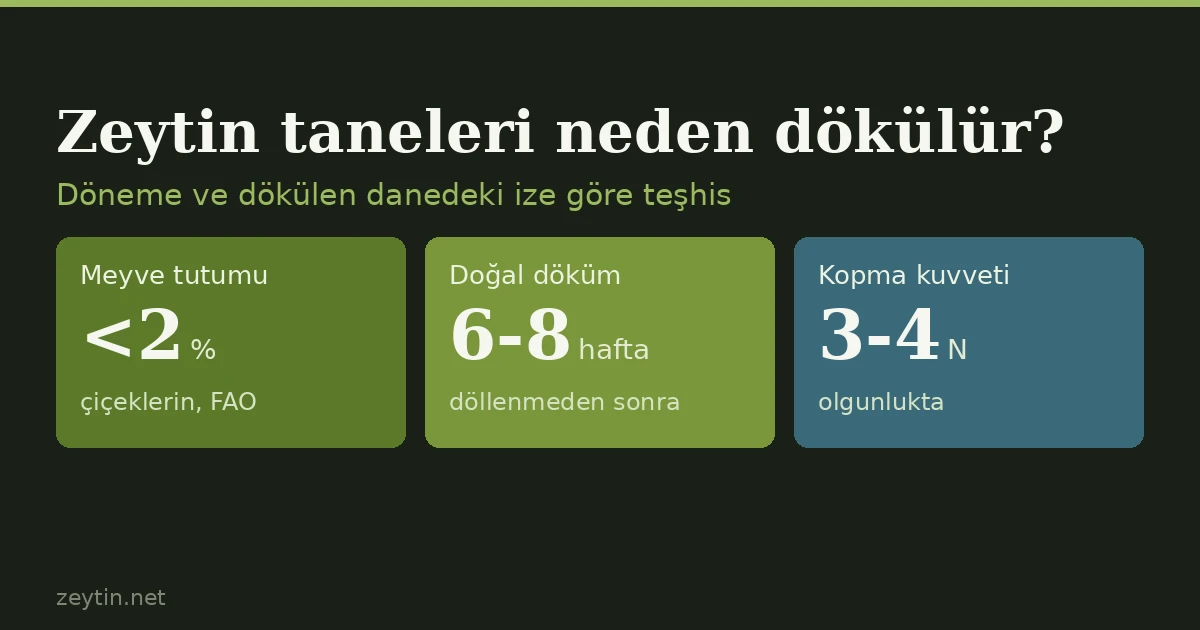
Fewer than 2 percent of olive flowers become fruit, so drop in the 6-8 weeks after bloom is normal. June peppercorn drop, fruit fly from summer, anthracnose and moth exit holes at ripening: a diagnosis table based on marks on the fallen olive.
 Article
Verticillium wilt: the disease that kills the tree and has no cure
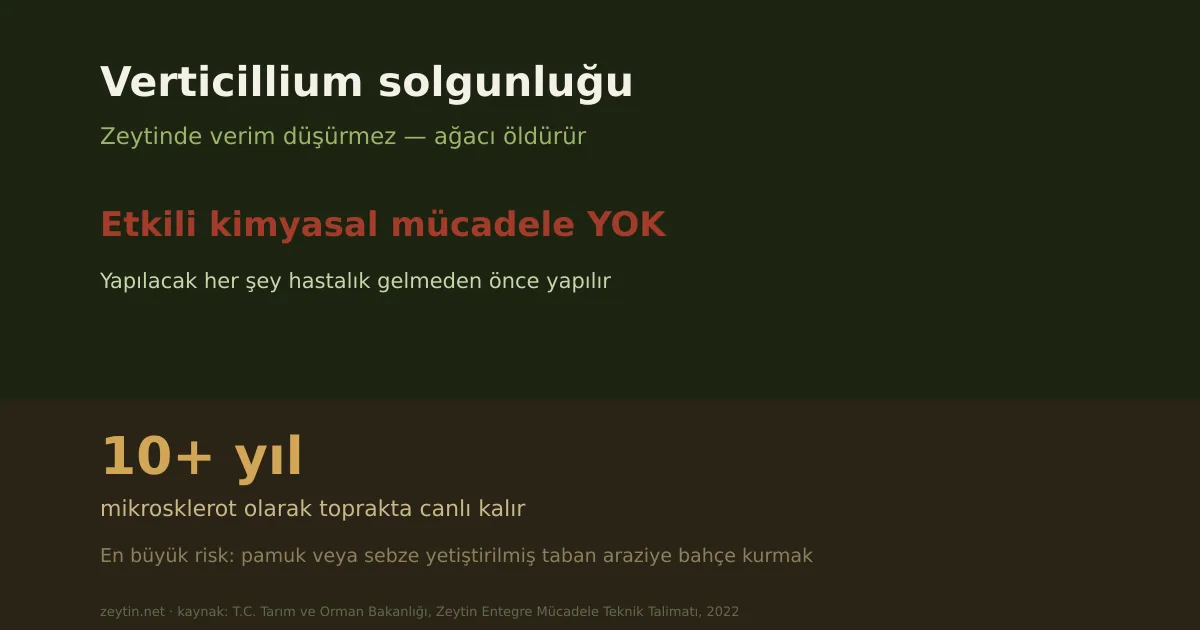
The olive tree disease that kills: it survives over 10 years in the soil, blocks the vessels, and has no effective chemical control.
 Article
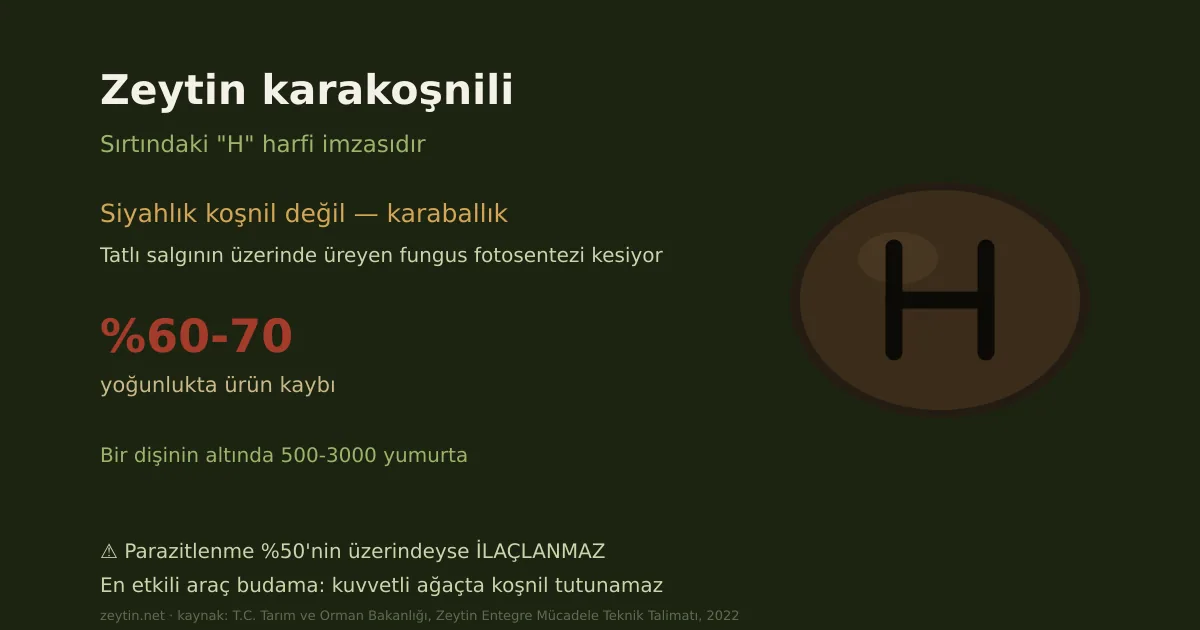
Olive black scale and sooty mould: the H on its back
The olive pest behind sooty mould: a scale with an H on its back. Losses of 60-70%; if parasitism tops 50%, do not spray.
 Article
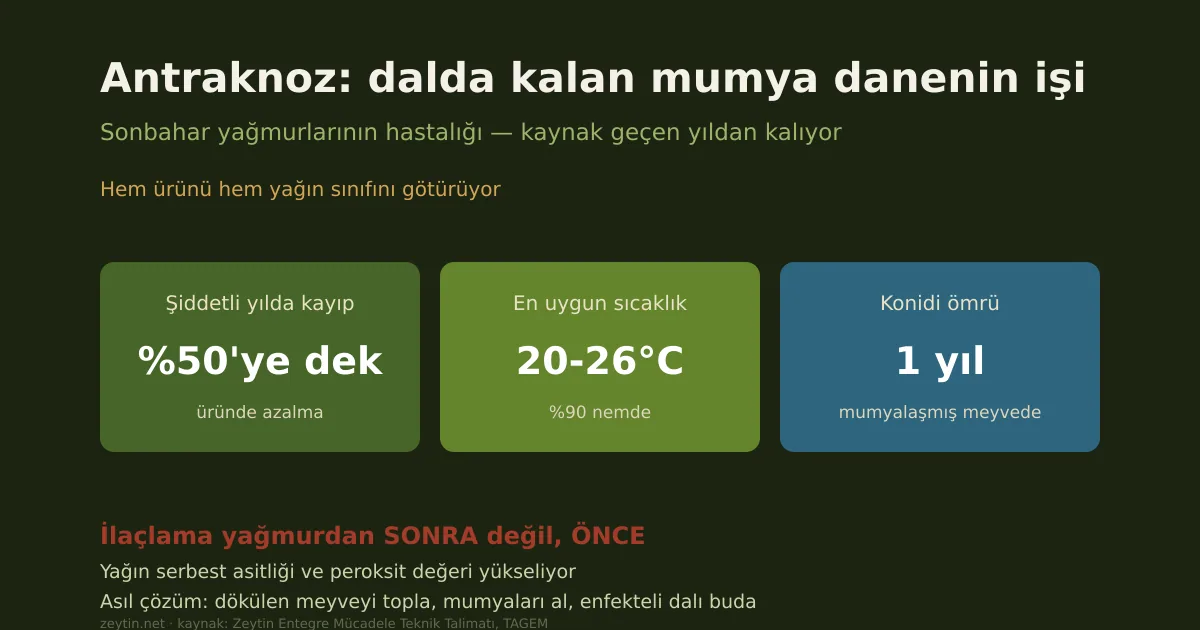
Olive anthracnose: the disease of the mummified fruit left on the branch
Up to 50% crop loss in bad years. The source is last year's mummified fruit still on the branch, and the spray goes on before the autumn rains, not after.