Altınözü Olive Oil: one oil from four cultivars
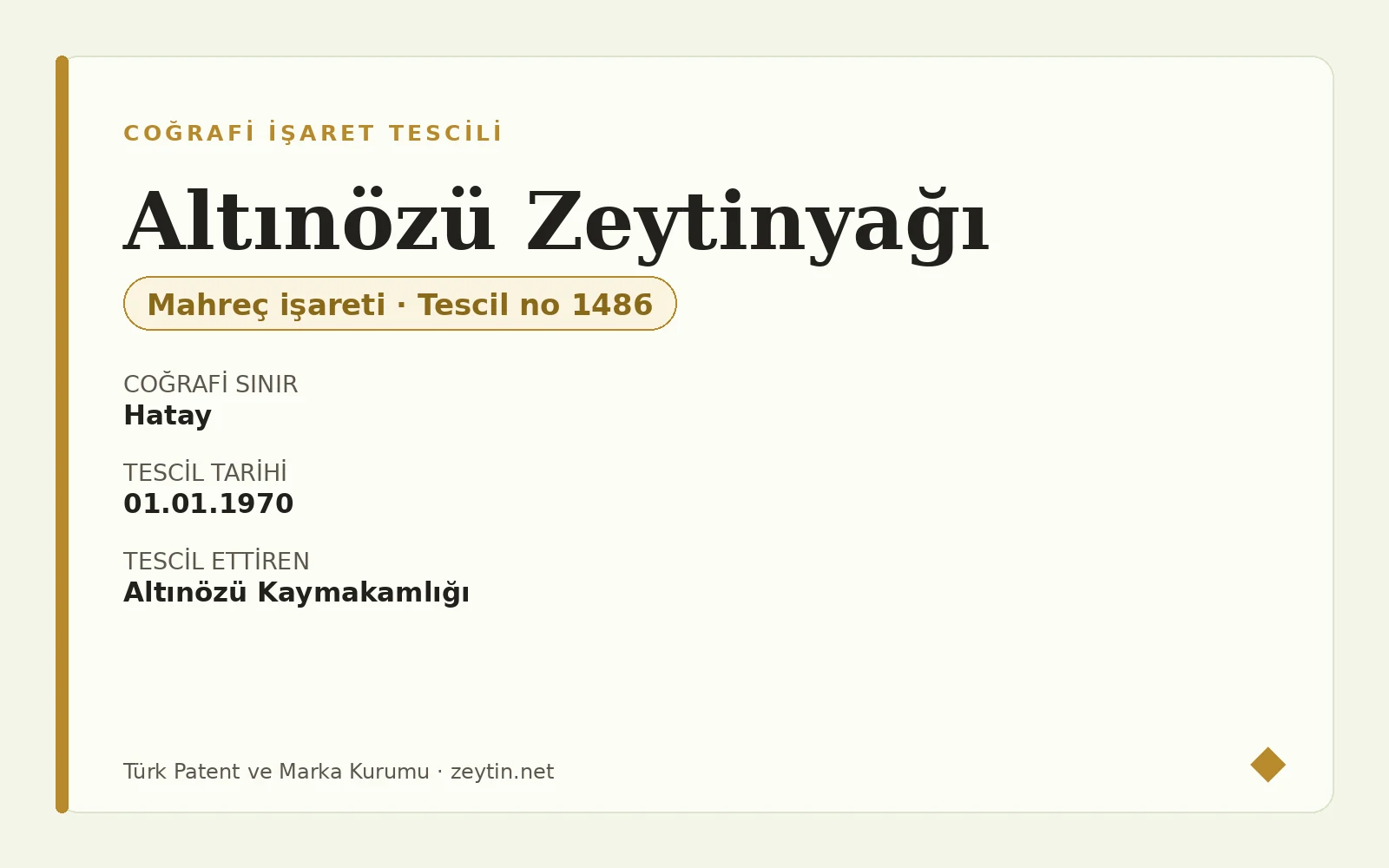
Registered in 2019. Halhalı, Saurani, Sarı Haşebi and Karamani are processed together. Alpha-tocopherol spans a wide 51.6-387.4 mg/kg.
Most olive oil registrations rest on a single cultivar. Altınözü Olive Oil is a blend of four — and the blend is written into the definition itself.
The record
| Registration no | 1486 |
| Protection from | 25.10.2019 |
| Type | Geographical indication |
| Registered by | Altınözü District Governorship |
| Area | The Altınözü district of Hatay |
| Cultivars | Halhalı (Hatay) · Saurani · Sarı Haşebi · Karamani |
All four are native to Hatay. Harvest runs from early November to the end of December, by hand or machine.
Sensory
Clear at room temperature, its colour between yellow and green tones. Fruitiness, bitterness and pungency are moderate — the balanced profile expected of a blend.
Fatty acids
| Fatty acid | Range (%) |
|---|---|
| Oleic acid (C18:1) | 66.3 – 74.0 |
| Linoleic acid (C18:2) | 4.8 – 12.4 |
| Stearic acid (C18:0) | 1.1 – 5.6 |
| Linolenic acid (C18:3) | 0.6 – 1.0 |
| Arachidic acid (C20:0) | 0.2 – 0.5 |
Pigments and tocopherols
| Compound (mg/kg) | Min | Max |
|---|---|---|
| Chlorophylls | 5.2 | 18.70 |
| Carotenoids | 5.0 | 12.80 |
| Alpha-tocopherol | 51.6 | 387.40 |
| Beta-tocopherol | 0.08 | 4.50 |
| Gamma-tocopherol | 0.80 | 17.90 |
The alpha-tocopherol range from 51.6 to 387.4 is striking — a spread of more than sevenfold. As the proportions of the blend and the harvest timing change, this value swings widely.
Alpha-tocopherol is the principal form of vitamin E and contributes to the oil's resistance to oxidation.
Phenolic compounds
| Compound (mg/kg) | Min | Max |
|---|---|---|
| Hydroxytyrosol | 2.10 | 75.10 |
| Tyrosol | 0.20 | 5.90 |
| Vanillic acid | 0.07 | 4.70 |
The Halhalı cultivar is registered as a table olive in Hatay (Hatay Halhalı Olive), as an oil in Mardin (Derik Halhalı), and here as one component of a blend.
The criteria the document binds
The registration does not only protect a name; it defines the product numerically:
| Criterion | Value in the document |
|---|---|
| Peroxide value | 2 meq O₂/kg (max) |
| Processing temperature | max 15 °C |
Capping processing at 15 °C is what cold extraction means in practice: above that threshold yield rises but aroma compounds and phenolics are lost.
Inspection. The inspection body convenes with at least 3 kişi. Members: Hatay Mustafa Kemal Üniversitesi, Altınözü Ziraat Odası. Results are reported under Industrial Property Law no. 6769 and submitted to the Turkish Patent and Trademark Office.
Its place in Hatay's olive production
| Item | Value |
|---|---|
| Fruit production | 213,297 t |
| — for oil | 203,089 t |
| — for the table | 10,208 t |
| Olive oil production | 31,244 t |
| Trees | 14,225 thousand |
| Yield per tree | 15.0 kg |
95% of the province's fruit goes to oil. An oil-based registration matches how the province actually produces.
Where does Altınözü sit in Hatay's olive production?
The registration carries the name Altınözü, but the district's weight within the province rarely appears in sources. The Hatay study by Bozdoğan Konuşkan and Canbaş (2008) supplies it:
| District | Share of Hatay's olive production |
|---|---|
| Altınözü | 48% |
| Samandağ | 10% |
| Antakya | (the three together ≈ 65%) |
Altınözü alone accounts for roughly half of Hatay's olive production. Taking the registration in this district's name is not symbolic; it points at the actual centre of production.
Measured oil yield
The same study sampled Alakent (Altınözü), Hüseyinli (Samandağ) and Narlıca (Antakya) at four different ripeness stages, comparing the Halhalı, Sarı Haşebi and Gemlik cultivars.
| Finding | Value |
|---|---|
| Oil content range (all samples) | 16.30 – 34.73% |
| Highest oil yield | 34.73% (Halhalı) |
| Lowest at end of ripening | 21.04% |
| Gemlik cultivar in Altınözü | 33.76% |
Two results stand out:
1. The highest oil yields were found in the Altınözü samples. Although the same cultivars were taken from three districts, Altınözü led on yield — so the difference comes from the place, not the cultivar. That is precisely what a geographical indication rests on.
2. The Gemlik cultivar reached 33.76% in Altınözü. That is unusually high for the cultivar: other studies put Gemlik's average at 29.6%, and another at 22.30%. The same cultivar is markedly oilier in Altınözü soil.
The study also found that width, length, hundred-fruit weight and oil content rise in parallel with ripening — a direct measurement of why oil harvest is delayed. We discussed that trade-off in deciding harvest by ripeness index.
⚠ Note: these measurements concern the Halhalı, Sarı Haşebi and Gemlik cultivars and date from 2008. They may not correspond exactly to the cultivar definition in the registration; they are cited here to show the region's oil-yield potential.
Further sources
- Bozdoğan Konuşkan, D. & Canbaş, A. (2008). Determination of some physical properties and oil yields of the Halhalı, Sarı Haşebi and Gemlik olive varieties grown in Hatay. Çukurova University Journal of the Institute of Natural and Applied Sciences, 19(2).
One rating per visitor; you can change yours at any time. Ratings are real reader votes — no seeded or default scores.
Related
 Article
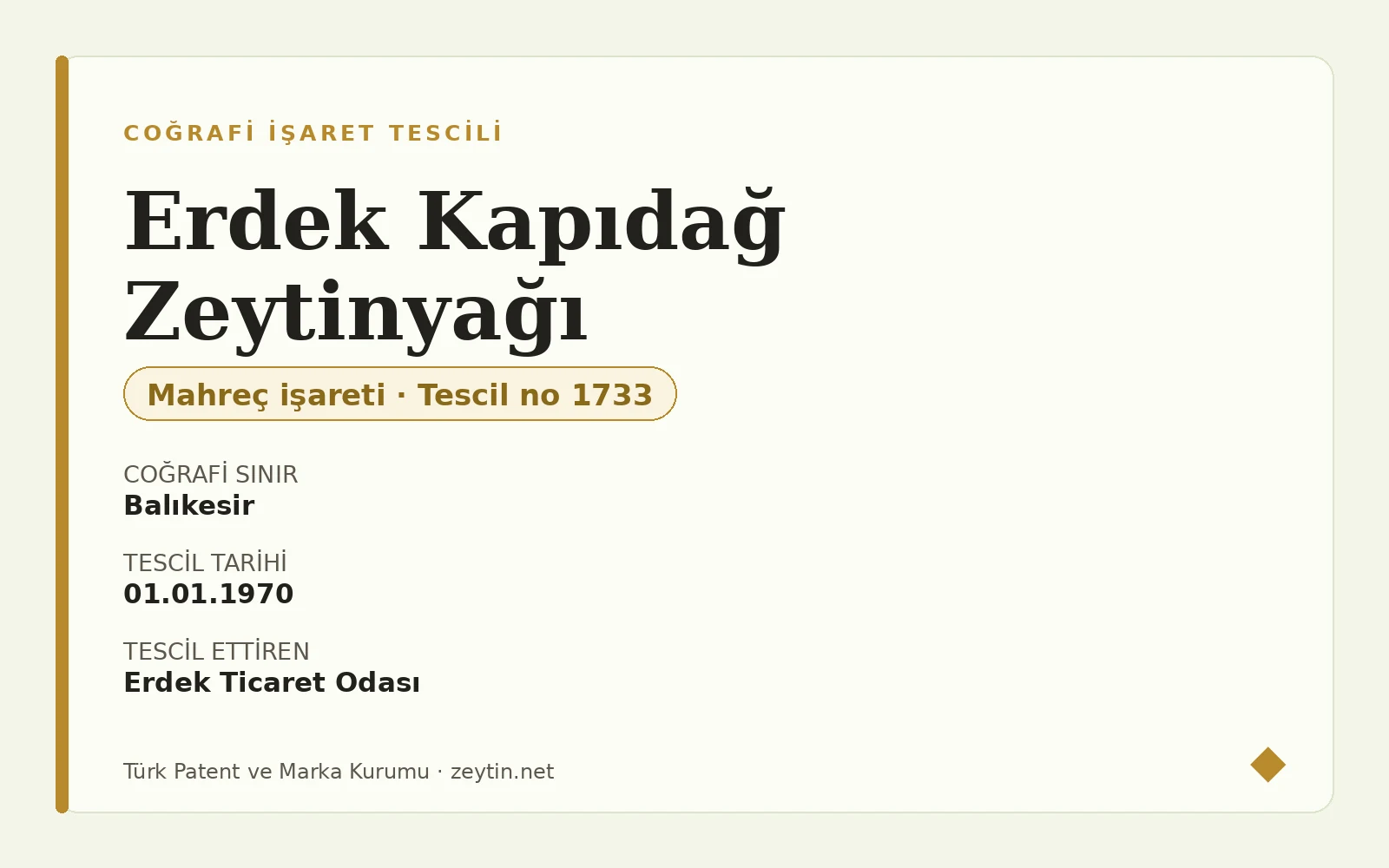
Erdek Kapıdağ Olive Oil: an oil whose grade changes in dry years
Registered in 2024. The certificate admits something rare: in dry periods the oil can fall from extra virgin to virgin grade.
 Article
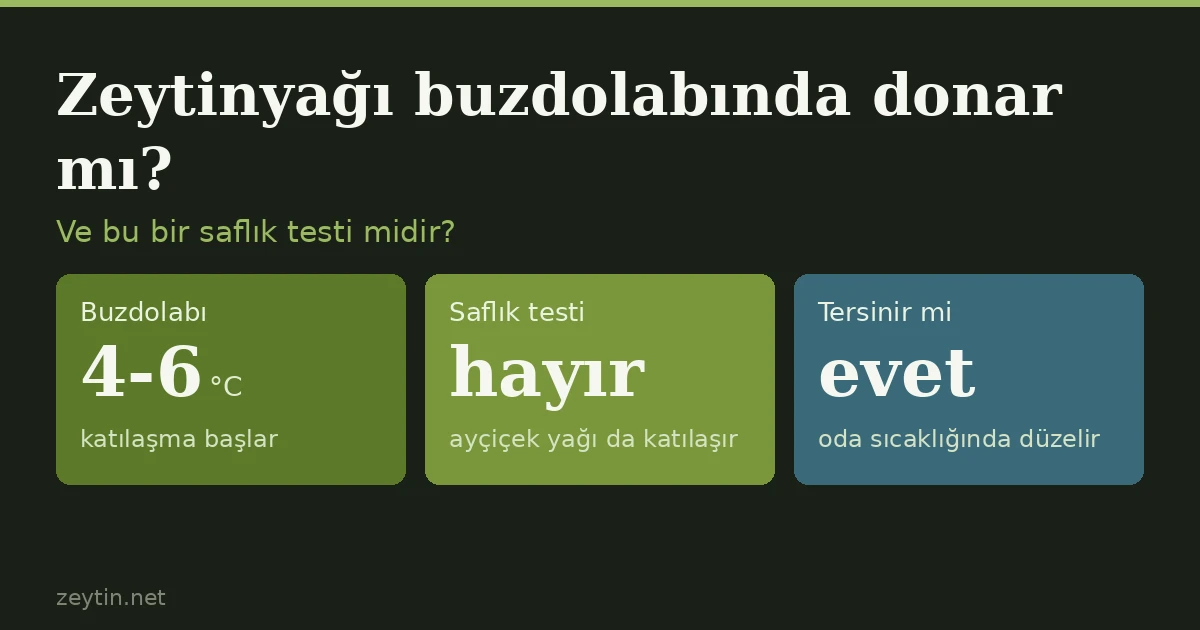
Does olive oil solidify in the fridge?
Olive oil solidifies in the fridge, but this is not a purity test: sunflower and canola oil do the same. The rate depends on variety and fatty acid composition.
 Article
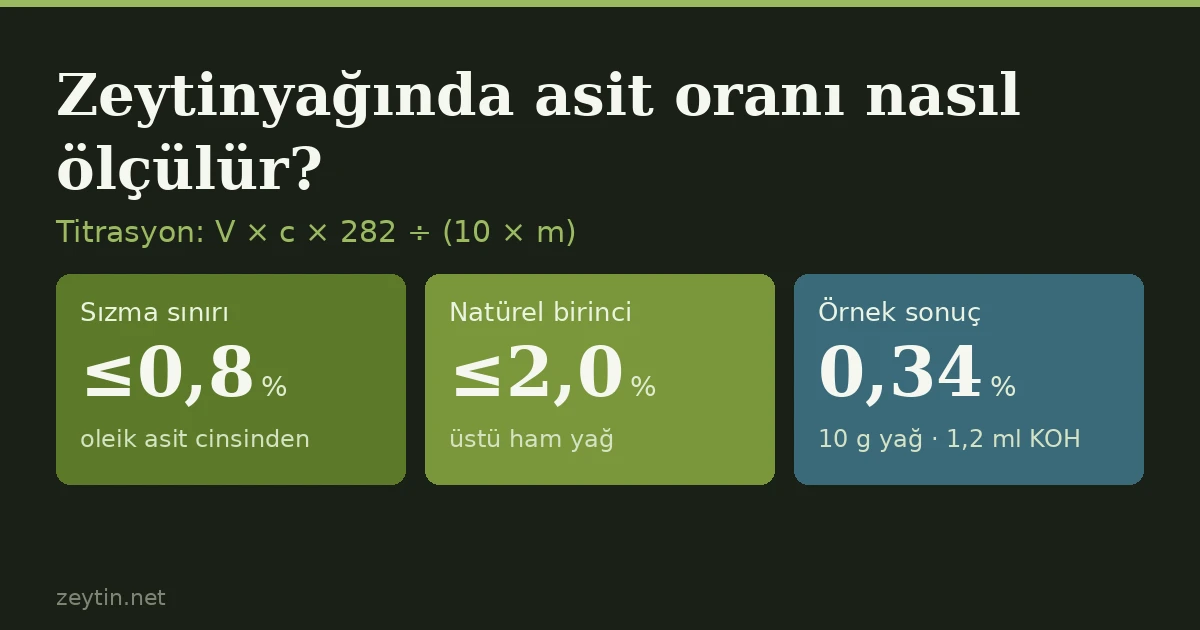
How is olive oil acidity measured? Titration, the formula and taking a sample
Olive oil acidity is measured in a laboratory by titration: the oil is dissolved in a solvent, free fatty acids are neutralised with potassium hydroxide, and the percentage is calculated as oleic acid from the amount used. The formula, a worked example, sampling and the limits of home test kits.
 Article
What is the peroxide value of olive oil? Is a high value harmful?
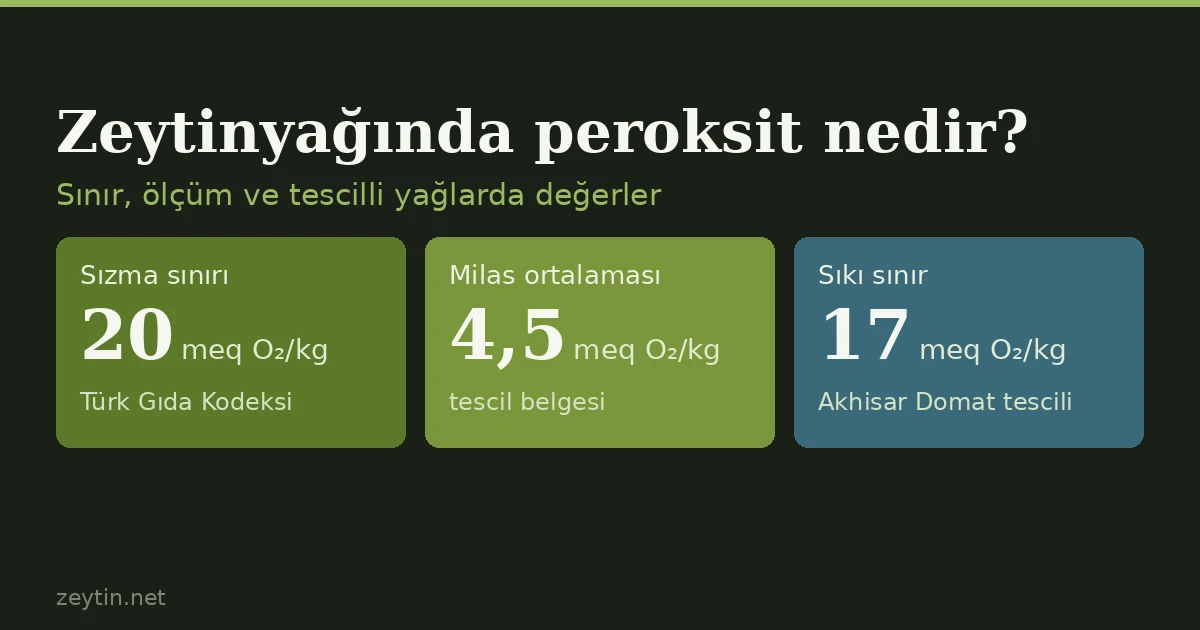
The peroxide value shows that oil has begun to oxidise; the limit for extra virgin is 20 meq/kg. Registered Turkish oils measure 4.5-9.3 on average.