What is kaolin clay spraying in olives? How well it works against the olive fruit fly
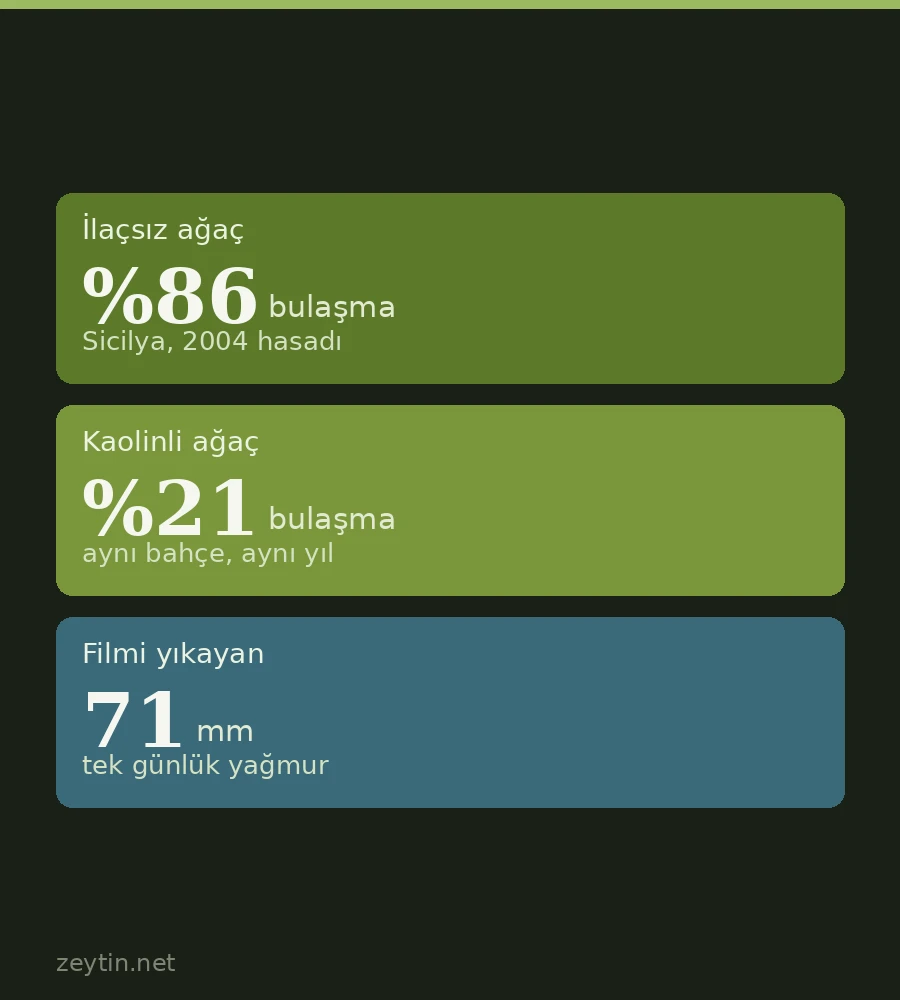
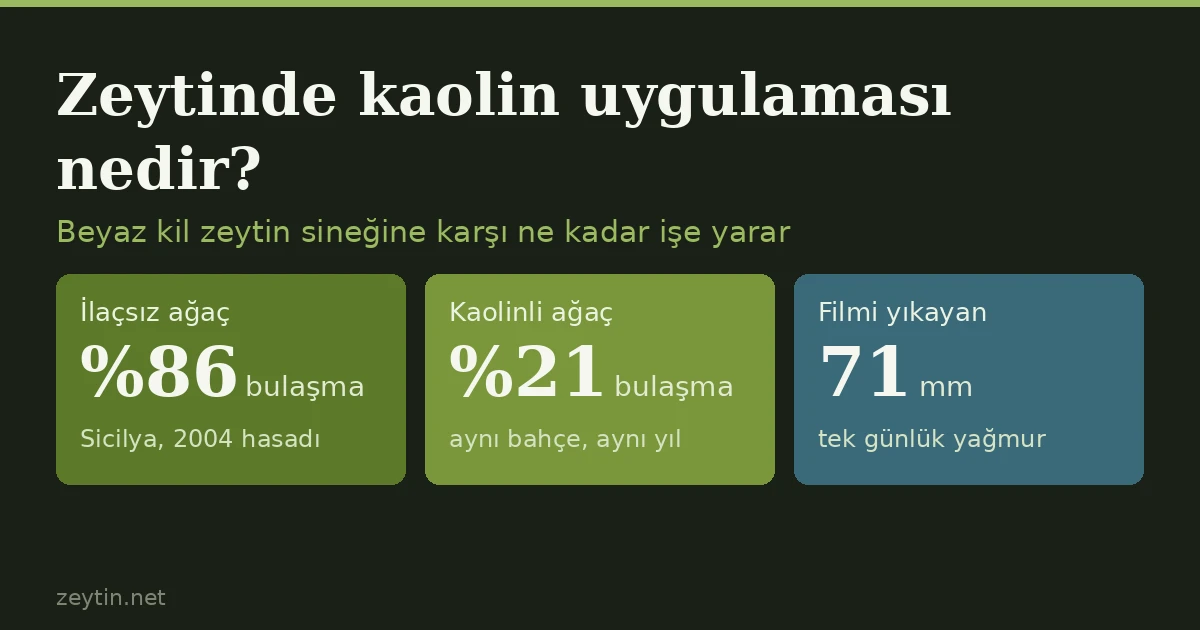
Kaolin is a clay that keeps the olive fruit fly away without killing it, by disguising the fruit under a white film. In Sicily in 2004, a year of heavy fly pressure, harvest infestation was 86 per cent on untreated trees and 21 per cent with kaolin. But rain washes it off and in cool climates it can lower photosynthesis. It is on Türkiye's organic list; registration status must be checked separately.
At the end of summer, some olive groves look as if the trees had been whitewashed. Leaves and fruit alike are covered with a thin white dust. More often than not this is not lime but kaolin: a white clay sprayed to keep the olive fruit fly away from the tree. The method, increasingly common among organic growers, does work in field measurements, but it is highly sensitive to rain, timing and climate.
What is kaolin?
Kaolin is a white, non-porous, non-swelling, fine-grained, platy aluminium silicate clay that is chemically inert. In agriculture it is used in what is called "particle film" technology: mixed with water and sprayed, it leaves a thin mineral layer on the plant once the water evaporates.
The method was developed at the US Department of Agriculture's Agricultural Research Service (USDA-ARS) station in Kearneysville, West Virginia, by Michael Glenn and Gary Puterka, together with the Engelhard company. The first commercial product, Surround, went on the market in 1999. It contains 95 per cent kaolin and is specially sized for agricultural use.
How it works
Kaolin does not kill insects. It works in two ways:
- Disguise: the white film changes the colour and surface of the fruit, so the female fly has difficulty recognising it as a host in which to lay eggs.
- Discomfort: the particles stick to the insect's legs, wings and mouthparts, and the insect moves away from the surface.
The consequence is important: kaolin is preventive. It has no effect on eggs already laid in the fruit or on larvae inside it. That is why it is applied not when stings appear, as an insecticide would be, but before the fruit becomes attractive to the fly. We cover the biology of the olive fruit fly and the intervention threshold in olive fruit fly control.
How well did it work in the field?
The most detailed measurements come from Sicily.
Caleca and Rizzo of the University of Palermo tested Surround WP on table olive varieties in 2003-2004, and in the second year also a pure kaolin used in the ceramics industry (BPLK) and copper hydroxide. The dose was 5 kg of kaolin per 100 litres of water. The first spray was applied at a threshold of 5 per cent total infestation, but in any case no later than the first week of September. Harmful infestation at the 2004 harvest was as follows:
| Grove | Surround WP | Ceramic kaolin | Untreated |
|---|---|---|---|
| Castelvetrano | 15-23% | 68-87% | 61-100% |
| Trapani | all three products 3-37% | 87% | |
The researchers attribute the failure of the ceramic kaolin at Castelvetrano to rain: 64 mm fell in three days after the last spray, and the clay that had not been prepared for agriculture washed off more easily. At Trapani, rainfall over the same period was 41 mm, spread over eight days.
In a 2003-2005 trial run by the Sicilian regional agriculture department and Italy's olive research institute (CRA), the dose was 3 kg per 100 litres of water and the intervention threshold was 3 per cent infestation. In 2004, a year of very heavy fly pressure, total infestation at harvest in the Randazzo grove reached 86 per cent on untreated trees, 48 per cent with copper and 21 per cent with kaolin. In 2005 at Sortino, kaolin came in at 18 per cent, copper at 27 per cent and untreated trees at 39 per cent.
In the same trial the difference carried through to the oil. At Randazzo, the oil from untreated trees had a free acidity of 1.1 per cent, above the extra virgin limit of 0.8 per cent; the oil from kaolin-treated trees stayed at 0.4 per cent. We explain how fly damage affects oil in fly-damaged olives: what happens to the oil.
In Spain, a three-year trial by Pascual and colleagues at Villarejo de Salvanés near Madrid, published in 2010, paints a more cautious picture: kaolin significantly reduced the olive fruit fly and the black scale only in 2007, the year of high fly pressure. In a study published in 2023 in an organic Carolea grove in Calabria, Italy, three sprays at the end of July, mid-August and mid-October kept harmful infestation significantly below the untreated plots in both years.
The weak point: rain and a thinning film
Kaolin works only as long as the film stays in place. In Caleca and Rizzo's grove the clay was still abundant on the fruit after 66 mm of rain in mid-September, but 71 mm falling in a single day on 18 October washed most of it away. In the CRA trial at Linguaglossa, protection was clearly lost after a 263 mm downpour on 22 October 2005. In the same trial, 30 mm of rain partly washed off the copper while the kaolin film stayed attached.
Even without rain, the film wears thin over time. Caleca and Rizzo applied the second spray when the fruit no longer looked covered by kaolin; in the CRA trial at the Motta Sant'Anastasia grove, the two sprays were made on 4 August and 7 September 2004. The advantage of the method is that the film is visible: as Caleca and Rizzo put it, growers can easily see when a new spray is needed by looking at the fruit in the grove.
Effect on heat stress depends on climate
The white film reflects solar radiation. According to a USDA-ARS report, kaolin halved sunburn damage on apples. In olives, the outcome depends on climate. In a study on the Correggiolo variety in the cool, humid Bologna area of Italy, published in 2021, kaolin-treated trees showed 27 per cent lower net photosynthesis and 55 per cent lower stomatal conductance, while water use efficiency rose. In other words, a film that relieves leaves in a hot, dry summer can cost photosynthesis in a cool grove where light is already limited. We discuss heat and drought in climate change and the olive.
Effect on beneficial insects
In a laboratory study in Spain (Bengochea and colleagues), kaolin was found harmless to the scale predator Chilocorus nigritus. The green lacewing Chrysoperla carnea and the olive fly parasitoid Psyttalia concolor did not die; only their reproduction fell slightly. The most sensitive species was the predatory bug Anthocoris nemoralis: 44 per cent mortality and a 66.6 per cent drop in egg production. Dimethoate, tested for comparison, killed every species outright within 24 hours.
In the field, the picture is mixed. Pascual and colleagues reported that both the abundance and the diversity of arthropods fell in the kaolin-treated grove, with a harmful effect on the natural enemy community. The Calabria study, by contrast, found no particular harm to the olive fly's parasitoids.
The situation in Türkiye
Kaolin is listed in the plant protection annex of Türkiye's Regulation on the Principles and Implementation of Organic Agriculture: an amendment published in the Official Gazette No. 29422 of 22 July 2015 added the line "Aluminium silicate (kaolin) — repellent" to the "other substances" section of Annex 2. It is therefore among the substances permitted in organic production. The general framework is covered in organic olive growing.
On the other hand, kaolin does not appear in the Ministry of Agriculture and Forestry's 2022 Integrated Pest Management Technical Instructions for Olives. Being on the organic list also does not mean that every kaolin product on the market is registered as a plant protection product. For this article we could not confirm a kaolin product registered against the olive fruit fly in the ministry's Plant Protection Products Database. Before buying, growers should check a product's registration status in that database and with their provincial or district agriculture directorate.
What to know before spraying
1. Timing is everything: kaolin does not kill eggs or larvae; it must go on before the fruit becomes susceptible to the fly.
2. Dose: the Sicilian trials used 3-5 kg per 100 litres of water; the dose on the commercial product's label should be followed.
3. Renewal: the film should be renewed after heavy rain or when the fruit loses its white coating.
4. Choice of clay: a product prepared for agriculture and a ceramic clay did not give the same result, as the Castelvetrano difference shows.
5. Table olives: the film stays on the fruit at harvest. Caleca and Rizzo note that the early harvest of table olives makes the method suitable for them.
6. It may not be enough on its own: monitoring with traps, early harvest and collecting fallen fruit complement kaolin. For the calendar, see olive pest calendar and intervention thresholds.
A note of caution
All the field measurements above come from Italy and Spain; we found no published study giving figures for kaolin's effect on the olive fruit fly under Turkish conditions. Results varied from year to year with fly pressure, rainfall and variety. Well timed, kaolin is a tool that can markedly lower infestation compared with an untreated grove, but it is not a "spray once and forget it for the season" method.
One rating per visitor; you can change yours at any time. Ratings are real reader votes — no seeded or default scores.
Related
 Article
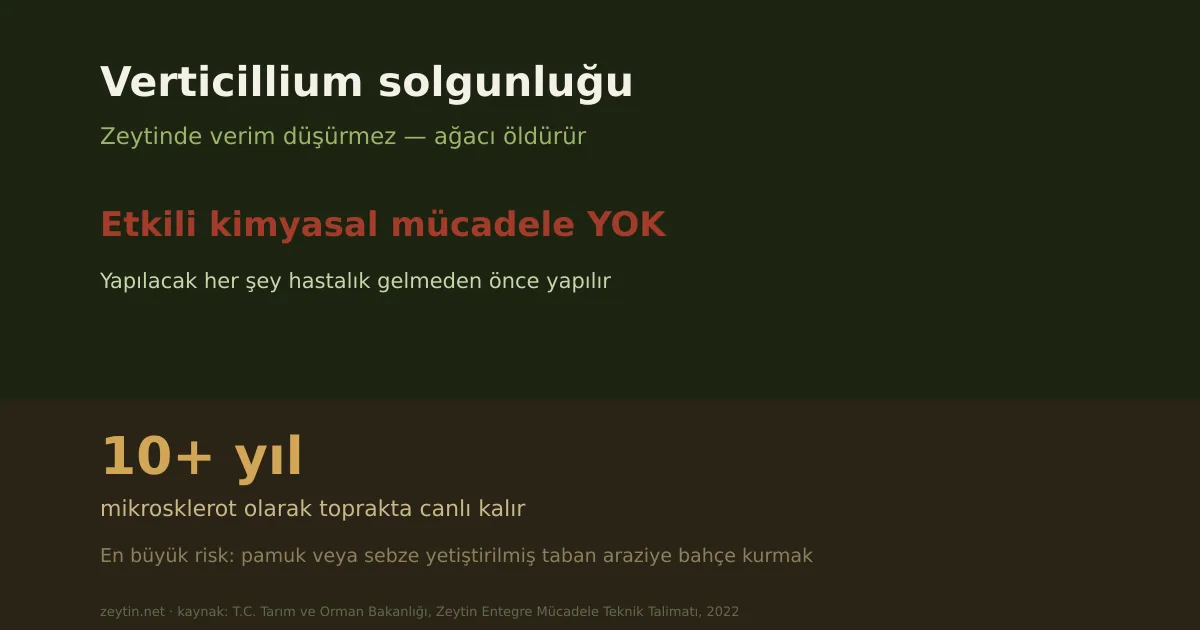
Verticillium wilt: the disease that kills the tree and has no cure
The olive tree disease that kills: it survives over 10 years in the soil, blocks the vessels, and has no effective chemical control.
 Article
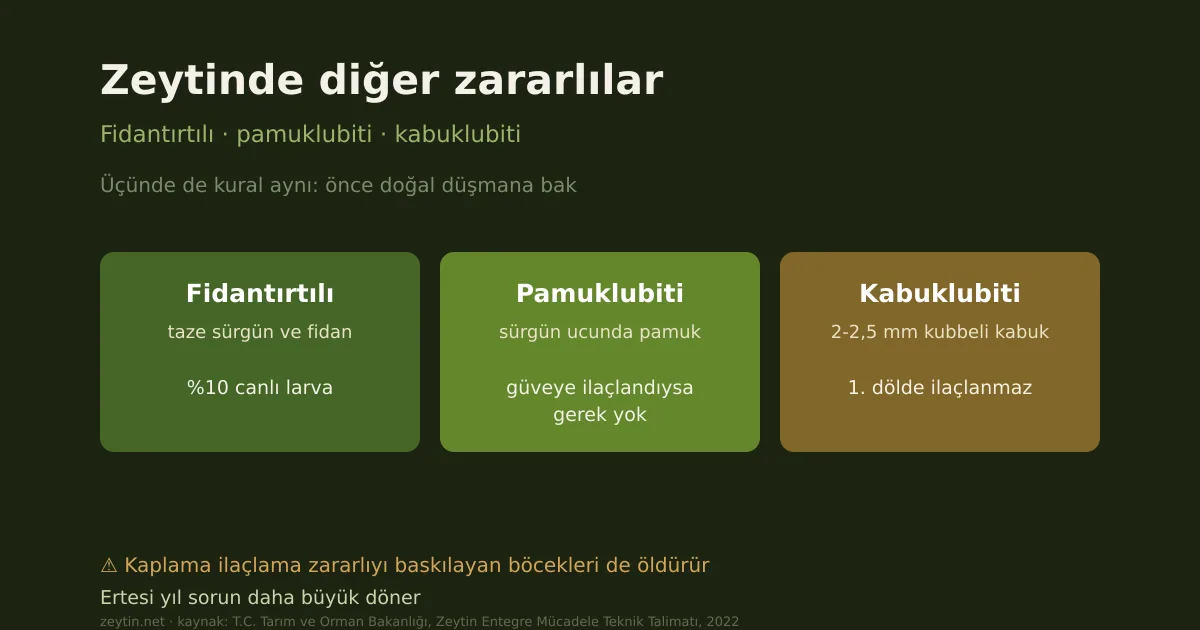
Other olive pests: jasmine moth, psyllid and olive scale
Three olive pests overshadowed by the fruit fly: the jasmine moth on tender shoots, the cottony psyllid, and olive scale.
 Article
How many days after the last spray can olives be harvested? Pre-harvest interval and residues
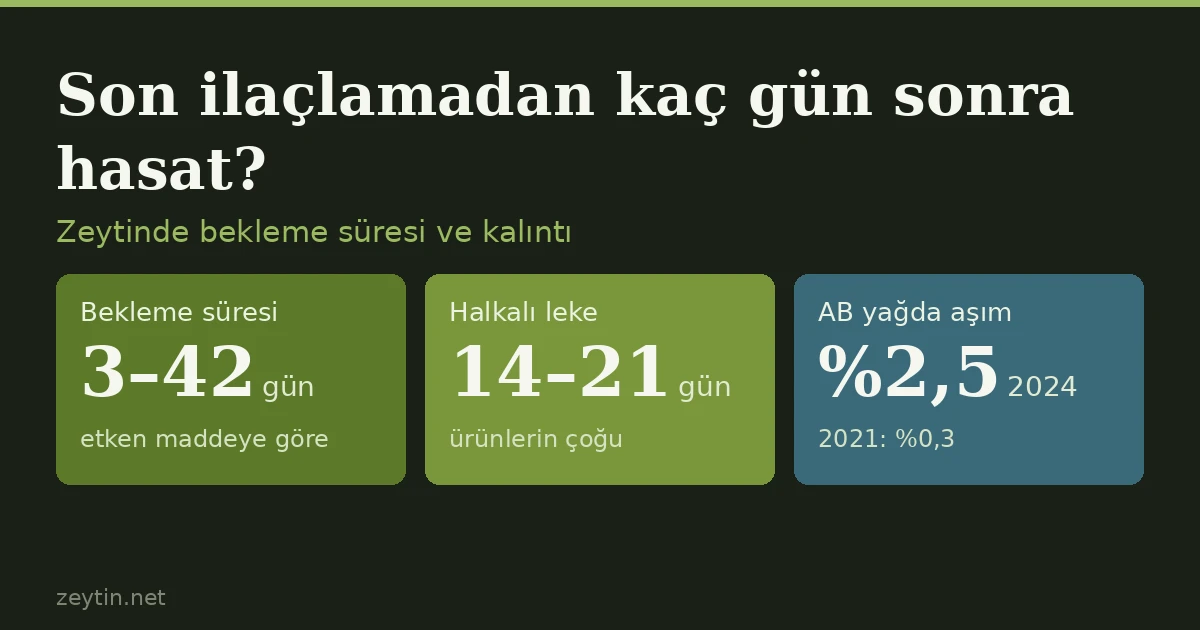
The interval between the last spray and harvest in olives ranges from 3 to 42 days depending on the active substance; most peacock spot products carry 14–21 days. Fat-soluble residues concentrate in the oil at pressing; EU exceedances in virgin olive oil rose to 2.5% in 2024. 2026/27 is Turkey's first harvest with spraying and harvest recorded plot by plot under B-Reçete.
 Article
Herbicide-free weed management in olive groves: from cover crops to autonomous robots
Managing weeds rather than eliminating them: cover crops, mulch, grazing, flame weeding and AI-assisted precision farming — five tools and a practical order for combining them.