What is an olive pit good for?
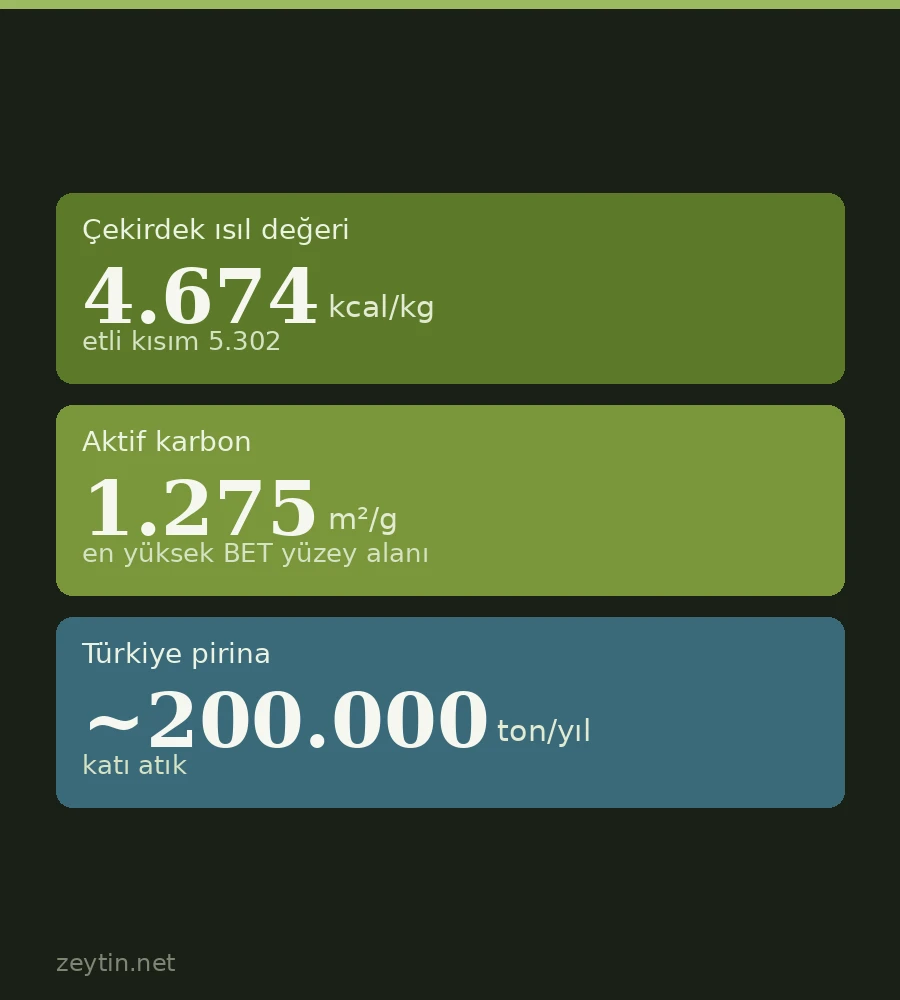
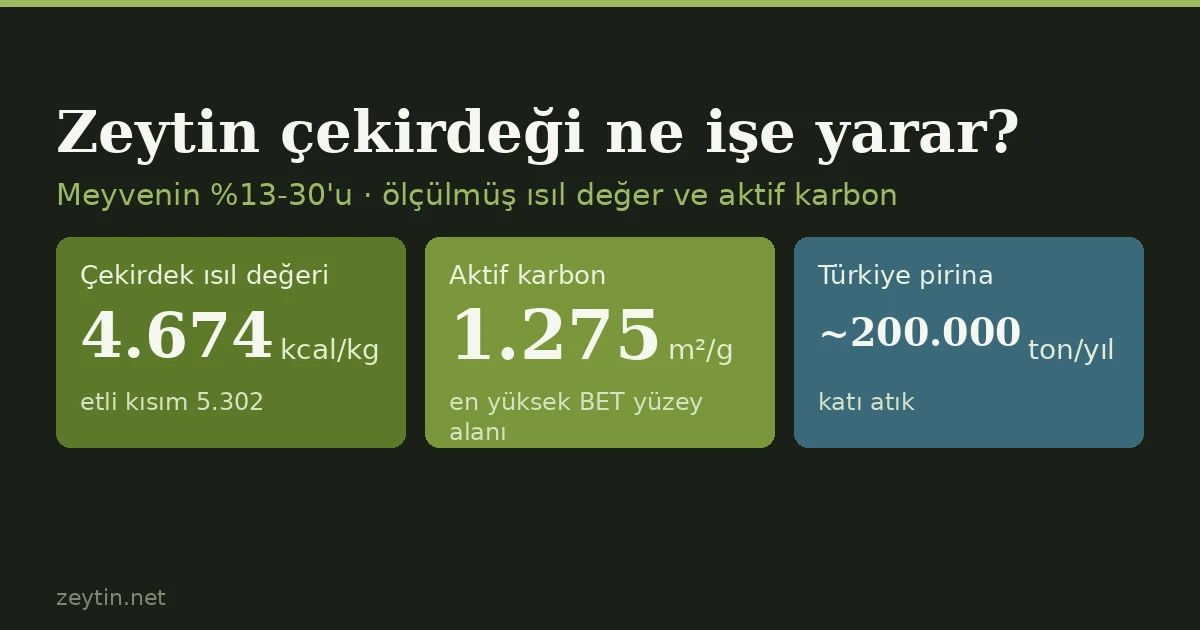
The pit makes up 13-30 percent of the fruit and its measured calorific value is 4,674 kcal/kg. But the laboratory result upsets intuition: the largest contribution to pomace energy comes from the flesh, not the pit. In activated carbon it yields 1,275 m²/g of surface area; in the nursery it is a seed that germinates poorly and demands grafting. Turkey produces roughly 200,000 tons of pomace a year.
An olive pit is a leftover at the table and a raw material measured in tonnes in industry. To understand the difference, it helps to start with where the pit sits in the fruit.
Botanically the olive belongs to the stone-fruit group, and its pit carries a single seed. The fruit has two main parts: the pericarp (the fleshy part) and the endocarp (the pit). The pericarp itself divides into the epicarp (skin) and the mesocarp (flesh).
The proportions run as follows: the flesh makes up roughly 68-83 percent of the fruit, the pit 13-30 percent and the skin 1-2 percent. Much of the oil sits in the mesocarp, in partial emulsion with the water present. Water content can reach 70 percent but is usually around 50 percent.
How heavy is the pit?
Pit weight varies by almost fourfold between varieties. On measured variety data, the lightest end is Arbequina at 0.27 g and the heaviest Çilli and Belluti at around 1.05 g. Gemlik sits above the middle at 0.90 g.
| Variety | Pit weight |
|---|---|
| Arbequina | 0.27 g |
| Memecik | 0.56 g |
| Manzanilla | 0.60 g |
| Domat | 0.86 g |
| Gemlik | 0.90 g |
| Çilli | 1.05 g |
For table olives that difference reaches the consumer directly: in the same kilo of olives, the heavier the pit, the less flesh there is to eat. In oil olives the pit becomes part of the solid mass left in the pomace after pressing.
As fuel, the numbers upset intuition
The most widespread use of the pit is fuel. The solid pomace waste arising from Turkey's olive oil industry comes to roughly 200,000 tons a year; part of this mass, which is not commercially exploited enough, is used as fuel. In and around Aydın, pomace is moulded, dried in the sun and then burned in bread ovens.
Calorific values have been measured with a bomb calorimeter. The pit comes to 4,674 kcal/kg, the fleshy part to 5,302 kcal/kg and mixed pomace to 5,000 kcal/kg. The pomace sample measured had a moisture content of 44.78 percent, an oil content of 12.5 percent and an ash content of 1.55 percent.
This is where the assumption that "the pit is the valuable fuel" breaks down: the study found that the largest contribution to the calorific value of pomace comes from the flesh. The reason is simple — what carries the energy is not the lignified shell but the oil remaining in the flesh. As the oil content of pomace falls, so does its net calorific value.
Two further practical conclusions come from the same work. When pomace samples were washed with tap water and dried, the calorific value rose and the ash content fell. Drying at high temperatures, by contrast, made no difference to either calorific value or ash; it only shortened the drying time. What determines quality is therefore not temperature but washing and moisture.
The pit does not leave the mill on its own
The step the sentence "pits make good fuel" skips is this: the pit does not come out of pressing by itself. Pomace is a mixture of olive pits and fleshy material. To obtain the "olive pit" sold as fuel, that mixture has to be separated mechanically.
The size of the mass matters for the same reason. In a plant running a continuous system, the vegetation water is not separated from the pomace, so one ton of olives yields 800-950 kg of wet pomace. In traditional press mills, processing a ton of olives additionally produces vegetation water; the wastewater released during pressing runs at 0.5-1.5 m³ per ton of olives.
Wet pomace has a high moisture content — 44.78 percent in the sample measured. Reducing that moisture is essential to capturing the fuel value, because burning a wet mass spends part of the energy evaporating the water. The practice around Aydın of moulding the pomace and drying it in the sun solves exactly this problem by the cheapest route available.
The composition of the fruit completes the picture: an olive contains roughly 20 percent oil, 20 percent carbohydrate, 5-6 percent cellulose, 1.6 percent protein and 1.5 percent ash. The cellulose and lignin left in the pomace explain why the pit's hard shell does not break down easily — and why it has low value as animal feed.
Activated carbon: the pit's most technical job
Being a hard, lignified, porous shell makes the pit a feedstock for activated carbon. In a research project carried out in Turkey, olive and apricot pit shells were impregnated with ZnCl₂, H₃PO₄ and KOH and carbonised; the surface area and pore structure of the resulting samples were measured by nitrogen adsorption using the BET method.
The highest BET surface area came out at 1,275 m²/g — a surface approaching a quarter of a football pitch in a single gram of material, and the entire reason activated carbon works in water treatment and filtration. In the project these carbons were tested as catalysts in the ozonation of a textile dye and outperformed commercial activated carbon samples in colour removal.
Can you grow an olive tree from a pit?
You can, but not in the way people expect. There are two separate problems.
The first is germination. Because the hard endocarp protects the seed, germination is slow and difficult. In research, chemical scarification treatments increase germination by 10-33 percent compared with the control — an improvement, but not an easy job. The germination capacity of wild olive seed is markedly weaker than that of cultivated varieties.
The second is what comes up. The seedling that emerges is not the variety whose pit you planted. Seed propagation produces rootstocks of widely differing types; those grown from wild seed show abnormal branching on the stem, which has reciprocal negative effects on the buds. For this reason the plant obtained from a pit is treated as a seedling rootstock and the desired variety is grafted onto it.
Whether the graft takes also depends on the variety. In one study, when the Domat cultivar was grafted onto seedling rootstocks, the highest graft success was 70 percent on Marantelli rootstocks and the lowest 23.3 percent on Yağ Çelebi. That is a more than threefold gap: the sentence "I planted a pit, it will become an olive tree" contains two separate gambles at once.
For anyone wanting to try it in a pot, the practical part is this: untreated pits are advised to be soaked in clean water before sowing and then kept in a moist, closed container. The seedling that emerges will live as an ornamental; for any expectation of fruit, grafting is essential.
Before you throw it away
There is no industrial-scale solution for the few pits on a plate — but the picture says this much: the pit is the least processed and most underestimated part of the olive. Fuel at mill scale, activated carbon at chemical scale, rootstock at nursery scale.
The real question is where the volume goes. While part of the 200,000 tons of annual pomace is used as fuel, the rest remains a waste problem. The calorific value of the pit is a measured fact, but capturing that value requires the mass to be collected, separated and dried — and those three steps are usually where the chain breaks.
To see the scale, it is enough to look at the other branch of the by-product: on 2007 data, Turkey produced 1,183,439 tons of vegetation water a year, of which 668,858 tons came from the Aegean region. The solid and liquid waste streams of pressing together form a mass many times larger than the olive oil produced.
The load carried by that water has also been measured: the organic pollution load arising from pressing runs at 45-55 kg BOD₅ per ton of olives processed. That figure describes the real tension that keeps the by-product suspended between "raw material to be exploited" and "waste to be disposed of."
What can be done at the table is modest: collect the pits in a separate container. A few hundred grams has no industrial equivalent — but the figures above show why the same material becomes a sector of its own at tonnage scale.
One rating per visitor; you can change yours at any time. Ratings are real reader votes — no seeded or default scores.
Related
 Article
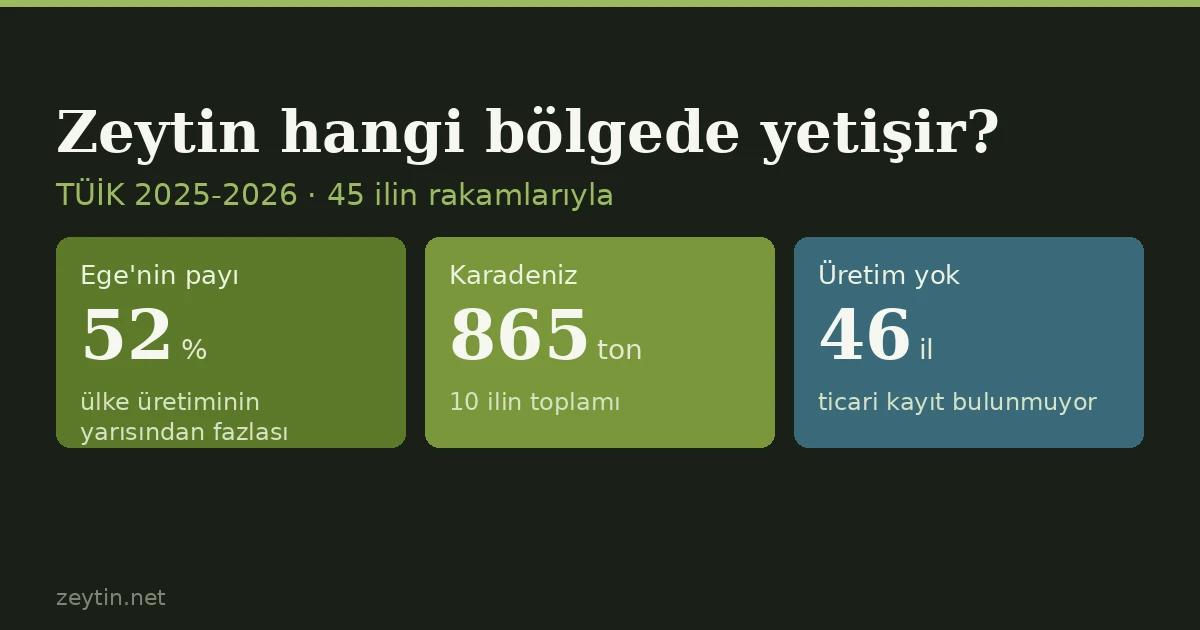
Where do olives grow in Turkey? The picture in 45 provinces
The Aegean alone produces half the national crop; ten Black Sea provinces together manage 865 tonnes. In 46 provinces there is no commercial production at all.
Article
Where do olives grow in Turkey? The picture in 45 provinces
The Aegean alone produces half the national crop; ten Black Sea provinces together manage 865 tonnes. In 46 provinces there is no commercial production at all.
 Article
Tavşanyüreği olive
Tavşanyüreği is a recorded variety of the Mediterranean. Described in the source.
Article
Tavşanyüreği olive
Tavşanyüreği is a recorded variety of the Mediterranean. Described in the source.
 Article
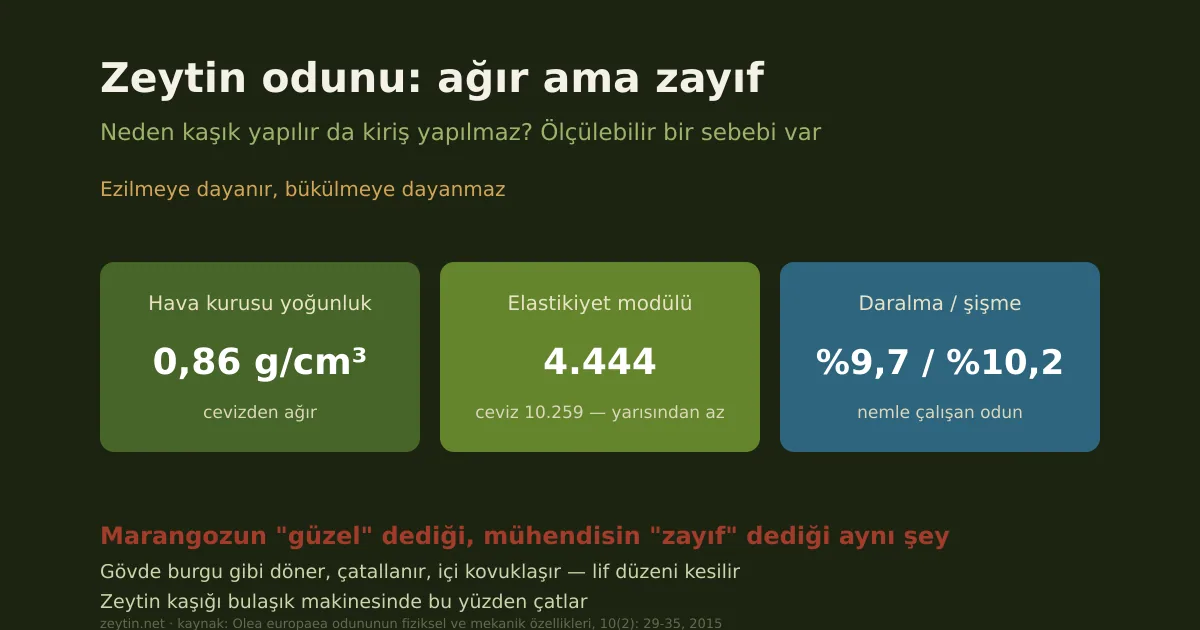
Olive wood: why spoons and not beams?
At 0.86 g/cm³ air-dried it is denser than walnut, yet its modulus of elasticity of 4,444 N/mm² is less than half walnut's. It resists crushing but not bending.
Article
Olive wood: why spoons and not beams?
At 0.86 g/cm³ air-dried it is denser than walnut, yet its modulus of elasticity of 4,444 N/mm² is less than half walnut's. It resists crushing but not bending.
 Article
Yağ Çelebi olive: characteristics, oil content and growing areas
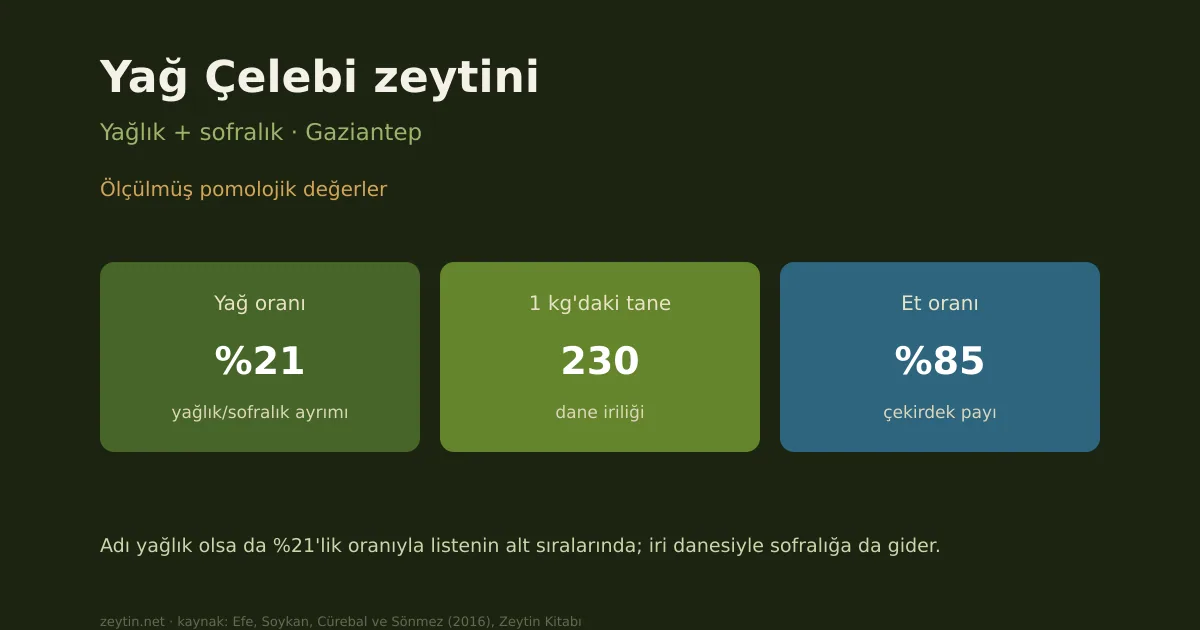
Despite the name, its 21% oil puts it low on the list; its large fruit also serves the table.
Article
Yağ Çelebi olive: characteristics, oil content and growing areas
Despite the name, its 21% oil puts it low on the list; its large fruit also serves the table.