What Are the Benefits of Olives? What Do They Actually Provide?
What olives do and do not provide. Fat, fibre, vitamin E, iron and polyphenols — without overstatement, with portions, and without skipping salt.
Most claims about olives are either overstated or given without a measure. Sentences like "a few a day cover all your vitamin needs" are not true. This piece looks at what olives actually provide, in what portion, and at the part that gets skipped.
Is an olive a fruit?
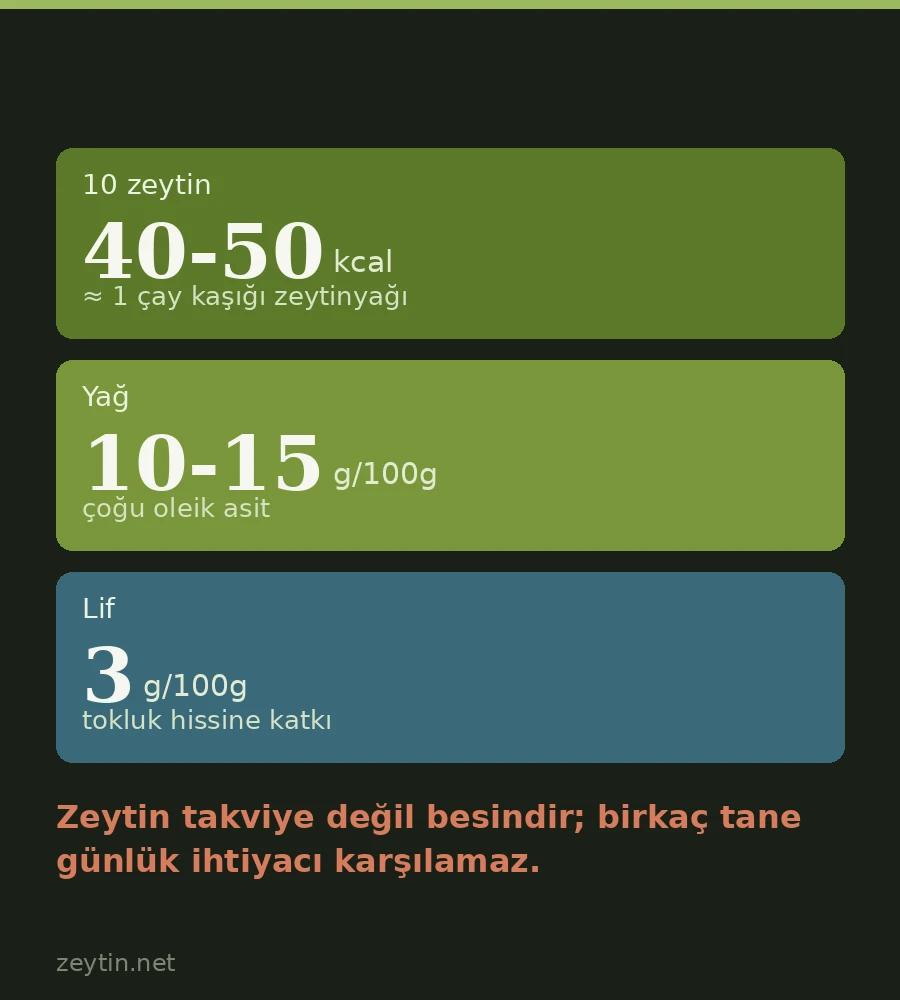
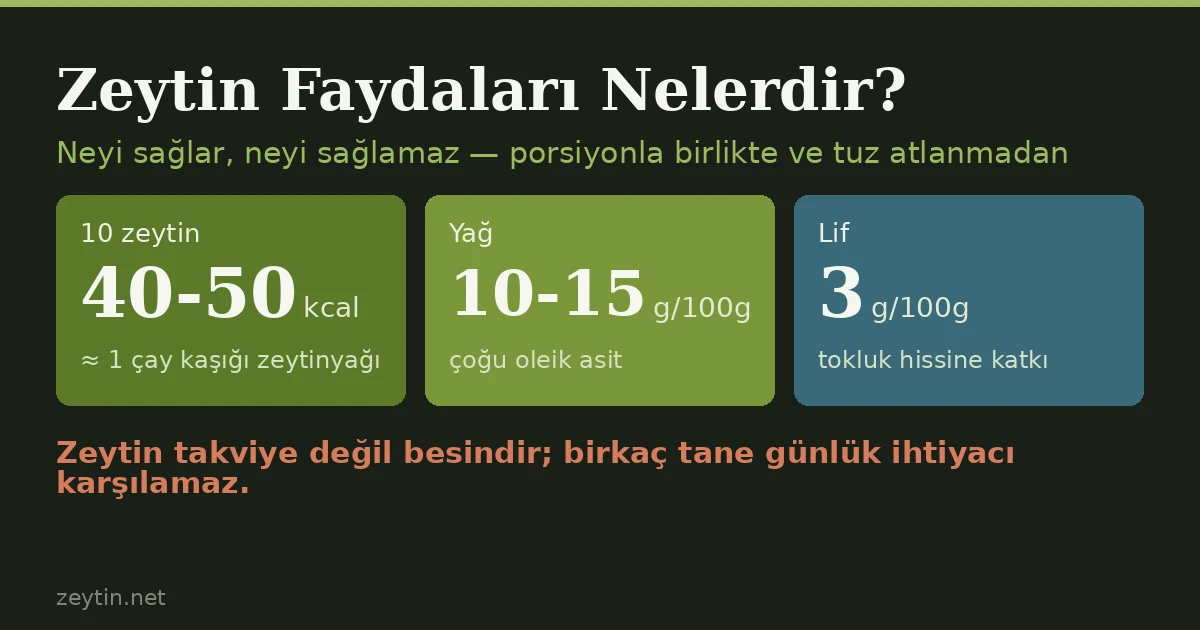
Botanically yes, nutritionally no. On the table it looks like a fruit, but it belongs with fatty foods. That distinction decides portion talk: ten olives carry roughly the energy of a teaspoon of olive oil. Think walnut, not apple.
How much energy?
| Portion | Calories |
|---|---|
| 1 medium olive | ~4-5 kcal |
| 10 olives | ~40-50 kcal |
| 100 g brined olives | 115-145 kcal |
Almost all of it comes from fat; carbohydrate is very low. "An olive" is not a fixed unit — size and brining move the figure.
What olives provide
Monounsaturated fat. 10-15 grams per 100, mostly oleic acid. Replacing saturated fat with monounsaturated fat contributes to maintaining normal blood cholesterol. The key word is replacing: adding olives changes little; putting them in place of butter does.
Fibre. About 3 grams per 100, contributing to satiety.
Vitamin E. A notable source of alpha-tocopherol, which contributes to the protection of cells from oxidative damage.
Iron and copper. More evident in black olives. Iron contributes to normal oxygen transport; absorption improves alongside vitamin C.
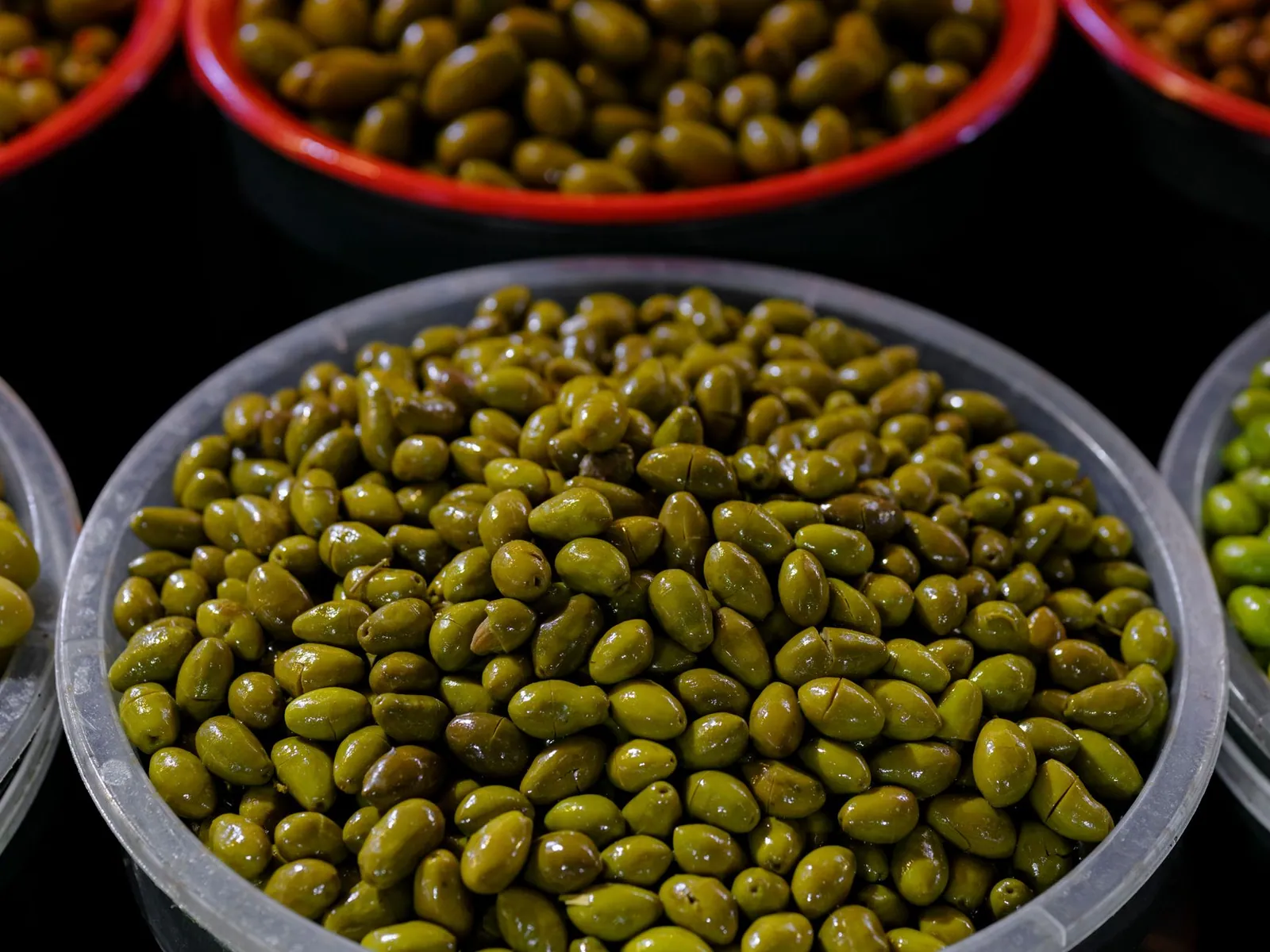
Polyphenols. Behind the bitterness and pungency. Content falls with ripening, so green olives typically hold more. A more bitter olive is a chemically richer one.
The part that gets skipped: salt
Salt is the most overlooked line and often the only one that matters. Brining method and time change sodium far more than colour does. For someone watching blood pressure the question is not the colour but how many and which brine.
What olives do not do
An olive is a food, not a supplement. It does not cover vitamin and mineral needs on its own, and it is neither a slimming nor a curative food. Its value lies in its place in the Mediterranean table — displacing saturated fat, bringing fibre and vitamin E, and satisfying in a small portion.
One rating per visitor; you can change yours at any time. Ratings are real reader votes — no seeded or default scores.
Related
 Article
How Much Olive Oil a Day?
Olive oil being healthy does not make it unlimited. A practical look at portions, calories and the logic of replacement.
Article
How Much Olive Oil a Day?
Olive oil being healthy does not make it unlimited. A practical look at portions, calories and the logic of replacement.
 Article
Olive oil or butter? What a 221,000-person study actually found
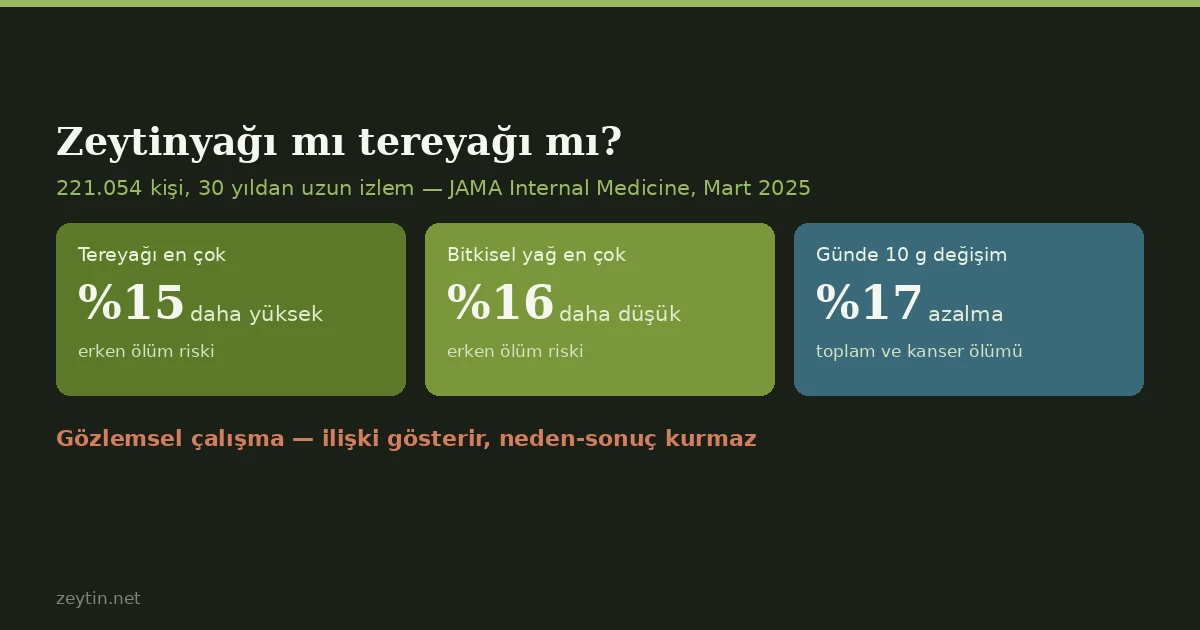
A Harvard-led study followed 221,054 people for over 30 years. Highest butter intake carried 15% higher mortality; highest plant-oil intake 16% lower. We look at what the numbers say — and what they do not.
Article
Olive oil or butter? What a 221,000-person study actually found
A Harvard-led study followed 221,054 people for over 30 years. Highest butter intake carried 15% higher mortality; highest plant-oil intake 16% lower. We look at what the numbers say — and what they do not.
 Article
The nutritional profile of olive oil: fatty acids, vitamins E and K, polyphenols
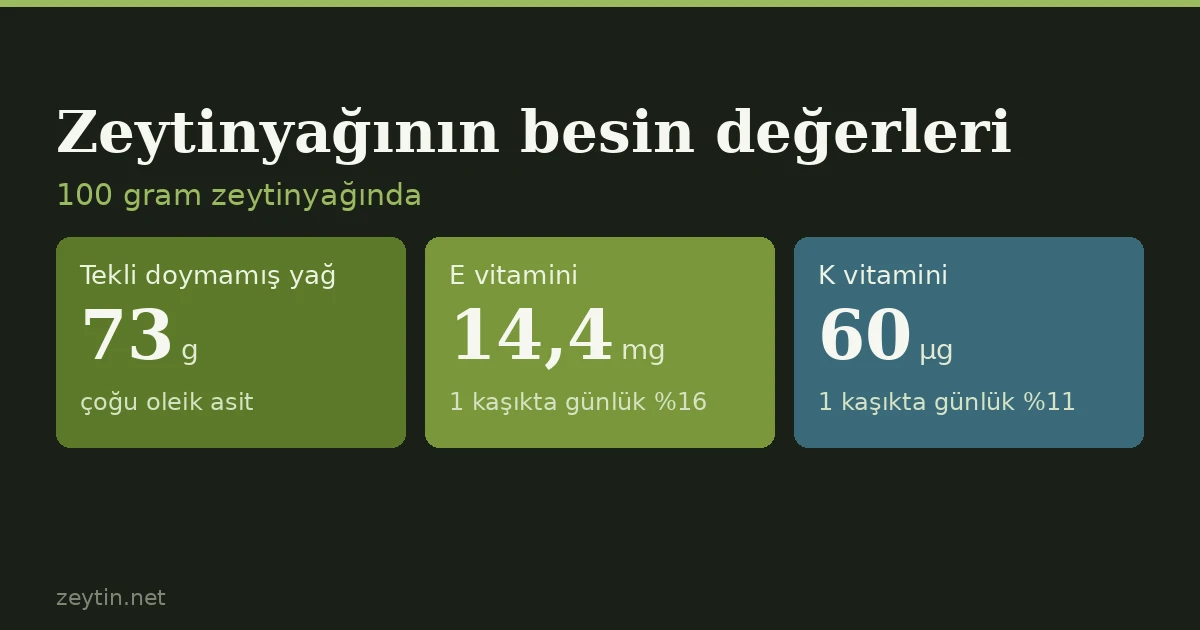
100 grams of olive oil contain 73 grams of monounsaturated fat, 14 mg of vitamin E and 60 micrograms of vitamin K, with no protein, carbohydrate or cholesterol. A per-tablespoon table, and why polyphenols do not appear on the label.
Article
The nutritional profile of olive oil: fatty acids, vitamins E and K, polyphenols
100 grams of olive oil contain 73 grams of monounsaturated fat, 14 mg of vitamin E and 60 micrograms of vitamin K, with no protein, carbohydrate or cholesterol. A per-tablespoon table, and why polyphenols do not appear on the label.
 Article
Oleocanthal and Polyphenols
Why does a good extra virgin oil sting the throat? That sensation is not a flaw but the mark of a measurable compound.
Article
Oleocanthal and Polyphenols
Why does a good extra virgin oil sting the throat? That sensation is not a flaw but the mark of a measurable compound.